
MBA-514 · Lesson 9 of 12 · 21 min
Corporate strategy: diversification, vertical integration and portfolio management
Owen Tremblay's chief executive has a habit of collecting businesses. Prairie Ridge Energy began as a gas processor, added wind farms fifteen years ago and solar more recently, and last year bought a small company that services compressors for other gas producers. Now the chief executive wants to buy a chain of equipment dealerships, which MBA-511 analysed and found to be priced above its standalone value. Owen's question for this session is broader than any one deal: how should a company decide which businesses it should be in?
Business-level strategy, the subject of lessons 5 and 6, asks how to compete in a given business. Corporate strategy asks which businesses to compete in and how the corporate parent adds value to them. It covers the scope of the firm along three dimensions: the range of products and markets it serves, its geographic reach, and its vertical scope, the stages of the value chain it performs itself. It also covers how the parent allocates capital and talent among its businesses and manages them.
When does diversification create value?
Shareholders can diversify their own portfolios cheaply, so a company does not create value for them merely by owning businesses in different industries. Diversification creates value only when the businesses are worth more together than apart. Michael Porter, in a 1987 Harvard Business Review article titled From Competitive Advantage to Corporate Strategy, proposed three tests that any diversification move should pass. The attractiveness test asks whether the industry the firm is entering is structurally attractive, or can be made so. The cost-of-entry test asks whether the cost of entering, whether through acquisition premiums or the cost of building a new business, will capitalize all the future profits. The better-off test asks whether the new unit or the existing business will gain competitive advantage from the link.
Porter's study of 33 large US companies from 1950 to 1986 found that most had divested more acquisitions than they kept, especially acquisitions in unrelated fields. Richard Rumelt, in his 1974 study of diversification, had found that firms diversifying into businesses related to their core skills or resources tended to outperform both single-business firms and unrelated conglomerates. Later research has refined but broadly supported the finding: relatedness, meaning shared resources, capabilities or customers, is the main source of value from diversification, and many conglomerates have traded at a discount to the sum of their parts. Philip Berger and Eli Ofek, in a 1995 study of US firms, estimated the average diversification discount at around 13 to 15 per cent, though later studies debated how much of it reflects the kinds of firms that diversify rather than diversification itself.
The sources of value from relatedness are economies of scope, which arise when two businesses can share an activity or resource more cheaply than each could provide it alone, and the transfer of skills, when a capability developed in one business improves another. Economies of scope can be operational, such as a shared sales force, distribution network or plant, or they can involve intangible resources such as a brand, technology or customer relationships. But sharing has costs: coordination, compromise, since a shared activity cannot be optimized for each business, and the risk that a struggling business drags down a healthy one. Many promised synergies never appear because these costs were ignored.
The role of the parent
Michael Goold, Andrew Campbell and Marcus Alexander, in their 1994 book Corporate-Level Strategy, argued that the central question of corporate strategy is whether the parent adds more value to its businesses than it costs, and whether it adds more value than any other potential owner could. They called this parenting advantage. A parent can add value by appointing strong managers, setting demanding standards, providing functional expertise, facilitating links among businesses, and allocating capital better than external capital markets would. It can destroy value through bureaucracy, misguided interventions, forced synergies, and cross-subsidies that keep weak businesses alive at the expense of strong ones. They proposed that each business be evaluated by how well the parent's skills fit its critical success factors: heartland businesses fit well and benefit from the parent; ballast businesses fit but have little to gain; alien territory fits poorly and should be sold; and value traps look attractive but involve parenting the parent is not equipped to provide.
Capital allocation is among the most important parenting decisions, and many companies do it badly. Stephen Hall, Dan Lovallo and Reinier Musters, in a 2012 McKinsey Quarterly article, reported that most large companies allocate capital among their businesses in nearly the same proportions year after year, and that companies which reallocated more resources across businesses over time earned higher shareholder returns than those which reallocated less. The finding does not mean that constant reshuffling is good; it means that a parent which simply rolls last year's budget forward is not doing its job.
Portfolio matrices
In the 1970s, consulting firms developed tools to help diversified companies manage their portfolios. The best known, the Boston Consulting Group's growth-share matrix, classified businesses by market growth and relative market share. Stars, with high share in fast-growing markets, needed investment to keep their position. Cash cows, with high share in slow-growing markets, generated cash to fund others. Question marks, with low share in fast-growing markets, required a decision to invest heavily or exit. Dogs, with low share in slow-growing markets, were candidates for divestment. The logic rested on the experience curve: high share meant low cost and high profit. The General Electric and McKinsey nine-box matrix used broader measures, industry attractiveness and business strength, each built from several factors.
Portfolio matrices have obvious weaknesses. Market share does not always bring low cost, growth does not always bring profit, and the labels can become self-fulfilling when cash cows are starved of investment. Most importantly, the matrices treat the businesses as independent, ignoring the links among them that are the main source of value in diversification. Modern practice usually starts instead from economic profit and its drivers. Chris Bradley, Martin Hirt and Sven Smit, in their 2018 book Strategy Beyond the Hockey Stick, showed that economic profit across large companies follows a steep power curve: a small fraction of companies earn most of it, most earn close to zero, and a fraction destroy large amounts. Within a diversified company, the same pattern usually holds among its businesses.
# Prairie Ridge's portfolio: economic profit, growth and a simple classification (millions of dollars)
wacc = 0.08
units = {  # name: (invested capital, ROIC, market growth, relative market share)
    "Gas processing":       (1450, 0.105, 0.010, 1.6),
    "Wind generation":      (820, 0.074, 0.050, 0.7),
    "Solar development":    (260, 0.061, 0.140, 0.4),
    "Compressor services":  (95, 0.152, 0.040, 1.2),
    "Dealerships (target)": (310, 0.058, 0.020, 0.9),
}
def label(growth, share):
    if growth >= 0.04: return "star" if share >= 1.0 else "question mark"
    return "cash cow" if share >= 1.0 else "dog"
total = 0
for name, (ic, roic, g, share) in units.items():
    ep = (roic - wacc) * ic
    total += ep if "target" not in name else 0
    print(f"{name:22s} capital {ic:5d}  ROIC {roic:5.1%}  EP {ep:+6.1f}  {label(g, share)}")
print(f"Economic profit of current portfolio: {total:+.1f}")Gas processing capital 1450 ROIC 10.5% EP +36.2 cash cow Wind generation capital 820 ROIC 7.4% EP -4.9 question mark Solar development capital 260 ROIC 6.1% EP -4.9 question mark Compressor services capital 95 ROIC 15.2% EP +6.8 star Dealerships (target) capital 310 ROIC 5.8% EP -6.8 dog Economic profit of current portfolio: +33.2
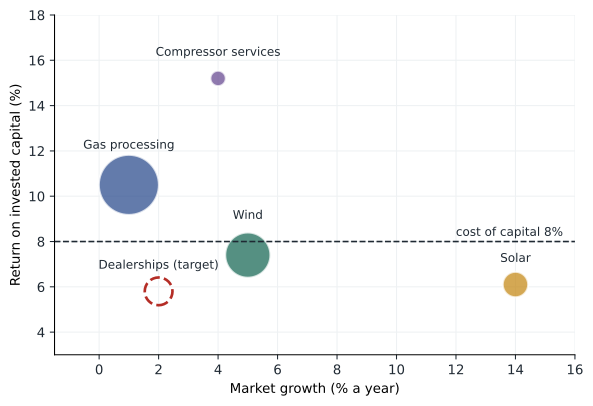
The output gives Owen a sharper picture than the growth-share labels alone. Gas processing, a cash cow in the old language, earns most of the portfolio's economic profit. Compressor services, a small business that the chief executive regards as a sideline, earns the highest return of all because it uses Prairie Ridge's engineering skills and relationships with producers, a clear case of related diversification passing Porter's better-off test. Wind generation earns less than its cost of capital, largely because of older contracts at low prices, and solar development, labelled a question mark, is still in its early, low-return years. The dealerships would add 310 million of capital earning below the cost of capital, with no obvious link to the rest of the portfolio. They fail both the cost-of-entry test, because the price exceeds standalone value, and the better-off test.
Vertical integration
Vertical scope is the other big corporate decision. A firm integrates backward when it takes over activities performed by its suppliers, and forward when it takes over activities performed by its customers or distributors. The basic question is the one Ronald Coase asked in 1937: why are some activities organized inside firms and others through markets? Markets have great advantages: suppliers can achieve scale by serving many customers, competition keeps them efficient, and the firm avoids the costs of managing activities it does not know well. Firms integrate when using the market is costly.
Oliver Williamson's transaction cost economics, developed in books in 1975 and 1985, identified when market transactions become costly. The key factor is asset specificity: investments that are valuable only in a particular relationship, such as a plant built next to a single customer, dies designed for one customer's part, or specialized skills. Once such investments are made, each party can try to renegotiate terms in its favour, the hold-up problem, because the other has few alternatives. Uncertainty, which makes complete contracts impossible, and frequent transactions, which justify the costs of a governance structure, make integration more attractive. The classic, and much-debated, example is General Motors' acquisition of Fisher Body in 1926, after disputes over the location of plants and the pricing of car bodies.
There are intermediate forms between market and hierarchy: long-term contracts, joint ventures, minority stakes and tapered integration, in which a firm makes part of its needs and buys the rest, keeping in-house knowledge and a benchmark for outside suppliers. Strategic considerations also matter: integration can secure access to scarce inputs or distribution, protect proprietary technology or coordinate activities that need tight timing. But it also carries costs, including the loss of supplier competition, inflexibility when technology or demand changes and the need to manage businesses with different requirements.
# Make or buy for Northfield: in-house steel coil slitting versus an outside steel processor
factors = {  # factor: (weight, score toward making, 1 to 5)
    "asset specificity of slitting equipment": (0.25, 2),
    "uncertainty in steel supply and pricing": (0.20, 4),
    "frequency and volume of purchases":        (0.15, 4),
    "supplier market competition":              (0.15, 2),
    "strategic importance to quality":          (0.15, 3),
    "capability to run the activity well":      (0.10, 3),
}
score = sum(w * s for w, s in factors.values())
print(f"Weighted case for making: {score:.2f} of 5")

capex, life, rate = 4.2, 10, 0.09
annuity = capex * rate / (1 - (1 + rate) ** -life)
tons = 38_000
in_house = annuity * 1e6 / tons + 21.0           # dollars per ton: capital plus operating
bought = 34.0                                     # outside processor's charge per ton
print(f"In-house cost {in_house:.1f} vs bought {bought:.1f} dollars per ton; "
f"annual difference {(bought - in_house) * tons / 1e6:+.2f} million")Weighted case for making: 2.95 of 5 In-house cost 38.2 vs bought 34.0 dollars per ton; annual difference -0.16 million
Daniel Osei uses the framework on a narrower question: whether Northfield should install its own steel coil slitting line, which cuts wide coils from the mills into strips for its presses, instead of buying slit coils from a steel service centre. The scoring suggests a moderate case for making, driven by uncertainty in steel supply rather than asset specificity, since slitting equipment is standard and several service centres compete for Northfield's business. The cost comparison goes the other way: with the line's capital charge, slitting in-house would cost about 38 dollars a ton against the service centre's 34, about 0.16 million dollars a year more at current volumes, before counting the management attention it would absorb. Daniel recommends a long-term supply contract with two service centres, with index-based pricing and guaranteed allocation in shortages, an intermediate form that addresses the uncertainty without the investment.
Cedarline's scope
Cedarline's corporate strategy questions are narrower than Prairie Ridge's but important. Should it integrate backward into manufacturing, perhaps by buying a stake in its main contract manufacturer? Should it integrate forward by opening more of its own stores and reducing wholesale, as the expansion plan proposes? Should it diversify into footwear, where a small brand has approached it about a sale? The cohort's preliminary analysis suggests that manufacturing would tie up capital in a business where Cedarline has no advantage and where competition among contract makers works in its favour; that forward integration into retail makes sense only in markets where its own stores earn returns above the cost of capital, which the staged rollout from MBA-511 was designed to test; and that footwear deserves a careful look in lesson 10, where the cohort will examine acquisitions.
Worked problem
Applying Porter's three tests
Fairway Grocers' owners propose that Fairway buy a regional chain of pharmacies with 60 stores, about half located near Fairway supermarkets. The pharmacy industry has high returns but faces falling dispensing fees and competition from online pharmacies. The asking price is 30 per cent above the chain's standalone value. Fairway expects to save on rent by moving pharmacies into its supermarkets and to raise basket sizes by attracting pharmacy customers. Evaluate the proposal.
Show solution
- Attractiveness: the industry has been profitable, but falling fees and online competition suggest its structure is weakening; the test is passed only weakly.
- Cost of entry: a 30 per cent premium over standalone value means the synergies must exceed the premium for the deal to create value; the burden of proof is on the synergies.
- Better-off: rent savings apply only to the pharmacies near Fairway stores and require relocations; extra basket sizes are plausible but uncertain, and Fairway has no pharmacy expertise to transfer.
- Alternative: a partnership with a pharmacy operator to open counters inside Fairway stores could capture the traffic benefit without paying a premium or managing an unfamiliar business.
Answer: The proposal fails the cost-of-entry test unless the synergies are large and certain, and the better-off test is uncertain. A partnership is likely to capture most of the benefit at a fraction of the risk.
Common mistakes
MistakeDiversification reduces risk and therefore creates value.
InsteadShareholders can diversify cheaply themselves; diversification creates value only through links that make businesses worth more together.
MistakePortfolio matrix labels tell you what to do.
InsteadThey ignore links among businesses and the drivers of economic profit; use them as prompts, not answers.
MistakeVertical integration lowers costs by cutting out the middleman.
InsteadMarket suppliers often have scale and competitive pressure; integrate when hold-up risk, uncertainty and specificity make markets costly.
MistakeA good business is always worth owning.
InsteadThe question is whether this parent adds more value than other owners would.
Summary and key terms
- Corporate strategy decides which businesses a firm competes in and how the parent adds value to them.
- Diversification must pass Porter's attractiveness, cost-of-entry and better-off tests; relatedness is the main source of value.
- Parenting advantage asks whether the parent adds more value than it costs and more than other owners could.
- Portfolio matrices classify businesses by growth and share or attractiveness and strength, but ignore links; economic profit is a better guide.
- Transaction cost economics explains vertical integration through asset specificity, uncertainty and frequency, which create hold-up risk.
- Intermediate forms such as long-term contracts, joint ventures and tapered integration often beat full integration.
- Corporate strategy
- Decisions about the scope of the firm and how the parent manages its businesses.
- Economies of scope
- Cost savings from sharing activities or resources across businesses.
- Parenting advantage
- The extra value a corporate parent adds to a business compared with other possible owners.
- Growth-share matrix
- BCG's portfolio tool classifying businesses as stars, cash cows, question marks and dogs.
- Asset specificity
- The degree to which an investment is valuable only in a particular relationship.
- Hold-up
- Opportunistic renegotiation by one party after the other has made relationship-specific investments.
Practice problems
Work each problem on paper first, then reveal the answer to check.
Why does unrelated diversification often fail the better-off test?
Show answer
The businesses share few resources or skills, so neither gains competitive advantage from common ownership.
A unit has invested capital of 200, a return of 6 per cent and a cost of capital of 8 per cent. What is its economic profit?
Show answer
(0.06 - 0.08) × 200 = minus 4.
What is tapered integration?
Show answer
Making part of a requirement in-house and buying the rest from outside suppliers.
Why was the hold-up problem central to the Fisher Body case?
Show answer
Body production required investments specific to General Motors, so each side could exploit the other's dependence when renegotiating.
Lesson quiz · 5 questions
Score 60% or more to complete this lesson.
Create a free account to save your progress, take quizzes and earn a certificate.