
MBA-514 · Lesson 6 of 12 · 20 min
Business-level strategy and positioning
Grace Mwangi has spent a month watching shoppers. A hard discounter opened two stores in Fairway Grocers' region last autumn, with narrow ranges of about 1,500 products, almost all private label, sold from pallets in no-frills stores at prices 15 to 20 per cent below Fairway's. At the other end, a specialty grocer with prepared meals, organic produce and a striking store design has been taking Fairway's higher-income shoppers in two suburbs. Fairway's response so far has been to match the discounter on 400 key items and to add a prepared-foods counter in its larger stores. Sales have held up, but margins have fallen, and Grace suspects that Fairway is becoming a weaker version of both competitors at once.
Dr. Ashford tells Grace she has rediscovered one of the oldest ideas in strategy. This lesson is about business-level strategy, the choices a single business makes about how it will compete in its market: which customers it will serve, what it will offer them, and how it will create more value than its rivals.
Porter's generic strategies
In his 1980 book Competitive Strategy, Michael Porter argued that a business can achieve above-average performance in three generic ways. Cost leadership means becoming the lowest-cost producer in the industry while offering a product customers regard as acceptable, so the firm can earn above-average returns at prices close to the industry average or win share at lower prices. Differentiation means being unique in ways customers value enough to pay a premium that exceeds the cost of providing it. Focus means targeting a narrow segment, a group of customers, a product line or a region, and serving it better than broadly targeted competitors, either through cost focus or differentiation focus.
The generic strategies follow from the value stick of lesson 5. A cost leader creates more value than rivals mainly by having a lower cost for a similar willingness to pay; a differentiator creates more value by raising willingness to pay by more than it raises cost. The two can be combined only if the firm finds a way to achieve both, and Porter warned that firms which try to do everything usually end up stuck in the middle, without the cost position of the leader or the distinctiveness of the differentiator. Each generic strategy requires a different set of activities, skills, organization and culture: tight cost control and standardized processes for cost leadership, creativity and close coordination among design, marketing and service for differentiation. Trying to do both creates the inconsistencies that lesson 1 described as the reason trade-offs exist.
The stuck-in-the-middle thesis has been challenged. Some firms have combined low cost and high quality, often through a new technology or management system that shifts the productivity frontier, as Toyota did with its production system, which lowered costs while improving quality. Danny Miller and others found that many successful firms pursue hybrid strategies. The modern reading is that the danger lies not in combining cost and differentiation but in combining them without a coherent system of activities that delivers both. A firm that adds premium features to a low-cost model, or cuts costs in a premium one, without redesigning its activity system, usually does lose its way.
Value disciplines and customer focus
Michael Treacy and Fred Wiersema, in their 1995 book The Discipline of Market Leaders, offered a related classification. They argued that market leaders excel at one of three value disciplines while meeting industry standards on the other two: operational excellence, offering reliable products at low prices with minimal inconvenience; product leadership, offering the most innovative or highest-performing products; or customer intimacy, tailoring offerings to specific customers and building long relationships. Their contribution was to emphasize that each discipline requires a different operating model, and that the choice must run through the whole organization.
Blue ocean strategy
W. Chan Kim and Renée Mauborgne, in their 2005 book Blue Ocean Strategy, criticized strategies that compete head-on in existing markets, which they called red oceans, and argued that the greatest profits come from creating uncontested market space, blue oceans, where competition is irrelevant. Their best-known example was Cirque du Soleil, founded in Quebec in 1984, which eliminated the animal acts and star performers that made traditional circuses expensive, reduced the thrill and danger elements, and created new elements borrowed from theatre, such as a storyline, artistic music and dance, attracting adults and corporate clients willing to pay theatre prices.
Their central tool is the strategy canvas, a chart that plots the factors on which an industry competes along the horizontal axis and the level of each factor that each competitor offers on the vertical axis. Each firm's profile is its value curve. A firm with a distinctive strategy has a value curve that differs clearly from its rivals', with focus on a few factors and divergence from the pack. To create a new value curve, they proposed four actions, the ERRC grid: which factors the industry takes for granted should be eliminated, which should be reduced well below the industry standard, which should be raised well above it, and which should be created that the industry has never offered.
Blue ocean thinking is a useful discipline for questioning industry assumptions. It is also open to criticism. Many apparent blue oceans attract imitators quickly, so the five forces and the resource-based view still decide whether the new space stays profitable. And the examples are chosen with hindsight; for every Cirque du Soleil there are new market spaces that turned out to have no customers. The strategy canvas is most useful as a picture of a position and its trade-offs, whatever one thinks of the larger claims.
Fairway's strategy canvas
Grace builds a strategy canvas for her market. She chooses eight factors that shoppers mention in Fairway's surveys and rates each competitor from 1 to 10: price level, product range, fresh produce quality, prepared foods, private-label quality, store convenience, service and store experience. The hard discounter scores 10 on price, low on range, service and experience, and high on convenience in the few locations it serves. The specialty grocer scores low on price and range but high on fresh, prepared foods and experience. Fairway's curve sits in the middle on almost every factor, the visual signature of a business stuck in the middle.
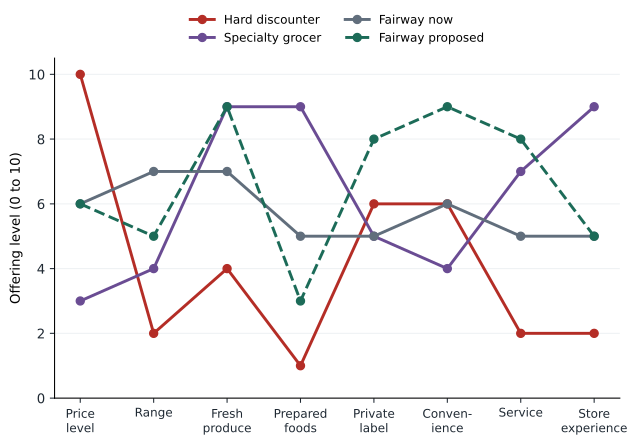
With the cohort, Grace works through the ERRC grid. Eliminate: the costly prepared-foods counters in smaller stores, where they lose money, and the practice of matching the discounter item by item. Reduce: the product range, especially slow-moving national-brand variants in centre-store aisles, by about 20 per cent, which frees space and working capital. Raise: fresh produce and meat, where Fairway already scores well, to clearly above the specialty grocer's level on everyday items; private-label quality and range, so that Fairway's own brand matches national brands at lower prices; and service in the fresh departments. Create: a weekday pickup service for orders placed by noon, using the store network that already sits within a short drive of most customers, which neither competitor offers in these towns.
# Strategy canvas: distance between value curves and the economics of an ERRC change
factors = ["price", "range", "fresh", "prepared", "private label", "convenience", "service", "experience"]
curves = {
    "Discounter": [10, 2, 4, 1, 6, 6, 2, 2],
    "Specialty":  [3, 4, 9, 9, 5, 4, 7, 9],
    "Fairway now": [6, 7, 7, 5, 5, 6, 5, 5],
    "Fairway proposed": [6, 5, 9, 3, 8, 9, 8, 5],
}
def distance(a, b): return sum(abs(x - y) for x, y in zip(a, b))
for name in ("Fairway now", "Fairway proposed"):
    d = {rival: distance(curves[name], curves[rival]) for rival in ("Discounter", "Specialty")}
    print(f"{name:17s} distance to discounter {d['Discounter']:2d}, to specialty {d['Specialty']:2d}")

# Annual effect of the ERRC moves on a typical store (thousands of dollars)
moves = {"eliminate small prepared counters": +160, "stop item-by-item price matching": +240,
         "reduce range by 20 per cent": +110, "raise fresh quality and staffing": -180,
         "raise private label": -60, "create weekday pickup": -95}
sales_effect = {"raise fresh quality and staffing": 0.030, "create weekday pickup": 0.015,
                "stop item-by-item price matching": -0.012, "reduce range by 20 per cent": -0.004}
store_sales, margin = 32_000, 0.27
cost_net = sum(moves.values())
extra_margin = sum(sales_effect.values()) * store_sales * margin
print(f"Cost and margin moves {cost_net:+.0f}; gross margin from sales change {extra_margin:+.0f}; "
f"total {cost_net + extra_margin:+.0f} thousand a store")Fairway now distance to discounter 23, to specialty 20 Fairway proposed distance to discounter 28, to specialty 23 Cost and margin moves +175; gross margin from sales change +251; total +426 thousand a store
The first part of the output measures how distinctive each curve is. Fairway's current curve is close to both rivals; the proposed curve is further from both, especially the discounter, which is the point. The second part estimates the economics for a typical store with 32 million dollars of annual sales and a 27 per cent gross margin. Eliminating and reducing save money, and the price-matching program in particular had cost margin without winning back many shoppers. Raising and creating cost money but are expected to lift sales in fresh departments and through pickup. Grace's team expects a gain of a little over 400 thousand dollars a store a year, but the estimate depends heavily on the sales effects, which she proposes to test in eight stores before committing the whole chain.
Positioning and segments
Business-level strategy is ultimately a choice of where to play and how to win, in the language of lesson 1. Positioning maps, which the cohort used in MBA-512 for marketing, show where competitors sit on the two or three attributes customers care most about and where gaps exist. But a gap on a map is not necessarily an opportunity: there may be no customers there, or the activities needed to serve it may conflict with the firm's existing position. A strategic position must be tested against three questions: are there enough customers who value it, can the firm deliver it at a cost that leaves a margin, and can it be defended?
Cedarline faces the same question as Fairway. Its products are differentiated, as lesson 5 showed, but its strategy has drifted toward the middle: it sells through every channel, offers 3,400 styles, runs frequent promotions and has expanded wholesale to chains that position it next to cheaper brands. The marketing plan from MBA-512 proposed a sharper position around durability and lifetime repair, with fewer styles and fewer promotions. In strategic terms, this is a move from an unclear hybrid toward differentiation focus: serving customers who care about performance and durability, and accepting that Cedarline will not be the choice of shoppers looking for the lowest price or the latest fashion.
Worked problem
Diagnosing a position
A regional airline flies between ten mid-sized cities and two large hubs. It has mixed jets and turboprops, a business-class cabin on half its flights, a loyalty program, free checked bags and fares between those of the national carrier and a new ultra-low-cost entrant. Its load factors are falling and its unit costs are higher than both rivals'. Use the generic strategies and the ERRC grid to suggest a direction.
Show solution
- Diagnose: the airline offers neither the lowest cost nor clear superiority; mixed fleets and partial business cabins add cost without a consistent benefit, a classic stuck-in-the-middle position.
- Choose a direction: a cost-leadership strategy would pit it against the ultra-low-cost entrant, which has a more consistent system; a focus strategy built on the routes and schedules business travellers in mid-sized cities need is more promising.
- Apply ERRC: eliminate the business cabin on short flights; reduce fleet types to one; raise schedule frequency and reliability on the busiest routes; create corporate travel accounts with flexible tickets and a simple loyalty benefit tied to those routes.
- Test the position: check that enough corporate travellers value frequency and flexibility, that a single fleet lowers costs enough, and that the national carrier cannot easily match the schedule.
Answer: The airline's problem is not any single cost or fare but the lack of a coherent position. A focused strategy for regional business travel gives it a reason to exist that neither rival matches.
Common mistakes
MistakeBeing good at everything is a safe strategy.
InsteadWithout a coherent activity system, firms that try to match every rival end up stuck in the middle.
MistakeCost leadership means having the lowest prices.
InsteadIt means having the lowest costs; the leader may price at the industry average and earn higher margins.
MistakeA gap on a positioning map is an opportunity.
InsteadIt may have no customers, or serving it may conflict with the existing position; test demand, cost and defensibility.
MistakeA blue ocean stays uncontested.
InsteadProfitable new spaces attract imitators unless the position is protected by trade-offs and hard-to-copy resources.
Summary and key terms
- Business-level strategy is how a single business chooses to compete: where to play and how to win.
- Porter's generic strategies are cost leadership, differentiation and focus on a narrow segment.
- Firms that try to combine strategies without a coherent activity system risk being stuck in the middle; hybrids succeed when a new system delivers both.
- Treacy and Wiersema's value disciplines are operational excellence, product leadership and customer intimacy.
- The strategy canvas plots competitors' value curves; the ERRC grid asks what to eliminate, reduce, raise and create.
- A position must have enough customers who value it, a cost that leaves a margin and defences against imitation.
- Generic strategy
- One of Porter's three broad approaches: cost leadership, differentiation or focus.
- Stuck in the middle
- A position with neither the lowest cost nor a valued distinctiveness.
- Value discipline
- Treacy and Wiersema's term for operational excellence, product leadership or customer intimacy.
- Strategy canvas
- A chart of the factors an industry competes on and the level each competitor offers.
- Value curve
- A firm's profile across the factors on a strategy canvas.
- ERRC grid
- The four actions of eliminate, reduce, raise and create used to build a new value curve.
Practice problems
Work each problem on paper first, then reveal the answer to check.
What distinguishes cost focus from cost leadership?
Show answer
Cost focus seeks a cost advantage in a narrow segment; cost leadership seeks the lowest cost across the broad market.
Why did Toyota not suffer from being stuck in the middle?
Show answer
Its production system shifted the frontier, delivering both lower cost and higher quality through a coherent set of activities.
Give one eliminate and one create action for a traditional bank branch.
Show answer
Eliminate paper-based account opening; create evening video appointments with advisers.
What three questions test a strategic position?
Show answer
Are there enough customers who value it, can it be delivered at a cost that leaves a margin, and can it be defended?
Lesson quiz · 5 questions
Score 60% or more to complete this lesson.
Create a free account to save your progress, take quizzes and earn a certificate.