
MBA-514 · Lesson 7 of 12 · 21 min
Competitive dynamics and game theory
Every November, Cedarline and its closest rival in technical outerwear play the same game. Each decides, in late October, how deep its holiday promotion will be. If both hold to modest discounts, both earn healthy margins on their best-selling jackets. If one discounts deeply while the other holds, the discounter takes share for the season. If both discount deeply, they sell roughly what they would have sold anyway, at much lower margins, and train customers to wait for the sale. For four years in a row, both have discounted deeply. The cohort met this structure in MBA-502 as the prisoner's dilemma. This lesson asks what strategists can do about it, and more broadly how firms should think about the moves and responses of rivals.
Strategy is interactive. The value of a price cut, a capacity expansion, a new product or an entry into a market depends on how competitors respond, and their responses depend on what they expect the firm to do next. Game theory, which the cohort studied at an introductory level in MBA-502, provides a language for this interdependence. Here the focus shifts from solving games to changing them.
Anticipating rivals
Before modelling a game, a firm needs to understand its rivals. Porter's competitor analysis, set out in Competitive Strategy, asks four questions about each significant competitor: what are its future goals, what assumptions does it hold about itself and the industry, what is its current strategy, and what are its capabilities? Goals and assumptions are the most revealing and the hardest to observe. A competitor owned by a private equity fund that plans to sell in three years will respond differently from a family firm committed to the business for generations. A competitor that believes it is the quality leader will resist price cuts that threaten that image. Signals of goals and assumptions come from executives' public statements, investor presentations, hiring, capital spending and past responses to similar moves.
For Cedarline's holiday game, the cohort's analysis of the rival is revealing. The rival is owned by a listed sporting goods group whose executives are paid on quarterly revenue growth; its chief executive has told investors that holiday share is a priority; and its inventory has risen faster than its sales, so it has stock to clear. This rival is not likely to stop discounting simply because Cedarline does. Understanding the rival changes the payoffs Cedarline should expect.
Solving larger games
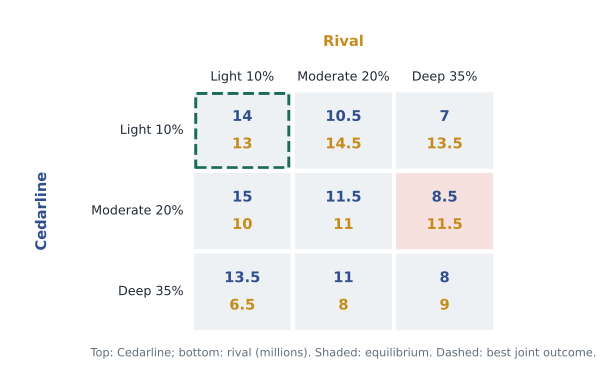
Most real decisions involve more than two options. The cohort models the holiday game with three choices for each firm: a light discount of 10 per cent, a moderate one of 20 per cent and a deep one of 35 per cent. The payoffs in the matrix are each firm's contribution from its holiday outerwear sales, in millions of dollars, estimated from past seasons. Two tools help solve such games. Iterated elimination of dominated strategies removes options that are worse than some other option whatever the rival does, then repeats the test on the smaller game. A Nash equilibrium is a pair of strategies from which neither firm can gain by changing its own choice alone. The code below applies both.
# Holiday promotion game: contribution in millions (Cedarline, Rival)
moves = ["light 10%", "moderate 20%", "deep 35%"]
pay = [  # rows: Cedarline's move; columns: Rival's move
    [(14.0, 13.0), (10.5, 14.5), (7.0, 13.5)],
    [(15.0, 10.0), (11.5, 11.0), (8.5, 11.5)],
    [(13.5, 6.5), (11.0, 8.0), (8.0, 9.0)],
]
def pure_nash(pay):
    eq = []
    for r in range(3):
        for c in range(3):
            row_best = all(pay[r][c][0] >= pay[k][c][0] for k in range(3))
            col_best = all(pay[r][c][1] >= pay[r][k][1] for k in range(3))
            if row_best and col_best: eq.append((moves[r], moves[c], pay[r][c]))
    return eq
print("Nash equilibria:", pure_nash(pay))

def eliminate(pay):
    rows, cols = [0, 1, 2], [0, 1, 2]
    changed = True
    while changed:
        changed = False
        for r in rows[:]:
            if any(all(pay[k][c][0] > pay[r][c][0] for c in cols) for k in rows if k != r):
                rows.remove(r); changed = True
        for c in cols[:]:
            if any(all(pay[r][k][1] > pay[r][c][1] for r in rows) for k in cols if k != c):
                cols.remove(c); changed = True
    return [moves[r] for r in rows], [moves[c] for c in cols]
print("Survive elimination:", eliminate(pay))
joint = max(((r, c) for r in range(3) for c in range(3)), key=lambda rc: sum(pay[rc[0]][rc[1]]))
print("Highest joint contribution:", moves[joint[0]], moves[joint[1]], sum(pay[joint[0]][joint[1]]))Nash equilibria: [('moderate 20%', 'deep 35%', (8.5, 11.5))]
Survive elimination: (['moderate 20%'], ['deep 35%'])
Highest joint contribution: light 10% light 10% 27.0The output confirms the cohort's experience. The only Nash equilibrium has Cedarline offering a moderate discount and the rival a deep one, giving contributions of 8.5 and 11.5 million dollars, and iterated elimination reaches the same pair: for the rival, a deep discount beats a light one whatever Cedarline does, and once the light discount is gone, Cedarline's deep discount is beaten by its moderate one, and so on. Yet both firms would earn far more, 27 million in total, if both offered only light discounts. The equilibrium is the outcome of each firm doing what is individually best, and it leaves both worse off.
Changing the game
Adam Brandenburger and Barry Nalebuff, in Co-opetition, argued that the most valuable strategic moves are those that change the game itself rather than playing it better. They summarized the elements of a game as PARTS: the players, their added values, the rules, the tactics, which shape players' perceptions, and the scope, the boundaries of the game. Each element can be changed. A firm can bring new players into the game, raise its own added value or reduce others', change the rules through contracts, alter perceptions through signals, or link the game to others.
Their value net places a firm among four kinds of players: customers, suppliers, competitors and complementors. A complementor is a player whose product makes the firm's product more valuable to customers, or makes it more attractive for suppliers to supply the firm. A competitor, in their definition, is a player whose product makes the firm's product less valuable to customers or makes suppliers less willing to supply it. The same firm can be both: two airlines compete for passengers but cooperate in demanding new aircraft from manufacturers, which lowers the cost of planes for both. Thinking in these terms reveals opportunities to cooperate to enlarge the total value while competing to divide it.
A player's added value is the total value created by the game with that player minus the total value created without it. In a competitive market no player can capture more than its added value. This gives a sharp test for any strategy: what would be lost if the firm disappeared? A firm whose customers could switch to a near-identical rival has little added value and little bargaining power, however large it is.
Commitment and credible moves
Thomas Schelling, in his 1960 book The Strategy of Conflict, showed that a player can gain by limiting its own options, provided rivals can see the limitation and believe it. A firm that builds a large plant before a rival can enter commits itself to high output, because once the plant is built, the cost of using it is low. The rival, anticipating that the incumbent will produce heavily, may decide not to enter or to enter small. Pankaj Ghemawat's 1991 book Commitment argued that strategy is largely a matter of a few irreversible commitments, such as large investments and long-term contracts, and that their value lies precisely in their irreversibility.
The second part of the cohort's analysis uses a capacity game from Owen's industry. Two gas processors serve a region where demand is linear in the price of processing. If both choose capacity at the same time, the result is the Cournot equilibrium the cohort studied in MBA-502. If Prairie Ridge can commit to its capacity first, by building before the rival decides, the outcome changes to what economists call the Stackelberg equilibrium.
# Capacity commitment: Cournot (simultaneous) versus Stackelberg (Prairie Ridge moves first)
a, b, c = 120.0, 1.0, 30.0          # price = a - b*Q; unit cost c (per unit of throughput)
def profit(q1, q2): return (a - b * (q1 + q2) - c) * q1
q_cournot = (a - c) / (3 * b)
q_leader = (a - c) / (2 * b)
q_follower = (a - c - b * q_leader) / (2 * b)
print(f"Cournot:     each {q_cournot:.1f}, profits {profit(q_cournot, q_cournot):.0f} and {profit(q_cournot, q_cournot):.0f}")
print(f"Stackelberg: leader {q_leader:.1f} -> {profit(q_leader, q_follower):.0f}, "
      f"follower {q_follower:.1f} -> {profit(q_follower, q_leader):.0f}")

# Repeated holiday game: how patient must firms be for light discounts to last?
cooperate, cheat, punish = 14.0, 15.0, 8.5     # Cedarline's payoffs from the matrix above
delta_min = (cheat - cooperate) / (cheat - punish)
print(f"Grim-trigger cooperation is stable if the discount factor exceeds {delta_min:.2f}")Cournot: each 30.0, profits 900 and 900 Stackelberg: leader 45.0 -> 1012, follower 22.5 -> 506 Grim-trigger cooperation is stable if the discount factor exceeds 0.15
With simultaneous choices, each processor builds 30 units of capacity and earns 900. If Prairie Ridge commits first, it builds 45 units, the rival's best response is 22.5, and Prairie Ridge's profit rises to about 1,012 while the rival's falls to 506. The first mover gains because its commitment changes the rival's best response. But the commitment must be credible: an announcement that Prairie Ridge will build is worth little if it could cancel cheaply. What makes the threat credible is the irreversible investment, the signed construction contracts and the long-term supply agreements with producers.
Repeated games and price wars
The prisoner's dilemma is less grim when it is played repeatedly, as Cedarline's holiday game is. Robert Axelrod's computer tournaments in the early 1980s, described in his 1984 book The Evolution of Cooperation, found that a simple strategy called tit for tat, cooperating in the first round and then copying the rival's previous move, performed remarkably well. Axelrod attributed its success to four properties: it was nice, never defecting first; retaliatory, punishing defection immediately; forgiving, returning to cooperation once the rival did; and clear, so that rivals could recognize the pattern. In theory, cooperation can be sustained when firms value future profits enough relative to the short-term gain from cheating. The last part of the code shows that, with these payoffs, cooperation on light discounts can be stable only if each firm puts a weight of at least about 0.15 on next season relative to this one, a low bar. The obstacle in practice is not patience but misunderstanding and the rival's incentives.
Akshay Rao, Mark Bergen and Scott Davis, in a 2000 Harvard Business Review article titled How to Fight a Price War, advised firms to avoid price wars where possible, to respond with non-price moves such as quality, service or bundles where it is not, to compete selectively in the segments that matter most, and to communicate clearly about their intentions and costs. Communication must stay within competition law. Agreements among competitors on prices or discounts are illegal, and even exchanges of information about future prices can be treated as evidence of collusion. What firms can do lawfully is act unilaterally and visibly: announce their own policies publicly, make commitments to customers, and let their actions speak.
For Cedarline, the analysis points to unilateral moves that change the game rather than attempts to coordinate with the rival. It can reduce its holiday exposure by cutting the inventory it buys for the season, which removes the need to clear stock; shift its promotions from price to value, such as free repairs or gift services; commit publicly to a policy of everyday fair prices with no holiday sales on its core durable products, a commitment that customers can hold it to; and focus its marketing on the customers who care most about durability, who are less likely to switch for a discount. Each move lowers the payoff Cedarline gets from deep discounting and therefore changes its best response, and a visible change in Cedarline's behaviour may change the rival's expectations as well.
Worked problem
Responding to an entrant
A hard discounter announces it will open three stores in Fairway's region next year. Fairway's managers propose three responses: cut prices on 1,000 items now to deter entry, do nothing until the stores open, or invest in fresh departments and pickup service in the threatened towns. Evaluate the options using commitment and credibility.
Show solution
- Deterrence through price cuts: the entrant has already committed sites and supply contracts, so pre-emptive price cuts are unlikely to stop entry and will cost Fairway margin across all its stores; they are not credible as a long-term threat because Fairway could not sustain them.
- Doing nothing: avoids wasting money but cedes the initiative, and the entrant will open with strong promotions in its first months.
- Investing in differentiation: shifts competition to dimensions where Fairway has an advantage and the discounter's model cannot follow without abandoning its low-cost system; the investment is visible and irreversible, which signals commitment to those towns.
- Selective response: if price action is needed, focus it on the 100 to 150 items customers use to judge price and only in the affected towns, preserving margin elsewhere.
Answer: The best response combines the third option with a narrow, local price response. It plays to Fairway's strengths, avoids a price war it would lose and makes a commitment the entrant can observe.
Common mistakes
MistakeGame theory predicts what rivals will do.
InsteadIt clarifies incentives; predictions depend on understanding rivals' goals, assumptions and payoffs.
MistakeKeeping options open is always valuable.
InsteadVisible, irreversible commitments can change rivals' choices in a firm's favour.
MistakePrice wars are won by the deepest discounter.
InsteadMost price wars destroy value for all players; non-price and selective responses usually work better.
MistakeFirms can agree with rivals to end a price war.
InsteadAgreements on prices are illegal; firms can only act and communicate unilaterally and publicly.
Summary and key terms
- Strategy is interactive: the value of a move depends on rivals' responses.
- Competitor analysis examines rivals' goals, assumptions, strategies and capabilities.
- Iterated elimination of dominated strategies and Nash equilibrium help solve games with several options.
- Changing the game, through the players, added values, rules, tactics or scope, is often more valuable than playing it better.
- Credible commitments, usually irreversible investments, can shift rivals' best responses and give first movers an advantage.
- Repeated interaction can sustain cooperation through strategies like tit for tat, but price coordination with rivals is illegal; firms must act unilaterally.
- Nash equilibrium
- A set of strategies from which no player can gain by changing its own strategy alone.
- Dominated strategy
- A strategy that is worse than another whatever the rivals do.
- Value net
- Brandenburger and Nalebuff's map of customers, suppliers, competitors and complementors.
- Added value
- The total value created with a player minus the total value created without it.
- Commitment
- An irreversible action that limits a firm's future options in a way rivals can see and believe.
- Tit for tat
- A strategy of cooperating first and then copying the rival's previous move.
Practice problems
Work each problem on paper first, then reveal the answer to check.
In a two-firm game, firm A earns more by choosing High whatever firm B does. What is High for A?
Show answer
A dominant strategy.
With demand price = 100 - Q and unit cost 10, what quantity does a Stackelberg leader choose?
Show answer
(100 - 10) / 2 = 45.
Why is a public pledge of no holiday sales a commitment?
Show answer
Breaking it would damage the firm's credibility with customers, so it raises the cost of discounting later.
A firm's products could be replaced by a rival's at no extra cost to customers. What is its added value?
Show answer
Close to zero, so it has little bargaining power.
Lesson quiz · 5 questions
Score 60% or more to complete this lesson.
Create a free account to save your progress, take quizzes and earn a certificate.