
MBA-514 · Lesson 8 of 12 · 21 min
Innovation, disruption and platform strategy
Leo Brandt brings a proposal to class that has split Kestrel's board. Lesson 4 established that Kestrel's pooled retail demand data is its most valuable resource. Leo's head of product now proposes going further: opening a marketplace where Kestrel's retail customers could share forecasts with their suppliers, and suppliers could pay to see aggregated demand signals for their products across hundreds of retailers. Kestrel would become a platform connecting two groups of customers rather than a software vendor selling to one. Two directors love the idea. One thinks it will distract the company from its core business. The chair asks Leo whether a firm of 140 people can build a platform at all.
Innovation is where strategy and uncertainty meet. Lessons 2 to 7 treated industries, resources and rivals as more or less given; this lesson asks how new technologies and business models change them, why incumbents so often fail to respond, and what makes platforms, such as the one Kestrel is considering, different from ordinary businesses.
Technology S-curves and kinds of innovation
Richard Foster, in his 1986 book Innovation: The Attacker's Advantage, described how the performance of a technology improves over time, or with cumulative effort, along an S-shaped curve: slowly at first, then rapidly, then slowly again as it approaches natural limits. A new technology often starts below the old one's performance but improves faster, and the incumbent that keeps investing in the old curve near its limit loses to an attacker on the new one. The point of greatest danger is when the old technology is still improving and the new one looks inferior.
Not all innovations threaten incumbents equally. Michael Tushman and Philip Anderson, in a 1986 study, distinguished competence-enhancing innovations, which build on the existing know-how of firms in an industry, from competence-destroying ones, which make that know-how obsolete. Rebecca Henderson and Kim Clark, in a 1990 article, identified a subtler category. Architectural innovations reconfigure how existing components are linked together without changing the components much, and incumbents often miss them because their organization, communication channels and problem-solving routines are built around the old architecture. An incumbent can understand every component of a new design and still fail to see that the way they fit together has changed.
Disruptive innovation
Clayton Christensen's 1997 book The Innovator's Dilemma, based on a study of the disk drive industry, offered the most influential account of why good companies fail. Incumbents improve their products along the dimensions their best customers value, a process he called sustaining innovation, and they usually win battles of sustaining innovation, even radical ones. Disruptive innovations are different. They begin as products that are worse on the dimensions mainstream customers value but cheaper, simpler, smaller or more convenient, and they serve customers the incumbents consider unattractive. Because technology often improves faster than customers' needs, the disruptive product eventually becomes good enough for mainstream customers, and the incumbents, who rationally ignored it while it served small, low-margin markets, find themselves displaced.
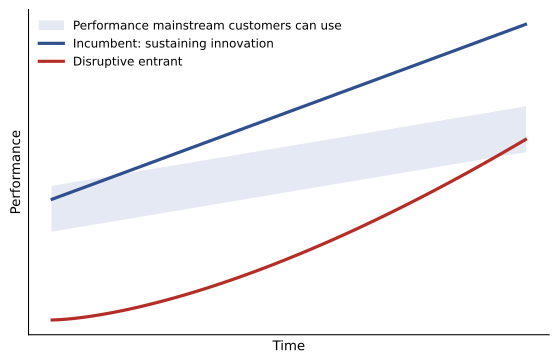
Christensen and his colleagues later distinguished low-end disruption, which targets the least demanding customers of an existing market with a cheaper offering, from new-market disruption, which serves people who previously could not use the product at all, such as the personal computer for people who could not afford a minicomputer. The theory explains why incumbents fail even when managed well: the resources, processes and values that make them excellent at serving their best customers, including their cost structures and their criteria for allocating capital, make them reject disruptive opportunities.
The theory has also been stretched far beyond its original meaning. Many entrants described as disruptors were simply better or better-funded competitors, and the historian Jill Lepore, in a 2014 critique, argued that several of Christensen's original cases were weaker than claimed. Andrew King and Baljir Baatartogtokh, in a 2015 study that asked experts to assess 77 cases cited as disruptions, found that fewer than one in ten matched all of the theory's main conditions. The lesson is to use the theory precisely: it predicts trouble for incumbents when an entrant starts at the low end or in a new market with a different business model that the incumbent has no incentive to copy, and when performance improves fast enough to reach the mainstream. It does not predict that every new technology or start-up will overturn an industry.
Profiting from innovation
Innovators do not always profit from their innovations. David Teece, in a 1986 article, asked why so often the imitators and the owners of complementary assets capture most of the value. His answer turned on two factors. The appropriability regime is the degree to which an innovator can protect its innovation, through patents, secrecy or the difficulty of copying. Complementary assets are the manufacturing capacity, distribution, service networks, brands and complementary technologies needed to commercialize an innovation. When protection is weak and the necessary complementary assets are specialized and held by others, the holders of those assets are in a strong position to capture the value. The practical question for an innovator is therefore not only whether its product is better, but who controls what is needed to bring it to customers.
Incumbents facing new technologies need what Charles O'Reilly and Michael Tushman, in a 2004 article, called ambidexterity: the ability to exploit existing businesses efficiently while exploring new ones. Their study found that companies which created separate units for new ventures, with their own structures, processes and cultures, but integrated them with the rest of the company at the senior management level, were far more successful at breakthrough innovation than those which kept new ventures inside existing units or spun them off entirely.
Platforms and network effects
A platform is a business that creates value by facilitating interactions between two or more groups of users, such as buyers and sellers, drivers and riders, or app developers and phone users. Jean-Charles Rochet and Jean Tirole, in a 2003 article, analysed such two-sided markets and showed that their pricing follows different rules from ordinary markets: a platform may charge one side little or nothing, or even subsidize it, because its presence attracts the other side, which pays. Geoffrey Parker, Marshall Van Alstyne and Sangeet Paul Choudary, in their 2016 book Platform Revolution, described the shift from pipelines, which create value by moving products through a linear chain, to platforms, which create value by orchestrating interactions they do not own.
The economics of platforms rest on network effects, which occur when the value of a product to a user depends on how many other users it has. Direct network effects operate within one group, as with a messaging app, which is more useful the more of one's contacts use it. Indirect or cross-side network effects operate across groups, as when more buyers attract more sellers and more sellers attract more buyers. Network effects create the possibility of tipping, in which one platform pulls ahead and becomes dominant because its size makes it more attractive, and of winner-take-most outcomes.
Whether a market tips depends on several conditions. Strong network effects favour concentration. High costs of multi-homing, using several platforms at once, also favour concentration; when users can easily use several platforms, as many drivers and riders do with ride-hailing apps, several platforms can survive. Strong demand for differentiated features favours multiple platforms, since a single platform cannot serve every need. And the platform must solve the chicken-and-egg problem: neither side wants to join until the other is there. Common solutions include subsidizing one side, seeding the platform with content or supply of its own, focusing on a small market until it reaches critical mass, and starting as a useful product for one side before adding the other.
# Network effects and critical mass: a simple adoption model for Kestrel's supplier marketplace
# Each period, the share of suppliers who join depends on the value they see, which rises
# with the share of retailers sharing data; retailers join as more suppliers do.
def simulate(retail_start, supplier_start, periods=12, strength=3.2, threshold=0.35):
    r, s = retail_start, supplier_start
    for _ in range(periods):
        s_target = 1 / (1 + 2.718281828 ** (-strength * 4 * (r - threshold)))
        r_target = 1 / (1 + 2.718281828 ** (-strength * 4 * (s - threshold)))
        s, r = s + 0.5 * (s_target - s), r + 0.5 * (r_target - r)
    return r, s

for start in (0.10, 0.20, 0.30, 0.40, 0.50):
    r, s = simulate(start, 0.05)
    outcome = "tips toward success" if s > 0.5 else "stalls"
    print(f"Retailers sharing data at launch {start:.0%}: after 12 periods retailers {r:.0%}, suppliers {s:.0%} -> {outcome}")

# Subsidy logic: what Kestrel could pay retailers per year to join if each retailer brings suppliers
supplier_fee, suppliers_per_retailer, margin = 6_000, 3.0, 0.80
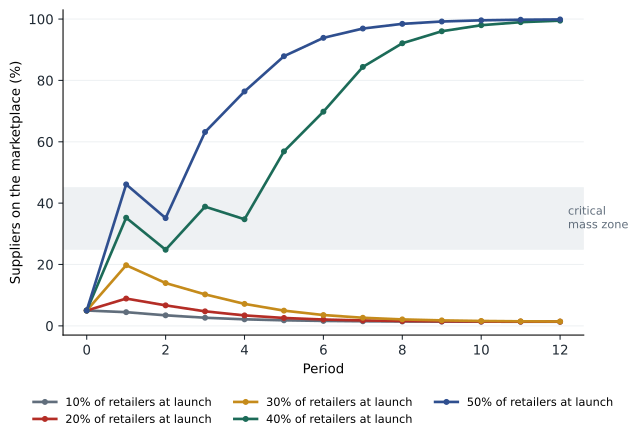
print(f"Value of one more retailer to the supplier side: {supplier_fee * suppliers_per_retailer * margin:,.0f} dollars a year")Retailers sharing data at launch 10%: after 12 periods retailers 1%, suppliers 1% -> stalls Retailers sharing data at launch 20%: after 12 periods retailers 1%, suppliers 1% -> stalls Retailers sharing data at launch 30%: after 12 periods retailers 1%, suppliers 1% -> stalls Retailers sharing data at launch 40%: after 12 periods retailers 99%, suppliers 99% -> tips toward success Retailers sharing data at launch 50%: after 12 periods retailers 100%, suppliers 100% -> tips toward success Value of one more retailer to the supplier side: 14,400 dollars a year
The model is stylized, but it captures the dynamics that worry Kestrel's board. Below a critical mass, which in this model lies between 30 and 40 per cent of retailers sharing data at launch, the marketplace stalls: too few retailers share data to interest suppliers, and too few suppliers join to persuade more retailers. Above it, adoption feeds on itself. The model also shows why Kestrel has an advantage over a new entrant: it already has more than 400 retail customers, and if a large fraction agree to share data from the start, the marketplace begins above critical mass. The second calculation shows why platforms subsidize one side. If each additional retailer attracts three suppliers paying 6,000 dollars a year at an 80 per cent margin, a retailer is worth about 14,400 dollars a year to the supplier side, so Kestrel could afford to offer retailers a substantial discount or a share of the revenue for agreeing to share data.
Platforms also need governance: rules about who may join, what they may do, how disputes are resolved and how data is used. Poor governance can destroy a platform's value, as when low-quality participants drive out good ones. For Kestrel, governance is central. Retailers will share data only if they trust that their competitors cannot see their individual figures, that suppliers will use the signals for planning rather than for negotiating against them, and that Kestrel will not use the data to compete with them. The cohort advises Leo to treat governance as part of the product, with aggregation rules, audit rights and a retailer advisory board, before writing any code.
Finally, platforms face envelopment, a term Thomas Eisenmann, Geoffrey Parker and Marshall Van Alstyne used in a 2011 article for an attack by a platform in an adjacent market that bundles the target's functionality with its own, using its existing user base. Kestrel's biggest risk is that a large enterprise software vendor adds a similar marketplace to the systems its retail customers already use. Kestrel's defence lies in what the vendor cannot easily copy, the pooled data and the trust of mid-sized retailers, and in moving quickly enough to reach critical mass first.
What this means for Cedarline
For Cedarline, the relevant innovations are more modest but real. Resale and rental of outdoor gear are new-market innovations that serve customers who could not afford or did not want to buy new technical clothing, and they could substitute for some new purchases. Several outdoor brands have launched resale programs that take back used products for credit and resell them after cleaning and repair. For Cedarline, whose position rests on durability and repair, resale is an opportunity to extend the life of its products and attract new customers, provided the program is designed so that it complements rather than cannibalizes new sales. A small resale and repair platform, run through its stores and website, would also strengthen the activity system the cohort sketched in lesson 1.
Worked problem
Will this market tip?
Owen Tremblay is evaluating an investment in a digital marketplace that matches small industrial buyers of natural gas with independent producers. Two rival marketplaces have launched in the past year. Producers can list on all three at little cost; buyers mostly want the lowest delivered price, and contracts are standardized. Is the market likely to tip to one winner, and what should the investment thesis depend on?
Show solution
- Network effects: cross-side effects exist, since more producers mean better prices for buyers and more buyers mean more sales for producers, but they weaken once a marketplace has enough liquidity to offer competitive prices.
- Multi-homing: producers can list on all three cheaply and buyers can check several, so multi-homing is easy, which works against tipping.
- Differentiation: standardized contracts leave little room for differentiated features, which favours concentration somewhat.
- Conclusion: with easy multi-homing and network effects that saturate, the market is more likely to support two or three marketplaces with thin margins than a single dominant winner.
Answer: The investment should not rest on a winner-take-all thesis. It should depend on whether the marketplace can offer something rivals cannot easily match, such as logistics or credit services for small buyers, and on its cost of acquiring users relative to their lifetime value.
Common mistakes
MistakeEvery new entrant with new technology is a disruptor.
InsteadDisruption starts at the low end or in a new market with a model incumbents lack the incentive to copy; most entrants are simply competitors.
MistakeThe best technology wins.
InsteadValue often goes to whoever controls complementary assets or protection; ask who holds what is needed to commercialize.
MistakeAll platforms become winner-take-all.
InsteadTipping requires strong network effects, costly multi-homing and limited demand for differentiated features.
MistakeA platform can charge every side its full value.
InsteadPlatforms often subsidize the side whose presence attracts the side that pays.
Summary and key terms
- Technologies improve along S-curves; attackers often win on new curves while incumbents invest near the limits of old ones.
- Architectural and competence-destroying innovations are especially dangerous to incumbents.
- Disruptive innovations start worse on mainstream dimensions but cheaper or more convenient and improve until they are good enough.
- Teece showed that appropriability and control of complementary assets decide who profits from innovation.
- Platforms create value by facilitating interactions between groups; network effects can lead to tipping when multi-homing is costly.
- Platforms must solve the chicken-and-egg problem, govern participation and data, and defend against envelopment.
- S-curve
- The pattern in which a technology's performance improves slowly, then rapidly, then slowly as it nears its limits.
- Architectural innovation
- An innovation that changes how existing components are linked together.
- Disruptive innovation
- An innovation that starts inferior on mainstream dimensions but cheaper or simpler, and improves until it displaces incumbents.
- Complementary assets
- Manufacturing, distribution, service and other capabilities needed to commercialize an innovation.
- Network effect
- An increase in a product's value to each user as the number of users grows.
- Multi-homing
- Using several competing platforms at the same time.
Practice problems
Work each problem on paper first, then reveal the answer to check.
Why might an incumbent rationally ignore a disruptive innovation at first?
Show answer
It serves small, low-margin markets its best customers do not want, so investing in it looks unattractive by the incumbent's criteria.
Give an example of a cross-side network effect.
Show answer
More app developers make a phone platform more attractive to users, and more users attract more developers.
Name two ways to solve the chicken-and-egg problem.
Show answer
Subsidize one side, seed the platform with the firm's own supply, or start with a small market or a standalone product.
What did O'Reilly and Tushman mean by ambidexterity?
Show answer
The ability to exploit existing businesses while exploring new ones, often through separate units integrated at the top.
Lesson quiz · 5 questions
Score 60% or more to complete this lesson.
Create a free account to save your progress, take quizzes and earn a certificate.