
MBA-514 · Lesson 3 of 12 · 21 min
The macro environment and scenario planning
Owen Tremblay's company has a decision that will outlast most of its executives. Prairie Ridge Energy processes natural gas, owns wind farms and is building a solar portfolio. Its board must decide within a year whether to commit about 900 million dollars to one of three paths: expanding its gas processing plant to serve export demand, doubling its renewable generation, or a balanced program that adds some of each and keeps options open. The assets will run for thirty years or more. The forecasts the planning team has prepared for gas prices, carbon policy and electricity demand disagree with one another, and with last year's forecasts. Owen asks Dr. Ashford how anyone can make a strategy when the future is this uncertain.
The answer, Dr. Ashford says, is not to find a better forecast. It is to stop relying on any single forecast and to design a strategy that performs acceptably across the futures that could plausibly occur, while positioning the company to move quickly when the future becomes clearer. That is the purpose of scenario planning, the main subject of this lesson. But first the cohort needs a way to organize the forces outside the industry that shape it.
The macro environment
Industry analysis looks at the forces close to a firm: rivals, buyers, suppliers, entrants and substitutes. Beyond them lies the macro environment, the broad forces that affect many industries at once. A common checklist is PESTEL: political, economic, social, technological, environmental and legal factors. Political factors include trade policy, government stability and industrial policy; economic factors include growth, interest rates, inflation and exchange rates, which the cohort studied in MBA-502; social factors include demographics, values and lifestyles; technological factors include new general-purpose technologies such as artificial intelligence; environmental factors include climate change and resource constraints; and legal factors include competition, labour, privacy and environmental law.
Checklists have a weakness: they produce long lists of trends with no sense of which ones matter. The useful question is not what is changing but what is changing that would alter the five forces in this industry or the value of this firm's resources. An aging population matters to Lakeview Health because it raises demand for chronic care and strains staffing; it matters much less to Kestrel Analytics. Dr. Ashford asks each member of the cohort to name the two macro forces that would most change their industry's structure over ten years. Grace names the spread of online grocery delivery and the persistence of food inflation, which have made shoppers more price-sensitive. Leo names generative AI, which could either make Kestrel's forecasting models more valuable or let large software firms bundle similar capabilities for free.
It also helps to separate forces by how predictable they are. Some are predetermined elements: the people who will be 65 in 2040 are already alive, and the physics of climate change will keep raising average temperatures whatever policy does. Others are critical uncertainties: forces that matter a great deal but whose direction cannot be known, such as the stringency of future carbon policy or the outcome of trade negotiations. Scenario planning builds on this distinction.
Scenarios at Shell
Scenario planning as a business practice is most closely associated with Royal Dutch Shell, where Pierre Wack and his colleagues in the planning group developed it in the late 1960s and early 1970s. Rather than forecast the price of oil, they described several possible futures, including one in which oil-producing countries, then gaining strength, would use their power to raise prices sharply. When the oil shock of 1973 came, Shell's managers had already thought through what such a world would mean, and the company is often credited with adapting faster than its rivals, though the story has been told with varying degrees of embellishment. Wack later wrote that the purpose of scenarios was not to predict the future but to change the mental models of decision makers, so that they would recognize a changing world sooner. Peter Schwartz, a later head of the group, popularized the method in his 1991 book The Art of the Long View.
Scenarios are not forecasts with a high and low case. A high and low forecast varies one or two numbers around a central estimate and assumes the structure of the world stays the same. Scenarios are internally consistent stories about how the world could work differently, each plausible, each challenging some assumption managers hold, and none labelled as most likely. Their value comes from forcing managers to imagine the conditions under which their strategy would fail.
Building scenarios
A practical process has six steps. First, define the focal question and the time horizon, such as which investment path should Prairie Ridge commit to for 2027 to 2040. Second, list the driving forces that bear on the question, using PESTEL and the five forces. Third, rank the forces by importance and uncertainty, separating predetermined elements from critical uncertainties. Fourth, choose two critical uncertainties that are largely independent of each other and use them as the axes of a two-by-two matrix, producing four scenarios. Fifth, write a narrative for each scenario, with a memorable name, describing how the world would get there and what it would mean for customers, competitors and the firm. Sixth, identify signposts, early indicators that would show which scenario is unfolding.
Prairie Ridge's planning team chooses two axes. The first is the stringency of climate policy over the next decade, from weak, with industrial carbon pricing softened or delayed, to strong, with tighter emissions caps and rising carbon costs for heavy emitters. Canada removed the consumer fuel charge in April 2025 while keeping carbon pricing for large industrial emitters, which shows how quickly policy can shift. The second axis is global demand for Canadian natural gas, from weak, if export projects stall and alternatives win in Asia, to strong, if liquefied natural gas exports from the West Coast, which began from LNG Canada in 2025, grow and new pipelines are built.
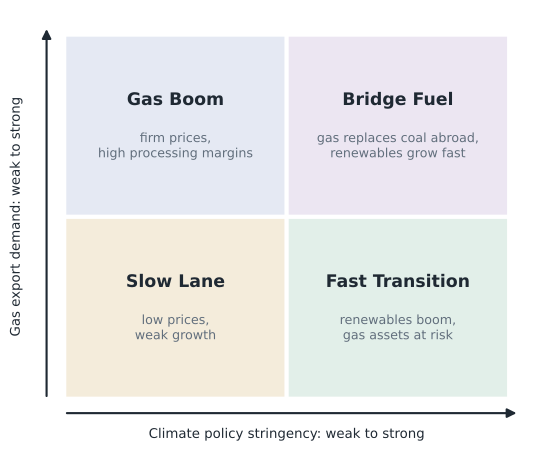
The team names the four scenarios. In Gas Boom, policy is weak and export demand strong: gas prices are firm, processing margins high and renewable projects compete on cost alone. In Bridge Fuel, policy is strong but export demand is also strong, because buyers in Asia use gas to replace coal; gas processing remains valuable but must cut its own emissions, and renewables grow quickly. In Fast Transition, policy is strong and export demand weak: renewables boom, gas volumes decline and processing assets risk being stranded. In Slow Lane, both are weak: growth is sluggish, prices are low and every investment struggles to earn its cost of capital.
From scenarios to strategy
Scenarios become useful when a firm tests its strategic options against each of them. The team estimates the net present value of each of the three investment paths in each scenario. The code below takes those estimates and compares the options in three ways: by expected value using probabilities the team assigns reluctantly, by the worst outcome, and by regret, the gap between an option's value in a scenario and the best option's value in that scenario.
# Testing three investment paths against four scenarios (NPV, millions of dollars)
scenarios = ["Gas Boom", "Bridge Fuel", "Fast Transition", "Slow Lane"]
prob = [0.20, 0.35, 0.25, 0.20]            # judgment only; scenarios are not forecasts
npv = {
    "Expand gas processing":  [420, 160, -310, -120],
    "Double renewables":      [-90, 180, 340, -80],
    "Balanced and staged":    [150, 200, 120, 10],
}
best = [max(v[i] for v in npv.values()) for i in range(4)]
print(f"{'Option':24s} {'expected':>8s} {'worst':>6s} {'max regret':>10s}")
for name, v in npv.items():
    ev = sum(p * x for p, x in zip(prob, v))
    regret = max(b - x for b, x in zip(best, v))
    print(f"{name:24s} {ev:8.0f} {min(v):6.0f} {regret:10.0f}")

# How sensitive is the ranking to the probabilities? Shift weight to Fast Transition.
for shift in (0.0, 0.10, 0.20):
    p = [prob[0] - shift / 2, prob[1], prob[2] + shift, prob[3] - shift / 2]
    evs = {n: sum(a * b for a, b in zip(p, v)) for n, v in npv.items()}
    top = max(evs, key=evs.get)
print(f"Fast Transition weight {p[2]:.2f}: best by expected value is {top} ({evs[top]:.0f})")Option expected worst max regret Expand gas processing 38 -310 650 Double renewables 114 -90 510 Balanced and staged 132 10 270 Fast Transition weight 0.25: best by expected value is Balanced and staged (132) Fast Transition weight 0.35: best by expected value is Double renewables (156) Fast Transition weight 0.45: best by expected value is Double renewables (199)
The output shows why scenario thinking changes decisions. Expanding gas processing has the highest value in one scenario and the worst outcome overall, a loss of about 310 million dollars if the energy transition is fast, and its maximum regret is 650 million. Doubling renewables is excellent if the transition is fast but loses money in two scenarios. The balanced and staged program is never far from the best: it has the highest expected value on the team's probabilities, it never loses money, and its maximum regret, 270 million, is less than half that of either alternative. The sensitivity test adds a caution. If the board believes Fast Transition is meaningfully more likely than the team assumed, doubling renewables overtakes the balanced program on expected value, though it still carries more regret. Probabilities assigned to scenarios are judgments, so a strategy that is good enough in every plausible future, called a robust strategy, is often worth more than one that is best only under a particular set of probabilities.
Robustness is not the only response to uncertainty. Hugh Courtney, Jane Kirkland and Patrick Viguerie, in a 1997 Harvard Business Review article, distinguished three postures. A firm can shape the future, using its scale or influence to push the industry toward the scenario it prefers, for example by setting standards. It can adapt, building the flexibility to respond quickly as the future unfolds. Or it can reserve the right to play, making small investments now that create options to commit later, such as land positions, pilot projects or minority stakes. They also distinguished four levels of uncertainty, from a clear enough future to true ambiguity, and argued that the right tools differ by level. Prairie Ridge faces what they called a range of futures, where scenarios are the appropriate tool.
The team's recommendation combines postures. It proposes to commit now to the parts of the program that pay off in most scenarios, such as cutting emissions from the existing plant and adding renewable capacity under long-term contracts, and to buy options on the rest: securing land and grid connections for further renewables, and designing the gas expansion in two phases, with the second triggered only if export contracts are signed. This is the real-options logic the cohort met in MBA-511, applied to strategy.
Signposts and monitoring
Scenarios lose their value if they are written once and filed away. Each scenario should come with signposts, observable events that would indicate it is unfolding: for Prairie Ridge, the final investment decisions on new export terminals, the price of long-term gas contracts in Asia, changes in carbon pricing for large emitters, and the cost of solar panels and batteries. The planning team reports on the signposts to the board every quarter, and the board agrees in advance which signals would trigger the second phase of the gas expansion or an acceleration of renewables. Agreeing on triggers in advance reduces the risk that managers will interpret every new fact as confirming the strategy they already prefer.
Cedarline's macro environment
Dr. Ashford asks the cohort to apply the method to Cedarline briefly, as preparation for the capstone. The predetermined elements include warmer average winters in many of its markets, which shorten the season for heavy insulated jackets, and growing consumer interest in durability and repair. The critical uncertainties include trade policy, since almost all of Cedarline's products are made in Asia and tariffs on imported apparel have risen and shifted repeatedly since 2025, and consumer spending, which depends on employment and interest rates. A quick two-by-two on tariffs and consumer demand produces four scenarios, and the cohort finds that Cedarline's current plan, built on rapid store expansion and broad wholesale distribution, performs poorly in three of them. The capstone will need a more robust strategy.
Worked problem
Choosing scenario axes for a hospital network
Hana Kowalski wants to use scenarios to plan Lakeview Health's investments over the next ten years. Her team has listed driving forces including an aging population, staff shortages, government funding, virtual care technology, competition from private clinics and the spread of AI in diagnosis. Choose two axes for a two-by-two matrix and sketch the four scenarios.
Show solution
- Separate predetermined elements from uncertainties: the aging population is predetermined; government funding, the adoption of virtual care and the availability of staff are uncertain.
- Choose two important uncertainties that are largely independent: the generosity of public funding, from constrained to expanding, and the adoption of virtual and AI-assisted care, from slow to rapid.
- Name and sketch the four scenarios: Stretched Thin (constrained funding, slow adoption), with long waits and burnout; Digital Front Door (constrained funding, rapid adoption), where virtual care absorbs demand; Building Boom (expanding funding, slow adoption), with new physical capacity; and Connected Care (expanding funding, rapid adoption), with integrated networks.
- Test options: an investment in virtual care infrastructure pays off in two scenarios and costs little in the others, making it a robust no-regrets move; a new hospital wing pays off mainly in Building Boom.
Answer: The exercise does not tell Hana which future will occur. It shows that investments in virtual care and staff retention are robust, and that a large capital project should be staged and tied to signposts such as multi-year funding commitments.
Common mistakes
MistakeScenarios are best, base and worst cases.
InsteadScenarios are distinct, internally consistent stories about how the world could work, not variations of one forecast.
MistakeThe goal is to pick the most likely scenario.
InsteadThe goal is a strategy that performs acceptably across scenarios and can adapt as signposts appear.
MistakeEvery trend belongs in the analysis.
InsteadFocus on forces that would change the industry's structure or the value of the firm's resources.
MistakeOnce written, scenarios are finished.
InsteadScenarios need signposts that are monitored and triggers agreed in advance.
Summary and key terms
- The macro environment can be organized as political, economic, social, technological, environmental and legal forces, but only forces that change industry structure or resource value really matter.
- Separate predetermined elements, which can be anticipated, from critical uncertainties, which cannot.
- Scenario planning, developed at Shell, builds several plausible, internally consistent futures to challenge managers' mental models.
- A two-by-two matrix of two independent critical uncertainties gives four scenarios, each with a narrative and signposts.
- Options can be compared by expected value, worst case and maximum regret; robust strategies perform acceptably in every scenario.
- Firms can shape the future, adapt to it or reserve the right to play by buying options.
- PESTEL
- A checklist of political, economic, social, technological, environmental and legal forces in the macro environment.
- Predetermined element
- A driving force whose direction can be anticipated with confidence.
- Critical uncertainty
- A force that matters greatly to the focal question but whose direction cannot be known.
- Scenario
- An internally consistent, plausible story about how the future could unfold.
- Regret
- The shortfall between an option's outcome in a scenario and the best option's outcome in that scenario.
- Signpost
- An observable indicator that a particular scenario is unfolding.
Practice problems
Work each problem on paper first, then reveal the answer to check.
Why should the two axes of a scenario matrix be largely independent?
Show answer
If they move together, two of the four quadrants are implausible and the matrix collapses into a single line.
An option has values 100, 50 and -20 in three scenarios where the best options score 120, 80 and 40. What is its maximum regret?
Show answer
Regrets are 20, 30 and 60, so the maximum regret is 60.
Give an example of reserving the right to play.
Show answer
Buying land options, running a pilot plant or taking a minority stake that allows a larger commitment later.
Why agree on triggers before signposts appear?
Show answer
It reduces the tendency to interpret new information as support for a preferred strategy.
Lesson quiz · 5 questions
Score 60% or more to complete this lesson.
Create a free account to save your progress, take quizzes and earn a certificate.