
MBA-514 · Lesson 10 of 12 · 21 min
Mergers, acquisitions and alliances
Grace Mwangi thought the hardest part of the Harvest Lane deal was behind her. In MBA-511 she valued Harvest Lane Markets, the chain of 22 grocery stores in a neighbouring region whose owners want to sell, and recommended that Fairway proceed at up to the asking price of 330 million dollars, keeping most of the synergies for Fairway's owners. Since then, a national grocery chain has entered the auction, and Harvest Lane's adviser has let it be known that bids above 370 million are now expected. Fairway's chief executive, who has wanted a larger company for years, is ready to go higher. Grace has been asked to tell the board whether the deal still makes sense, and how Fairway should integrate Harvest Lane if it wins.
Mergers and acquisitions are the most visible corporate strategy decisions and among the most consequential. They can transform a company's scope in a few months, and they can destroy more value faster than almost any other decision. This lesson looks at acquisitions as strategy rather than valuation, which MBA-511 covered: why firms acquire, why so many acquisitions disappoint, how to think about synergies, premiums and integration, and when an alliance is a better choice.
Why firms acquire
Acquisitions are an alternative to building a business internally or obtaining access to resources through contracts and alliances. They can be justified when they give faster access to markets, capabilities or resources than internal development, which suffers from the time compression diseconomies of lesson 4; when the combined firm can achieve economies of scale or scope; when they consolidate an industry with excess capacity; or when the buyer can improve the target's management. They are also pursued for weaker reasons: empire building by managers whose pay and prestige grow with the size of the firm, defensive moves to keep a target from a rival, diversification for its own sake, and the belief that a deal will raise earnings per share.
Deal activity runs in waves, often peaking when share prices are high and credit is cheap. The first half of 2026 set a record: announced global mergers and acquisitions totalled about 2.8 trillion US dollars according to LSEG data, up about 48 per cent from a year earlier, even though the number of deals fell by about 9 per cent to roughly 24,000. Deals worth more than 10 billion dollars accounted for nearly half of the value. Large waves of acquisitions have historically been followed by disappointing returns for many buyers, because high prices and competition for targets push premiums up.
The evidence on acquisitions
Studies of share price reactions to acquisition announcements reach a consistent conclusion. Target shareholders gain substantially, usually receiving premiums of 20 to 40 per cent over the pre-announcement price. Acquirers' shareholders, on average, gain little or nothing, and in large deals involving public targets they often lose. Sara Moeller, Frederik Schlingemann and René Stulz, in a 2005 study, found that acquirers' shareholders lost very large sums on a small number of large deals at the height of the late-1990s boom. The combined value of acquirer and target often rises, which shows that acquisitions can create value, but the target's owners capture most of it.
Richard Roll, in a 1986 article, offered the hubris hypothesis: managers who win auctions are those who most overestimate the value of the target, so the winners systematically overpay. This is a form of the winner's curse familiar from auctions of oil leases, where the highest bidder is the one whose estimate of the oil in the ground was most optimistic. The remedy is discipline: estimate value independently, decide the walk-away price before bidding begins and treat each increase in the bid as giving value away to the seller.
Synergies and premiums
The value an acquisition creates for the buyer's owners equals the target's standalone value plus the present value of synergies, minus the integration costs, minus the price. The premium paid over standalone value must be covered by synergies for the buyer to gain. Synergies come in three kinds. Cost synergies arise from purchasing scale, combining overheads, consolidating distribution and closing duplicate facilities; they are usually the most reliable because they are within the buyer's control. Revenue synergies arise from cross-selling, wider distribution and combining products; they depend on customers' choices and are much less reliable, with many deals failing to deliver them. Financial synergies, such as tax benefits or a lower cost of capital, are usually small and sometimes illusory.
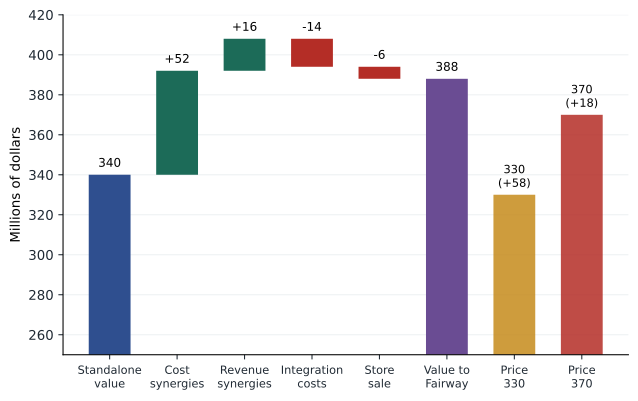
Grace's team builds the value bridge with care. Harvest Lane's standalone value is about 340 million dollars, the middle of the discounted cash flow range from MBA-511. Cost synergies, mostly from combined purchasing and a shared distribution network, are worth about 52 million in present value after tax and a two-year ramp-up. Revenue synergies from extending Fairway's private-label range to Harvest Lane stores are worth perhaps 16 million, but the team regards them as uncertain. Integration costs, including systems, rebranding and severance, are about 14 million. The competition review, discussed below, is likely to require the sale of one store in an overlapping town, costing about 6 million in lost value. The code below assembles the bridge and asks what happens at different prices.
# Value to Fairway's owners from acquiring Harvest Lane (millions of dollars, present values)
standalone, cost_syn, revenue_syn, integration, divestiture = 340, 52, 16, 14, 6
value_to_fairway = standalone + cost_syn + revenue_syn - integration - divestiture
walk_away_strict = standalone + cost_syn - integration - divestiture    # ignores uncertain revenue synergies
for price in (330, 350, 370, 390):
    created = value_to_fairway - price
    paid_away = max(0, price - standalone) / (cost_syn + revenue_syn - integration - divestiture)
    print(f"Price {price}: value created {created:+4d}, share of net synergies paid to sellers {paid_away:5.0%}")
print(f"Walk-away price including revenue synergies {value_to_fairway}; counting cost synergies only {walk_away_strict}")

# Earnings accretion can mislead: Prairie Ridge buying the dealerships with debt
price, roic, rate, tax = 310.0, 0.058, 0.0625, 0.25
net_income, shares = 240.0, 150.0
added = price * roic - price * rate * (1 - tax)
eps_before, eps_after = net_income / shares, (net_income + added) / shares
print(f"EPS {eps_before:.3f} -> {eps_after:.3f} ({eps_after / eps_before - 1:+.1%}) "
f"while the deal earns {roic:.1%} against an 8.0% cost of capital")Price 330: value created +58, share of net synergies paid to sellers 0% Price 350: value created +38, share of net synergies paid to sellers 21% Price 370: value created +18, share of net synergies paid to sellers 62% Price 390: value created -2, share of net synergies paid to sellers 104% Walk-away price including revenue synergies 388; counting cost synergies only 372 EPS 1.600 -> 1.623 (+1.4%) while the deal earns 5.8% against an 8.0% cost of capital
At the original asking price of 330 million, Fairway would pay less than its estimate of Harvest Lane's standalone value and keep all of the net synergies of 48 million, creating about 58 million for its owners. At 370 million, the sellers would capture about 62 per cent of the net synergies, and Fairway's owners would gain 18 million on an investment of 370, a thin margin of safety given the uncertainty. If Grace excludes the uncertain revenue synergies, as a conservative board should, the walk-away price is 372 million, barely above the level the auction has reached. Her recommendation is to bid no more than 360 million and to accept losing the auction if the national chain bids more. Losing a bidding war, Dr. Ashford tells the cohort, is often the best outcome of a bidding war.
The second calculation illustrates a different trap. If Prairie Ridge bought the dealerships discussed in lesson 9 for 310 million dollars, financed with debt at 6.25 per cent, its earnings per share would rise by about 1.4 per cent, because the dealerships' after-tax return of 5.8 per cent exceeds the after-tax cost of the debt of about 4.7 per cent. A deal can be accretive to earnings and still destroy value, because earnings per share ignore the cost of the equity capital that the extra debt puts at risk. Accretion and dilution tell investors about accounting, not about value.
Integration
Most of the value in an acquisition is won or lost after the deal closes. Philippe Haspeslagh and David Jemison, in their 1991 book Managing Acquisitions, argued that the right approach to integration depends on two questions: how much strategic interdependence is needed to create the expected value, and how much autonomy the target needs to preserve the capabilities that make it valuable. Low interdependence and high autonomy call for preservation, leaving the target largely alone; high interdependence and low autonomy call for absorption, fully combining the two; and high levels of both call for symbiosis, the hardest approach, in which the organizations gradually become interdependent while preserving what makes each distinctive.
Grace's analysis points to a mixed approach. The cost synergies require absorbing Harvest Lane's purchasing, distribution and back-office systems into Fairway's within eighteen months. But Harvest Lane's stores have loyal local customers and store managers with deep community ties, and the private-label revenue synergies depend on introducing Fairway's products without making the stores feel like they have been taken over. She proposes keeping the Harvest Lane name and store managers for at least two years, appointing an integration leader with authority across both organizations, and setting a 100-day plan with specific milestones for the purchasing and systems integration. Studies of integration consistently emphasize speed in the areas where integration is needed, early decisions about leadership, clear communication to employees and customers, and attention to culture, which is easier to damage than to change.
Competition law
Large acquisitions in Canada must be notified to the Competition Bureau when the parties and the transaction exceed size thresholds, and the Bureau can challenge any merger that is likely to prevent or lessen competition substantially, whether or not it was notified. Amendments to the Competition Act in 2023 and 2024 repealed the efficiencies defence, which had allowed some anticompetitive mergers to proceed if their efficiencies were large enough, and introduced a structural presumption: a merger is presumed likely to harm competition if it gives the merged firm a market share above 30 per cent, or if the post-merger HHI exceeds 1,800 and rises by more than 100. In November 2025 the Bureau published draft updated merger enforcement guidelines for consultation to replace those of 2011. Foreign acquisitions of Canadian businesses may also be reviewed under the Investment Canada Act.
Although Harvest Lane operates in a neighbouring region, three towns along the border have stores from both chains. In one of them, Fairway has a 22 per cent share of grocery sales and Harvest Lane 18 per cent, with three other grocers holding 35, 15 and 10 per cent. Before the merger, the HHI is 2,358; afterwards it would be 3,150, an increase of 792, and the merged firm would have a 40 per cent share. The merger would be presumed harmful in that town, so Grace's team plans to offer to sell one store there to another grocer, which is the divestiture included in the value bridge.
Alliances and joint ventures
Not every strategic objective requires ownership. Strategic alliances, ranging from contractual partnerships to equity joint ventures, let firms combine complementary resources while each retains its independence. Jeffrey Dyer and Harbir Singh, in a 1998 article, described the relational view: partners can earn returns neither could earn alone through relation-specific assets, knowledge-sharing routines, complementary resources and effective governance. Alliances are also a way of creating options. Bruce Kogut, in a 1991 study, showed that joint ventures often serve as options to expand, with one partner later buying out the other when uncertainty resolves.
Alliances have their own problems. Partners' objectives diverge over time, one partner may learn faster and use the alliance to build capabilities that make the partner redundant, and governance without ownership is difficult. Many alliances end early or are judged failures by at least one partner. Firms that manage many alliances, and that build a dedicated alliance function with templates, training and regular reviews, tend to do better than those that treat each one as a one-off.
Grace's team considers an alliance as a fallback if Fairway loses the auction. Fairway could join a purchasing alliance with two other independent regional grocers, combining their buying for national-brand products and private-label manufacturing. The alliance would capture perhaps half of the purchasing synergies Grace expected from Harvest Lane without any premium or integration cost. It is less than the acquisition offers at a good price, but more than the acquisition offers at a bad one.
Worked problem
Should Cedarline buy a footwear brand?
A small hiking-boot brand has approached Cedarline about a sale. It has revenue of 60 million dollars, a strong reputation among serious hikers and EBITDA of 6 million. Its owners want 75 million dollars. Cedarline's managers expect revenue synergies from selling the boots in Cedarline's stores and online, and cost synergies from shared logistics. Cedarline has no experience in footwear, which has different manufacturing, sizing and return patterns. How should Cedarline approach the decision?
Show solution
- Standalone value: at a typical multiple for small branded footwear businesses, a standalone value of perhaps 55 to 65 million, so the asking price implies a premium of 10 to 20 million that synergies must cover.
- Synergies: logistics savings are modest and fairly reliable; revenue synergies from Cedarline's channels are plausible but uncertain, and Cedarline's stores have limited space.
- Better-off test: Cedarline's strengths in apparel design and repair transfer poorly to footwear, and its management is already stretched by the store rollout and repair service.
- Alternatives: a licensing or distribution alliance, in which Cedarline sells the brand's boots in its stores for a margin, would test the revenue synergies without the premium; an option to acquire later could be negotiated.
Answer: At 75 million, the acquisition depends on uncertain revenue synergies and distracts management at a critical time. A distribution alliance with an option to buy later tests the idea at low cost and keeps the decision open.
Common mistakes
MistakeAn acquisition that raises earnings per share creates value.
InsteadAccretion ignores the cost of capital; a deal returning less than the cost of capital destroys value even if it is accretive.
MistakeRevenue synergies are as reliable as cost synergies.
InsteadRevenue synergies depend on customers and are frequently missed; weight them cautiously.
MistakeWinning the auction is success.
InsteadThe winner of a competitive auction often overpays; decide the walk-away price in advance.
MistakeIntegration is an administrative task after the deal.
InsteadMost value is won or lost in integration, and the approach must match the interdependence and autonomy the deal requires.
Summary and key terms
- Acquisitions offer speed and access to resources but often disappoint because buyers pay away the value they create.
- Target shareholders usually gain large premiums; acquirers' shareholders gain little on average, and the winner's curse explains overpayment in auctions.
- Value to the buyer equals standalone value plus synergies minus integration costs minus the price; cost synergies are more reliable than revenue synergies.
- Earnings accretion is not value creation; returns must be compared with the cost of capital.
- Integration should follow the needs for interdependence and autonomy, through preservation, absorption or symbiosis.
- Alliances and joint ventures combine resources without ownership, can serve as options, but require careful governance.
- Synergy
- The extra value created by combining two businesses compared with their separate values.
- Control premium
- The amount paid above a target's pre-bid market or standalone value to acquire control.
- Winner's curse
- The tendency of the winning bidder in an auction to be the one who most overestimated the asset's value.
- Accretion
- An increase in the acquirer's earnings per share as a result of a deal.
- Absorption
- An integration approach that fully combines the target into the acquirer.
- Joint venture
- A separate entity jointly owned by two or more firms to pursue a shared objective.
Practice problems
Work each problem on paper first, then reveal the answer to check.
A target is worth 200 standalone, synergies are worth 50 and integration costs 10. What is the most the buyer should pay?
Show answer
240, at which price the buyer creates no value; it should aim well below that.
Why are acquirers' returns on average close to zero when combined returns are positive?
Show answer
Competition among bidders and premiums transfer most of the value created to the target's shareholders.
A market has shares 30, 25, 25 and 20. Two firms with 25 each merge. What are the HHI before and after?
Show answer
Before: 900 + 625 + 625 + 400 = 2,550. After: 900 + 2,500 + 400 = 3,800, an increase of 1,250.
When is a joint venture a real option?
Show answer
When it gives one partner the right, but not the obligation, to expand or buy out the other once uncertainty resolves.
Lesson quiz · 5 questions
Score 60% or more to complete this lesson.
Create a free account to save your progress, take quizzes and earn a certificate.