
MBA-514 · Lesson 1 of 12 · 22 min
What strategy is: choices, trade-offs and fit
The first Friday of the winter term at the Lakeshore School of Business in Toronto begins with an index card. Dr. Julian Ashford, who spent fourteen years as a strategy partner at a consulting firm and six more as chief strategy officer of a building-products company, hands one to each member of the cohort and asks them to write their organization's strategy in no more than 35 words. Ten minutes later he reads the cards aloud without names. One says the company aims to be the customer's partner of choice through operational excellence and innovation. Another says it will grow profitably by delivering superior value to all stakeholders. A third lists five priorities. Nobody can tell which card belongs to the grocery chain and which to the energy company.
That, Dr. Ashford says, is the problem this course is about. Every card describes an ambition or a set of virtues; none describes a choice. A strategy that could belong to any company in any industry is not a strategy at all, because it does not tell anyone in the organization what to do differently tomorrow, what to stop doing, or what the company will refuse even when a customer asks for it. Over the next twelve lessons the cohort will learn the tools strategists use: industry analysis, scenario planning, the resource-based view, the economics of competitive advantage, game theory, the strategy of innovation and platforms, corporate strategy, mergers and alliances, and execution. But the tools serve one purpose, which is to make a small number of coherent choices that give an organization a reason to exist that its competitors cannot easily copy.
Operational effectiveness is not strategy
In a 1996 Harvard Business Review article titled What Is Strategy?, Michael Porter drew a distinction that remains the starting point for most strategy courses. Operational effectiveness means performing similar activities better than rivals: less waste, faster cycle times, fewer defects, better use of technology. It matters enormously, and the gaps between the best and worst firms in an industry are often large. But operational improvements spread quickly, because best practices can be benchmarked, consultants carry them from firm to firm and suppliers sell them to everyone. When every firm in an industry adopts the same improvements, they move the whole productivity frontier outward, and customers and suppliers capture most of the gain. Firms run faster to stay in place.
Strategy, in Porter's account, is performing different activities from rivals, or performing similar activities in different ways, so as to deliver a unique mix of value. It rests on three ideas. The first is a unique position, which can be based on the variety of products or services a firm offers, on the needs of a particular group of customers, or on a way of reaching customers that differs because of their location, scale or some other feature of access. The second is trade-offs. A position is sustainable only if it requires giving something up, because otherwise rivals could simply add the position to what they already do. Trade-offs arise from inconsistencies in image or reputation, from activities that cannot be optimized for two purposes at once, and from the limits of internal coordination. The third is fit: the activities a firm performs reinforce one another so that the whole system is harder to imitate than any part.
Porter's best-known illustration was Southwest Airlines in the 1990s. Southwest flew one aircraft type, the Boeing 737, between mid-sized cities and secondary airports, without assigned seats, meals or connections to other airlines, and turned its planes around at the gate in about 15 minutes. Each choice made the others more valuable. A single fleet cut maintenance and training costs and made crew scheduling flexible; no meals and no assigned seats sped up boarding; secondary airports reduced congestion; fast turnarounds kept planes flying more hours a day, which supported low fares and frequent departures. A rival that copied one practice, such as the absence of meals, gained little, because the advantage lay in the system. IKEA, which Porter also discussed, offers a similar pattern: modular flat-packed furniture, self-service showrooms, customers who transport and assemble products themselves, and in-house design for low-cost manufacturing all reinforce a position of stylish furniture at low prices for young, price-conscious buyers.
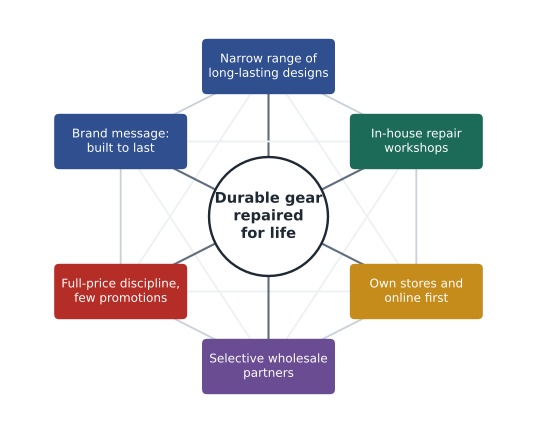
Porter distinguished three orders of fit. First-order fit is simple consistency: each activity is aligned with the overall position, as when a low-cost airline also has low-cost gate operations. Second-order fit occurs when activities reinforce one another, as when advertising that features a product's durability is believable because the firm also offers lifetime repairs. Third-order fit is optimization of effort across activities, such as coordinating design and manufacturing so that a product needs fewer parts and less inventory. The higher the order of fit, the harder the system is to imitate, because a rival must match many activities at once, and the probability of matching all of them is roughly the product of the probabilities of matching each one.
Deliberate and emergent strategy
Not all strategy is planned. Henry Mintzberg and James Waters, in a 1985 article, distinguished intended strategy, what leaders plan, from realized strategy, what the organization actually does. Part of the intended strategy is deliberate and is realized as planned; part is unrealized, abandoned or overtaken by events; and part of the realized strategy is emergent, a pattern of actions that nobody intended but that arose as managers responded to opportunities and problems. The classic example, much debated, is Honda's entry into the American motorcycle market in 1959, where the company planned to sell large motorcycles but found demand for its small Supercub, which its employees had been riding around Los Angeles. Emergent strategy is not a failure of planning. Good strategists watch for patterns that work and make them deliberate, and they design strategies that leave room for learning.
The lesson for managers is balance. A purely deliberate strategy assumes the future can be foreseen and ignores what the organization learns as it acts. A purely emergent one is a collection of reactions. Most effective strategies set a clear direction and a few firm commitments while treating many specifics as experiments, a theme the cohort will return to with scenario planning in lesson 3 and with the staged decisions they studied in MBA-511.
Good strategy and bad strategy
Richard Rumelt, in his 2011 book Good Strategy Bad Strategy, argued that much of what organizations call strategy is something else: lists of goals, statements of ambition, or fluff, meaning abstract language that sounds strategic but commits to nothing. He identified four hallmarks of bad strategy: fluff, failure to face the challenge, mistaking goals for strategy, and bad strategic objectives that are either a jumble of unrelated priorities or impossible targets. A goal such as twenty per cent annual growth says nothing about how the growth will be achieved or why competitors will allow it.
Good strategy, in Rumelt's account, has a kernel of three parts. A diagnosis explains what is going on, simplifying a complex situation by identifying the critical challenge. A guiding policy is an overall approach chosen to cope with or overcome the challenge, which channels action in certain directions without defining exactly what to do. Coherent actions are coordinated steps that carry out the guiding policy and reinforce one another. The diagnosis is often the hardest part, because it requires naming the obstacle honestly, including obstacles inside the organization.
A. G. Lafley, the former chief executive of Procter and Gamble, and Roger Martin, the former dean of the Rotman School of Management at the University of Toronto, offered a complementary framework in their 2013 book Playing to Win. They describe strategy as a cascade of five integrated choices: a winning aspiration, where to play (which customers, products, channels and regions), how to win in those places, the capabilities that must be in place, and the management systems that support and measure the choices. Where to play and how to win are the heart of it; the rest make those two choices real.
David Collis and Michael Rukstad, in a 2008 article titled Can You Say What Your Strategy Is?, proposed that every strategy statement should define three things: the objective, a single specific and time-bound end; the scope, the domain in which the firm will operate, including the boundaries it will not cross; and the advantage, what the firm will do differently or better than others and why customers will choose it. Dr. Ashford's 35-word index card comes from their article.
Strategy and value
Strategy matters because it determines whether a firm creates value. As the cohort learned in MBA-511, a company creates value for its owners only when its return on invested capital exceeds its cost of capital. Growth at returns below the cost of capital destroys value, and the faster such a company grows, the more value it destroys. A strategy is therefore not just a story about customers and competitors; it is a claim that the firm can earn returns above its cost of capital in the places it chooses to play, for longer than competitors would normally allow.
Dr. Ashford introduces the course's capstone company, which the cohort already knows well. Cedarline Outdoor, the outdoor apparel company headquartered in Toronto that they diagnosed in MBA-501, valued in MBA-511 and planned for in MBA-512, grew its revenue from 312 million dollars in fiscal 2022 to 468 million in fiscal 2026. Over the same period its return on invested capital fell from 12.1 to 8.0 per cent, against a cost of capital of about 9 per cent. The code below computes Cedarline's economic profit and uses the value-driver formula from MBA-511 to show why growth at its current returns does not help its owners.
# Economic profit and the value of growth for Cedarline (millions of dollars)
ebit, tax_rate, roic, wacc = 39.8, 0.265, 0.080, 0.09
nopat = ebit * (1 - tax_rate)
invested = nopat / roic
print(f"NOPAT {nopat:.1f}, invested capital {invested:.0f}, economic profit {(roic - wacc) * invested:+.1f}")

# Value-driver formula: value = NOPAT x (1 - g / RONIC) / (WACC - g)
def value(nopat, g, ronic, wacc=0.09):
    return nopat * (1 - g / ronic) / (wacc - g)

print("Growth   RONIC 8%   RONIC 9%   RONIC 12%")
for g in (0.00, 0.02, 0.04, 0.06):
    row = [value(nopat, g, r) for r in (0.08, 0.09, 0.12)]
print(f"{g:>5.0%} " + " ".join(f"{v:9.0f}" for v in row))NOPAT 29.3, invested capital 366, economic profit -3.7 Growth RONIC 8% RONIC 9% RONIC 12% 0% 325 325 325 2% 313 325 348 4% 293 325 390 6% 244 325 488
The output makes the point vividly. Cedarline's economic profit is already negative, about minus 3.7 million dollars a year. With no growth, its operations are worth about 325 million dollars on these assumptions. If new capital earns 8 per cent, each step up in growth lowers the value, and at 6 per cent growth the operations are worth only about 244 million, a quarter less. If new capital earns exactly the cost of capital, growth makes no difference at all. Only if new investments earn 12 per cent does growth add value, and then it adds a great deal: at 6 per cent growth the value rises to about 488 million. The question for Cedarline's strategy is therefore not how fast it can grow but where it can earn returns well above 9 per cent, and what it must stop doing to get there.
Canadian retail offers a sobering reminder of what happens when a company loses a distinctive position. Hudson's Bay, founded in 1670 and once Canada's best-known department store, filed for creditor protection on 7 March 2025, began liquidating its stores later that month and closed all of them on 1 June 2025. Canadian Tire bought the Hudson's Bay name, stripes and coat of arms for about 30 million dollars. Analysts disagreed about the causes, from heavy rents and debt to the long decline of the department store format, but most agreed that by the end the chain no longer gave shoppers a clear reason to choose it over specialty stores, discounters or online retailers.
Worked problem
Writing a strategy statement for Fairway Grocers
Grace Mwangi's first index card read: Fairway will be the region's favourite grocer by delivering quality, value and service to every customer. Fairway is a regional supermarket chain whose customers are mostly families in suburban and small-town markets. A hard discounter is opening stores in its region, and premium and specialty grocers are taking its higher-income customers. Its own strengths are its fresh departments, which customers rate highly, its private-label range and its store locations in towns where large competitors are absent. Rewrite the statement using objective, scope and advantage.
Show solution
- Objective: replace the vague favourite grocer with a specific, time-bound end, such as a return on invested capital of 11 per cent and same-store sales growth of at least 3 per cent a year by fiscal 2029.
- Scope: name the customers and places Fairway will serve and those it will not, such as families in suburban and small-town markets within its existing region, and no expansion into downtown cores or new provinces or states.
- Advantage: say why customers will choose Fairway over the discounter and the specialty grocers, such as the best fresh food within a short drive, a private-label range that matches national brands at lower prices, and staff who know their customers.
- Combine and test: the statement now rules things out, such as matching the discounter on every price or chasing affluent downtown shoppers, and a store manager could use it to decide how to allocate space.
Answer: One version Grace reads aloud is: By 2029, earn an 11 per cent return on capital as the best fresh grocer within a short drive for families in suburban and small-town markets in our region, with private label that beats national brands on value. It has 33 words, and nobody could mistake it for the energy company's.
Common mistakes
MistakeStrategy is a list of goals or priorities.
InsteadGoals are ends; strategy is a coherent set of choices about how to reach them that rules some things out.
MistakeDoing everything better than rivals is a strategy.
InsteadThat is operational effectiveness, which rivals can copy; strategy requires a different position with real trade-offs.
MistakeAny growth is good growth.
InsteadGrowth adds value only when new capital earns more than the cost of capital; otherwise it destroys value.
MistakeA good plan should be followed rigidly.
InsteadRealized strategy mixes deliberate and emergent elements; good strategists learn from what works and adapt.
Summary and key terms
- Operational effectiveness means doing similar activities better; strategy means choosing a different set of activities to deliver a unique mix of value.
- Sustainable positions depend on trade-offs that make imitation costly and on fit among activities that makes the whole system hard to copy.
- Realized strategy combines deliberate plans with emergent patterns; good strategists notice and build on what works.
- Good strategy has a kernel of diagnosis, guiding policy and coherent actions; bad strategy is fluff, goals and wish lists.
- Strategy is a cascade of choices: aspiration, where to play, how to win, capabilities and management systems.
- A strategy creates value only if it lets the firm earn returns above its cost of capital in the places it chooses to compete.
- Operational effectiveness
- Performing similar activities better than rivals perform them.
- Strategic position
- A unique mix of value based on the variety offered, the needs served or the means of access to customers.
- Trade-off
- A choice that makes doing more of one thing require doing less of another, which protects a position from imitation.
- Fit
- The way a firm's activities are consistent with its position and reinforce one another.
- Emergent strategy
- A pattern of action that was not intended but arose as the organization responded to events.
- Kernel of strategy
- Rumelt's three elements of good strategy: a diagnosis, a guiding policy and coherent actions.
Practice problems
Work each problem on paper first, then reveal the answer to check.
Give one example of operational effectiveness and one of a strategic choice for a coffee chain.
Show answer
Faster drink preparation through better equipment is operational effectiveness; choosing to serve only drive-through commuters, with no seating, is a strategic choice involving trade-offs.
Why does fit make a strategy harder to imitate?
Show answer
A rival must match many reinforcing activities at once, and the chance of matching all of them is much lower than the chance of matching any one.
A firm earns 7 per cent on new capital with a cost of capital of 9 per cent. What happens to its value if it grows faster?
Show answer
Value falls, because each dollar of new investment earns less than investors require.
What are the three parts of a Collis and Rukstad strategy statement?
Show answer
The objective, the scope and the advantage.
Lesson quiz · 5 questions
Score 60% or more to complete this lesson.
Create a free account to save your progress, take quizzes and earn a certificate.