
MBA-514 · Lesson 2 of 12 · 21 min
Analysing industries: the five forces and industry economics
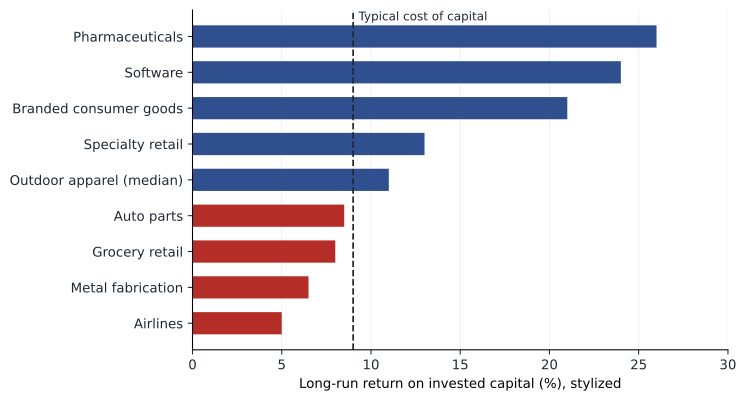
Daniel Osei arrives at the second session with a question that has bothered him for years. Northfield Components, the metal stampings and assemblies maker where he is plant controller, is well run by any operational measure. Its scrap rates are low, its on-time delivery is better than its rivals', and its plant was one of the first in its region to automate press changeovers. Yet its operating margin has hovered around 5 per cent for a decade. Owen Tremblay, whose company processes natural gas, points out that Prairie Ridge's worst years have been better than Northfield's best. Is Northfield badly managed, Daniel asks, or is it in a bad business?
Dr. Ashford's answer is that it is probably some of both, and that separating the two is one of the most useful things a strategist can do. Some industries are structurally more profitable than others, and the differences persist for decades. Within an industry, some firms do much better than others. A firm's profitability is the sum of the two effects: the average profitability of its industry and its own advantage or disadvantage relative to that average. This lesson is about the first effect, how the structure of an industry shapes the profits available to everyone in it.
How much does industry matter?
Researchers have tried to measure the relative importance of industry and firm. Richard Rumelt, in a 1991 study of manufacturing businesses, found that differences between business units within industries explained much more of the variation in profitability than differences between industries. Anita McGahan and Michael Porter, using a broader sample of US companies in a 1997 study, found that industry membership explained roughly a fifth of the variation in profitability and business-specific effects about a third, with industry effects larger in services and retail than in manufacturing. The precise numbers depend on the sample and method, but the conclusion is robust: both matter, and neither can be ignored. A manager who blames the industry for every problem is as mistaken as one who thinks good management can overcome any structure.
The five forces
Porter's framework, introduced in a 1979 Harvard Business Review article and restated in 2008, holds that the profitability of an industry is determined by five competitive forces. The stronger the forces, the more of the value created in the industry flows to customers, suppliers, substitutes and new entrants rather than to the incumbents. The framework is not a checklist of whether an industry is attractive in some general sense; it is a way of explaining why the profits in an industry are what they are, and of predicting how they will change.
Rivalry among existing competitors is the most visible force. Rivalry is intense when competitors are numerous or roughly equal in size, when industry growth is slow, when exit barriers such as specialized assets or labour agreements keep failing firms in the market, when fixed costs are high relative to variable costs so that firms are tempted to cut prices to fill capacity, when products are perishable or hard to differentiate, and when rivals are highly committed to the business for reasons other than profit. Rivalry on price is the most damaging form, because it transfers profit directly to customers. Rivalry on features, service or brand can expand the value an industry creates.
The threat of entry limits profits because potential entrants would come in if returns were high. What matters is not actual entry but the threat, which depends on barriers to entry and on the reaction entrants expect. Barriers include supply-side economies of scale, demand-side benefits of scale such as network effects, customer switching costs, capital requirements, incumbency advantages independent of size such as proprietary technology, favourable locations and established brands, unequal access to distribution channels, and government policy such as licensing or regulation. Entrants are also deterred if incumbents have the resources and the history to retaliate.
The bargaining power of suppliers is high when suppliers are more concentrated than the industry they sell to, when they do not depend heavily on the industry for revenue, when the industry faces switching costs in changing suppliers, when suppliers offer differentiated products, when there is no substitute for what they supply, and when suppliers can credibly threaten to integrate forward. Workers are suppliers too: skilled labour that is scarce or well organized can capture much of an industry's value.
The bargaining power of buyers is high when buyers are few or purchase in large volumes relative to a seller's size, when products are standardized, when switching costs are low, and when buyers can credibly integrate backward. Buyers are price-sensitive when the product is a large share of their costs, when they earn low profits themselves, when the product's quality has little effect on the quality of their own products, and when it has little effect on their other costs.
The threat of substitutes caps the prices an industry can charge. A substitute performs the same or a similar function by a different means: videoconferencing for business travel, plastic for aluminum in containers, a used jacket for a new one. Substitutes are easily overlooked because they look so different from the industry's own product. The threat is high when the substitute offers an attractive trade-off of price and performance and when the buyer's cost of switching is low.
Factors that are not forces
Porter warned against treating every feature of an industry as a sixth force. Industry growth rate, technology and innovation, government and complementary products all matter, but they matter through the five forces. Fast growth does not guarantee profit if it attracts entrants or if suppliers are powerful; government regulation can raise entry barriers or increase buyer power; a new technology can create substitutes or lower barriers. Complements, products that increase the value of an industry's product when used together, such as software for computers, deserve special attention. Adam Brandenburger and Barry Nalebuff, in their 1996 book Co-opetition, argued that complementors belong on any map of an industry alongside customers, suppliers and competitors, and that much of strategy involves cooperating with some players to enlarge the total value while competing to capture a share of it. The cohort will return to this value net in lesson 7.
Measuring concentration
A first step in analysing rivalry is measuring concentration. The four-firm concentration ratio, CR4, is the combined market share of the four largest firms. The Herfindahl-Hirschman index, HHI, is the sum of the squared market shares of all firms, measured in percentage points, so it ranges from close to zero in a fragmented market to 10,000 for a monopoly. The HHI gives more weight to large firms and reflects the whole distribution of shares, which is why competition authorities use it. A market with an HHI below about 1,000 to 1,500 is usually considered unconcentrated and one above about 1,800 to 2,500 highly concentrated, with thresholds differing across jurisdictions and guidelines.
Concentration is a clue, not a verdict. A concentrated industry can be fiercely competitive if its few firms have high fixed costs and undifferentiated products, as airlines often are; a fragmented one can be profitable if each firm has a local niche. Market definition matters too, because shares depend on what counts as the market. The code below computes concentration for three markets the cohort works in and adds a simple scoring of the five forces.
# Concentration and a five-forces scorecard
markets = {
    "Regional grocery":    [31, 24, 18, 9, 7, 5, 6],      # shares, per cent (last = many small)
    "Auto stampings":      [14, 11, 9, 8, 7, 6] + [3] * 15,
    "Outdoor apparel":     [9, 7, 5, 4, 4, 3] + [1] * 68,
}
def hhi(shares): return sum(s * s for s in shares)
def cr4(shares): return sum(sorted(shares, reverse=True)[:4])
for name, s in markets.items():
    print(f"{name:18s} total {sum(s):3d}%  CR4 {cr4(s):3d}%  HHI {hhi(s):5d}")

# Force strength 1 (weak) to 5 (strong); weights reflect importance in this industry
forces = ["rivalry", "entry", "substitutes", "suppliers", "buyers"]
scores = {"Auto stampings": [4, 2, 3, 4, 5], "Outdoor apparel": [4, 4, 3, 3, 4]}
weights = [0.30, 0.15, 0.15, 0.15, 0.25]
for name, sc in scores.items():
    pressure = sum(w * x for w, x in zip(weights, sc))
    strongest = forces[max(range(5), key=lambda i: sc[i] * weights[i])]
print(f"{name:18s} weighted pressure {pressure:.2f} of 5; biggest drain: {strongest}")Regional grocery total 100% CR4 82% HHI 2052 Auto stampings total 100% CR4 42% HHI 682 Outdoor apparel total 100% CR4 25% HHI 264 Auto stampings weighted pressure 3.80 of 5; biggest drain: buyers Outdoor apparel weighted pressure 3.70 of 5; biggest drain: rivalry
The scores are judgments, and the value of the exercise lies in the argument behind them rather than the arithmetic. But the output captures Daniel's situation. Auto stampings is a fragmented industry selling to a concentrated set of vehicle and equipment makers. The buyers purchase huge volumes, know their suppliers' costs in detail, demand annual price reductions written into contracts, and can resource parts at the end of a program. Steel, the main input, comes from a handful of mills whose prices swing with trade policy, and suppliers like Northfield have limited ability to pass increases on quickly. High fixed costs in presses and dies encourage suppliers to bid low to keep capacity busy. On top of this, the shift to electric vehicles and large single-piece castings threatens to substitute for some stamped assemblies. Northfield's margins, Dr. Ashford concludes, are about what the structure would predict for a competent firm.
Using the analysis
Industry analysis is useful in four ways. First, it explains current profitability and identifies the forces that limit it. Second, it supports positioning: a firm can look for a position where the forces are weakest, such as customers who are less price-sensitive or segments where entry is harder. Third, it suggests ways to reshape the structure in the firm's favour, by raising switching costs, differentiating to blunt rivalry, standardizing inputs to reduce supplier power, or collaborating with rivals on industry standards. Fourth, it helps a firm anticipate change, because shifts in the forces, such as a new substitute or the consolidation of buyers, alter profitability before they show up in the accounts.
For Daniel, the analysis points to three possible moves. Northfield could shift its mix toward agricultural and construction equipment makers, which buy smaller volumes of more complex assemblies and care more about engineering support and reliability than about the last cent of price. It could raise customers' switching costs by doing more of the design work on the assemblies it supplies, so that it becomes part of the customer's engineering process. And it could reduce its exposure to steel price swings by negotiating index-based pricing that passes changes through. None of these changes the industry overnight, but each moves Northfield to a part of it where the forces are weaker.
Cedarline's industry
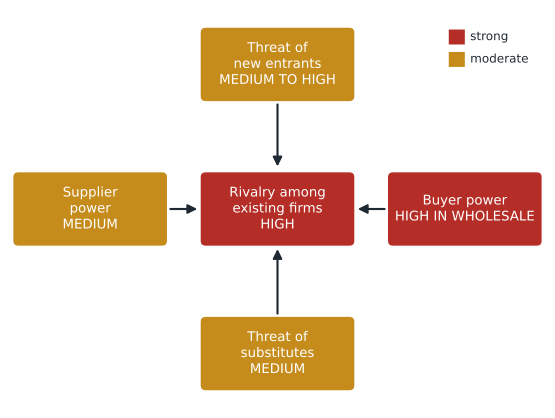
Outdoor apparel looks attractive at first sight: it has grown faster than apparel overall, strong brands earn premium prices, and many customers care about performance and durability. But the five forces explain why returns vary so much across the industry. Rivalry is intense among global brands, specialty brands and retailers' private labels, and promotional discounting is common at the end of each season, when perishable seasonal inventory must be cleared. Entry is easy at the low end and online, where a new brand can use contract manufacturers and digital advertising, though building a trusted brand at the high end takes years. Substitutes include athletic and lifestyle apparel worn for outdoor use, second-hand and rental gear, and simply keeping a jacket longer. Supplier power is moderate: contract manufacturers in Asia are numerous, but specialized fabric and membrane makers have significant power. Buyer power is high in wholesale, where large sporting goods chains demand allowances and markdown support, as the cohort saw in the price waterfall of MBA-512, and moderate in direct channels, where individual customers have no bargaining power but can compare prices instantly.
The conclusion for Cedarline is that the industry is not uniformly attractive. The profitable positions are those where a brand is strong enough to blunt rivalry and buyer power, where it controls its own customer relationships, and where it offers something substitutes do not. That conclusion will shape the capstone in lesson 12.
Worked problem
Explaining a gap in airline profitability
A student argues that because airlines create enormous value for travellers, they should be among the most profitable industries. Use the five forces to explain why airlines have historically earned low returns on capital, and what the more profitable airlines have done differently.
Show solution
- Rivalry: airlines have high fixed costs and perishable inventory, since an empty seat cannot be sold after departure, so they cut prices to fill planes; products are hard to differentiate on most routes, and exit barriers such as bankruptcy protection keep capacity in the market.
- Suppliers: aircraft manufacturers form a duopoly, engine makers are few, airports are local monopolies and pilots and other workers are often well organized, so suppliers capture much of the value.
- Buyers: travellers compare fares instantly online and switch easily; corporate buyers negotiate discounts.
- Entry and substitutes: entry by low-cost carriers is possible where airport slots are available, and road, rail and videoconferencing substitute on shorter trips.
- Exceptions: the more profitable airlines have usually found positions where the forces are weaker, such as dominant hubs with limited slots, loyalty programs that raise switching costs, or a low-cost system that rivals cannot match.
Answer: The value airlines create is real, but the industry's structure passes most of it to travellers, suppliers and workers. Creating value and capturing it are different things.
Common mistakes
MistakeAn attractive industry is one that is growing fast.
InsteadGrowth helps only if the five forces allow incumbents to capture the value; fast growth often attracts entry.
MistakeConcentration guarantees profitability.
InsteadConcentrated industries can be fiercely competitive, as airlines show; the forces, not the count of firms, decide.
MistakeSubstitutes are products in the same industry.
InsteadSubstitutes perform the same function by a different means and are easy to overlook.
MistakeIndustry analysis is done once.
InsteadThe forces change with technology, regulation and consolidation; the analysis should be revisited.
Summary and key terms
- Both industry structure and firm-specific advantage explain profitability; neither can be ignored.
- The five forces are rivalry, the threat of entry, supplier power, buyer power and the threat of substitutes.
- The stronger the forces, the more value flows to customers, suppliers, workers and entrants rather than to incumbents.
- Growth, technology, government and complements matter through the forces rather than as forces of their own.
- Concentration measures such as CR4 and HHI are clues about rivalry, not verdicts, and depend on market definition.
- The analysis supports positioning, reshaping the industry and anticipating change.
- Five forces
- Porter's framework of rivalry, entry, supplier power, buyer power and substitutes that shapes industry profitability.
- Barrier to entry
- A feature of an industry, such as scale economies or switching costs, that makes entry costly for newcomers.
- Switching cost
- The cost a buyer incurs in changing from one supplier to another.
- Substitute
- A product that performs the same or a similar function by a different means.
- Herfindahl-Hirschman index
- The sum of squared market shares, a measure of concentration from near 0 to 10,000.
- Complementor
- A firm whose product makes another's product more valuable to customers.
Practice problems
Work each problem on paper first, then reveal the answer to check.
A market has five firms with shares 40, 25, 15, 10 and 10 per cent. What are its CR4 and HHI?
Show answer
CR4 = 90 per cent; HHI = 1,600 + 625 + 225 + 100 + 100 = 2,650.
Why are buyers more price-sensitive when a product is a large share of their costs?
Show answer
Small savings on a large cost item have a big effect on their own profits, so they shop harder and negotiate more.
Name two ways a firm can raise customers' switching costs.
Show answer
Integrating its product into the customer's processes or systems, offering loyalty benefits, or providing training and data that would be lost on switching.
Why is fast industry growth not a sixth force?
Show answer
Its effect on profit depends on the forces: it may soften rivalry but also attract entry or strengthen suppliers.
Lesson quiz · 5 questions
Score 60% or more to complete this lesson.
Create a free account to save your progress, take quizzes and earn a certificate.