
MBA-514 · Lesson 12 of 12 · 21 min
Capstone: a strategy for Cedarline
The final two sessions of the course are given to a single task. Cedarline Outdoor's board, which the cohort has advised throughout the program, has asked for a strategy for fiscal 2027 to 2029. The chief executive has a plan of her own: open 18 new stores and a second distribution centre over three years for about 95 million dollars, grow wholesale with the national sporting goods chains, and consider the hiking-boot brand that has offered itself for sale. The private equity investor that owns part of the company wants returns restored before any exit. The founding family wants the company to remain independent and true to its reputation. The cohort works in teams, and Dr. Ashford asks for a recommendation that a board could act on: a diagnosis, a guiding policy, coherent actions, the numbers that support them and the measures that will show whether they are working.
Diagnosis
The teams start with the facts the cohort has established across the program. In fiscal 2026 Cedarline had revenue of 468 million dollars, 45 per cent through its own stores, 25 per cent online and 30 per cent wholesale. Revenue had grown by half in four years, but gross margin had fallen from 54.0 to 49.8 per cent, inventory had more than doubled to 128 million, the cash conversion cycle had stretched to 177 days, and return on invested capital had fallen from 12.1 to 8.0 per cent, below the cost of capital of about 9 per cent. Lesson 1 showed that at these returns, growth destroys value.
The teams' diagnosis, in Rumelt's terms, names the critical challenge plainly. Cedarline has a valuable brand built on durability, but it has been growing by accumulation, adding styles, channels, promotions and wholesale accounts, rather than by choice. Each addition looked reasonable on its own; together they have blurred the position that justifies its prices, raised inventory and complexity, and handed bargaining power to wholesale chains and to customers trained to wait for sales. The challenge is not a lack of growth but a lack of focus, and the obstacle is internal as well as external: the organization's structure and rewards are built for volume.
Industry, environment and resources
The analysis of lesson 2 found outdoor apparel to be an industry where returns differ widely by position. Rivalry is intense and promotional in the middle of the market, buyer power is high in wholesale and entry is easy at the low end, but brands with a credible reputation for performance and durability, strong direct relationships with customers and disciplined pricing earn good returns. The scenario analysis of lesson 3 identified tariffs on imported apparel and consumer demand as critical uncertainties, and warmer winters and growing interest in durability and repair as predetermined trends.
The VRIO analysis of lesson 4 identified two resources capable of sustained advantage: the brand's reputation for durability, accumulated over three decades, and the repair workshop's skills, records and customer relationships. Both are valuable, rare and costly to imitate. Neither is yet exploited by an organization that treats repair as a customer service cost. The value sticks of lesson 5 showed that Cedarline's products create more value than mass-market rivals', but its pricing and channel choices have been giving much of that value away.
Options
The teams develop three strategic options. Option A, Grow everywhere, is the chief executive's plan: 18 stores and a second distribution centre committed now, wholesale growth with the national chains and the current breadth of styles and promotions. Option B, Durable focus, builds on the marketing plan from MBA-512 and the staged financing from MBA-511: reduce styles from 3,400 to about 2,400, halve promotions and commit to everyday fair prices on core products, turn repair into a lifetime service and add resale, keep wholesale only with partners that present the brand well, release about 50 million dollars of working capital, and open stores in tranches of six, each conditional on the previous tranche meeting its targets. Option C, Focus plus footwear, is Option B with the acquisition of the hiking-boot brand for 75 million dollars.
Each team projects the three options to fiscal 2029 and tests them against the four scenarios from lesson 3, combining high or low tariffs with strong or weak consumer demand. The code below sets out the base projections and the scenario test.
# Cedarline options to fiscal 2029 (millions of dollars); tax 26.5 per cent, WACC 9 per cent
tax, wacc = 0.265, 0.09
base = {  # revenue, EBIT margin, invested capital in fiscal 2029
    "A Grow everywhere":   (620, 0.078, 514),
    "B Durable focus":     (530, 0.115, 372),
    "C Focus + footwear":  (595, 0.110, 447),
}
start_ic, start_nopat = 366, 39.8 * (1 - tax)
print(f"{'Option':20s} {'NOPAT':>6s} {'ROIC':>6s} {'EP 2029':>8s} {'EP 3 yr':>8s}")
for name, (rev, m, ic) in base.items():
    nopat = rev * m * (1 - tax)
    roic = nopat / ic
    path = [(start_nopat + (nopat - start_nopat) * t / 3, start_ic + (ic - start_ic) * t / 3) for t in (1, 2, 3)]
    ep3 = sum(n - wacc * k for n, k in path)
    print(f"{name:20s} {nopat:6.1f} {roic:6.1%} {nopat - wacc * ic:+8.1f} {ep3:+8.1f}")

# Scenario test: (revenue factor, change in EBIT margin) by scenario and option
scen = {"low tariffs, strong demand": {"A": (1.05, 0.010), "B": (1.04, 0.008), "C": (1.05, 0.008)},
        "low tariffs, weak demand":   {"A": (0.90, -0.022), "B": (0.94, -0.010), "C": (0.92, -0.014)},
        "high tariffs, strong demand": {"A": (1.00, -0.020), "B": (1.01, -0.010), "C": (1.00, -0.013)},
        "high tariffs, weak demand":  {"A": (0.86, -0.040), "B": (0.92, -0.020), "C": (0.89, -0.027)}}
eps = {k: [] for k in "ABC"}
for s, adj in scen.items():
    for (name, (rev, m, ic)), key in zip(base.items(), "ABC"):
        f, dm = adj[key]
        eps[key].append(rev * f * (m + dm) * (1 - tax) - wacc * ic)
best = [max(eps[k][i] for k in "ABC") for i in range(4)]
for k in "ABC":
    print(f"Option {k}: EP 2029 by scenario " + ", ".join(f"{x:+5.1f}" for x in eps[k])
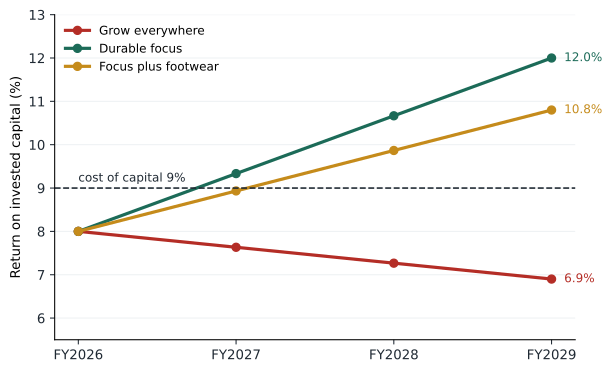
+ f"; worst {min(eps[k]):+5.1f}; max regret {max(b - x for b, x in zip(best, eps[k])):4.1f}")Option NOPAT ROIC EP 2029 EP 3 yr A Grow everywhere 35.5 6.9% -10.7 -25.1 B Durable focus 44.8 12.0% +11.3 +18.9 C Focus + footwear 48.1 10.8% +7.9 +12.1 Option A: EP 2029 by scenario -4.2, -23.3, -19.8, -31.4; worst -31.4; max regret 31.9 Option B: EP 2029 by scenario +16.4, +5.0, +7.8, +0.6; worst +0.6; max regret 0.0 Option C: EP 2029 by scenario +14.0, -1.6, +2.2, -7.9; worst -7.9; max regret 8.5
The results are clear. Option A grows revenue the most but earns a return of about 6.9 per cent on its larger capital base by fiscal 2029, below the cost of capital, so its economic profit is negative and worsens. Option B earns about 12 per cent on a capital base barely larger than today's, turning economic profit positive at about 11 million dollars a year by 2029. Option C adds revenue but its extra capital earns less than the cost of capital, so it has lower economic profit than B in every year. The scenario test strengthens the conclusion: Option B has the highest economic profit in every scenario, the best worst case and no regret, while Option A loses heavily if tariffs rise and demand weakens.
The recommendation
The teams converge on Option B and write its strategy statement in Collis and Rukstad's form: By fiscal 2029, earn a return on capital above 12 per cent as the outdoor brand people trust to last, serving customers who value performance and durability through our own stores, online and selected partners, with gear repaired for life. The statement has 41 words, slightly over Dr. Ashford's limit, and he lets it pass.
The guiding policy is to compete on durability and trust rather than on breadth and price, and to grow only where returns exceed the cost of capital. The coherent actions follow from it and reinforce one another, forming the activity system the cohort sketched in lesson 1.
Position and offer: cut the range by about 30 per cent, concentrating design on long-lasting core products updated rather than replaced each season; launch the lifetime repair service on all core products and a resale program run through stores and online; and replace frequent promotions with an everyday fair price policy on core products, announced publicly, which also changes the holiday game of lesson 7 by making deep discounting costly for Cedarline's credibility.
Channels and scope: keep wholesale only with partners that present the brand well and accept fewer allowances, allowing wholesale to fall from 30 to about 20 per cent of revenue; open new stores in three tranches of six, each conditional on the previous tranche reaching its sales and contribution targets and on leverage staying below 3; defer the second distribution centre and use a third-party warehouse until store growth justifies it; and stay out of manufacturing, where competition among contract makers works in Cedarline's favour.
Footwear and alliances: decline to buy the hiking-boot brand at 75 million dollars and instead offer it a distribution agreement for Cedarline's stores and website, with an option to acquire a stake later if the boots sell well, testing the revenue synergies without paying for them in advance, as lesson 10 recommended.
Innovation: treat repair and resale as the core of a learning system. Repair records show how products fail, which feeds design; resale extends the life of products and brings in younger customers at lower prices; and both strengthen the durability reputation. The teams recommend building the resale program in-house at first, at small scale, rather than joining a third-party marketplace, so that Cedarline keeps the customer relationship and the data.
Execution
The teams devote as much attention to execution as to the choices, because lesson 11 showed that strategies most often fail there. They propose four organizational changes. First, a single chief merchandising officer responsible for range, inventory and pricing across all channels, ending the separate channel inventories that drove the build-up of stock. Second, the repair workshop becomes a business unit, Cedarline Care, reporting to the chief executive with its own budget and growth targets. Third, incentives change: merchandisers are rewarded on gross margin return on inventory rather than revenue, the wholesale team on contribution after allowances rather than volume, and store managers on contribution and customer experience. Fourth, a strategy office of three people tracks the scorecard and the conditions for each store tranche, reporting to the board quarterly.
The scorecard has twelve measures. In the financial perspective, return on invested capital, gross margin and inventory turnover. In the customer perspective, the share of sales at full price, repeat purchase rate and net promoter score among core customers. In internal processes, the number of active styles, repair turnaround time and new store contribution against plan. In learning and growth, design changes informed by repair data, staff trained in repair and product knowledge, and employee engagement in stores. Each measure has a target for fiscal 2029, an owner and a quarterly milestone.
Risks and signposts
The teams are candid about the risks. Revenue will grow more slowly than under the chief executive's plan, and there may be a year in which revenue falls as styles and wholesale accounts are cut; the board must be prepared for it. Competitors may copy the repair service, though the cohort's VRIO analysis suggests that matching Cedarline's reputation and workshop skills would take years. Customers trained to wait for sales may resist the fair price policy at first. Tariffs could rise further, though Option B's lower inventory and capital make it the most resilient option. The signposts they propose for the board include the full-price sales share, the return rate on repaired products, the performance of the first store tranche and the gross margin in wholesale after allowances, with agreed thresholds that would trigger a change of course.
Dr. Ashford closes the course with the cohort's index cards from the first session, which he has kept. Next to Grace's original card about being the region's favourite grocer, he places the 33-word statement she wrote in lesson 1. Next to the vague cards from the first night, he places the teams' statement for Cedarline. The difference, he says, is the difference between an aspiration and a strategy: the second set of cards makes choices, accepts trade-offs, and tells everyone in the organization what to do differently on Monday.
Worked problem
Presenting to the board
The chief executive objects to the recommendation: Option B gives up the revenue growth that the private equity investor expects, and staging the stores will let competitors take the best locations. Prepare the cohort's response in four points.
Show solution
- Value, not size: the investor's returns depend on value, and Option A's growth earns about 6.9 per cent on capital against a 9 per cent cost, destroying value; Option B raises economic profit from about minus 4 million to about plus 11 million a year by fiscal 2029, which is what a buyer will pay for.
- Resilience: Option B has the best result in every scenario the board has seen, including the one with higher tariffs and weaker demand, where Option A suffers most.
- Staging: the first tranche of six stores goes ahead immediately in the best available locations; later tranches follow quickly if it succeeds, and the option value of staging, about 10.6 million dollars in MBA-511's analysis, exceeds the likely cost of losing a few sites.
- Growth is not abandoned: once returns exceed the cost of capital, faster growth adds value, as lesson 1 showed; Option B creates the conditions under which Cedarline can grow profitably.
Answer: The response turns the debate from growth versus no growth into a question of which growth creates value, and gives the board clear conditions under which it can accelerate.
Common mistakes
MistakeA capstone strategy should include every good idea.
InsteadStrategy is choice; the recommendation must rule things out and accept trade-offs.
MistakeRevenue growth is what owners want.
InsteadOwners want value, which requires returns above the cost of capital.
MistakeExecution can be planned after the strategy is approved.
InsteadStructure, incentives and measures are part of the strategy and should be designed with it.
MistakeA recommendation should hide its risks.
InsteadBoards trust recommendations that name risks, signposts and the conditions for changing course.
Summary and key terms
- Cedarline's diagnosis is growth by accumulation: added styles, channels, promotions and wholesale have blurred a valuable position and driven returns below the cost of capital.
- Its sustainable resources are its durability reputation and its repair capability, which its current organization does not exploit.
- The durable focus option earns about 12 per cent on capital by fiscal 2029 and performs best in every scenario.
- The coherent actions narrow the range, add lifetime repair and resale, end frequent promotions, focus wholesale, stage stores and replace an acquisition with an alliance.
- Execution requires one owner for range, inventory and pricing, a repair business unit, new incentives and a twelve-measure scorecard.
- A board-ready strategy states its trade-offs, risks, signposts and the conditions under which it will change.
- Guiding policy
- The overall approach chosen to overcome the challenge identified in the diagnosis.
- Coherent actions
- Coordinated steps that carry out the guiding policy and reinforce one another.
- Economic profit
- Net operating profit after tax minus a charge for the capital employed.
- Staged commitment
- An investment made in tranches, each conditional on the results of the previous one.
- Signpost
- An observable indicator that shows whether the strategy's assumptions are holding.
- Gross margin return on inventory
- Gross margin divided by average inventory at cost, a measure of merchandising productivity.
Practice problems
Work each problem on paper first, then reveal the answer to check.
Why does Option C earn less economic profit than Option B even though it has more revenue?
Show answer
The extra 75 million of capital earns less than the 9 per cent cost of capital, so it reduces economic profit.
What makes the everyday fair price policy a commitment in the sense of lesson 7?
Show answer
It is public, so abandoning it would damage Cedarline's credibility with customers, which makes deep discounting costly.
Name two signposts that would tell the board the strategy is working.
Show answer
A rising share of sales at full price and the first store tranche meeting its contribution targets.
Why change merchandisers' incentives from revenue to gross margin return on inventory?
Show answer
Revenue rewards range breadth and promotions; GMROI rewards selling more at full price with less inventory, consistent with the strategy.
Lesson quiz · 5 questions
Score 60% or more to complete this lesson.
Create a free account to save your progress, take quizzes and earn a certificate.