
LVT-330 · Lesson 2 of 12 · 19 min
CEC Section 16 and Section 60
Most of what Cobalt Line installs falls under two sections of the Canadian Electrical Code. Section 60 covers electrical communication systems: telephone, data, intercom and similar circuits that carry signals rather than power. Section 16 covers Class 1 and Class 2 circuits: the limited-energy circuits that power and control security devices, door hardware, sensors, thermostats, low-voltage lighting and many audio outputs. Optical fibre has its own Section 56, covered in lesson 7. Greta asks Maya to learn the boundaries of each section first, because the first question on any device is which section it falls under, and every later rule depends on the answer.
What a communication circuit is
The CEC defines communication circuits as circuits that carry signals for telephone, telegraph, data, alarm and similar purposes, as distinct from circuits that supply power to equipment. Section 60 covers the conductors and equipment of those systems from the point where they enter a building, including the protectors at the entrance, to the equipment that uses them, and the cables that connect them. A structured cabling system carrying Ethernet is a communication system under Section 60. So is a telephone system, an intercom system that uses communication cable and the paging part of a system when the equipment is designed as communication equipment.
Section 60 sets rules for the parts of a communication system that matter to safety: protection of conductors that enter from outside and may be exposed to lightning or power contact, grounding and bonding of protectors and cable shields, separation of communication conductors from electrical conductors, and the type of conductors and cables used inside buildings, with Rule 2-130 and the building code setting the flame-spread ratings. It does not set rules for the performance of the network.
Class 1 and Class 2 circuits
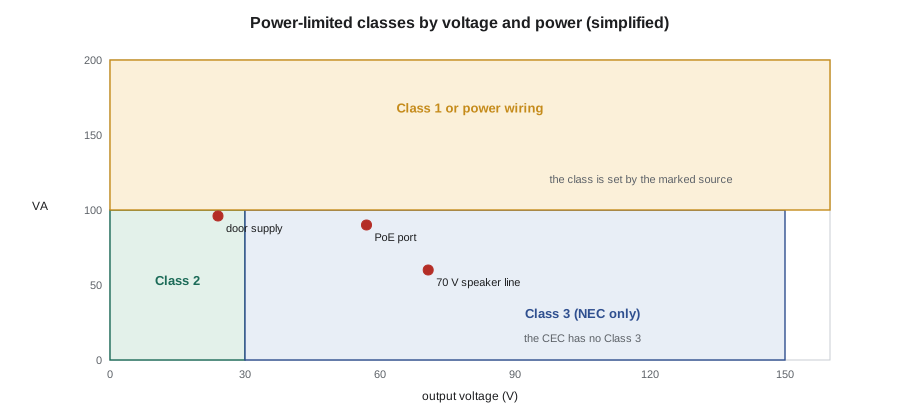
A Class 2 circuit is one supplied by a source whose output is limited, by its design or by a protective device, so that the circuit is safe from fire and shock under normal conditions and when faulted. The CEC limits Class 2 sources by open-circuit voltage, at no more than about 42 V peak, and by the current and power they can deliver, with tables relating them. A Class 2 power supply is marked as such, and so are transformers and many devices with Class 2 outputs. Because the source is limited, Section 16 allows lighter wiring methods for the circuit than for power wiring: Class 2 cable without a raceway, smaller conductors and simpler support.
Class 1 circuits are the other part of Section 16: remote-control and signal circuits supplied by sources up to 600 V that are not limited like Class 2, or limited-power Class 1 circuits up to 30 V and 1,000 VA. Class 1 conductors are wired like power conductors and must be kept apart from Class 2 and communication conductors. Canada has no Class 3 category; a circuit that is not Class 2 is Class 1 or power.
When a circuit stays Class 2
A Class 2 circuit keeps that status only while it is connected to a listed or certified Class 2 source and wired as Class 2. Three common mistakes destroy it:
- Paralleling the outputs of two Class 2 supplies to get more current. The combined source is no longer limited and the circuit is not Class 2 unless the manufacturer's listing allows it.
- Replacing a failed Class 2 supply with an ordinary power supply that has the same voltage. The new supply may deliver far more current into a fault.
- Running Class 2 conductors in the same raceway, box or cable as power or Class 1 conductors without the barrier or separation the code requires. The separation rules are in lesson 5.
Power over Ethernet sits at an interesting boundary. PoE equipment is designed and certified to keep each port's output within power limits, and the CEC treats the cabling as communication cable carrying limited power. The heat that bundles of cables carrying power produce matters more as PoE ports deliver up to about 90 W, and both the code's rules for cables carrying power and the cabling standards now address it. For Cobalt Line, the practical rule is to use cables whose ratings and conductor size suit the PoE class on the design, and to follow the bundle-size guidance in the specification and in TIA's PoE bulletin.
# Is this circuit power-limited? Simplified screen against CEC class limits (illustrative values)
devices = [  # (name, open-circuit volts, rated VA, source marked as power-limited)
    ("Door controller supply", 27.6, 96, True),
    ("Paralleled pair of 24 V supplies", 27.6, 192, False),
    ("Paging amplifier 70 V output", 70.7, 60, True),
    ("Replacement supply, unmarked", 24.0, 240, False),
    ("PoE port, Type 4", 57.0, 90, True),
]
def classify(v, va, marked):
    if not marked:
        return "not power-limited: treat as Class 1 or power"
    if v <= 42.4 and va <= 100:
        return "Class 2"
    if v <= 150 and va <= 100 and False:
        return "Class 3"
    return "check the listing (no Class 3 in the CEC)"
for name, v, va, marked in devices:
print(f"{name:34s} {v:5.1f} V {va:4d} VA -> {classify(v, va, marked)}")Door controller supply 27.6 V 96 VA -> Class 2 Paralleled pair of 24 V supplies 27.6 V 192 VA -> not power-limited: treat as Class 1 or power Paging amplifier 70 V output 70.7 V 60 VA -> check the listing (no Class 3 in the CEC) Replacement supply, unmarked 24.0 V 240 VA -> not power-limited: treat as Class 1 or power PoE port, Type 4 57.0 V 90 VA -> check the listing (no Class 3 in the CEC)
The screen is only a first look. The CEC's Class 2 limits use peak voltage and differ for AC and DC and for wet locations, and what governs in the end is the marking and certification of the source. The 70 V speaker line shows why: it is above most Class 2 voltages, and the code treats it according to how the amplifier output is certified, which the data sheet states.
The structure of Section 60 and Chapter 8
Section 60 is organized roughly in the order a cable meets the rules. It starts with scope and general requirements. Then come the rules for conductors outside buildings, on poles, on buildings and underground. Next are the rules for protection at the entrance, followed by the rules for conductors inside buildings: types of cable and where they may run, separation from other systems, and installation in raceways and through fire separations. It ends with grounding and bonding: what must be grounded, the size and route of grounding conductors and where they connect to the building's electrical system.
| Part of Section 60 | What it covers |
|---|---|
| General | Scope, definitions, approved equipment |
| Outside conductors | Overhead, on buildings, underground, clearances from power |
| Protection | Protectors where conductors may be exposed |
| Inside conductors | Cable types, separation, raceways, fire separations |
| Grounding and bonding | Protector and shield grounding, bonding conductor size and route |
Equipment approval
The CEC requires that electrical equipment be approved, which in practice means certified by an accredited certification body such as CSA Group or UL Solutions and marked with its mark for Canada. That applies to communication equipment connected to the network, to Class 2 power supplies, to protectors and to cables, whose certification includes the flame test marking discussed in lesson 3. Equipment imported without a Canadian certification mark can be refused even if it carries a US listing; the inspector looks for the c or CAN mark.
A device-by-device check
On the St. Brendan's east wing, Maya builds a table listing every system the crew installs, the part of the code it falls under, its source and the cable type the design calls for. Sanjay reviews it before ordering. The table catches two issues before any cable is bought: the nurse call vendor's corridor lights are fed from a supply that is not marked Class 2, so their wiring must follow the rules for power wiring unless the vendor supplies a certified Class 2 source; and the access control panels are specified with a battery charger whose output is Class 2 only when the panel is wired as its installation manual shows. Both go back to the design team as questions.
Worked problem
Choosing the right part of the code for a wall of devices
At Juniper Point's lobby, one wall holds a door intercom, a card reader, an electric strike, a camera and a fire alarm pull station. Maya lists the rule set for each.
Show solution
- Door intercom on communication cable to the concierge desk: Section 60.
- Card reader and electric strike, fed from the access control panel's Class 2 outputs: Section 16.
- PoE camera on a data outlet: Section 60 for the cabling, with the PoE source certified as limited.
- Fire alarm pull station: Section 32 and the fire alarm installation standard; installed by the fire alarm contractor, with its own cable type.
Answer: Five devices on one wall fall under four different rule sets. Each one sets its own cable type, separation and support, so the crew labels the boxes and keeps the cables apart in the wall.
Low-voltage lighting, controls and other Class 2 systems
Class 2 circuits are no longer only door hardware and thermostats. LED lighting fed by Class 2 drivers, lighting control networks, motorized shades, building automation sensors, audio-visual control buses and the low-voltage side of many appliances all run on Class 2 power. On St. Brendan's east wing, Maya counts eleven different Class 2 systems from six trades in the corridor ceilings alone. Each trade may assume another is responsible for keeping its cables apart from power and correctly rated, so the closeout crew checks them all. The rules are the same as for Cobalt Line's own Class 2 cabling: a marked source, the right cable type for the space, separation from power and Class 1 wiring, and support from the structure.
Class 2 wiring also meets communication wiring in the same boxes and devices more and more. A card reader may have both a Class 2 power pair and a data connection; an IP intercom may take PoE and also switch a Class 2 door strike. The CEC allows Class 2 and communication conductors to share a cable or enclosure in some cases, where the equipment and cable are certified for it, but not where it would let a fault on one system raise the voltage on the other. Sanjay's rule for Cobalt Line designs is simple: use a cable certified for both uses, or run separate cables, and never use spare pairs of a data cable for a Class 2 power circuit unless the cable and equipment instructions allow it.
Labels help inspectors as much as installers. Cobalt Line marks Class 2 power supplies with the systems they feed, marks junction boxes that contain Class 2 wiring and keeps the power supply data sheets in the closeout package. When an inspector asks whether a circuit is Class 2, the answer should take seconds, not a search through the ceiling.
Questions to ask about any device
When a new device appears on a drawing, Maya asks the same four questions before the crew pulls a cable to it. What is the source of power for the device, and is that source marked as Class 2 or as power-limited? What kind of circuit carries its signals: communication, Class 2 control, fire alarm or power? What cable type does the manufacturer's installation manual call for, and does it have the rating the spaces on the route require? And where will the device's wiring meet other systems, in a box, a panel or a shared pathway, so that separation must be planned? The answers usually take a few minutes with the data sheet and the installation manual. Skipping them is how a crew ends up with a corridor of card readers wired with the wrong cable, found at the rough-in inspection after the ceiling grid is already up.
The same questions catch changes during construction. When a vendor substitutes a different power supply or a different model of reader, the answers can change, and the crew lead checks the new data sheet before accepting the substitution.
Common mistakes
MistakeAssuming every low-voltage circuit is Class 2.
InsteadClass 2 depends on a certified or listed limited source; check the marking.
MistakeParalleling two Class 2 supplies for more current.
InsteadThe combined source is no longer limited unless the listing allows it.
MistakeReplacing a Class 2 supply with any supply of the same voltage.
InsteadUse a certified Class 2 replacement or the circuit loses its status.
MistakeIgnoring the power carried by PoE.
InsteadCheck the bundle and conductor rules for cables carrying power.
MistakeUsing equipment with only a US listing in Ontario.
InsteadLook for a Canadian certification mark accepted by the inspector.
Summary and key terms
- Section 60 covers communication systems; Section 16 covers Class 1 and Class 2 circuits; Section 56 covers optical fibre.
- A power-limited circuit is defined by its source, which must be marked; wiring it wrongly or changing the source can remove its status.
- The CEC has no Class 3; circuits are Class 2, Class 1 or power.
- PoE adds power to data cable, and the codes and TIA guidance address bundle heating.
- The communication rules follow the cable's path: outside, protection, inside, separation, fire, and grounding and bonding.
- Equipment must be approved with a certification mark accepted in Canada.
- Communication circuit
- A circuit carrying signals such as voice and data rather than supplying power.
- Class 2 circuit
- A circuit supplied by a certified limited source, safe from fire and shock.
- Class 1 circuit
- A remote-control or signal circuit wired like power wiring.
- Certification mark
- The mark showing that equipment was tested by an accredited body for use in Canada.
- Approved
- Accepted under the code, normally by certification.
Practice problems
Work each problem on paper first, then reveal the answer to check.
Which CEC section covers a data cabling system?
Show answer
Section 60.
Two 24 V Class 2 supplies are wired in parallel. Is the output Class 2?
Show answer
Not unless the manufacturer's certification allows it.
Does the CEC recognize Class 3 circuits?
Show answer
No.
Why does PoE raise questions about cable bundles?
Show answer
The cables carry power, so large bundles heat up.
Lesson quiz · 5 questions
Score 60% or more to complete this lesson.
Create a free account to save your progress, take quizzes and earn a certificate.