
LVT-330 · Lesson 6 of 12 · 19 min
Entrances, protectors and outside plant
Every building's communication system has a weak point where cables come in from outside. Inside, the cables are protected by the building; outside, on poles, along walls and underground, they can be struck by lightning, touched by a fallen power line or raised in voltage by a fault on a nearby power system. The codes deal with that risk at the entrance: protectors that divert surges and power crosses to ground, a bonding conductor that ties the protector to the building's grounding system, and rules for how far outdoor cable may run inside. This lesson follows Maya through the entrance room at Riverside school, where the expansion adds a fibre link and copper pairs to a new portable classroom building, and through the outdoor plant that connects them.
Why entrances are dangerous
Lightning does not have to strike a cable to put a surge on it. A strike nearby induces voltage in long outdoor conductors, and a strike to a pole or the ground lifts the earth potential around it. A telephone or data pair running a few hundred metres between buildings can carry thousands of volts for a few microseconds. A power line falling across a communication cable on a pole, or a fault in a buried power cable sharing a trench, can put power voltage on it for much longer. Without protection, that energy enters the building on conductors designed for a few volts, damages equipment, starts fires and can kill someone using a handset or working on the cabling.
Two measures handle it. A primary protector, installed where the conductors enter, clamps the voltage on each conductor and diverts the current to ground before it reaches the inside wiring. Bonding then ties the protector's ground, the cable shields and the building's electrical grounding together, so the whole building rises and falls together during a surge instead of having one part at a high voltage relative to another.
When protectors are required
Section 60 requires protectors on communication conductors that enter a building from outside and are exposed to lightning or to accidental contact with power conductors operating above the voltage the code sets. In practice, nearly every outdoor copper communication circuit is considered exposed, and the telephone company installs protectors on its own lines. Where Cobalt Line runs copper between buildings on a campus, it is the installer of those conductors and must provide the protection at both ends. A circuit run entirely underground in a metal-sheathed cable within a small campus may not be exposed in the code's sense, but that is a decision for the designer and the inspector, not a field assumption.
Protectors come in two main types. Gas tube and solid-state protectors for each pair are mounted in a building entrance terminal, a block with a ground lug that the bonding conductor connects to. Fused protectors also open the circuit if a sustained power cross flows. Data and coaxial circuits use protectors designed for their signals, so the protection does not degrade a 1 gigabit link or a video feed. Primary protection at the entrance is often followed by secondary protection at sensitive equipment, but the secondary device does not replace the primary.
Where the protector goes
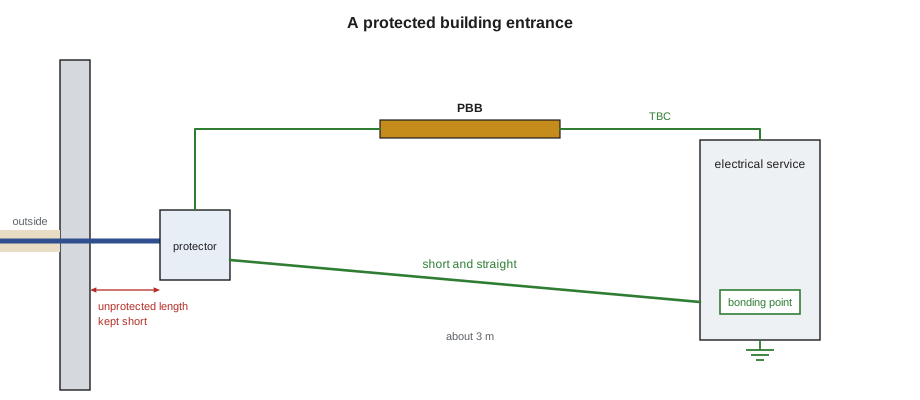
The protector must be as close as practicable to the point where the conductors enter the building, and inside the building or on its outside wall, so that the unprotected length inside is as short as possible. It must not be located in hazardous locations or near easily ignitable material, and the location must allow the bonding conductor to run short and straight to the building's grounding.
The bonding conductor
The conductor from the protector's ground terminal to the building's grounding system must be copper or another corrosion-resistant conductor, insulated, of at least the size the code sets, and run in as straight a line as practicable. It connects to the building's grounding electrode system at an accessible point: the bonding point the electrician provides at the service, the grounding electrode conductor, the metal service raceway or the service enclosure. Sharp bends and long routes raise the conductor's impedance to a fast surge, so a protector ten metres from the electrical service with a conductor looping around a room offers much less protection than one mounted beside it.
The cabling standards add to the code. TIA-607 requires the telecommunications bonding system, described in lesson 11, to start at a primary bonding busbar in the entrance room, bonded to the electrical service, and the protectors bond to that busbar. Where the protector and the busbar are close together, one short conductor serves both.
# Entrance bonding conductor check: size, length and bends against the job rules
MIN_AWG = 14             # smallest size allowed (a larger number is a smaller wire)
MAX_LEN = 6.0             # m, length limit where it applies (dwelling) or job target
runs = [  # (entrance, size AWG, length in m, number of 90-degree bends, dwelling?)
    ("Riverside main entrance", 6, 2.5, 1, False),
    ("Riverside portable building", 14, 4.0, 3, False),
    ("Caretaker's house", 14, 8.5, 2, True),
]
for name, awg, length, bends, dwelling in runs:
    notes = []
    if awg > MIN_AWG:
        notes.append("too small")
    if dwelling and length > MAX_LEN:
        notes.append("too long for a dwelling: add a separate electrode, bonded to the service")
    if bends > 2:
        notes.append("reroute to reduce bends")
print(f"{name:28s} {awg:3d} AWG {length:5} m {bends} bends {'OK' if not notes else '; '.join(notes)}")Riverside main entrance 6 AWG 2.5 m 1 bends OK Riverside portable building 14 AWG 4.0 m 3 bends reroute to reduce bends Caretaker's house 14 AWG 8.5 m 2 bends too long for a dwelling: add a separate electrode, bonded to the service
The dwelling limit in the check is the job rule Cobalt Line uses on houses, taken from common practice; the CEC's requirement is that the conductor be as short and straight as practicable, and the inspector judges what is practicable. The point of the check is the same in every building: long, looping bonding conductors defeat the protector.
Shields, sheaths and metallic members
Outdoor cables often have metal in them besides their conductors: an aluminium or copper shield, a steel armour, or the strength members and armour of some fibre cables. That metal can carry surge current just as conductors can. The codes require the metallic sheath or shield of a cable entering a building to be bonded to ground as close as practicable to the entrance, or interrupted by an insulating joint at the entrance. Fibre cables with metallic members are treated the same way, which is one reason designers prefer all-dielectric fibre cable between buildings: with no metal, there is nothing to bond and no path for a surge.
Outdoor cable inside the building
Outdoor cable is built for sunlight, water and burial, not for fire performance, and most of it has no FT rating. The codes allow it to run only a short distance into a building, to the point where it is terminated or spliced to rated indoor cable, or inside a raceway or other enclosure that the code accepts. Riverside's specification calls for every outdoor cable to end in the entrance room within a few metres of the wall sleeve, at a splice enclosure for fibre and at the protector block for copper. Indoor-outdoor cables that carry both an outdoor rating and an FT4 or FT6 rating can run further, because they meet the indoor requirement too.
Outside plant between buildings
On a campus, the owner usually owns the pathways and cables between buildings, called customer-owned outside plant. TIA-758 is the standard for its design. The main elements are underground conduits, called duct banks when several are encased together, handholes and maintenance holes where cables can be pulled and spliced, direct-buried cable in some cases, and aerial cable on poles where underground is not practical.
- Conduits are buried below the frost line where the climate requires it, with enough cover to protect them from traffic and digging, and sloped to drain toward handholes so water does not sit at the building wall.
- Every conduit entering a building is sealed at the wall with a duct seal or a mechanical plug designed for it, to keep water, gas and rodents out. A gas leak in a street can travel along an unsealed conduit into a building.
- Power and communication cables in a shared trench are separated by the distances the utilities and the codes require, often with a barrier of concrete or a specified depth of earth between them.
- A warning tape is laid above buried conduits, and the route is recorded with GPS coordinates for future locates.
Before any digging, the crew must have the utilities located through Ontario One Call, and private locators must mark the owner's own lines, which the public utilities do not locate. Riverside's own buried lines include an old copper cable to the portable classrooms, the sprinkler main and a parking lot lighting circuit, none of which the public locate would show.
Copper or fibre between buildings
Copper between buildings brings every problem this lesson describes: lightning, power crosses, ground potential differences between the buildings and protectors at both ends. All-dielectric fibre brings none of them. That is why most campus designs now use fibre for data between buildings and keep copper only for circuits that must be copper, such as some fire alarm, intercom or elevator phone lines, or analog lines required by the telephone company. Riverside's expansion runs a 12-strand singlemode fibre to the portable building for data and a 6-pair copper cable for the intercom and the elevator emergency phone, with protectors at both ends of the copper.
Worked problem
A protector at the wrong end of the room
At Riverside's portable building, the electrician has mounted the electrical panel on the east wall. Cobalt Line's drawing shows the copper entering through the west wall, with the protector beside the entrance sleeve, ten metres from the panel. Maya is asked whether that is acceptable.
Show solution
- The protector must be close to the entrance, so the west wall location is right for the protector.
- The bonding conductor must run as short and straight as practicable to the building's bonding point, which is at the panel on the east wall: about 10 m.
- A better arrangement moves the cable entrance to the east wall, beside the panel, so both the unprotected length and the bonding conductor are short.
- The conduit has not been installed yet, so moving the entrance costs almost nothing now.
Answer: Sanjay revises the drawing to bring the conduit in on the east wall. The lesson is that the entrance, the protector and the electrical service should be planned together, before the electrician sets the panel if possible.
Coaxial and broadband entrances
Cable television and broadband coaxial cables entering a building follow the same principles under Section 54: the outer conductor of the coaxial cable is bonded to the building's grounding at the entrance, as close as practicable to the point of entrance, usually through a grounding block. Satellite and antenna masts are bonded too. Cobalt Line installs coaxial distribution for the condo tower at Juniper Point and bonds the provider's grounding blocks to the PBB in the entrance room.
Records at the entrance
The entrance room is where future trouble is most likely to be investigated, after a lightning strike or a power cross, so its records matter. Cobalt Line photographs each protector and its bonding conductor route, labels the protector blocks with the cable and pair counts they serve and records the length of every outdoor cable from the wall to its splice or termination. The protector bonding conductors are labelled at both ends, and their connection to the PBB is shown on the bonding riser diagram. When the owner's electrician later replaces the service, those records tell him exactly what must be reconnected.
Common mistakes
MistakeTreating secondary surge protection at equipment as enough.
InsteadPrimary protectors at the entrance are required; secondary protection adds to them.
MistakeRunning the bonding conductor around the room.
InsteadKeep it short and straight to the building's bonding point.
MistakePulling outdoor cable deep into the building.
InsteadTerminate or splice it near the entrance, or use an indoor-outdoor cable rated for the space.
MistakeLeaving conduits unsealed at the building wall.
InsteadSeal every entrance conduit against water, gas and rodents.
MistakeDigging after the public locate only.
InsteadHave a private locator mark the owner's own buried lines.
Summary and key terms
- Outdoor copper can carry lightning surges and power crosses into a building.
- Primary protectors are required on exposed circuits, as close as practicable to the point of entrance.
- The bonding conductor runs short and straight from the protector to the building's bonding point at the electrical service.
- Metallic shields and fibre strength members are bonded at the entrance; all-dielectric fibre avoids the problem.
- Outdoor-only cable may run only a short distance inside before it is terminated or spliced to rated indoor cable.
- Outside plant needs frost-depth burial where required, sealed entrances, separation from power, warning tape, records and locates.
- Primary protector
- A device at the entrance that clamps surges on each conductor and diverts them to ground.
- Exposed circuit
- A circuit at risk of lightning or contact with power conductors.
- Bonding point
- The electrician's connection point for other systems' bonding conductors at the service.
- Outside plant
- The pathways and cables between buildings.
- Duct seal
- A sealant or plug that closes a conduit at a building wall.
Practice problems
Work each problem on paper first, then reveal the answer to check.
Where must a primary protector be installed?
Show answer
As close as practicable to the point of entrance.
Why should the bonding conductor run straight?
Show answer
Bends and length raise its impedance to a surge.
Why do designers prefer all-dielectric fibre between buildings?
Show answer
It has no metal to carry surges or need bonding.
What must be done before digging on a school site?
Show answer
Call Ontario One Call and have a private locator mark the owner's lines.
Lesson quiz · 5 questions
Score 60% or more to complete this lesson.
Create a free account to save your progress, take quizzes and earn a certificate.