
LVT-330 · Lesson 9 of 12 · 19 min
Firestopping systems and installation
Lesson 8 explained what rating a penetration needs. This lesson is about how that rating is achieved in the field. The answer is never just a product. A tube of red sealant does not have a fire rating; a tested system does. A firestop system is a specific combination of the assembly being penetrated, the items passing through it, the size of the opening and the annular space, the packing and sealant materials, their depths and how they are installed, all tested together and listed by a certification body. Change any one of those and the rating may not apply. Greta's rule for the closeout crew is short: no system sheet, no seal.
Tested and listed systems
Firestop systems are tested to CAN/ULC-S115 and listed by ULC, UL Solutions or Intertek in directories that installers can search. Many systems are tested to both CAN/ULC-S115 and the US standard and listed for both countries; the system sheet shows which ratings apply in Canada. A system sheet shows a drawing of the penetration, the assemblies it applies to, the penetrating items it covers, the ranges of annular space and fill allowed, the materials and their depths, and the F, FT and L ratings achieved.
The UL system numbering is used widely and is worth knowing. A number such as C-AJ-3195 has three parts. The first letter gives the assembly type: F for floors, W for walls, C for systems that apply to both. The second part gives the construction: A for concrete or masonry floors and walls, with further letters describing thickness and type, and other letters for wood frame, steel stud and other assemblies. The number gives the kind of penetrant: the 3000 series covers electrical cables, the 4000 series cable trays, 1000 metal pipes and conduits, 2000 non-metallic pipes, 5000 insulated pipes, 7000 mechanical items such as ducts and 8000 combinations of different penetrants.
Firestop products
Most cable penetrations use one of a few kinds of product, each tested as part of systems:
- Intumescent sealants and caulks expand when heated, closing the gap left as cable jackets burn away. They are the most common seal around cables in sleeves and small openings.
- Putties and putty pads stay soft, so cables can be added or removed. Putty pads wrap outlet boxes in rated walls.
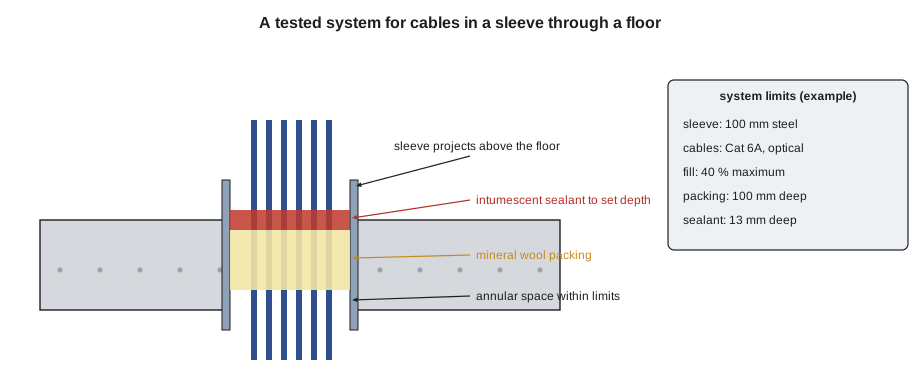
- Mineral wool packing fills the depth of an opening and supports the sealant applied over it; it must be the density the system specifies.
- Firestop pillows and blocks fill larger openings and can be removed and replaced, which suits cable trays and openings that change often.
- Composite sheets and mortars close large openings around multiple penetrants, often in electrical rooms and shafts.
- Fire-rated pathway devices are listed sleeves with built-in intumescent material that seal themselves around whatever cable passes through, up to a stated fill, and need no sealant when cables are added or removed.
Pathway devices have changed cabling work. Before them, every cable added to a sealed sleeve meant removing and replacing the seal, and in practice seals were often left broken. A pathway device lets cable be added at any time without touching a seal, which is why owners specify them at telecommunications rooms and risers. They cost more to install but save their price the first time a tenant adds cable.
Matching a system to the job
Choosing a system means matching every condition on site to the system sheet:
- The assembly: its type, construction and rating. A system tested in a concrete floor does not apply to a wood floor, and one tested in a 1 hour gypsum wall may not apply to a 2 hour wall.
- The penetrants: the kind of cable, its jacket type and size, and whether it is a bundle, in a sleeve or loose. Some systems cover only certain cable types or sizes; many specifically list Category 6A, fibre and power-limited cables.
- The opening and sleeve: size and material, and whether a sleeve is required.
- The annular space and fill: the gap between the penetrants and the edge of the opening, within the system's minimum and maximum, and the cable fill, usually given as a maximum percentage of the opening's area.
- The materials and their depths: which product, how deep, on one side or both sides of the assembly.
When no listed system matches the condition exactly, the manufacturer may issue an engineering judgment, a written opinion based on similar tested systems that describes how to seal that specific condition. Engineering judgments must be accepted by the AHJ and are meant for unusual conditions, not to avoid buying the right product. Cobalt Line asks for one only after Sanjay confirms that no listed system fits.
# Sleeve fill and annular space check against a firestop system's limits
import math
SYSTEM = {"name": "C-AJ-3xxx (example)", "max_fill_pct": 40, "min_annular": 0, "max_annular": 50}
def area(d):
    return math.pi * d * d / 4
sleeves = [  # (penetration, sleeve inside diameter, list of (cable OD, count)) in mm
    ("P-K-301 riser", 103, [(7.5, 24), (9.0, 2)]),
    ("P-K-302 riser", 103, [(7.5, 40)]),
    ("P-K-311 corridor wall", 53, [(6.1, 6)]),
]
for pid, d, cables in sleeves:
    a_cab = sum(area(od) * n for od, n in cables)
    fill = 100 * a_cab / area(d)
    bundle_d = math.sqrt(a_cab / 0.75 * 4 / math.pi)     # rough bundle diameter at 75 % packing
    gap = (d - bundle_d) / 2
    notes = []
    if fill > SYSTEM["max_fill_pct"]:
        notes.append(f"fill {fill:.0f} % over {SYSTEM['max_fill_pct']} %")
    if not SYSTEM["min_annular"] <= gap <= SYSTEM["max_annular"]:
        notes.append(f"annular space {gap:.0f} mm outside {SYSTEM['min_annular']} to {SYSTEM['max_annular']}")
print(f"{pid:22s} fill {fill:4.0f} % gap {gap:5.0f} mm {'OK' if not notes else '; '.join(notes)}")P-K-301 riser fill 14 % gap 29 mm OK P-K-302 riser fill 21 % gap 24 mm OK P-K-311 corridor wall fill 8 % gap 18 mm OK
The second riser sleeve is over its fill limit: forty Category 6A cables are too many for a 100 mm (4 in) sleeve under this system. The remedies are to split the cables into another sleeve, choose a system that allows more fill, or install a pathway device rated for the fill. Fill limits are not only about the seal; a packed sleeve leaves no room for the packing and sealant to reach the depth the test used.
Installing a seal
Installation follows the system sheet and the product instructions exactly. For a typical cable bundle in a sleeve through a floor, the steps are:
- Confirm the system: assembly, rating, sleeve, cables and fill all match the sheet, and the product on hand is the one the system names.
- Prepare the opening: clean dust and debris, check the sleeve is set and projects as the system requires, and spread the cables so packing and sealant can surround each one where the system requires it.
- Install packing: mineral wool of the specified density, compressed to the specified depth, recessed to leave room for sealant.
- Apply sealant: to the specified depth, tooled to fill around and between the cables and against the sleeve, on one or both sides as required.
- Identify and record: fix a label at the seal and enter the penetration in the log with a photo before anything covers it.
Firestop products have conditions too: minimum temperatures for application, cure times before they can be disturbed, shelf lives and compatibility with cable jackets. Some sealants are not compatible with certain jacket compounds, and the manufacturer's compatibility list says which. Cobalt Line uses one manufacturer's products on each job so that all the systems come from one directory and the products are compatible.
Labels and records
Most specifications, and many owners' fire safety plans, require a label at each firestop, stating that it is a fire-rated seal and must not be disturbed, with the system number, the product, the installer, the date and the rating. In hospitals and high-rise buildings, the label and log are how future trades know what is behind a seal and how to restore it after adding cable. Cobalt Line's labels are printed and numbered to match the penetration log.
Inspection of firestops
Building officials inspect firestops before ceilings and shafts are closed. In hospitals and other large projects, owners often hire a third-party firestop inspector, who checks seals against the system sheets, measures sealant depths and may cut out a sample seal to confirm depths. ASTM E2174, the US standard practice for inspecting through-penetration firestops, is often used in Canada too as a method. On St. Brendan's, the owner's firestop inspector, Gil Navarro, inspects a sample of every system on every floor and a hundred per cent of the seals at the riser and smoke compartment walls.
The most common defects inspectors find on cabling penetrations are these: no listed system for the condition; sealant too shallow; packing missing; fill over the system limit; foam used where it is not part of a tested system; seals broken by later cable additions; and no label or log entry. Expanding foam deserves a special warning: ordinary spray foam from a hardware store is combustible and is not a firestop. Some firestop foams are tested as parts of systems, but only in the systems that name them.
Qualified installers
Firestopping is specialized work, and many specifications require it to be done by a contractor with a recognized qualification, such as a contractor approved under FM 4991 or the UL Qualified Firestop Contractor Program, or by installers trained and certified by the manufacturer. Cobalt Line's crews seal their own cabling penetrations under the manufacturer's training, and the firestop subcontractor seals large openings and electrical room penetrations. The division of work is written into the contract, so that every penetration has an owner.
Worked problem
A seal broken by a tenant's cabling
Eighteen months after St. Brendan's east wing opens, a lab equipment vendor adds six cables to a corridor wall sleeve and leaves the sealant cut open. The hospital's fire safety officer finds it on a routine walk and calls Cobalt Line.
Show solution
- The penetration's label gives its number; the log gives the system, product and depths.
- The crew removes the damaged sealant, checks that the new cable count keeps the fill within the system's limit and repacks and reseals to the system.
- The fill is now at the limit, so Maya recommends replacing the sleeve with a pathway device at the next opportunity.
- The log entry is updated with the date, the new cable count, the installer and a new photo.
Answer: The seal is restored to its tested condition in an hour. The hospital adds a rule that any trade adding cable through a rated wall must use Cobalt Line or another qualified installer and update the log.
Planning firestops before the work starts
The cheapest firestop is the one designed in from the start. On new projects, Sanjay shows every cabling penetration of rated construction on the drawings, with sleeves or pathway devices sized for the cable count plus growth, and the system number for each type. That lets the crew order the right sleeves and products, lets the general contractor cast sleeves into slabs before the concrete is poured and lets the inspector see a plan before the first hole is drilled. On renovations, the closeout crew surveys the existing penetrations early, so the cost of sealing old holes is known before the job is priced.
Planning also means choosing products the crew can install well. Pathway devices at telecommunications rooms, one sealant and one putty for the job, and sleeves sized so the fill stays well under the system limit make it far more likely that every seal on the job matches its system on the day the inspector looks.
When a seal must be removed
Seals sometimes have to come out: to remove abandoned cable, to replace a damaged cable or to add capacity. Removing a seal opens a hole in a rated assembly, so the work is planned to keep the opening open as briefly as possible, and in occupied buildings such as hospitals the owner's fire safety staff are told beforehand. Re-enterable products such as putty and pillows can be removed and reinstalled; cured sealants must be cut out and replaced. The restored seal follows its system and gets a new log entry and photo.
Common mistakes
MistakeAsking for a firestop product without a system.
InsteadChoose a tested system that matches the assembly, penetrants and opening, then use its products.
MistakeExceeding the system's fill limit.
InsteadSplit the cables, choose another system or use a pathway device.
MistakeUsing hardware-store spray foam.
InsteadUse only products named in a tested system.
MistakeLeaving seals unlabelled and unlogged.
InsteadLabel each seal and record it with a photo before it is covered.
MistakeCutting a seal to add cable and leaving it open.
InsteadRestore the seal to its system and update the log, or use re-enterable products.
Summary and key terms
- A firestop rating belongs to a tested system, not to a product.
- System sheets set the assembly, penetrants, opening, annular space, fill, materials and depths.
- UL system numbers show the assembly type, construction and kind of penetrant; 3000 is cables and 4000 cable trays.
- Pathway devices let cable be added without disturbing a seal.
- Installation follows the system exactly, with labels and a log entry for each seal.
- Inspectors check seals against system sheets; foam, shallow sealant, over-fill and broken seals are common defects.
- Firestop system
- A tested combination of assembly, penetrants, opening and materials with a rating.
- Annular space
- The gap between the penetrating items and the edge of the opening.
- Intumescent
- Expanding when heated to close gaps.
- Pathway device
- A listed sleeve that seals itself around the cables passing through.
- Engineering judgment
- A manufacturer's written opinion for a condition no tested system matches, subject to AHJ acceptance.
Practice problems
Work each problem on paper first, then reveal the answer to check.
What does the 3000 series in a UL system number cover?
Show answer
Electrical cables.
A sleeve is over the system's fill limit. Name two remedies.
Show answer
Split the cables into another sleeve, or use a system or pathway device rated for more fill.
Is spray foam from a hardware store a firestop?
Show answer
No; only products named in a tested system are.
What information goes on a firestop label?
Show answer
That it is a fire-rated seal, the system number, product, rating, installer, date and penetration number.
Lesson quiz · 5 questions
Score 60% or more to complete this lesson.
Create a free account to save your progress, take quizzes and earn a certificate.