
LVT-330 · Lesson 5 of 12 · 19 min
Separation from power and other systems
Low-voltage cables share ceilings, walls, trays and boxes with power wiring, fire alarm cables, other trades' cables and the building's structure. Two kinds of rule decide how close they may come. Safety rules in the electrical code keep power from reaching communication or Class 2 conductors if insulation fails, and keep different systems from being mixed in ways that let a fault on one damage another. Performance rules in the cabling standards keep electrical noise from motors, lights and transformers out of data cables. The safety rules are mandatory; the performance rules are good practice that becomes mandatory when the specification adopts them. This lesson covers both, and the rules on how cable is supported, which inspectors check alongside separation.
Why separation matters
The hazard is a power conductor failing against a low-voltage conductor. If a damaged 347 V or 120 V conductor touches a communication pair, the communication cable, the equipment at both ends and anyone touching it can be energized at power voltage. Low-voltage cable insulation is thin and not designed to contain power faults, and the equipment is not built for it. Separation, barriers and raceways keep the two systems apart so that a single failure in one cannot reach the other.
Separation between low-voltage systems has its own reasons. Fire alarm circuits must keep working during a fire and be supervised, so they are kept apart from other circuits that could fault onto them. Class 2 circuits and communication circuits from different sources should not share a cable if the code does not allow it, because a fault on one can raise the voltage on the other.
Raceways, boxes and cables
The CEC's basic rule, in Sections 16 and 60, is that Class 2 and communication conductors must not be placed in the same raceway, box, outlet or cable as power or Class 1 conductors. The exceptions are where a barrier of suitable material separates them for their whole length in the raceway or box, where the conductors are in separate compartments of a listed raceway, or where the equipment, such as a door strike controller or a PoE switch, is certified for both kinds of connection and keeps them apart internally. Where exposed communication and power conductors run together, the code requires a separation, commonly 50 mm, unless one of the systems is in raceway or metal-sheathed cable or a fixed non-conducting separator is between them.
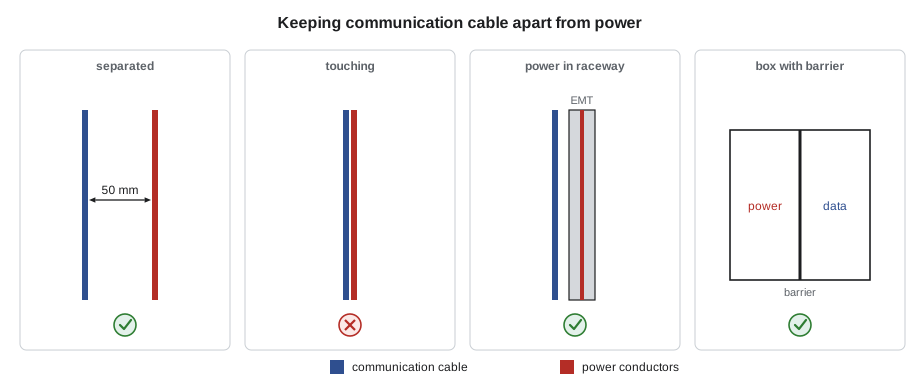
Combination devices are increasingly common: floor boxes with power receptacles and data jacks, furniture feeds with both, desk-mounted modules and access control panels with a power input and Class 2 outputs. Each must be certified or listed for the combination, with its barrier installed. A floor box missing its divider is one of the most common defects inspectors write up in office fit-outs, along with data cables pulled into the power side of a box because it was easier.
Shared pathways
Low-voltage cable may share a ceiling with power wiring, but it should not share its supports. Cobalt Line's practice follows the codes and the cabling standards together:
- Never lay cable on or tie it to conduit, piping, ductwork or sprinkler lines. Power conduit and pipes are not supports for cable, and an inspector will write it up.
- Keep cable trays and J-hooks for low-voltage cable separate from the electrician's supports, and cross power runs at right angles where crossing is unavoidable.
- Keep the separation from power conductors that are not in raceway, such as armoured or metal-clad cable feeding lights, at least as far as the code requires; more is better.
- In shared trays, use a listed divider between power and low-voltage cable, or a separate tray.
Support of cable
Cables must be supported by the building structure in a way that protects them from damage, with supports spaced to prevent sag and strain. Ceiling grid and the wires that hold up the grid are not supports; cables lying on ceiling tiles or tied to grid wires are defects, because they load a system not designed for them and fall when tiles are lifted. Independent support wires, fixed to the structure and identified for the purpose, are acceptable where the ceiling contractor installs them for the cabling. In plenums, cable ties and other non-metallic support materials must themselves be rated for the space, which means plenum-rated cable ties, often in a contrasting colour so the inspector can see them.
The cabling standards add the performance side: J-hooks or other supports at intervals of no more than 1.5 m (5 ft), a sag of no more than about 300 mm (12 in) between supports, no more cables in a support than its rated fill and no crushing from tight ties. LVT-130 covered those in detail; the code cares that the supports are attached to the structure and suitable for the space.
Noise separation: the cabling standard's view
Electrical noise is not a safety issue, but it can make a link fail or a camera picture break up. Motors, variable frequency drives, transformers, fluorescent and some LED drivers, and power cables carrying large currents create electric and magnetic fields that couple into unshielded twisted-pair cable. Balanced twisted-pair cable rejects most of this, which is why the separation the cabling standards recommend is modest, but large sources and long parallel runs still matter.
TIA-569 gives guidance rather than fixed distances, relating separation to the source and to whether the power or the cabling is in a grounded metal pathway. Many specifications turn that guidance into a table. Sanjay's version for Cobalt Line's projects, adapted from manufacturer and specification tables, is shown below; it is a project rule, not a code rule.
| Source | Unshielded cable in open pathway | Cable in grounded metal pathway |
|---|---|---|
| Power cable under 2 kVA | 130 mm (5 in) | 65 mm (2.5 in) |
| Power cable 2 to 5 kVA | 300 mm (12 in) | 150 mm (6 in) |
| Power cable over 5 kVA | 600 mm (24 in) | 300 mm (12 in) |
| Fluorescent or LED fixtures | 130 mm (5 in) | 130 mm (5 in) |
| Motors, transformers, drives | 1.0 m (40 in) | 1.0 m (40 in) |
Crossing a power cable at right angles has very little effect, because the coupling length is short. Running parallel to it for tens of metres has a much larger effect. Where separation cannot be achieved, metal pathway, shielded cable or fibre is the answer; the designer decides.
# Separation check for a list of measured spacings, against the code minimum and the project noise table
CODE_MIN = 50        # mm, exposed communication to power not in raceway
NOISE = {"lighting": 130, "feeder over 5 kVA": 300, "drive or motor": 1000}
spots = [  # (location, what is nearby, spacing in mm, power in raceway?)
    ("Kellerman 7 corridor", "lighting", 150, True),
    ("Kellerman 7 open office", "power cable", 35, False),
    ("Kellerman 7 elec room", "feeder over 5 kVA", 250, True),
    ("Kellerman roof AHU", "drive or motor", 1200, False),
]
for where, near, gap, raceway in spots:
    problems = []
    if near == "power cable" and not raceway and gap < CODE_MIN:
        problems.append("below code minimum")
    if near in NOISE and gap < NOISE[near]:
        problems.append(f"below project noise distance {NOISE[near]} mm")
print(f"{where:24s} {near:18s} {gap:5} mm {'OK' if not problems else '; '.join(problems)}")Kellerman 7 corridor lighting 150 mm OK Kellerman 7 open office power cable 35 mm below code minimum Kellerman 7 elec room feeder over 5 kVA 250 mm below project noise distance 300 mm Kellerman roof AHU drive or motor 1200 mm OK
The open-office case is the one that matters for inspection: a communication bundle laid within a few centimetres of a lighting whip of armoured cable is a code issue if the separation is less than the code requires and the whip is not in raceway. The electrical room case is a performance issue only, and the remedy is to move the cable tray or add a metal barrier.
Fire alarm and other life safety circuits
Fire alarm circuits are installed by fire alarm contractors under Section 32 and the CAN/ULC-S524 installation standard. Low-voltage installers should keep their cables out of fire alarm raceways and boxes, never use spare pairs in a fire alarm cable for another purpose and never support their cable from fire alarm conduit. Where a security or access control system connects to the fire alarm system, for example to release doors on alarm, the connection is made at a listed interface, by or with the fire alarm contractor, and its wiring follows the fire alarm rules.
Elevators, lightning and other special locations
A few places have special rules worth knowing. Elevator hoistways may contain only wiring associated with the elevator; a building's communication riser must never use the hoistway as a pathway. Lightning protection down conductors on the outside of a building should be kept well away from communication cables, and the codes ask for separation where practicable, so a cable route down an exterior wall must be planned with the lightning protection drawings. Wet and corrosive locations need cables and fittings rated for them. Hazardous locations, such as fuel rooms or some industrial areas, have their own wiring methods, and low-voltage cable may not enter them without following those rules.
Worked problem
A floor box that fails inspection
At the Kellerman fifth-floor fit-out, the inspector rejects four floor boxes on the rough-in. Maya opens one. The box has a receptacle on one side and two data jacks on the other, but the divider that came with the box is in its bag on the floor of the box, and two data cables run past the receptacle terminals on their way to the jacks.
Show solution
- Communication and power conductors are in the same box with no barrier, which Section 60 does not permit.
- The box is certified as a combination box only with its divider installed.
- Correction: reroute the data cables into the low-voltage compartment, install the divider and check that the cables do not cross the power side.
- Check the other floor boxes of the same type before the re-inspection.
Answer: All 38 floor boxes on the floor are checked; 11 have the same fault. The crew fixes them in a day, photographs each one and the re-inspection passes.
Shared spaces in telecommunications rooms
Telecommunications rooms often contain power and low-voltage equipment side by side: panelboards, transformers for the room's power, UPS units, racks, backboards and cable runway. The cabling standards ask that the room be used only for telecommunications equipment, but in renovations the room may also contain building automation panels, security panels and the electrician's equipment. Separation still applies inside the room. Power cords and whips feeding racks are kept away from the cable runway, cable from the runway drops into racks on its own path, and the panelboard is reached without stepping over cable. Clearances in front of electrical equipment, set by the electrical code, must be kept clear of racks and cable.
Working space in front of panelboards and other electrical equipment, commonly at least 1 m deep under the electrical code, must stay clear for the full width of the equipment and the height the code sets. A rack placed in that space, or a backboard full of cables mounted in front of a panel, is a defect that inspectors write up on almost every renovation. Sanjay lays out every telecommunications room with the electrical equipment and its clearances drawn first, and racks and backboards placed around them.
Checking separation on the rough-in
Separation problems are cheap to fix before ceilings close and expensive afterwards. Before every rough-in inspection, the crew lead walks each ceiling with three questions: is any low-voltage cable resting on or tied to another trade's work, is any bundle within the code distance of power wiring that is not in raceway, and does every box or floor box with both kinds of wiring have its barrier? The walk takes an hour on a typical floor and saves days of rework.
Common mistakes
MistakePulling data cable through the power side of a combination box.
InsteadUse the low-voltage compartment and install the divider.
MistakeTying cable to conduit, pipes or ceiling grid wires.
InsteadSupport cable from the structure with suitable hardware.
MistakeUsing ordinary cable ties in a plenum.
InsteadUse plenum-rated ties and supports.
MistakeRunning parallel to a large feeder for a long distance.
InsteadIncrease separation, cross at right angles or use metal pathway.
MistakeUsing a hoistway as a riser.
InsteadOnly elevator wiring belongs in a hoistway.
Summary and key terms
- Separation rules keep power faults from reaching low-voltage conductors and keep systems from faulting onto each other.
- Low-voltage and power conductors may not share a raceway, box or cable without a barrier or a certified combination device.
- Exposed communication conductors are kept apart from power conductors, commonly 50 mm, unless raceway, metal sheath or a fixed separator provides the separation.
- Cables are supported from the structure, never from grid wires, ceiling tiles, conduit or pipes; plenum supports and ties must be rated.
- Noise separation is a performance matter governed by TIA guidance and the specification.
- Fire alarm circuits, hoistways, lightning protection and hazardous locations have their own rules.
- Barrier
- A fixed divider separating power and low-voltage conductors in a box or raceway.
- Combination device
- A box or device certified for both power and low-voltage connections, with internal separation.
- Independent support wire
- A wire fixed to the structure and identified for supporting cable.
- Plenum-rated cable tie
- A non-metallic tie rated for low smoke and heat release in plenums.
- Electromagnetic interference
- Electrical noise coupled into a cable from nearby sources.
Practice problems
Work each problem on paper first, then reveal the answer to check.
What is the common separation between exposed communication and power conductors?
Show answer
50 mm, unless raceway, metal sheath or a fixed separator provides it.
May a data cable share a box with a receptacle?
Show answer
Only in a certified combination box with its barrier installed.
Is the ceiling grid an acceptable support for cable?
Show answer
No; support from the structure or independent support wires.
Where may a communication riser not run?
Show answer
In an elevator hoistway.
Lesson quiz · 5 questions
Score 60% or more to complete this lesson.
Create a free account to save your progress, take quizzes and earn a certificate.