
LES-205 · Lesson 11 of 12 · 19 min
Truth and reconciliation: the Calls to Action and community safety
▶ Video coming soon A video version of this lesson is on the way.
Two weeks after Tara Pelletier was found safe, the Port Ardent Police Service held a meeting at the Nimkii Bay community hall at the family's request. Danielle Pelletier, Elder Marion Shawanda, Sergeant Keeshig, Sergeant Haddad, Detective Whitlock and Constable Morin sat in a circle with about forty community members. Danielle spoke first. She thanked the officers who had found her sister and described the forty minutes at the front counter. 'I almost left,' she said. 'If I'd left, would anyone have looked for her before Monday?' Haddad answered honestly: probably not. Then she explained what the service had changed since.
Desjardins says the meeting shows what reconciliation means for police. It is not a ceremony or a statement, though those can matter. It is a long series of practical changes, made with communities rather than for them, and measured by whether people are treated better on the next call. The Truth and Reconciliation Commission described reconciliation as establishing and maintaining a mutually respectful relationship between Indigenous and non-Indigenous peoples, which requires awareness of the past, acknowledgment of the harm, atonement for the causes and action to change behaviour.
The Calls to Action and the justice system
The TRC's 94 Calls to Action, released in 2015, are addressed to governments, churches, professions and all Canadians. Calls 25 to 42 deal with justice. Call 25 asks the federal government to affirm the independence of the RCMP to investigate crimes in which the government has its own interest as a potential or real party. Call 30 asks governments to commit to eliminating the overrepresentation of Aboriginal people in custody over the next decade, and Call 38 asks the same for youth. Call 31 asks for funding and evaluation of community sanctions as alternatives to imprisonment, and Call 32 asks for judges to be allowed to depart from mandatory minimum sentences. Calls 39 and 40 ask for data on the victimization of Aboriginal people and for culturally appropriate victim programs. Call 41 asked for the inquiry into missing and murdered Indigenous women and girls, and Call 42 asks governments to recognize and implement Aboriginal justice systems. Call 57 asks governments to educate public servants, including police, on the history of Indigenous peoples, treaties and Aboriginal rights.
Progress has been uneven. Organizations that track the Calls to Action, such as CBC's Beyond 94 project and the Yellowhead Institute, have found that only a small number have been fully completed, and that the justice Calls have advanced especially slowly; overrepresentation in custody has grown, not shrunk, since 2015, as Lesson 7 showed. At the same time, real changes have been made: the UN Declaration Act, the 2019 child welfare law, the inquiry into missing and murdered Indigenous women and girls, the repeal of some mandatory minimum penalties and the expansion of conditional sentences in 2022, and in March 2025 Canada's first Indigenous Justice Strategy, developed with Indigenous partners. Desjardins tells the class that police services do not have to wait for governments. Many of the most practical changes are within their own control.
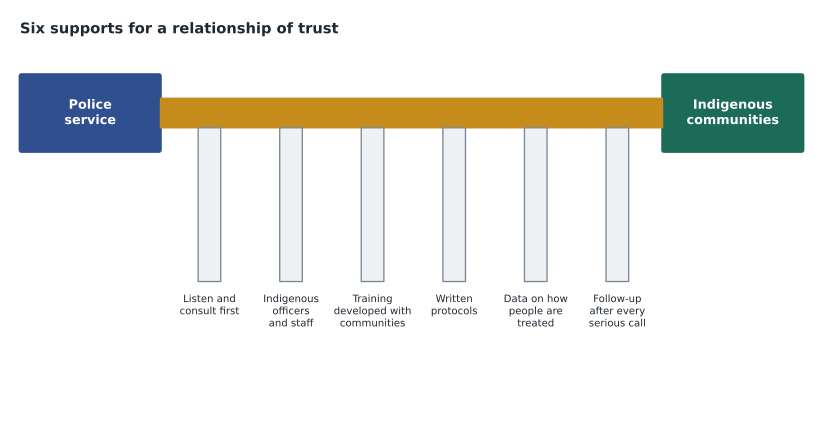
What police services can change
Haddad describes the changes Port Ardent has made since the Pelletier case, most of them developed with Nimkii Bay and the Port Ardent Indigenous Justice Centre. Every missing person report now goes to a supervisor for a risk assessment within fifteen minutes, whatever the officer taking it thinks. Front-counter officers have a short guide on what not to say, including the phrase 'adults have the right to go missing' unless a supervisor has assessed the risk as low. Missing person reports now include a field, completed by asking, for Indigenous identity and nation, so that the service can measure how such cases are handled. And every high-risk missing person case is automatically assigned a family liaison officer.
Other changes are longer-term. The service has an Indigenous advisory circle that meets four times a year with the chief, including Elder Shawanda, representatives of Nimkii Bay's council and police service, the Indigenous Justice Centre and urban Indigenous organizations. Recruits now spend a day at Nimkii Bay during their field training, and every officer takes a full-day course on Indigenous history and law, taught partly by community members. The service has a written protocol with the Nimkii Bay police on shared cases, which was rewritten after the Pelletier case to cover missing persons explicitly. And the recruiting unit has a goal of doubling the number of Indigenous officers within five years, supported by a cadet program with the college.
| Change | Why it matters |
|---|---|
| Supervisor risk review of every missing person report within 15 minutes | Removes the decision from the least experienced officer and from habit |
| Recording Indigenous identity by asking | Makes it possible to measure how cases are handled |
| Automatic family liaison in high-risk cases | Answers the most common complaint of families |
| Indigenous advisory circle | Brings community views into decisions before crises |
| Training co-developed and partly taught by community members | Gives officers knowledge and relationships, not only facts |
| Written protocol with the community police | Settles who leads and how to share information before it is urgent |
| Recruitment goals and a cadet program | Builds a service that reflects the communities it polices |
Measuring whether it works
Desjardins says that changes like these are easy to announce and hard to sustain, and that the only real test is whether people are treated better and trust grows. Services can measure that in several ways: how quickly missing person reports are assessed and acted on, how many cases involve Indigenous people and how their outcomes compare, how many complaints come from Indigenous community members and what they concern, how many officers have completed training, and how many Indigenous people the service recruits and keeps. Surveys of community members, done with the community and reported back to it, show whether people would call the police and whether they think they would be treated fairly. Ontario's Anti-Racism Act, 2017 and its data standards require police services to collect and report race-based data, including Indigenous identity, on use of force, which gives services and communities a way to see patterns.
Worked problem
Did trust improve?
In 2024, before the changes, the Nimkii Bay community safety committee surveyed 120 community members; 31 said they would call Port Ardent police if a family member went missing in the city. In 2026, after the changes, 130 were surveyed and 54 said they would. What share said yes each time, and how much did it change?
Show solution
- 2024: 31 divided by 120 is about 0.258, or about 26 in 100.
- 2026: 54 divided by 130 is about 0.415, or about 42 in 100.
- Change: about 42 minus 26 is 16 more in every 100.
- Caution: the two surveys asked different people, and one survey cannot prove that the changes caused the difference, but the direction is encouraging.
Answer: About 26 in 100 said yes in 2024 and about 42 in 100 in 2026, an increase of about 16 in 100. More than half of those asked still would not call, which tells the service how much work remains. Keeshig says the most useful part of the survey was the comments, which named specific officers, good and bad.
Community safety from inside the community
Ontario requires municipalities and First Nations that choose to do so to plan for community safety and well-being, not only policing. Nimkii Bay's community safety committee, made up of elders, parents, band council members and the police service, has its own plan: youth evenings at the community centre, a land-based summer program, a walk-home program for women and girls coming back from the city late, a phone tree for when young people go missing and a monthly table where the police, the health centre, the school, the child and family service and the band's housing office meet to discuss people at acute risk before something goes wrong. Port Ardent has a similar situation table, and since the Pelletier case, Nimkii Bay's coordinator has a seat at it.
Jesse Morningstar tells the class that these programs matter more to him than anything about jurisdiction. 'The best call is the one that never happens,' he says. 'The kid who's at the youth night instead of at the party. The woman who has a ride home. The guy who gets into treatment before he breaks somebody's face. Police are part of that, but only part. If you want to help, show up at the hockey game and the feast, not just the crime scene.'
Acknowledgments, apologies and their limits
Many police services now begin events with a land acknowledgment, recognizing the Indigenous nations whose territory they are on. Elder Shawanda says a land acknowledgment can be meaningful when it is specific, accurate and followed by action, and empty when it is read from a card by someone who does not know what it means. Apologies, such as those offered by RCMP commissioners for the force's role in residential schools, and by individual services for specific failures, can also matter. Haddad says the most important apology she ever saw was not a speech but a detective who went back to a family, years later, to tell them that their daughter's death had been wrongly classified as an accident, and that it was being reinvestigated.
Keeshig returns to his point from Lesson 3: trust is measured on the next call. He asks each student to write down one thing they will do, as officers, that would make an Indigenous family more likely to call them. The answers include learning the names of the nations in their area, always explaining why they are at the door, never telling a family to wait, asking about identity respectfully, going to community events off duty, and calling the Nimkii Bay police first on any case that might involve their community. Keeshig collects the cards and says he will send them back to each student a year after graduation.
Recruiting and keeping Indigenous officers
Haddad describes the service's recruiting effort with some candour. For years, she says, Port Ardent advertised at job fairs and wondered why few Indigenous applicants came forward. What changed things was relationships: officers coaching youth hockey at Nimkii Bay, a cadet program run with the college, mentors who had been through the process themselves, and a service that people in the community had begun to trust. Keeping officers matters as much as hiring them. Indigenous officers report that they are sometimes treated as the default expert on every Indigenous matter, asked to explain their whole people to colleagues, or caught between loyalty to the community and to the service. Good practice includes support networks, time for ceremony and community obligations, mentoring, and promotion paths that value community knowledge.
Jesse Morningstar, who has accepted a position with the Nimkii Bay police service, says the hardest part for him will not be the law or the calls. 'It'll be policing my own family,' he says. 'But I'd rather it was me, who knows them, than someone who doesn't. That's the whole point.' Desjardins says that the best training for officers who are not Indigenous is often the simplest: time spent in communities, listening, outside of calls, and a willingness to be taught by people like Jesse.
Training that works
Training on Indigenous history and law is now common in police services, but its quality varies. Training that works, according to the people who deliver it, is developed and taught with Indigenous communities, uses local history and local people rather than generic slides, connects history to specific police decisions, and is repeated and reinforced rather than delivered once. It includes time in communities, conversations with elders and survivors, and practical scenarios such as a missing person report or a rights claim on a highway. Training that does not work is a one-hour online module completed once and forgotten. Keeshig says he can tell within one call which kind an officer has had.
Common mistakes
MistakeReconciliation is mainly about ceremonies and statements.
InsteadIt is a long series of practical changes, made with communities and measured on the next call.
MistakeThe Calls to Action are directed only at governments.
InsteadThey are directed at governments, institutions, professions and all Canadians, and many changes are within police services' own control.
MistakeOne good survey result proves a program works.
InsteadSurveys show direction; services need several measures over time, shared with the community.
MistakeCommunity safety is the police's job alone.
InsteadIt depends on youth programs, health, housing and family supports; police are one partner.
Summary and key terms
- The TRC issued 94 Calls to Action in 2015; Calls 25 to 42 address justice, and Call 57 asks for education of public servants, including police.
- Progress has been slow, but the UN Declaration Act, the 2019 child welfare law, the 2022 sentencing reforms and the 2025 Indigenous Justice Strategy are real changes.
- Police services can change practices directly: risk review, identity data, family liaison, advisory circles, co-developed training, protocols and recruitment.
- Changes should be measured by response times, outcomes, complaints, recruitment and community surveys shared with the community.
- Community safety rests on youth, health, housing and family programs as well as policing.
- Calls to Action
- The 94 recommendations of the Truth and Reconciliation Commission, released in 2015.
- Reconciliation
- The process of establishing and maintaining a mutually respectful relationship between Indigenous peoples and the state, through acknowledgment and practical change.
- Advisory circle
- A group of community members and leaders who advise a police service on its priorities and practices.
- Situation table
- A regular meeting of agencies that identifies people at acute risk and arranges help before a crisis.
- Land acknowledgment
- A statement recognizing the Indigenous nations whose territory an event or institution is on.
Practice problems
Work each problem on paper first, then reveal the answer to check.
What do Calls to Action 30 and 38 ask for?
Show answer
The elimination, within a decade, of the overrepresentation of Aboriginal adults and youth in custody.
Name four changes Port Ardent made after the Pelletier case.
Show answer
Any four of: supervisor risk review within 15 minutes, identity recorded by asking, automatic family liaison, advisory circle, co-developed training, a rewritten protocol, recruitment goals and a cadet program.
In a survey, 54 of 130 people say they would call police. About how many in 100 is that?
Show answer
About 42 in 100.
What makes a land acknowledgment meaningful, according to Elder Shawanda?
Show answer
Being specific, accurate and followed by action.
Lesson quiz · 5 questions
Score 60% or more to complete this lesson.
Create a free account to save your progress, take quizzes and earn a certificate.