
HSE-219 · Lesson 9 of 12 · 27 min
Power lines, wind and other hazards
Some of the deadliest crane hazards are outside the crane and outside the load: overhead power lines, wind, weather, other cranes, nearby structures and the people and traffic around the site. A crane that is perfectly set up and rigged can still kill if its boom swings within reach of a power line or if a gust catches a large panel. This lesson covers how to recognize and control these hazards. The electrical background to why power lines are so dangerous, including step and touch potential, is covered in more depth in HSE-224.
Why power lines are so dangerous for cranes
Crane booms are long, conductive and often operated from a cab where the operator cannot judge distance to a wire overhead. A boom, hoist line, load or tag line that touches or comes close to an energized line can carry current to the crane and to the ground around it. Higher voltages can arc across air gaps without contact. The person most often killed is not the operator, who is somewhat protected in the cab, but a rigger or worker touching the load, the hook or the crane body while standing on the ground.
Distances to wires are very hard to judge from the ground or the cab. Lines sag more in hot weather and under heavy load and can swing in the wind. Many sites also have lines that nobody noticed during planning: service drops to buildings, lines hidden by trees, and lines on the far side of a street within the boom's reach.
Limits of approach
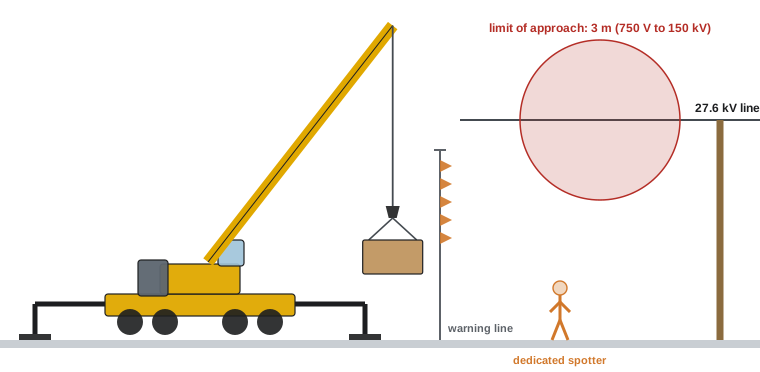
Every province sets minimum distances, called limits of approach, between equipment and energized overhead conductors. In Ontario, O. Reg. 213/91 s. 188 requires at least 3 m for lines from 750 V to 150 kV, 4.5 m for 150 kV to 250 kV and 6 m for lines over 250 kV, unless the line has been de-energized or specific written precautions are in place. British Columbia sets limits in Table 19-1A of its regulation and Alberta in Part 17 of its code. The distances apply to every part of the crane, the hoist line, the load and the rigging.
| Nominal voltage, phase to phase | Minimum distance under O. Reg. 213/91 s. 188 |
|---|---|
| 750 V to 150,000 V | 3 m |
| Over 150,000 V to 250,000 V | 4.5 m |
| Over 250,000 V | 6 m |
Controls for work near power lines
The safest option is always to remove the hazard. The utility may be able to de-energize and ground the line, reroute it or schedule the lift during an outage. If the line must stay energized, the crane should be positioned so that no part of it can reach the limit of approach, even at full boom extension and full swing. Only when neither is possible should the lift rely on administrative controls and warning devices.
| Control | How it helps |
|---|---|
| De-energize and ground, with written confirmation from the utility | Removes the hazard |
| Plan crane placement so the boom cannot reach the limit of approach | Prevents encroachment by design |
| Written measures and procedures for any work that could encroach | Required in Ontario when equipment may come near the limit; sets the controls in advance |
| A competent signaller or spotter whose only job is watching the line | Warns the operator before encroachment |
| Visible warning lines, barriers and range-limiting devices | Give the operator a visible or automatic limit |
| Insulated links and proximity alarms | Add a layer of protection but do not replace distance |
| Non-conductive tag lines, kept dry and clean | Reduce the risk to workers guiding the load |
Insulating covers that utilities place on lines, sometimes called line hose or cover-up, are designed to protect utility workers from brief, accidental contact. They do not make a line safe for a crane boom to touch, and they do not change the limit of approach unless the utility and the regulation say so.
Worked problem
Will the crane reach the limit of approach?
A crane will set up 14 m from a 27.6 kV distribution line, measured horizontally from the centre of rotation to the line. The planned lift needs a maximum radius of 12 m, and the boom tip at that radius is well above the line's height. Does the planned work encroach on the limit of approach?
Show solution
- The line is between 750 V and 150 kV, so the Ontario limit is 3 m.
- At 12 m radius, the closest the hook, load or boom tip can come to the line horizontally is \( 14 - 12 = 2 \) m if the crane swings toward the line.
- Two metres is less than 3 m, so a swing toward the line would encroach.
- Either move the crane at least 1 m further away, so that \( 14 + 1 - 12 = 3 \) m, preferably more, or limit the swing with a range-limiting device and a dedicated signaller, under written measures, or ask the utility to de-energize.
Answer: Yes. Move the crane so that the closest possible approach is at least 3 m, ideally with extra margin for sag, swing and load movement, or have the line de-energized.
If contact occurs
If a crane touches or arcs to a power line, the ground around it can become energized, with voltage falling off with distance from the crane. Someone walking across that ground can be shocked by the difference in voltage between their feet. The response is counter-intuitive, so it must be part of every pre-lift meeting where lines are present.
- The operator stays in the cab, unless there is fire or another immediate danger, and tries to move the boom away from the line if it can be done safely.
- Everyone else stays well away from the crane, the load and anything touching them; at least 10 m is a common guideline, and nobody approaches to help.
- Someone calls the utility and emergency services and keeps others away until the utility confirms the line is de-energized.
- If the operator must leave because of fire, they jump clear with feet together, without touching the crane and the ground at the same time, and then shuffle or hop away with feet together.
- After any contact, the crane must be inspected before it is used again, because current can damage wire rope, bearings, hydraulics and electronics.
Wind
Wind pushes on the boom and on the load. The force grows with the square of wind speed, so a gust 50 per cent stronger than the average pushes more than twice as hard. Large, light loads such as wall panels, formwork, roof trusses, signs and glazing catch the most wind for their weight and can swing, spin or pull the crane over.
Here \( \rho \) is the density of air, about 1.2 kg/m³, \( v \) is the wind speed, \( A \) is the area facing the wind and \( C_d \) is a drag coefficient that depends on shape, roughly 1.2 to 2 for flat panels. The formula is a simplification; manufacturers and engineers use more detailed methods.
Worked problem
Wind on a precast panel
A 6.0 m by 2.4 m precast panel hangs from the hook face-on to the wind. Using a drag coefficient of 1.2, estimate the wind force at 10 m/s (36 km/h) and at 15 m/s (54 km/h).
Show solution
- Area: \( 6.0 \times 2.4 = 14.4 \) m².
- At 10 m/s: \( F = 0.5 \times 1.2 \times 10^{2} \times 14.4 \times 1.2 = 1037 \) N, about 106 kg of sideways force.
- At 15 m/s: \( F = 0.5 \times 1.2 \times 15^{2} \times 14.4 \times 1.2 = 2333 \) N, about 238 kg.
- A 50 per cent increase in wind speed more than doubles the force. At height, wind is usually stronger than at ground level, and gusts are stronger than the average.
Answer: About 1 kN at 10 m/s and 2.3 kN at 15 m/s. That sideways push swings the load, side-loads the boom and increases the radius. The crane manufacturer's wind limits, often lower for loads with large surface areas, set the maximum.
Manufacturers set the maximum wind speed for operation in the load chart notes and operator's manual, sometimes with reduced limits for long booms or large sail areas. Tower cranes have anemometers and stop limits. The lift plan should state the wind limit for each critical lift and who checks the wind, how and when. Ground-level readings understate wind at the boom tip, so use the crane's anemometer or a forecast for height. Lifts should stop before the limit is reached, not when it is.
Other weather and environmental hazards
- Lightning: cranes are tall conductors. Stop lifting and lower the load when thunderstorms approach, commonly when thunder is heard or lightning is seen within a set distance, and keep people away from the crane until the storm has passed.
- Cold: steel becomes less tough at low temperatures, and manufacturers may set minimum operating temperatures or reduced capacities. Hydraulic oil thickens and controls respond slowly. Ice on the boom and load adds weight and can fall.
- Heat: operators fatigue, hydraulic systems may overheat, and power lines sag closer to the ground.
- Visibility: fog, snow, rain, darkness and glare reduce what operators and signallers can see. Lifts in poor visibility need more lighting, radios or a stop until conditions improve.
- Ground changes: heavy rain or a thaw can soften ground that was firm when the crane set up, so outriggers and mats need checking after weather.
Other cranes, structures and the public
When two or more cranes share a site, their working areas may overlap. Tower crane jibs at different heights can still strike each other's hoist lines or loads, and a mobile crane working under a tower crane can be hit by its load. Sites with overlapping cranes need a coordination plan that sets priorities, communication between operators and, for tower cranes, often a zoning or anti-collision system.
Buildings, scaffolds, other equipment and trees can be struck by booms, counterweights and loads. The counterweight at the back of a rotating crane creates a crushing hazard against anything nearby, and the gap between the counterweight and a wall or truck must be either generous or barricaded so nobody can enter it.
Lifts near roads, sidewalks and public areas may need permits from the municipality, traffic control and temporary closures. Cranes near airports may need assessment under Transport Canada and NAV CANADA land use processes, and lifts over railways need the railway's permission.
Near powerful radio, television or radar transmitters, a crane boom can act as an antenna and pick up an induced charge strong enough to shock a worker touching the hook. Sites near transmitters need a specific assessment, grounding or insulating measures, and a procedure from a qualified person.
Common mistakes
MistakeJudging distance to a power line by eye from the cab or ground.
InsteadMeasure, plan crane placement and use spotters, warning lines or range limiters.
MistakeTreating utility cover-up as making a line safe to touch.
InsteadInsulating covers protect against brief accidental contact; the limit of approach still applies.
MistakeRunning to help when a crane contacts a power line.
InsteadStay well away, keep others back and call the utility and emergency services.
MistakeChecking wind only at ground level.
InsteadUse the crane's anemometer or forecasts for height and stop before the limit.
MistakeIgnoring the counterweight swing area.
InsteadBarricade the area around the rotating superstructure so nobody can be crushed.
Summary and key terms
- Power line contact can kill workers touching the crane or load, and high voltages can arc without contact.
- Ontario requires 3 m from lines of 750 V to 150 kV, 4.5 m to 250 kV and 6 m above that; other provinces have their own tables.
- De-energizing or positioning the crane out of reach is better than relying on spotters and warning devices.
- After a contact, the operator stays in the cab unless there is fire, and others stay well away.
- Wind force grows with the square of speed; large, light loads are most affected, and manufacturer limits govern.
- Lightning, cold, heat, visibility, other cranes, structures and the public all need planning.
- Limit of approach
- The minimum distance equipment, loads and rigging must keep from an energized overhead conductor.
- Encroachment
- Any part of the crane, load line or load coming within the minimum distance from a power line.
- Step potential
- The voltage difference between a person's feet when standing on energized ground.
- Range-limiting device
- A device that prevents the boom from moving beyond set limits.
- Insulating link
- A device installed between the hook and load to resist current flow.
- Sail area
- The area of a load or boom exposed to wind.
- Anemometer
- An instrument that measures wind speed.
Practice problems
Work each problem on paper first, then reveal the answer to check.
Why is the worker on the ground more at risk than the operator during a power line contact?
Show answer
Current can pass through a worker touching the load or crane to the ground, while the operator is somewhat protected in the cab.
What is the Ontario limit of approach for a 44 kV line?
Show answer
3 m.
What is the most effective control for work near a power line?
Show answer
Having the utility de-energize and ground the line, or positioning the crane so it cannot reach the limit.
Do insulating covers on a line allow the crane to touch it?
Show answer
No. They protect against brief accidental contact only.
What should the operator do if the boom contacts a line and there is no fire?
Show answer
Stay in the cab, try to move away from the line if safe, and wait for the utility.
How should a person leave a crane that is energized and on fire?
Show answer
Jump clear with feet together without touching the crane and ground at once, then shuffle or hop away.
If wind speed doubles, how does wind force change?
Show answer
It increases about four times.
Estimate the wind force on a 10 m² panel at 12 m/s with Cd = 1.2.
Show answer
\( 0.5 \times 1.2 \times 144 \times 10 \times 1.2 = 1037 \) N.
Name three weather hazards other than wind.
Show answer
Lightning, cold, heat, poor visibility, rain or thaw softening ground, ice.
What hazard does the counterweight create?
Show answer
Crushing between the rotating counterweight and nearby objects.
Lesson quiz · 5 questions
Score 60% or more to complete this lesson.
Create a free account to save your progress, take quizzes and earn a certificate.