
HSE-219 · Lesson 2 of 12 · 28 min
Law, standards and qualifications
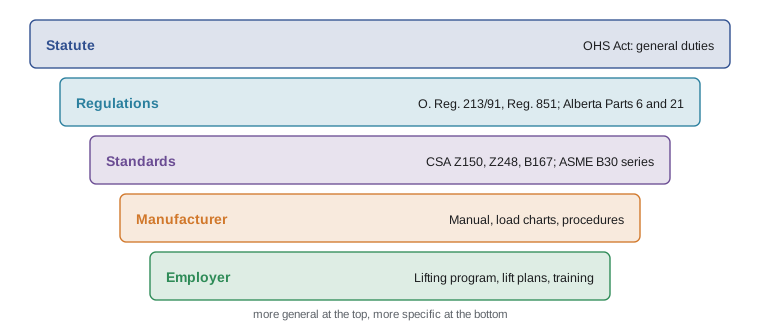
Lifting is one of the most heavily regulated activities on a work site. The rules come in layers: a general health and safety statute, regulations that set specific requirements for cranes, hoists and rigging, technical standards that regulations adopt by reference, the manufacturer's instructions, and finally the employer's own program. A supervisor does not need to memorize every clause, but does need to know which layer answers which question and where to look.
This lesson maps those layers, explains who must hold which qualification, and shows how to check that the people doing a lift are allowed to do it. Requirements change and vary by jurisdiction, so always confirm the current version of the rules that apply where you work. The citations here were checked in October 2026.
The statute: general duties
Each province and territory has an occupational health and safety act, and federally regulated workplaces fall under Part II of the Canada Labour Code. In Ontario, the Occupational Health and Safety Act requires employers to provide information, instruction and supervision, to make sure equipment is maintained in good condition, and to take every precaution reasonable in the circumstances. Supervisors must make sure workers follow the regulations and use the protective devices required, and must advise workers of known hazards. Workers must use equipment as required and report defects. These general duties apply to every lift whether or not a specific regulation covers it.
Regulations for cranes, hoists and rigging
Regulations turn the general duties into specific requirements. In Ontario, Regulation 213/91 (Construction Projects) and Regulation 851 (Industrial Establishments) are the two most relevant.
| Provision | What it requires (summary) |
|---|---|
| O. Reg. 213/91 s. 150(1) | Operators of mobile cranes rated over 16,000 lb must hold a certificate of qualification or provisional certificate under the Building Opportunities in the Skilled Trades Act, 2021, or be a registered apprentice |
| O. Reg. 213/91 s. 150(2) and (3) | Operators of smaller cranes and other hoisting devices need written proof of training from the employer, carried while operating |
| O. Reg. 213/91 s. 151 | A crane's load-carrying capacity is determined under the applicable CSA standard |
| O. Reg. 213/91 s. 102(d) | No load may be left suspended from an unattended crane, with a narrow exception for tower crane balance weights |
| O. Reg. 213/91 s. 153 | Platforms attached to a crane to raise workers must meet specific design requirements |
| O. Reg. 213/91 ss. 168 to 172 | Rigging requirements, which also apply when backhoes, excavators and forklifts are used to hoist |
| O. Reg. 213/91 s. 188 | Minimum distances between equipment and energized overhead conductors |
| Reg. 851 s. 51 | Lifting devices in industrial establishments must be constructed, maintained and operated so loads are handled within capacity, and operated only by a competent person |
Other provinces follow similar patterns with their own numbering. Alberta's OHS Code Part 6 (sections 59 to 114) covers cranes, hoists and lifting devices, including load charts, operator requirements, log books, a written lift calculation whenever a load reaches 75 per cent or more of the crane's capacity (section 68.1), loads over work areas, tag lines and hand signals. Rigging is in Part 21 (sections 292 to 309). British Columbia's Occupational Health and Safety Regulation places cranes and hoists in Part 14 and rigging in Part 15. Federally regulated workplaces, such as ports and some transport operations, follow the Canada Occupational Health and Safety Regulations.
Standards adopted by reference
Regulations often say that a crane must be designed, inspected or operated in accordance with a named standard. When they do, that edition of the standard becomes part of the legal requirement. When they do not, standards still describe good practice, and inspectors and courts use them to judge whether an employer took reasonable precautions.
| Standard | Scope |
|---|---|
| CSA Z150 (2020 edition current) | Safety code on mobile cranes: design, inspection, testing, maintenance and operation |
| CSA Z248 (2026 edition replaced Z248-17) | Code for tower cranes |
| CSA B167 (fifth edition, 2026) | Overhead cranes, gantry cranes, monorails, hoists and jib cranes |
| ASME B30.5 | Mobile and locomotive cranes |
| ASME B30.2 and B30.3 | Overhead and gantry cranes; tower cranes |
| ASME B30.9 | Slings: wire rope, chain, synthetic web, round slings and metal mesh |
| ASME B30.10, B30.20 and B30.26 | Hooks; below-the-hook lifting devices; rigging hardware such as shackles and eyebolts |
| ASME B30.23 | Personnel lifting systems |
A regulation may name an older edition than the one currently on sale. Alberta's code, for example, was written around earlier editions of CSA Z150 and Z248. Where the regulation names an edition, that edition sets the legal minimum, but following the newer edition is usually good practice and is often what manufacturers and owners expect.
The manufacturer's instructions
Every crane has an operator's manual and a load chart specific to its model, serial number and configuration. Regulations in both countries require cranes to be used within the manufacturer's ratings and instructions. If the manual says the crane must be level within 1 per cent, or that a particular jib may not be used in winds above a given speed, that limit is binding. Modifications that affect capacity or safe operation generally need the manufacturer's approval or an engineer's design.
Qualifications: who may do what
Lifting involves several distinct roles, and each has its own qualification. A common audit finding is a site that checks the crane operator's card carefully but never asks who is rigging or signalling.
| Role | Typical requirement in Canada |
|---|---|
| Mobile crane operator | Trade certificate in most provinces; in Ontario, hoisting engineer (mobile crane operator 1 or 2) for cranes over 16,000 lb, with the class set by the crane's rated capacity; Red Seal endorsement available for mobile crane operator (hydraulic) |
| Tower crane operator | Tower crane operator trade certificate; Red Seal trade |
| Operators of small cranes and hoists | Employer training and written proof of training, such as for overhead cranes in a plant or cranes rated 16,000 lb or less in Ontario construction |
| Rigger | Competent person for the work; employer training and evaluation; some employers and owners require third-party rigging certificates |
| Signaller | Competent, trained in the signals in use, and able to see both the load and the operator or in radio contact |
| Lift supervisor or lift director | Competent person appointed by the employer to plan and direct the lift |
In Ontario, the crane's rated capacity, not the weight of the load being lifted, decides which certificate the operator needs. The Ministry of Labour has said that derating a crane simply to avoid hiring a certified operator is not acceptable; a crane may only be derated by physical changes that cannot easily be reversed. The ministry also notes that excavators, backhoes and forklifts used to hoist material are not cranes for the purpose of the certificate requirement, but the rigging rules and the duty to train still apply.
Worked problem
Which qualification is needed?
An Ontario contractor plans to use a boom truck rated at 25,000 lb to set roof trusses. The operator holds a hoisting engineer, mobile crane operator 2 certificate. Next month the contractor will rent a 60-tonne hydraulic crane. What does the operator need for each machine?
Show solution
- The boom truck is rated over 16,000 lb, so s. 150(1) of O. Reg. 213/91 applies and a certificate of qualification is required.
- Cranes rated between 16,000 lb and 30,000 lb can be run by a mobile crane operator 1 or 2, so the current certificate covers the boom truck.
- A 60-tonne crane is far over 30,000 lb, so it requires a mobile crane operator 1 certificate.
- The employer must still train the operator on the specific crane, its controls and its load chart, and keep proof of that training.
Answer: The current certificate covers the boom truck. The 60-tonne crane needs a mobile crane operator 1 certificate, and both machines need employer training on the specific crane.
Worked problem
Checking a certificate on site
A supervisor checks the documents of a rented crane and its operator on arrival. The operator's card is current, the crane's annual inspection report is ten months old, the load chart in the cab is for a different counterweight configuration than the one rigged, and there is no rigger listed on the lift plan. What should happen?
Show solution
- The operator's qualification and the crane's annual inspection are acceptable.
- The load chart must match the configuration actually used. A chart for a different counterweight gives wrong capacities and must not be used.
- The supervisor should stop the setup until the correct chart is in the cab or the crane is reconfigured to match the chart available.
- The lift plan must name who is rigging and confirm that person is competent or qualified for the loads involved.
- Record the checks and corrections on the pre-lift checklist.
Answer: Hold the lift until the correct load chart is available and a competent or qualified rigger is assigned and recorded. A valid operator card does not make the rest of the lift compliant.
Duties of employers, supervisors and workers
Whatever the jurisdiction, the duties fall into a familiar pattern.
- The employer selects suitable equipment, makes sure it is inspected and maintained, provides qualified people, develops a lifting program and plans for critical lifts, and makes sure everyone is trained.
- The supervisor or lift director checks qualifications and documents, confirms the lift plan matches site conditions, controls the area around the lift, stops work when conditions change, and makes sure defects are reported and acted on.
- The operator inspects the crane, knows the load chart, refuses lifts that are unsafe and has the final say on whether the crane will lift.
- Riggers and signallers do their tasks as trained and stop the lift if they see a problem.
- Every worker stays out of the fall zone and the swing radius unless they have a job there.
Ontario's Act also gives every worker the right to refuse unsafe work, and a crane operator who doubts that a lift is safe has both a legal right and a professional duty to refuse. Alberta's code puts this directly into section 66: if the operator has doubts about the safety of a lift, it must stop until the condition is made safe.
Checking qualifications in practice
A qualification check takes a few minutes and should happen before the crane is set up, not after the first lift. For the operator, ask to see the certificate of qualification or provisional certificate and check the name, the trade and the expiry date. Skilled Trades Ontario keeps a public register that can confirm whether a certificate is valid, and other provinces have similar services. Then ask the employer for the record of training on this particular crane, because a certificate shows trade competence, not familiarity with a specific model and its controls.
For riggers and signallers, ask the employer what training they have had, who assessed them and when, and whether it covers the kind of rigging and signalling in the plan. A worker who has rigged steel beams for years may never have rigged a load with an offset centre of gravity using a spreader beam. If a lift plan names people who have not been assessed for its specific demands, the lift waits until they have been, or until people who have been are found.
Keep a simple record of the check: names, documents seen, dates and any gaps found. It protects the workers, the employer and the supervisor, and it is the first thing an inspector will ask for after an incident.
Common mistakes
MistakeChecking only the crane operator's card.
InsteadCheck the qualifications of the rigger, the signaller and the lift director as well.
MistakeAssuming a certificate means the operator is qualified on any crane.
InsteadCertification must match the equipment, and the employer must train or evaluate on the specific crane.
MistakeUsing a load chart for a different configuration.
InsteadThe chart must match the boom, jib, counterweight and outrigger setup actually rigged.
MistakeTreating the newest edition of a standard as automatically the legal requirement.
InsteadThe edition named in the regulation is the legal minimum; newer editions are good practice.
MistakeDerating a crane on paper to avoid certification rules.
InsteadCapacity and qualification follow the crane's real rating; paper derating is not accepted.
Summary and key terms
- Lifting rules come in layers: statute, regulations, adopted standards, manufacturer instructions and the employer program.
- In Ontario, O. Reg. 213/91 and Reg. 851 set the main crane requirements; other provinces have their own codes, such as Alberta Parts 6 and 21.
- CSA and ASME standards become legal requirements when a regulation names them, and describe good practice when it does not.
- The manufacturer's load chart and manual are binding for the specific crane and configuration.
- Operators, riggers, signallers and lift directors each need the qualification required for their role.
- Operators have the authority and duty to refuse an unsafe lift.
- Adopted by reference
- A standard that becomes part of the law because a regulation names it.
- Certificate of qualification
- A provincial trade certificate showing that a person has passed the exam for a compulsory trade such as hoisting engineer.
- Certification
- Proof that an operator has passed written and practical tests for a type, or type and capacity, of crane.
- Employer evaluation
- A documented demonstration that an operator can safely run the specific equipment for the work assigned.
- Competent person
- A person qualified by knowledge, training and experience to do the work safely and familiar with the hazards and the law.
- Load chart
- The manufacturer's table of rated capacities for each configuration, radius and boom length.
- Signaller
- A worker who directs the operator by hand signals or radio, also called a signal person.
Practice problems
Work each problem on paper first, then reveal the answer to check.
Name the five layers of lifting rules described in this lesson.
Show answer
Statute, regulations, standards adopted by reference, manufacturer instructions and the employer program.
Which section of O. Reg. 213/91 sets crane operator certification?
Show answer
Section 150.
What decides which Ontario certificate a mobile crane operator needs?
Show answer
The crane's rated capacity, not the weight being lifted.
Why must the load chart match the crane's actual configuration?
Show answer
Capacities change with boom length, jib, counterweight and outriggers; the wrong chart gives wrong limits.
When does a standard become a legal requirement?
Show answer
When a regulation adopts it by reference.
Which ASME standard covers slings?
Show answer
ASME B30.9.
What does Alberta's section 68.1 require?
Show answer
A written lift calculation when the load reaches 75 per cent or more of the crane's capacity.
Who has final authority to refuse an unsafe lift?
Show answer
The crane operator, backed by the law and the employer program.
Name two roles other than the operator whose qualifications should be checked.
Show answer
Rigger, signaller, lift director or assembly director.
Does a certificate alone make an operator qualified for a particular crane?
Show answer
No. The employer must also train or evaluate the operator on that equipment and work.
Lesson quiz · 5 questions
Score 60% or more to complete this lesson.
Create a free account to save your progress, take quizzes and earn a certificate.