
HSE-219 · Lesson 3 of 12 · 28 min
Cranes and hoists: types and uses
The word crane covers machines that range from a 500 kg electric chain hoist on a monorail to a crawler crane that can lift more than 1,000 tonnes. They share the same basic job, raising and moving a suspended load, but they fail in different ways and need different controls. A supervisor who can tell a rough terrain crane from an all terrain crane, or a hammerhead tower crane from a luffing jib, can ask better questions about setup, ground, wind and exclusion zones.
This lesson surveys the main families of lifting equipment, what each is used for, the hazards typical of each, and the safety devices you should expect to find. Choosing the right crane for a project is a planning and engineering task covered in CON-250; here the focus is on recognizing equipment and its risks.
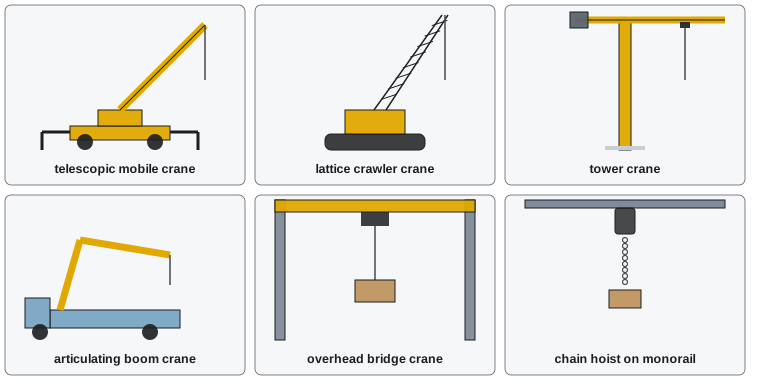
Mobile cranes
Mobile cranes travel to the job and set up on outriggers or tracks. They are the most common cranes on construction sites and the type most often involved in overturning incidents, because their stability depends entirely on correct setup and firm ground.
- Telescopic hydraulic cranes have a boom made of nested sections that extend by hydraulic cylinders. Rough terrain cranes have large tires and a single cab and work on unpaved sites. All terrain cranes can travel on highways and work off-road. Truck-mounted cranes and boom trucks combine a crane with a commercial truck chassis.
- Industrial and carry deck cranes are small, manoeuvrable cranes used in plants and refineries. Some can pick and carry a load, which brings special limits on travel speed and ground slope.
- Lattice boom cranes use a boom built from steel sections pinned together. Crawler cranes run on tracks and can travel with a load if the manufacturer allows it. Lattice cranes are assembled on site, which brings the hazards of assembly and disassembly: workers on or under booms, pins under load and heavy components.
Mobile cranes are rated by their maximum capacity at the shortest radius, which can be misleading. A crane described as a 100-tonne machine may lift only a few tonnes at long radius with the boom fully extended. The load chart, covered in Lesson 4, is what matters.
Articulating boom cranes
Articulating or knuckle boom cranes fold like an arm. They are usually mounted behind the cab of a truck and are used to deliver building materials, drywall, steel and equipment. They are compact and versatile, but operators often work from a remote control while standing close to the load, and the boom can move quickly in ways that are hard to predict from the ground. Outrigger setup on sidewalks and residential driveways is a frequent weak point, and their use near overhead lines along streets is a recurring cause of electrocutions.
In Canada, CSA Z150.3 covers articulating boom cranes; in the United States, ASME B30.22 does.
Tower cranes
Tower cranes are fixed to a foundation or a building structure and can lift heavy loads high and at long radius for months or years. Their main hazards come from erection, climbing and dismantling, from wind, and from overlapping work areas when several tower cranes share a site.
- Hammerhead and flat-top tower cranes have a horizontal jib with a trolley that moves the hook in and out. They need clear airspace because the jib and counter-jib sweep a full circle.
- Luffing jib tower cranes raise and lower their jib to change radius. They suit congested city sites where the jib cannot swing over neighbouring properties.
- Self-erecting tower cranes fold for transport and unfold on site. They are common on mid-rise residential projects and need careful ground preparation and ballast.
Tower cranes have overload limiters that prevent the hoist from lifting more than the rated load and moment limiters that stop the trolley from moving out with a load that is too heavy for that radius. They usually carry an anemometer, and the manufacturer sets the wind speeds at which operation must stop and the crane must be left to weathervane, free to rotate with the wind.
Overhead and gantry cranes
Overhead cranes run on rails along fixed runways inside plants, warehouses, steel mills and power stations. A bridge spans the runway and carries a trolley and hoist. Gantry cranes stand on legs that run on rails at floor level, and semi-gantry cranes have one leg on the floor and one end on an elevated runway. Jib cranes swing a horizontal arm from a column or wall, and monorails carry a hoist along a single beam.
Overhead cranes are often run by plant workers from a pendant or wireless remote rather than by a dedicated operator. That convenience is also their main weakness: people who use them occasionally may not inspect them, may side-pull loads or may walk the load over coworkers. Typical incidents involve dropped loads, hands crushed during rigging, loads swinging into people, and maintenance workers on runways struck by moving bridges.
| Overhead crane hazard | Typical control |
|---|---|
| Load carried over people | Planned travel paths, warning horn or light, keeping aisles clear |
| Side pulling or dragging loads | Hoist only vertically; reposition the crane over the load |
| Upper limit switch failure | Test the limit switch at the start of each shift without load |
| Pendant or remote misuse | Training, clear labelling of directions, a working emergency stop |
| Workers on the runway during maintenance | Lockout of the crane and adjacent cranes, rail stops, warning signs |
Hoists
A hoist is the lifting mechanism itself: a drum and wire rope, or a sprocket and load chain, driven by an electric motor, compressed air or hand. Hoists are mounted on overhead cranes, monorails and jibs, and are also hung temporarily from beams or lifting points for maintenance work.
- Electric chain hoists and wire rope hoists are used for repeated lifts in plants and for rigging in theatres and arenas.
- Manual chain hoists, also called chain falls, lift by pulling a hand chain.
- Lever hoists, sometimes called come-alongs, lift or pull by working a lever and are used for positioning and tensioning.
A hoist is only as strong as what it hangs from. A 2-tonne chain fall hung from a pipe rack, a roof truss or a beam clamp that was never checked can bring the whole support down. Temporary lifting points need a known rating, from the building's structural drawings, an engineer or a manufactured and marked anchor.
Worked problem
Checking a temporary hoist support
A maintenance crew wants to hang a 2-tonne manual chain hoist from a beam clamp on a steel beam to remove a 1,400 kg pump. The beam clamp is marked 2 t. Nobody knows the beam's capacity. Is the arrangement acceptable?
Show solution
- The hoist and clamp are each rated above the pump weight, but the support is the weakest link that nobody has checked.
- Add the hoist, the clamp and the rigging to the load: the beam carries roughly 1,400 + 40 + 10 + 20 = 1,470 kg plus any dynamic effect from jerking the hand chain.
- The beam must be checked by an engineer or against the building's structural information, including its span and other loads on it.
- Until then the crew should use a rated lifting point or a portable gantry with a known capacity.
Answer: Not yet. The beam's capacity must be confirmed before the lift. Ratings on the hoist and clamp say nothing about the structure they hang from.
Derricks and hoists for materials and people
Derricks are masts or booms guyed or braced to a structure and operated by a separate hoist. They are less common today but still used for steel erection on tall buildings and in some industrial settings. Material hoists carry materials up a building on a platform that runs on a mast, and personnel hoists, also called construction elevators, carry workers. Riding a material hoist is prohibited, and personnel hoists need their own inspections and interlocks. Lifting people with a crane in a suspended platform is allowed only when no safer method is practical and only with an engineered platform, a trial lift and a written plan.
Other machines used as cranes
Excavators, backhoes, telehandlers, loaders and forklifts are often used to lift suspended loads with a hook or a jib attachment. When they are, they become lifting equipment and the rigging rules apply. The machine must have a rated capacity for the configuration, ideally a lifting chart from the manufacturer, a proper attachment point such as a rated hook on the bucket linkage, and an operator trained in lifting with it.
Ontario's Ministry of Labour has said that excavators and similar machines used to hoist are not cranes for the certificate requirement, but sections 93 to 96, 102, 103, 150(2) and (3), 156, 168 to 172, 175 and 179 of O. Reg. 213/91 still apply. Telehandlers with suspended loads are covered in HSE-218.
Safety devices to look for
Modern cranes carry several devices that protect against the most common failures. They are aids, not substitutes for planning, and none of them should ever be bypassed.
| Device | What it does | Found on |
|---|---|---|
| Load moment indicator or rated capacity limiter | Calculates load as a percentage of capacity from boom length, angle, radius and load; warns and may stop motions that increase the load moment | Mobile and articulating cranes |
| Anti-two-block device | Stops hoisting up or telescoping out before the hook block hits the boom tip | Mobile and articulating cranes |
| Boom angle indicator | Shows the boom angle so the operator can find radius and capacity | Mobile cranes |
| Overload and moment limiters | Prevent lifting over the rated load and trolleying out too far with a heavy load | Tower cranes |
| Upper and lower limit switches | Stop the hook before it hits the hoist or runs the rope off the drum | Hoists and overhead cranes |
| Swing alarm, horn and lights | Warn people that the crane is about to swing or travel | Mobile, tower and overhead cranes |
| Anemometer | Measures wind speed at height | Tower cranes and large mobile cranes |
| Zoning and collision avoidance systems | Stop jibs entering prohibited areas or colliding with other cranes | Tower cranes on shared sites |
Worked problem
Area covered by a tower crane
A flat-top tower crane has a jib with a maximum working radius of 50 m. What area of the site can its hook reach, and what does that mean for site planning?
Show solution
- Area of a circle: \( A = \pi r^{2} = \pi \times 50^{2} = 7854 \) m², about 0.79 hectares.
- The jib sweeps this whole area, and the counter-jib sweeps a smaller circle behind the mast.
- Every part of that area is a potential load path, so site planning must decide where loads may travel and where people work.
- Where the circle extends over a street or a neighbouring property, the crane may need zoning limits, airspace agreements or a luffing jib instead.
Answer: About 7,850 m². That entire area, not just the spot where a load is landed, has to be managed for load paths and people.
Remote controls and pendants
More cranes and hoists are now operated by wireless remote controls. They let the operator stand where they can see the load, which can improve safety, but they also tempt operators to stand too close to the load or under it. Remotes must have a working emergency stop, must be paired only with the intended crane, and must be stored so that nobody can pick one up and move the wrong crane. Pendants should hang where the operator can stand clear of the load, and their buttons should be clearly labelled with directions that match marks on the crane.
Common mistakes
MistakeJudging a mobile crane by its maximum rated capacity.
InsteadCapacity depends on radius and configuration; read the load chart for the actual lift.
MistakeHanging a hoist from any convenient beam or pipe.
InsteadUse a support with a known rating confirmed by drawings, an engineer or a marked anchor.
MistakeTreating an excavator used to hoist as ordinary earthmoving.
InsteadWhen it lifts suspended loads, rigging rules, training and the lifting chart apply.
MistakeBypassing a load moment indicator or limit switch to finish a lift.
InsteadNever bypass safety devices; stop and replan the lift.
MistakeSide pulling with an overhead crane.
InsteadPosition the crane directly over the load and hoist vertically.
Summary and key terms
- Mobile cranes, telescopic and lattice, depend on setup and ground for stability and are the most common type in overturning incidents.
- Articulating boom cranes are compact but often run by remote close to the load and near street power lines.
- Tower cranes bring hazards in erection, climbing, dismantling, wind and overlapping work areas.
- Overhead and gantry cranes are often run by plant workers, so training, inspection and travel paths matter.
- A hoist is only as strong as its support; temporary lifting points need a known rating.
- Safety devices such as load moment indicators, anti-two-block devices and limit switches support safe operation but never replace planning.
- Telescopic boom
- A boom made of nested sections that extend hydraulically.
- Lattice boom
- A boom built from pinned steel lattice sections, assembled on site.
- Articulating boom crane
- A crane with a folding, jointed boom, often truck-mounted.
- Luffing jib
- A tower crane jib that changes radius by raising and lowering.
- Overhead crane
- A crane with a bridge running on an elevated runway, carrying a trolley and hoist.
- Weathervaning
- Leaving a tower crane free to rotate with the wind when not in use.
- Anti-two-block device
- A device that prevents the hook block from contacting the boom tip.
Practice problems
Work each problem on paper first, then reveal the answer to check.
What is the difference between a rough terrain crane and an all terrain crane?
Show answer
A rough terrain crane works off-road with a single cab; an all terrain crane can also travel on highways.
Why is a mobile crane's headline capacity misleading?
Show answer
It applies only at the shortest radius; capacity falls sharply as radius and boom length increase.
What extra hazards come with lattice boom cranes?
Show answer
Assembly and disassembly hazards: workers on or under booms, pins under load, heavy components.
Why might a luffing jib tower crane be chosen in a city?
Show answer
It can work without swinging its jib over neighbouring properties.
What does an overload limiter do on a tower crane?
Show answer
Prevents the hoist from lifting more than the rated load.
Why are overhead cranes in plants prone to misuse?
Show answer
They are often run by occasional users who may skip inspections, side pull or travel loads over people.
What must be checked before hanging a chain hoist from a beam?
Show answer
The beam's capacity, through drawings or an engineer, in addition to the hoist and clamp ratings.
Calculate the area reached by a tower crane with a 40 m radius.
Show answer
\( \pi \times 40^{2} = 5027 \) m².
When an excavator is used to lift a suspended load, which rules apply?
Show answer
The rigging rules, operator training and the manufacturer's lifting chart.
Name three safety devices found on mobile cranes.
Show answer
Load moment indicator, anti-two-block device, boom angle indicator, swing alarm.
Lesson quiz · 5 questions
Score 60% or more to complete this lesson.
Create a free account to save your progress, take quizzes and earn a certificate.