
HSE-219 · Lesson 8 of 12 · 27 min
Signals and communication
A crane operator often cannot see the load, the landing point or the people near it. The boom, the building, the load itself or simple distance block the view. In those moments the operator is effectively blind and depends entirely on someone else's eyes. Clear, agreed, reliable signals are what make a blind lift possible. Confused or missing signals are what turn it into an incident.
This lesson explains when a signaller is needed, what qualifies someone to signal, the standard hand signals, the rules for radio and voice communication, and the habits that keep communication working through a whole lift. It is awareness training: anyone who will signal cranes needs the specific training and qualification required where they work.
When a signaller is needed
Canadian rules require a signaller whenever the operator's view of the load, the load path or the equipment's travel is obstructed, or when the equipment or its load could endanger someone. In Ontario construction, the employer must appoint a competent worker as signaller, give oral training and oral and written instructions, keep the instructions on site and provide high-visibility apparel; the signaller must not do other work while signalling, must stay clear of the path, keep it in view and stay in the operator's full view. Alberta's code addresses hand signals for cranes in section 71 and requires a designated signaller where the operator's view is obstructed.
In practice, most lifts on busy sites need a signaller at some point: when the load goes over a roof parapet, behind a building, into a shaft or onto a floor the operator cannot see. Even when the operator can see the load, a signaller can watch the swing radius, power lines and people that the operator's attention is not on.
Who can signal
A signaller must know the signals, understand how the crane responds to them and be able to see both the load and the operator, or be in reliable radio contact. They must be able to judge distance and speed, recognize when the load is getting close to an obstruction or a person, and stop the lift without hesitation.
In Canada, the employer decides whether a worker is competent to signal, and must be able to show the training and instruction provided. Many employers use third-party rigger and signaller courses, and some owners require them. The signaller's garment, often blaze orange with reflective stripes in Ontario, helps the operator identify the one person giving signals.
One signaller, but anyone can stop
Only one person should give movement signals to a crane at any time. If two people signal, the operator may follow the wrong one or freeze. The one exception is the stop signal: anyone who sees danger may give a stop or emergency stop, and the operator must obey it immediately, whoever gives it.
Canadian codes and CSA Z150 follow the same principle, and Alberta's code requires operators to obey all stop signals regardless of who gives them.
Standard hand signals
Standard hand signals for mobile cranes are published in ASME B30.5 and CSA Z150, and OSHA's Subpart CC Appendix A reproduces the standard method. Overhead cranes have their own set in ASME B30.2 and CSA B167. The most important signals are shown below. A chart of the signals in use should be posted on or near the crane.
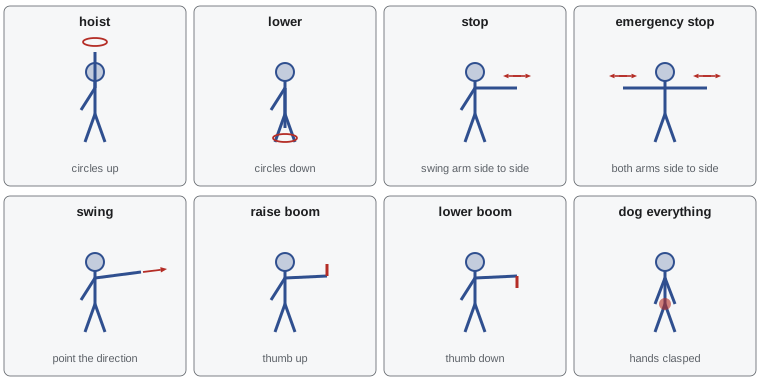
| Signal | How it is given |
|---|---|
| Hoist | Forearm vertical, forefinger pointing up, hand making small horizontal circles |
| Lower | Arm extended downward, forefinger pointing down, hand making small horizontal circles |
| Stop | Arm extended, palm down, arm moved back and forth horizontally |
| Emergency stop | Both arms extended, palms down, arms moved back and forth horizontally |
| Swing | Arm extended, forefinger pointing in the direction of swing |
| Raise boom or lower boom | Arm extended, fingers closed, thumb pointing up or down |
| Extend or retract boom | Both fists in front of the body, thumbs pointing outward to extend or toward each other to retract |
| Use main hoist or auxiliary hoist | Tap fist on head for the main hoist, or tap elbow with the other hand for the auxiliary line, then give regular signals |
| Move slowly | Give the signal with one hand while holding the other hand motionless in front of it |
| Dog everything | Clasp hands in front of the body; stop all motion and hold |
Signals must be given clearly and continuously while the motion is wanted. When the signaller stops signalling, the operator stops. An unclear signal should get no response: the operator stops and waits for a clear one. Directions such as left and right must be given from the operator's point of view, which is why swing signals point in the direction of movement rather than using words.
Non-standard signals should be avoided. If the work involves a motion or attachment the standard signals do not cover, the operator, signaller and lift director must agree on any special signal before the lift and record it in the plan.
Where the signaller stands
The signaller's position is a safety decision in itself. They must be where they can see the load, its path and the landing area, and where the operator can see them clearly. They must also be safe: outside the fall zone, clear of the swing radius and pinch points, not walking backward near edges, and protected from traffic. High-visibility gloves and clothing help the operator pick out the signaller's hands against a busy background. If no single position gives a view of both the load and the operator, the lift needs radio communication or a relay arrangement.
Radio and voice signals
When the operator cannot see the signaller, radios carry the signals. Radio communication brings its own failure modes: dead batteries, crossed channels, noise, dead spots and misunderstandings. Good radio practice addresses each of these.
- Test the radios at the lift location before the lift starts.
- Use a dedicated channel that nobody else uses during the lift.
- Identify the crane at the start of each instruction if more than one crane is on the channel.
- Give each instruction as function, direction, distance or speed, then the stop: for example, hoist up, ten metres, five, three, one, stop.
- Keep talking during blind movements so that silence means stop.
- Agree on what the operator does if communication is lost: stop all motion and wait.
Canadian employers usually set radio procedures in their lifting programs, often following CSA Z150 guidance and IHSA or provincial safety association material.
Reaction time matters
Every signal takes time to work. The signaller has to notice the problem, give the signal, and the operator has to see or hear it, understand it and move the controls. Then the crane takes time to stop. During all of that, the load keeps moving.
Worked problem
How far does a load move before it stops?
A load is swinging at a radius of 25 m while the crane slews at 1 revolution per minute. The total time from the signaller seeing a problem to the crane beginning to stop is about 2 seconds. How far does the load travel in that time?
Show solution
- Circumference at the load: \( 2 \pi r = 2 \pi \times 25 = 157 \) m.
- At 1 revolution per minute, the load moves \( \tfrac{157}{60} = 2.6 \) m/s.
- In 2 seconds it travels \( 2.6 \times 2 = 5.2 \) m before the crane even starts to slow.
- Slowing a swinging load takes more distance, and the load may keep swinging after the crane stops.
Answer: More than 5 m. Signallers must give slow and stop signals early, well before the load reaches an obstruction or a person, and the plan should limit swing speed near hazards.
Worked problem
Choosing a communication method
A rooftop unit must be lifted over the front of a four-storey building and landed on the roof, behind a parapet. The crane is in the street in front. The operator can see the pickup point but not the roof. From the roof, a person can see the landing area but not the operator's cab. The site is noisy. What communication arrangement should the plan specify?
Show solution
- Hand signals alone will not work, because nobody can see both the landing area and the operator.
- One option is a relay: a signaller on the roof passes signals to a second signaller on the street who is in the operator's view. Relays add delay and the chance of error, so they need practice and simple signals.
- A better option is radio: the roof signaller, who can see the load and landing area, gives continuous voice signals on a dedicated channel to the operator through a hands-free headset.
- A second person at street level can watch the pickup area and the swing radius and has authority to give a stop.
- The plan should say who signals during each phase, how control passes from the street signaller to the roof signaller, which channel is used and what happens if radio contact is lost.
Answer: Use radio with a dedicated channel and a hands-free headset for the operator, a qualified signaller on the roof for the landing, a defined handover from the ground signaller, and a lost-communication rule of stop all motion.
Communication beyond signals
Signals are the last link in a chain of communication that starts with the lift plan. The pre-lift meeting is where everyone learns the plan, agrees on signals and channels, identifies the signaller and confirms that everyone understands the stop rule. Language matters: signals and instructions must be understood by everyone involved, and workers who share a site may not share a first language. Noise from generators and traffic, glare at sunrise and sunset, rain and darkness all degrade communication and should be planned for, for example with better lighting, headsets or a pause in nearby noisy work.
When communication is lost or unclear, stop. That rule is simple and easy to remember, and it prevents most communication failures from becoming incidents.
Signalling overhead cranes and hoists
In plants, overhead cranes are often operated from a pendant or a radio remote by the same person who rigs the load, so there may be no separate signaller at all. That person must be able to see the load, its path and the people near it throughout the lift. When the load must travel out of the operator's sight, for example around a column or into another bay, a second person should act as signaller using the overhead crane signals in ASME B30.2 and CSA B167, which differ in some details from mobile crane signals; bridge travel and trolley travel, for example, have their own signals.
Plants should post the signal chart near each crane, train every authorized user in it and make sure the warning horn or light is used before travelling a load through an occupied area. Where many cranes share a building, labelling each crane and its remote clearly prevents a user from moving the wrong crane, a surprisingly common cause of incidents. Supervisors should watch for informal habits, such as waving a load along with a hand gesture nobody agreed on, and correct them before they become the norm.
Common mistakes
MistakeLetting several workers give signals to the operator at once.
InsteadDesignate one signaller at a time; anyone may give a stop.
MistakeUsing informal or invented hand signals.
InsteadUse the standard signals; agree on any special signal before the lift.
MistakeContinuing to move the load when a signal is unclear.
InsteadStop and wait for a clear signal.
MistakeStanding in the swing radius or under the load to get a better view.
InsteadChoose a safe position with a clear view, or use radio.
MistakeStarting a radio-controlled lift without testing radios or agreeing on a channel.
InsteadTest radios on site, use a dedicated channel and agree on a lost-signal rule.
Summary and key terms
- A signaller is needed whenever the operator cannot see the load, its path or the landing area, or site hazards require one.
- Signallers must be competent and trained; Ontario requires oral and written instructions and high-visibility apparel.
- Only one person gives movement signals, but anyone can give a stop, and the operator must obey it.
- Standard hand signals from ASME B30.5, CSA Z150 and OSHA Appendix A should be used and posted.
- Radio signals need on-site testing, a dedicated channel, continuous talk and a lost-communication rule.
- Reaction time means loads keep moving after a signal; give slow and stop signals early.
- Signaller
- The designated worker who directs the crane operator by hand, voice or radio signals.
- Blind lift
- A lift in which the operator cannot see the load or landing area.
- Point of operation
- The load and the area where it is being moved or landed.
- Standard hand signals
- The published set of crane signals in ASME B30.5, CSA Z150 and OSHA Subpart CC Appendix A.
- Dedicated channel
- A radio channel used only for one lift or crane operation.
- Relay signalling
- Passing signals through a second signaller who can see the operator.
- Dog everything
- A signal to stop all motion and hold.
Practice problems
Work each problem on paper first, then reveal the answer to check.
Name two situations that require a signaller.
Show answer
When the operator cannot see the load or landing area, when the travel path is obstructed, or when site hazards require it.
How many people may give movement signals at one time?
Show answer
One.
Who may give a stop signal?
Show answer
Anyone who sees a hazard; the operator must obey it.
Describe the hoist signal.
Show answer
Forearm vertical, forefinger pointing up, small horizontal circles.
Describe the emergency stop signal.
Show answer
Both arms extended, palms down, moved back and forth horizontally.
What should an operator do when a signal is unclear?
Show answer
Stop and wait for a clear signal.
Why give directions from the operator's point of view?
Show answer
Left and right differ for the signaller and operator; pointing in the direction of movement avoids confusion.
List three good radio practices.
Show answer
Test on site, use a dedicated channel, keep talking during blind moves, identify the crane, agree on a lost-signal rule.
A load at 20 m radius slews at 1 rpm. How far does it move in 2 s?
Show answer
\( 2 \pi \times 20 / 60 \times 2 = 4.2 \) m.
What is the rule when communication is lost?
Show answer
Stop all motion and wait until communication is restored.
Lesson quiz · 5 questions
Score 60% or more to complete this lesson.
Create a free account to save your progress, take quizzes and earn a certificate.