
HSE-219 · Lesson 1 of 12 · 28 min
Why lifts go wrong
Cranes and hoists move loads that no person could move alone, and they do it every day on construction sites, in steel mills, at ports, in warehouses and in plants. Most lifts end safely because someone planned them, rigged them correctly and kept people out of harm's way. When a lift goes wrong, though, the consequences are rarely minor. A dropped load, an overturned crane or a boom touching a power line can kill people who were not even part of the lift.
This course is awareness and supervisor training. It explains how lifting operations fail, what the law and standards expect, how to recognize sound rigging and planning, and how to keep yourself and others clear of the load. It does not qualify anyone to operate a crane, to rig loads or to signal a crane operator.
In Ontario, operators of mobile cranes rated over 16,000 lb need a certificate of qualification as a hoisting engineer (mobile crane operator 1 or 2) or a registered apprenticeship under the Building Opportunities in the Skilled Trades Act, and tower crane operators need the tower crane trade. Other provinces have their own trade certification. Riggers and signallers must be competent for the work, which means the employer must train them, check that they can do the task and keep proof of it. Completing this course is one part of that picture, not a substitute for it.
What a lift actually involves
It helps to think of a lift as a system with six parts. If any one of them fails, the whole lift can fail.
- The crane or hoist: its structure, its rated capacity in the configuration used, its safety devices and its condition.
- The ground or supporting structure: soil, mats, outrigger pads, floors, runway beams and anything else that carries the crane's weight and the load.
- The rigging: slings, shackles, hooks, spreader bars and the way they are attached to the load.
- The load: its true weight, its centre of gravity, its strength and its lifting points.
- The people: operator, rigger, signaller, lift supervisor and everyone else on site, including people who simply walk past.
- The environment: wind, weather, visibility, power lines, nearby structures, other cranes and traffic.
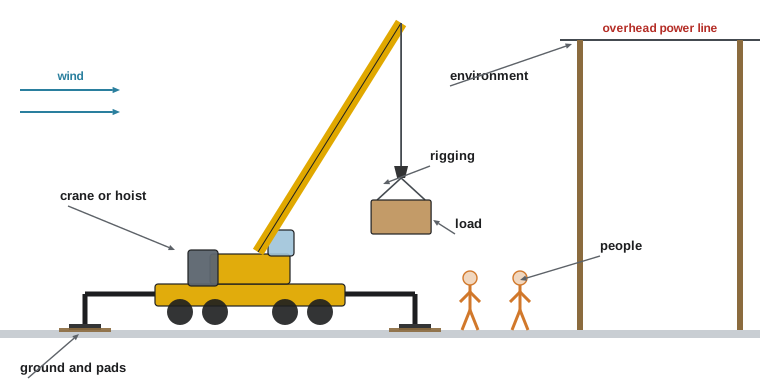
Most serious incidents involve more than one part. A crane may overturn because the load was heavier than the shipping paper said, the outrigger pad sat over a backfilled trench, and the operator was relying on a signaller who could not see the load. Each weakness alone might have been survivable. Together they were not.
What the numbers show
Canada does not publish a single national count of crane-related deaths. Provincial workers' compensation boards and ministries report crane incidents through their own fatality and serious injury reports, and these consistently show the same patterns found elsewhere: workers struck by loads or crane parts, cranes overturning, and contact with overhead power lines. The most detailed public breakdown comes from the United States, and Canadian safety associations such as IHSA in Ontario use similar categories in their crane safety material.
The Bureau of Labor Statistics counted 297 crane-related workplace deaths in the United States from 2011 to 2017, an average of about 42 a year. More than half of them, 154 deaths, happened when a worker was struck by an object or equipment, and 91 of those involved a falling object such as a dropped load or a collapsing boom. Private construction accounted for 43 per cent of the deaths and manufacturing for 24 per cent.
| Finding (U.S., 2011 to 2017) | Value | What it suggests |
|---|---|---|
| Crane-related deaths | 297 (about 42 a year) | Crane deaths are not rare events on a national scale |
| Struck by an object or equipment | 154 deaths, about 52 per cent | Keeping people out of the load path and fall zone matters most |
| Struck by a falling object | 91 of the 154 | Rigging, load control and structural integrity are central |
| Private construction | 43 per cent | Construction sites need strong lift planning and exclusion zones |
| Manufacturing | 24 per cent | Overhead cranes and hoists in plants are a major exposure too |
These counts cover deaths only. Dropped loads, crushed hands during rigging, near misses and property damage are far more common and are where most learning should come from. A crane that touched down an outrigger in soft ground and settled 50 mm before the operator stopped is a gift: it shows exactly where the next overturn will start.
How lifts fail
Lifting incidents fall into a small number of patterns. Learning to recognize them is the first step in spotting the conditions that lead to them.
| Failure pattern | Typical underlying causes | Main controls |
|---|---|---|
| Overturning (tip-over) | Load heavier than thought, radius larger than planned, outriggers not fully extended, soft or undermined ground, side loading | Accurate weights, lift calculation, ground assessment, mats, load moment indicator |
| Structural failure | Overload, damaged or modified boom, wrong configuration, poor assembly, fatigue cracks | Inspection, following the load chart for the actual configuration, qualified assembly |
| Dropped load | Wrong hitch, sling too weak or damaged, sharp edges, unbalanced load, no hook latch, two-blocking | Correct rigging, inspection, edge protection, anti-two-block device, trial lift |
| Power line contact | Work too close to overhead lines, no spotter, misjudged distance, boom swing | Planning, limits of approach, de-energizing, spotters and barriers |
| Struck by swinging load or crane | People in the swing radius, pinch points at the counterweight, uncontrolled load rotation | Barricades, exclusion zones, tag lines, communication |
| Falls and caught-in during assembly | Working on booms or jibs without fall protection, removing pins on the wrong side | Manufacturer procedures, qualified assembly director, fall protection |
Look at how many of the causes sit outside the operator's cab. The weight of the load is a planning and communication problem. Ground conditions are a site management problem. Rigging is a rigger and supervisor problem. People in the fall zone are everyone's problem. That is why supervisors, site managers and workers who never touch the controls still need to understand how lifts fail.
The energy in a suspended load
A suspended load stores energy. If it falls, that energy goes into whatever it hits. The potential energy of a load is its mass times gravitational acceleration times the height it can fall.
Worked problem
How much energy does a dropped load carry?
A bundle of steel weighing 2,000 kg is being lifted 10 m above a deck. How much energy is released if it falls, and how fast is it moving when it hits the deck? Ignore air resistance.
Show solution
- Energy: \( E = m g h = 2000 \times 9.81 \times 10 = 196\,200 \) J, or about 196 kJ.
- Impact speed: \( v = \sqrt{2 g h} = \sqrt{2 \times 9.81 \times 10} = 14.0 \) m/s.
- Convert to a familiar unit: \( 14.0 \times 3.6 = 50 \) km/h.
- For comparison, that is roughly the energy of a 1,500 kg car hitting a wall at about 58 km/h.
Answer: About 196 kJ, arriving at roughly 50 km/h. No hard hat or work boot offers meaningful protection from that; only distance does.
The example makes a simple point: personal protective equipment does not protect anyone from a falling load. The control that works is keeping people out of the area where the load could land. That idea, the fall zone, returns in almost every lesson of this course.
Applying the hierarchy of controls to lifting
The hierarchy of controls from HSE-103 applies to lifting just as it does to any other hazard. Start at the top and work down.
| Level | Lifting examples |
|---|---|
| Elimination | Deliver materials directly to their final position; design so that heavy items are set before walls go up; avoid lifts over occupied areas entirely |
| Substitution | Use a smaller crane closer to the load, lift lighter subassemblies, use a material hoist instead of crane picks, choose a crane with a larger capacity margin |
| Engineering controls | Load moment indicators, anti-two-block devices, swing limiters, outrigger monitoring, engineered lifting lugs, spreader beams, crane mats |
| Administrative controls | Lift plans, critical lift procedures, exclusion zones, qualified operators and riggers, inspections, wind limits, permits near power lines |
| Personal protective equipment | Hard hats, gloves, high-visibility clothing and safety footwear protect against minor hazards around the lift, not against a falling load |
The best lifts are often the ones that never happen. A project team that sequences deliveries so that rooftop units arrive while the crane is already on site for steel avoids a second mobilization and a second set of risks. A plant that installs a jib crane at a workstation removes dozens of improvised lifts with chain falls hung from beams that were never rated for them.
A simple risk screen for a lift
Not every lift needs an engineer. A tote of bolts lifted onto a scaffold by a small overhead hoist is very different from a 90-tonne transformer set with two cranes. Many employers use a short screening tool to decide how much planning a lift needs.
Worked problem
Screening a lift
A site plans to lift a 6,800 kg precast stair unit with a mobile crane whose chart capacity at the planned radius and configuration is 8,500 kg, including deductions. The lift passes near an occupied site office and a 27.6 kV overhead line is 12 m from the crane. Should this be treated as an ordinary or a critical lift?
Show solution
- Percentage of capacity: \( \tfrac{6800}{8500} \times 100 = 80 \) per cent.
- Many employers treat any lift above 75 per cent of chart capacity as critical; Alberta's OHS Code requires a written lift calculation at 75 per cent or more.
- The load path passes near an occupied building, which raises the consequence of a dropped load.
- The overhead line is within reach of the boom's swing, so limits of approach and controls for power lines must be planned.
- Each factor alone pushes the lift toward critical. Together they clearly require a written critical lift plan.
Answer: Treat it as a critical lift. It needs a written plan, a review of the ground, rigging and power line controls, and the office should be cleared or the load path moved.
Lesson 5 returns to lift planning in detail. For now, the habit to build is simple: before any lift, ask how heavy the load really is, how close to capacity the crane will be, what is underneath the load path and what is overhead.
Who this course is for
This course is written for site supervisors, foremen, safety coordinators, plant maintenance leads, project engineers and workers who work around lifting operations. It will help you:
- recognize unsafe conditions before a lift starts;
- check that the people doing the work hold the right qualifications;
- read a lift plan and a load chart well enough to ask good questions;
- inspect slings and hardware for obvious defects and remove them from service;
- set up and enforce exclusion zones; and
- respond correctly when something goes wrong.
If you will operate a crane, rig loads or signal as part of your job, you need the trade certification, employer training and evaluation required where you work. Related HSE courses cover topics that overlap with lifting: HSE-212 for fall protection, HSE-218 for telehandlers and forklifts with suspended loads, and HSE-224 for the electrical background to overhead power line hazards.
Common mistakes
MistakeTreating a crane incident as the operator's fault by default.
InsteadLook at the whole system: load weight, ground, rigging, communication, environment and planning.
MistakeBelieving a hard hat protects you if you stand under a load.
InsteadOnly distance protects you; stay out of the fall zone.
MistakeAssuming awareness training qualifies a worker to rig or signal.
InsteadRigging, signalling and operating need the competence, certification and evaluation required by law.
MistakeIgnoring near misses because nobody was hurt.
InsteadReport and investigate near misses; they show where the next serious incident will come from.
MistakePlanning every lift the same way regardless of risk.
InsteadScreen lifts and give critical lifts more planning, review and supervision.
Summary and key terms
- A lift is a system of crane, ground, rigging, load, people and environment; weakness in any part can cause failure.
- In the United States, 297 workers died in crane-related incidents from 2011 to 2017, more than half struck by objects or equipment.
- Common failure patterns are overturning, structural failure, dropped loads, power line contact, struck-by and falls during assembly.
- A suspended load carries enough energy to kill; distance from the fall zone is the only reliable protection.
- The hierarchy of controls applies to lifting, from eliminating lifts to engineered limit devices and lift plans.
- This course builds awareness; it does not certify operators, riggers or signallers.
- Lift
- The complete operation of raising, moving and landing a load with a crane or hoist.
- Fall zone
- The area where a load or part of it could fall if it slipped, broke free or the crane failed.
- Overturning
- A crane tipping over because the load moment exceeded its stability.
- Two-blocking
- Contact between the hook block and the boom tip sheaves, which can break the hoist line and drop the load.
- Critical lift
- A lift with elevated risk, for example close to chart capacity, involving multiple cranes or over occupied areas, that requires a written plan.
- Load moment indicator
- A device that monitors load, radius and boom configuration and warns or stops the crane as it nears its limits.
- Qualified rigger
- A rigger with the knowledge, training and experience to rig loads safely for the work, as required by the employer and the law.
Practice problems
Work each problem on paper first, then reveal the answer to check.
Name the six parts of the lift system described in this lesson.
Show answer
The crane or hoist, the ground or supporting structure, the rigging, the load, the people and the environment.
What was the most common type of event in U.S. crane deaths from 2011 to 2017?
Show answer
Being struck by an object or equipment, in 154 of 297 deaths.
Calculate the energy released if a 500 kg load falls 6 m.
Show answer
\( 500 \times 9.81 \times 6 = 29\,430 \) J, about 29 kJ.
Why does personal protective equipment not control the main hazard of a suspended load?
Show answer
The energy of a falling load far exceeds what a hard hat or boots can absorb; only distance protects.
Give an example of eliminating a lift.
Show answer
Delivering material directly to its final position, or setting heavy equipment before walls are built so no later lift is needed.
List three causes of crane overturning.
Show answer
Overload or understated weight, radius larger than planned, soft or undermined ground, outriggers not fully extended, side loading.
What is two-blocking and why is it dangerous?
Show answer
The hook block contacts the boom tip; the hoist line can break and drop the load.
A load is 4,200 kg and the chart capacity is 5,000 kg. What percentage of capacity is that?
Show answer
84 per cent.
Why are near misses valuable?
Show answer
They reveal hazards and weak controls before someone is hurt.
Does this course qualify you to signal a crane?
Show answer
No. Signalling requires the competence or qualification required by law and evaluation by the employer.
Lesson quiz · 5 questions
Score 60% or more to complete this lesson.
Create a free account to save your progress, take quizzes and earn a certificate.