
HSE-219 · Lesson 11 of 12 · 29 min
Exclusion zones, site coordination and emergency response
Lesson 1 showed that more than half of crane deaths involve workers struck by objects or equipment. Most of those workers were not operating the crane. They were walking past, working below, standing near the counterweight or guiding a load from too close. Exclusion zones keep people out of the places where a lift can hurt them, site coordination keeps lifts from colliding with other work, and emergency planning makes sure that when something does go wrong, the response does not make it worse.
The zones around a lift
Several overlapping zones surround every crane lift. Each needs its own control.
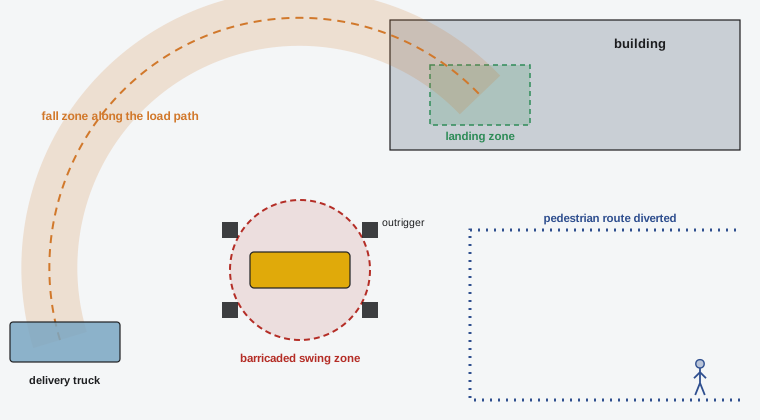
- The fall zone is the area where a load or part of it could land if it slipped, broke free or the crane failed. It includes the area directly under the load and extends beyond it, because falling loads can drift, tumble, slide or scatter debris.
- The counterweight or tail swing zone is the area swept by the rotating upperworks of the crane. Anyone caught between the counterweight and a fixed object can be crushed.
- The landing zone is where the load will be set down. Only the workers needed to receive and land the load may be there, and only when the load is close to landing.
- The outrigger and track areas can be hazardous if a float settles or a beam moves.
- Power line zones are covered in Lesson 9.
Canadian rules generally prohibit moving loads over workers where it can be avoided and require that workers not stand or pass under a suspended load. Alberta's section 69 says lift planning must ensure, wherever possible, that loads are not moved over workers, and that workers who must be nearby are warned. Ontario's construction regulation requires that loads not pass over workers and that areas where workers could be endangered be controlled.
Sizing and marking the fall zone
There is no single formula for the size of a fall zone. It depends on the load's size, height, shape and the way it might fail. A compact steel casting dropped from a low height lands nearly straight below. A sheet of plywood, a bundle of pipe or a panel lifted high in wind can glide or scatter well beyond its footprint. Good practice is to mark a zone that covers the load path with a generous margin on each side, and to make it larger for higher lifts, lighter flat loads and windy conditions.
Worked problem
Barricading a load path
Precast panels 6 m long are lifted from a trailer and swung along a 30 m path to the building. The site's procedure sets a fall zone margin of 3 m beyond each side of the load's swept width. If the panels are carried with their long side across the path, what width and area must be controlled along the path?
Show solution
- Swept width of the load: 6 m, with the panel's long side across the path.
- Controlled width: \( 6 + 2 \times 3 = 12 \) m.
- Area along the path: \( 12 \times 30 = 360 \) m², plus the pickup and landing areas.
- Because the load swings on an arc rather than a straight line, the real zone is a curved band; plan it on a site drawing using the crane position and radius.
Answer: A band about 12 m wide, roughly 360 m² along the path. Anything in that band, people, parked vehicles, trailers or temporary offices, must be cleared or protected, or the path changed.
Fall zones are marked with barricades, fencing, warning tape, cones and signs, and enforced by a person whose job is to keep people out. On multi-storey buildings, floors below a load path may need to be cleared, and work under a tower crane's regular routes may need overhead protection or rescheduling. Where a load must pass over an occupied area, such as a lift over an operating plant, the plan should say how people will be moved, warned or protected for the duration.
The counterweight swing zone
A rotating crane's counterweight can crush a person against a truck, a wall, a scaffold or another machine. Operators usually cannot see behind the crane while swinging. The zone is controlled by barricading it so nobody can walk in, with the barricade placed far enough from the counterweight that a person standing at it cannot be reached.
Worked problem
Placing a swing radius barricade
A rough terrain crane has a tail swing radius of 4.2 m, measured from the centre of rotation to the farthest point of the counterweight. The site procedure requires a barricade at least 0.6 m beyond the tail swing. One side of the crane is 4.5 m from a building wall. What barricade radius is needed, and is the wall a problem?
Show solution
- Barricade radius: \( 4.2 + 0.6 = 4.8 \) m from the centre of rotation.
- The wall is 4.5 m from the centre of rotation, which is inside the barricade radius.
- The gap between the counterweight and the wall is only \( 4.5 - 4.2 = 0.3 \) m, a crushing hazard that the barricade cannot fully enclose.
- The space between the crane and the wall must be physically closed off at both ends so nobody can enter it while the crane can swing, or the crane must be moved so the gap is either very large or the swing toward the wall is prevented.
Answer: A barricade at 4.8 m, but the narrow gap to the wall is a crush point that must be blocked off completely or eliminated by moving the crane.
Site coordination
On a busy site, a crane is one activity among many. Lifts need to be scheduled so that other trades know when areas will be closed, deliveries arrive when the crane and crew are ready, and loads do not travel over workers on scaffolds or roofs. A daily lift schedule, a crane coordination meeting and a single person responsible for crane priorities help prevent conflicts.
| Coordination task | Purpose |
|---|---|
| Daily lift schedule shared with all trades | Everyone knows when and where lifts happen |
| Crane coordinator or lift director for the site | One person sets priorities and resolves conflicts |
| Permits for critical lifts and lifts near power lines | Ensures plans are reviewed and approved |
| Traffic and pedestrian plans | Keeps vehicles and people out of fall and swing zones |
| Public protection and municipal permits | Closes sidewalks or lanes when loads pass near or over them |
| Coordination with other cranes and equipment | Prevents collisions and overlapping fall zones |
| Shift handover notes | Passes on crane status, defects and incomplete lifts to the next crew |
Work above other work is a recurring problem. A crane setting roof trusses over a floor where electricians are working, or a tower crane flying rebar bundles over a busy deck, puts people in the fall zone for hours at a time. The answer is usually scheduling, rerouting the load path or clearing the area below, not asking workers to watch out.
Emergency planning
Every lift plan should include what to do if something goes wrong, and critical lifts should have a specific emergency section. The crew should talk through the most likely emergencies at the pre-lift meeting so that everyone knows their part before it is needed.
| Emergency | Key response |
|---|---|
| Dropped load | Stop all crane motion, keep people away until the load and rigging are stable, care for injured workers, secure the scene |
| Crane overturn or structural failure | Clear the area of secondary hazards such as fuel, hydraulics and unstable components, call emergency services, do not attempt to right the crane |
| Power line contact | Operator stays in the cab unless there is fire, everyone stays well back, call the utility and emergency services |
| Load stuck in the air from mechanical or power failure | Keep the fall zone clear, follow the manufacturer's emergency lowering procedure, never send people under the load |
| Worker trapped under a load | Call emergency services; use the crane to lift the load only if the crane and rigging are sound and a competent person directs it |
| Operator medical emergency at height | Activate the high-angle rescue plan, which must exist before tower crane work starts |
| Sudden high wind or storm | Land or secure the load, stop operations, follow the manufacturer's out-of-service procedure |
Tower crane operators work in cabs tens of metres above the ground. If an operator becomes ill or injured, getting them down requires trained rescuers, rope rescue equipment and a plan that has been practised. Local fire services may or may not have high-angle rescue teams that can respond quickly; the employer must find out and plan accordingly before the crane is erected.
Reporting and investigation
In Ontario, the Occupational Health and Safety Act requires immediate notice to the Ministry of Labour, Immigration, Training and Skills Development of a death or critical injury, with a written report within 48 hours, and the scene must not be disturbed except to save life, relieve suffering or prevent further damage. The Act and the construction regulation also require notice of certain incidents even when nobody is hurt, such as the collapse or failure of a crane or hoisting device; check the current list in the regulation. Other provinces have similar rules.
Every crane incident and near miss should be investigated to find root causes, not just the immediate trigger. A dropped load may trace back to a missing weight on a shipping document, a sling that should have been retired months ago or a schedule that pushed the crew to lift in rising wind. The investigation methods in HSE-103 apply: gather facts, preserve evidence such as the load moment indicator data log and the failed rigging, interview witnesses, and identify the system failures behind the event.
Worked problem
Responding to a near miss
During a lift of formwork panels, a gust swings a panel and it strikes the edge of a scaffold, knocking a toolbox off the platform. Nobody is hurt and the panel is landed safely. The foreman wants to keep working because the schedule is tight. What should happen?
Show solution
- Stop lifting and secure the area. Check the scaffold for damage and confirm nobody is injured.
- Check the wind at height against the manufacturer's and the plan's limits; formwork panels have large sail areas.
- Record the near miss and report it according to the site procedure.
- Review why the load path passed close to a scaffold where tools could be knocked off, whether workers were below, and whether tag lines or a different path would control the load better.
- Resume only when wind is within limits and the plan has been adjusted, for example with a revised path, cleared scaffold platforms or a lower wind limit for panels.
Answer: Stop, check, report and fix the plan before resuming. A near miss is a warning that the next gust could hit a person instead of a toolbox.
Common mistakes
MistakeMarking only the spot directly under the load as the fall zone.
InsteadInclude the whole load path with a margin for drift, tumbling and scatter.
MistakeLeaving the gap between the counterweight and a wall open.
InsteadBarricade the swing radius and block off any crush points.
MistakeLetting other trades work under the load path to save time.
InsteadSchedule, reroute or clear the area below.
MistakeSending a worker under a stuck load to fix it.
InsteadKeep the fall zone clear and follow the manufacturer's emergency lowering procedure.
MistakeTreating a near miss as a lucky escape.
InsteadReport it, investigate it and fix the plan before resuming.
Summary and key terms
- Each lift has a fall zone, a counterweight swing zone, a landing zone and outrigger areas, each needing control.
- Loads should not pass over workers; only those receiving or guiding the load may be near it, under strict conditions.
- Fall zones should cover the load path with a margin that grows with height, wind and flat or loose loads.
- Swing radius barricades keep people away from the counterweight; crush points against walls must be closed off.
- Site coordination, lift schedules and a single coordinator prevent conflicts with other work and other cranes.
- Emergency plans, reporting duties and root-cause investigations turn incidents and near misses into lessons.
- Fall zone
- The area where a load or part of it could reasonably fall if something went wrong.
- Tail swing radius
- The distance from the centre of rotation to the farthest point of the rotating counterweight.
- Landing zone
- The area where a load is set down and received.
- Barricade
- A physical barrier that prevents entry to a hazardous area.
- Lift schedule
- A plan of when and where lifts will happen, shared with other trades.
- High-angle rescue
- Rescue of a person from height using ropes and specialized equipment.
- Root cause
- An underlying system failure that allowed an incident to happen.
Practice problems
Work each problem on paper first, then reveal the answer to check.
Name four zones around a crane lift.
Show answer
Fall zone, counterweight swing zone, landing zone, outrigger areas; also power line zones.
Why is the fall zone larger than the load's footprint?
Show answer
Falling loads can drift, tumble, slide or scatter debris.
A load 4 m wide is carried along a 20 m path with a 2 m margin each side. What area is controlled?
Show answer
\( (4 + 4) \times 20 = 160 \) m².
Tail swing is 3.8 m and the required clearance is 0.6 m. Where does the barricade go?
Show answer
At 4.4 m from the centre of rotation.
What should be done about a narrow gap between the counterweight and a wall?
Show answer
Block it off completely so nobody can enter, or move the crane.
Give three site coordination tasks for crane work.
Show answer
Daily lift schedule, a crane coordinator, permits, traffic plans, public protection, shift handovers.
What should happen if a load is stuck in the air because of a mechanical failure?
Show answer
Keep the fall zone clear and follow the manufacturer's emergency lowering procedure.
Why must a high-angle rescue plan exist before tower crane work begins?
Show answer
An ill or injured operator at height needs trained rescuers and equipment that may not be available quickly otherwise.
Within what time must a death or critical injury be reported in Ontario?
Show answer
Immediately, with a written report within 48 hours.
What evidence should be preserved after a crane incident?
Show answer
The load moment indicator data log, failed rigging, the scene, photographs and witness accounts.
Lesson quiz · 5 questions
Score 60% or more to complete this lesson.
Create a free account to save your progress, take quizzes and earn a certificate.