
HSE-219 · Lesson 6 of 12 · 30 min
Rigging hardware and its inspection
Rigging is everything between the crane hook and the load: slings, shackles, hooks, eyebolts, hoist rings, spreader beams and lifting beams. It is often the cheapest part of a lift and the part most likely to be damaged, misused or left in service after it should have been thrown away. A crane with a perfect inspection record will still drop a load if the sling under the hook is cut, kinked or overloaded.
This lesson describes the main types of rigging hardware, explains rated loads and design factors, and sets out what to look for during inspection and when to remove an item from service. It does not make anyone a qualified rigger, but it should allow a supervisor to recognize obviously defective gear and to ask the right questions of the people using it.
Rated load, design factor and the identification tag
Every piece of lifting hardware has a rated load, also called the working load limit: the maximum load the manufacturer allows in a stated configuration. The rated load is the minimum breaking strength divided by a design factor. The design factor gives a margin for wear, small shock loads and imperfect conditions; it is not extra capacity for the user.
| Rigging type | Typical design factor in ASME B30.9 and B30.26 |
|---|---|
| Alloy steel chain slings | 4 to 1 |
| Wire rope slings | 5 to 1 |
| Synthetic web slings and round slings | 5 to 1 |
| Metal mesh slings | 5 to 1 |
| Shackles and other rigging hardware | Commonly 5 to 1 or 6 to 1, set by the manufacturer |
Slings must carry a legible identification tag showing the manufacturer, the rated loads for the hitches the sling may be used in, and details such as the size, material or grade. ASME B30.9 requires slings to be removed from service when the tag is missing or unreadable, because without it nobody can know the sling's capacity. Shackles, hooks and hoist rings are marked by forging or stamping with their rated load and the manufacturer's name or mark.
Worked problem
Breaking strength and design factor
An alloy steel chain sling is tagged with a working load limit of 5,400 kg for a vertical hitch. Its design factor is 4 to 1. What minimum breaking strength does the manufacturer guarantee, and what does this mean for a load that is snatched suddenly?
Show solution
- Minimum breaking strength: \( 5400 \times 4 = 21\,600 \) kg force.
- A load lifted smoothly puts about its own weight on the sling.
- A load that drops a short distance onto a slack sling, or is jerked off the ground, can briefly multiply that force several times.
- Combined with wear, a small nick or a tight bend, a snatch load can reach the breaking strength even though the static load was within the rated load.
Answer: At least 21,600 kg. The design factor is a margin for normal imperfections, not permission to snatch loads or exceed the rated load. Lift smoothly and take up slack slowly.
Types of slings
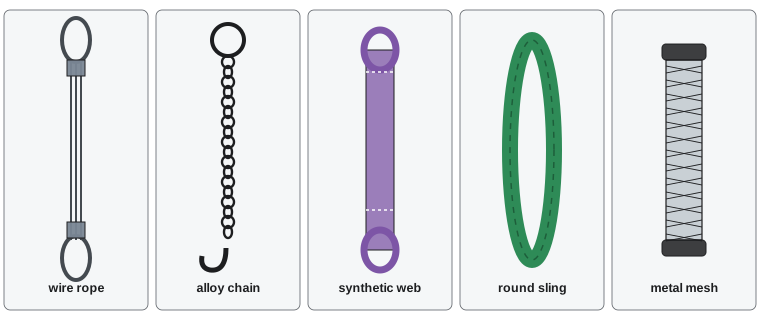
| Sling type | Strengths | Weaknesses |
|---|---|---|
| Wire rope | Strong, fairly light, resists abrasion and moderate heat | Damaged by kinking, crushing, sharp bends and corrosion |
| Alloy steel chain | Very durable, resists heat and rough handling, adjustable | Heavy; can fail suddenly from cracks; only alloy grades are suitable for overhead lifting |
| Synthetic web (nylon or polyester) | Light, flexible, protects finished surfaces | Easily cut by edges, damaged by heat, chemicals and sunlight |
| Round sling | Light, flexible, conforms to the load | Load-bearing core hidden inside the cover; easily cut |
| Metal mesh | Grips loads, resists abrasion and heat | Heavy, less common, damaged by distortion |
Chain used for overhead lifting must be alloy steel chain of a grade intended for lifting, such as grade 80 or grade 100, and marked accordingly. Transport chain, such as grade 30, 43 or 70 used for tie-downs, is not suitable for overhead lifting and must never be used as a sling. Homemade slings, knotted ropes and chains joined with bolts are not acceptable rigging.
Nylon and polyester web slings behave differently. Nylon stretches more and is damaged by acids; polyester stretches less and is damaged by alkalis. Both lose strength at elevated temperatures, and manufacturers set maximum service temperatures, commonly around 90°C (194°F). Many web slings and round slings contain coloured warning yarns or a red core cover that becomes visible when the outer layer is worn or cut through.
Shackles, hooks, eyebolts and other hardware
- Shackles connect slings to loads and to each other. Screw pin shackles are common for temporary connections; bolt type shackles with a nut and cotter pin are preferred where the pin could rotate or the shackle stays in place for long periods. A shackle pin must be the one supplied by the manufacturer for that shackle, never a bolt from the shelf.
- Hooks should have a latch that closes the throat, unless the application allows otherwise. A hook should carry the load in its bowl, not on its tip.
- Eyebolts and swivel hoist rings attach to threaded holes in the load. Shoulder eyebolts can be loaded at an angle only if fully seated with the shoulder flush, and their rated load drops sharply at angles; non-shoulder eyebolts are for vertical loading only. Swivel hoist rings rotate and pivot to align with the load and are preferred for angled lifts.
- Spreader beams and lifting beams are below-the-hook lifting devices. They must be designed for the purpose, marked with their rated load and weight, and inspected under ASME B30.20. A length of pipe or a piece of channel from the scrap pile is not a lifting beam.
- Wire rope clips, turnbuckles and master links all have their own ratings and installation rules. Wire rope clips, for example, must be installed with the saddle on the live, load-carrying part of the rope and torqued to the manufacturer's value.
Inspection: frequent and periodic
Rigging inspection happens at two levels. A frequent inspection is a visual check by a competent person before each use or each shift. A periodic inspection is a thorough, documented inspection of each item at least once a year, and more often when the rigging is used heavily, in harsh conditions or in critical service.
ASME B30.9 and B30.26 describe both levels and are widely used in Canada. Provincial regulations, such as Alberta's Part 21 and Ontario's rigging requirements, require rigging to be inspected, maintained and used in accordance with the manufacturer's instructions and sound practice, and to be removed from service when defective.
Removal criteria
Removal criteria are the conditions that mean an item must be taken out of service. They come from the manufacturer and the applicable standard, and the inspector should have them on hand. The table below gives common examples.
| Item | Common removal criteria |
|---|---|
| Any sling | Missing or illegible tag; evidence of heat damage; damage that causes doubt about strength |
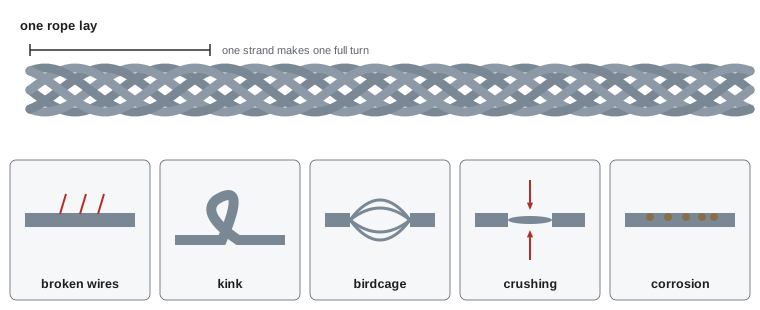
| Wire rope sling | For single-part slings, 10 randomly distributed broken wires in one rope lay or 5 broken wires in one strand in one lay; severe wear of outer wires; kinking, crushing, birdcaging or other distortion; corrosion; damaged end fittings |
| Alloy chain sling | Cracks, gouges or nicks; links stretched or worn beyond the manufacturer's limits; twisted or bent links; damaged hooks or master links |
| Synthetic web or round sling | Acid or caustic burns; melting or charring; holes, tears, cuts or snags; broken or worn stitching in load-bearing splices; exposed warning yarn or core; excessive abrasive wear; knots |
| Hooks | Cracks; throat opening increased beyond the limit (ASME B30.10 generally uses 5 per cent, not exceeding 6 mm or ¼ in); twist; missing or damaged latch |
| Shackles | Bent body or pin; wear beyond the manufacturer's limit, often 10 per cent of the original dimension; wrong pin; missing markings |
Worked problem
Counting broken wires
A 16 mm wire rope sling has a rope lay of about 105 mm. During the daily check a rigger finds 7 broken wires spread across different strands within one 105 mm length, and in that same length 3 of them are in a single strand. There is no kinking or corrosion. Does the broken-wire criterion require removal?
Show solution
- The criterion for a single-part sling is 10 randomly distributed broken wires in one rope lay, or 5 in one strand in one lay.
- Seven broken wires in one lay is below 10.
- Three broken wires in one strand is below 5.
- The broken-wire criterion is not yet met, but 7 broken wires in one lay is a clear sign of deterioration.
- The rigger should check the rest of the sling carefully, record the finding, and the employer may choose to remove it early, especially if it is used for critical lifts.
Answer: Not by the broken-wire count alone, but the sling is close to the limit and deteriorating. Many employers would retire it now. Any kink, crushing or heat damage found during the same inspection would require immediate removal.
Bending a sling: the D/d ratio
A wire rope sling bent around a small pin, a shackle or a sharp corner loses strength because the outer wires are stretched more than the inner ones. The effect depends on the D/d ratio: the diameter of the object the rope bends around, D, divided by the diameter of the rope, d. The smaller the ratio, the greater the loss. Manufacturers publish efficiency curves; typical values are shown below.
| D/d ratio | Approximate efficiency of the bent rope |
|---|---|
| 1 | About 50 per cent |
| 2 | About 65 per cent |
| 4 | About 75 per cent |
| 8 | About 83 per cent |
| 25 or more | About 95 per cent |
Worked problem
A sling around a small pin
A 22 mm wire rope sling is used in a basket around a 44 mm diameter pin on a load. The sling's rated load in a basket hitch on a large-diameter object is 7,600 kg. Estimate the effect of the small pin.
Show solution
- D/d ratio: \( \tfrac{44}{22} = 2 \).
- Approximate efficiency at D/d = 2: about 65 per cent.
- Reduced capacity: \( 7600 \times 0.65 = 4940 \) kg.
- The sling may also be permanently damaged by the tight bend, even below that load.
Answer: Roughly 4,900 kg instead of 7,600 kg, a loss of about a third. Use a shackle with a larger bow, a padded saddle or a different hitch, and check the manufacturer's D/d requirements.
Removing, storing and caring for rigging
When an item fails inspection, tag it out of service and remove it from the work area so nobody picks it up by mistake. Damaged slings should be destroyed or cut so they cannot be used again, and a record kept. Rigging should be stored off the ground, in a dry place out of sunlight and away from chemicals and heat, and hung on racks so it can be seen and does not get kinked or crushed. A tidy rigging loft makes inspection easy and makes missing or damaged items obvious.
Common mistakes
MistakeUsing a sling with a missing or unreadable tag because it looks fine.
InsteadRemove it from service; without a tag its capacity is unknown.
MistakeUsing transport chain or homemade slings for overhead lifting.
InsteadUse only alloy lifting chain and manufactured slings rated for lifting.
MistakeReplacing a lost shackle pin with an ordinary bolt.
InsteadUse only the manufacturer's pin for that shackle, or replace the shackle.
MistakeLoading a non-shoulder eyebolt at an angle.
InsteadUse non-shoulder eyebolts only for vertical loads; use swivel hoist rings for angled lifts.
MistakeLeaving a damaged sling in the gang box for someone else to sort out.
InsteadTag it out, remove it from the area and destroy it.
Summary and key terms
- Rated load equals minimum breaking strength divided by a design factor; the factor is a margin, not extra capacity.
- Slings must have a legible tag showing rated loads; missing tags mean removal.
- Wire rope, alloy chain, synthetic web, round and metal mesh slings each have strengths and weaknesses.
- Shackles, hooks, eyebolts, hoist rings and lifting beams must be rated, marked and used as the manufacturer intends.
- Rigging needs a visual check before each use and a documented periodic inspection at least yearly.
- Bending a wire rope around a small diameter reduces its strength; check the D/d ratio.
- Rated load
- The maximum load allowed by the manufacturer for an item in a stated configuration, also called working load limit.
- Design factor
- The ratio of minimum breaking strength to rated load.
- Rope lay
- The length along a wire rope in which one strand makes one complete turn.
- Birdcaging
- Wire rope damage in which strands open outward like a cage, usually from shock unloading.
- D/d ratio
- The diameter of the object a rope bends around divided by the rope diameter.
- Below-the-hook lifting device
- A device such as a spreader beam or lifting beam attached between the hook and the load.
- Swivel hoist ring
- A threaded lifting attachment that pivots and rotates to align with the sling angle.
Practice problems
Work each problem on paper first, then reveal the answer to check.
What is the typical design factor for wire rope slings?
Show answer
5 to 1.
A shackle has a minimum breaking strength of 30,000 kg and a design factor of 6. What is its rated load?
Show answer
5,000 kg.
Why must a sling with a missing tag be removed?
Show answer
Its rated load cannot be known.
Which chain grades are suitable for overhead lifting?
Show answer
Alloy grades intended for lifting, such as grade 80 or 100, marked accordingly.
Name three removal criteria for synthetic web slings.
Show answer
Acid or caustic burns, melting or charring, cuts or tears, broken stitching, exposed warning yarns, knots.
What is the broken-wire removal criterion for a single-part wire rope sling?
Show answer
10 randomly distributed broken wires in one rope lay, or 5 in one strand in one lay.
How often should rigging have a documented periodic inspection?
Show answer
At least once a year, more often for severe or critical service.
A 20 mm rope bends around an 80 mm pin. What is the D/d ratio and approximate efficiency?
Show answer
D/d = 4; about 75 per cent.
Why should a shoulder eyebolt be fully seated before an angled lift?
Show answer
Its angled rating depends on the shoulder bearing flush against the load.
What should happen to a sling that fails inspection?
Show answer
Tag it out, remove it from the work area and destroy it, keeping a record.
Lesson quiz · 5 questions
Score 60% or more to complete this lesson.
Create a free account to save your progress, take quizzes and earn a certificate.