
HSE-219 · Lesson 7 of 12 · 30 min
Rigging practice: hitches, sling angles and load control
Choosing sound rigging is only half the job. The way slings are attached to the load, the angles they form and the way the load is guided and landed decide whether that rigging carries its rated load or fails well below it. Many dropped loads involve slings that passed inspection that morning but were used in the wrong hitch, at too flat an angle or across a sharp edge.
This lesson explains the basic hitches, how sling angles multiply the tension in each leg, how unequal load sharing arises, how to protect slings from edges, and how to control and land a load safely. The calculations show why the rules exist. On the job, the rigger uses the manufacturer's tag and rigging tables, and complex arrangements are designed by a qualified person.
The three basic hitches
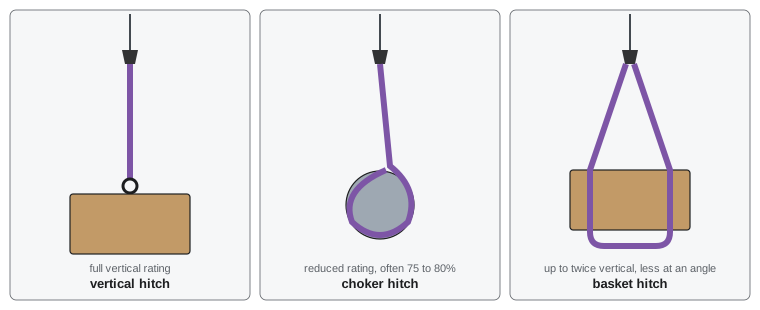
- Vertical hitch: a single sling leg runs straight from the hook to a lifting point. The sling carries the full load and its rated load is the vertical rating on the tag. A single vertical leg gives no control over rotation, so it suits loads with one central lifting eye.
- Choker hitch: the sling wraps around the load and passes through its own eye or a shackle, tightening as it is loaded. Chokers grip bundles and round loads, but the tight bend at the choke point weakens the sling. Choker ratings are lower than vertical ratings, typically around 75 to 80 per cent for wire rope and synthetic slings when the choke angle is 120 degrees or more, and lower still if the choke is pulled down to a sharper angle.
- Basket hitch: the sling passes under or through the load with both eyes on the hook. With both legs vertical, a basket carries up to twice the vertical rating, but only if the D/d ratio is adequate and the load is balanced. As soon as the legs spread apart at an angle, the capacity falls.
Bridle hitches use two, three or four legs from a master link to separate lifting points. They give good control, but the load is only shared evenly if the legs are the same length, the lifting points are symmetrical about the centre of gravity and the load is rigid. With three or four legs on a rigid load, it is common practice to assume that only two legs carry the load unless an engineer shows otherwise.
Sling angles multiply tension
When a sling leg is at an angle, it pulls both up and sideways. Only the upward part supports the load, so the tension in the leg must be greater than its share of the weight. For a load shared equally by \( n \) legs, each at angle \( \theta \) measured from the horizontal, the tension in each leg is:
The factor \( 1/\sin\theta \) is the sling angle factor. It is 1.0 when the legs are vertical and grows quickly as the angle flattens.
| Sling angle from horizontal | Angle factor (1 / sin θ) | Tension in each of two legs for a 1,000 unit load |
|---|---|---|
| 90 degrees (vertical) | 1.000 | 500 |
| 60 degrees | 1.155 | 577 |
| 45 degrees | 1.414 | 707 |
| 30 degrees | 2.000 | 1,000 |
| 15 degrees | 3.864 | 1,932 |
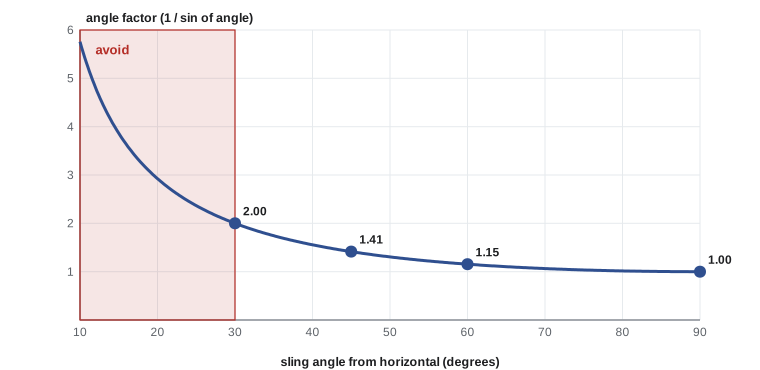
Angles can be measured directly with an angle finder or worked out from the sling length and the vertical height from the hook to the lifting point: \( \sin\theta = H/L \). That relationship lets a rigger check the angle with a tape measure.
Worked problem
Tension in a two-leg bridle
A 4,000 kg load is lifted with a two-leg bridle. Each leg is 3.0 m long and the hook sits 2.1 m above the lifting points. Find the sling angle and the tension in each leg, and say whether legs rated 2,500 kg each in a vertical hitch are adequate.
Show solution
- Angle: \( \sin\theta = \tfrac{2.1}{3.0} = 0.70 \), so \( \theta \approx 44.4^{\circ} \).
- Tension: \( T = \tfrac{4000}{2 \times 0.70} = 2857 \) kg in each leg.
- Each leg is rated 2,500 kg vertical, which is less than 2,857 kg, so the legs are overloaded.
- Options: use longer slings so the angle steepens, use a spreader beam to keep the legs vertical, or use slings with a higher rating.
- With 4.2 m legs and the same lifting points, the height becomes about 3.6 m, \( \sin\theta \approx 0.86 \), and \( T \approx 2326 \) kg, within the rating.
Answer: Each leg carries about 2,860 kg, more than its 2,500 kg rating. Longer slings or a spreader beam bring the tension within the rating.
Flat sling angles also create a horizontal force that squeezes the load between the lifting points. Thin-walled loads, long bundles and fabricated frames can buckle or bend under that force. A spreader beam keeps the slings vertical and takes the squeezing force in the beam instead of the load.
Unequal load sharing
Equal tension in every leg is the exception, not the rule. Whenever the centre of gravity is not centred between the lifting points, the legs nearer to it carry more. For two vertical legs, the share of each leg is found by taking moments about the other lifting point.
Here \( a \) is the horizontal distance from lifting point A to the centre of gravity and \( b \) is the distance from the centre of gravity to point B.
Worked problem
Leg loads on an offset skid
The equipment skid from Lesson 5 weighs 1,800 kg and is 2.4 m long, with its centre of gravity 1.05 m from the left end. It has lifting lugs at each end and is lifted with two vertical legs from a spreader beam. What does each leg carry?
Show solution
- Distances: \( a = 1.05 \) m from the left lug to the centre of gravity, \( b = 2.4 - 1.05 = 1.35 \) m to the right lug.
- Left leg: \( F_{L} = 1800 \times \tfrac{1.35}{2.4} = 1013 \) kg.
- Right leg: \( F_{R} = 1800 \times \tfrac{1.05}{2.4} = 788 \) kg.
- Check: \( 1013 + 788 = 1801 \) kg, which matches the weight allowing for rounding.
- The left leg carries 56 per cent of the load. Its sling and the left lug must be rated for that share, and the spreader beam's hook point must be over the centre of gravity, not the beam's middle.
Answer: About 1,010 kg in the left leg and 790 kg in the right. Sizing both legs for half the load would underrate the left leg.
When slings of slightly different lengths are used in a bridle, the shorter one takes more load and may carry nearly all of it on a rigid load. Matched sets of slings, adjustable chain legs or turnbuckles help balance the load.
Edges, softeners and protection
A sharp edge can cut a synthetic sling under load in an instant and can crush and break the wires of a wire rope. Steel beams, plate, precast concrete corners and the edges of crates are all hazards. Edge protection, also called softeners, includes manufactured corner protectors, wear sleeves, split pipe and padding. It must be strong enough for the load and stay in place as the sling tightens. Wood blocks and rags often slip out and give false confidence.
Surface protection is different from edge protection. A sleeve that protects a painted finish from scuffing may not protect the sling from being cut. Check that any protector is rated for cut resistance if it will be used on a sharp edge.
Hooking up
- Seat sling eyes in the bowl of the hook, never on the tip, and close the latch.
- Avoid putting more than two sling eyes directly on a hook; use a shackle or master link to gather several legs.
- Keep the included angle between legs at the hook within the limits set by the hook and sling manufacturers.
- Make sure shackle pins are fully engaged and, for screw pin shackles, tightened and if necessary moused so they cannot unscrew.
- Do not twist, knot or shorten slings by tying them; use the correct length.
- Never wrap the hoist rope itself around a load as a sling.
Controlling the load
A suspended load can rotate, swing and drift with the wind. Tag lines, usually made of non-conductive rope, let workers guide the load from a distance. They should be attached before the lift, long enough that workers can stay outside the fall zone, and held so they can be released instantly. Workers should never wrap a tag line around a hand or body. Push poles and hands-free load-control devices let workers guide loads without touching them at all.
Tag lines can also add risk. Near energized lines, even a dry rope can track current if it becomes wet or dirty, and a tag line that snags on equipment can pull a worker toward the load. Alberta's guidance, for example, notes that tag lines should not be used where they increase the danger, such as near live conductors, moving machinery or mobile equipment. The lift plan should say whether tag lines are used and who holds them.
| Practice | Reason |
|---|---|
| Lift a few centimetres first and hold | Checks balance, seating and brakes before the load is committed |
| Keep the load as low as practical while moving | Reduces fall height and swing |
| Move smoothly; avoid sudden starts and stops | Prevents swing and shock loading |
| Never ride a load or the hook | Riding is prohibited except in engineered personnel platforms |
| Keep hands and feet out from under the load when landing | A load can shift or drop as it settles |
| Prepare dunnage or cribbing before landing | Allows slings to be removed without lifting the load again by hand |
| Remove slings only when the load is stable and blocked | Prevents tipping when slings slacken |
Landing and unhooking
Landing is one of the most dangerous phases of a lift because people are close to the load. Prepare the landing area in advance: firm, level, clear, with dunnage or cribbing placed so slings can be pulled out after the load is down. Lower the load slowly the last part of the way, stop just above the landing point, position it with tag lines or push poles, then set it down. Check that the load is stable before slackening the slings, and never pull a sling out from under a load with the crane, which can flip the load or whip the sling.
Worked problem
Choosing between a choker and a basket
A bundle of pipe weighing 2,600 kg must be lifted with one synthetic round sling rated 3,200 kg vertical, 2,560 kg choker and 6,400 kg basket with vertical legs. A basket would place the legs at about 60 degrees. Which hitch is acceptable?
Show solution
- Choker: rated 2,560 kg, less than the 2,600 kg load, so a single choker is not acceptable.
- Basket at 60 degrees: \( 6400 \times \sin 60^{\circ} = 6400 \times 0.866 = 5542 \) kg, well above the load.
- But a single basket under a bundle of loose pipe does not grip the pipes; they can slide out of the ends.
- A better answer is two slings in double-wrap chokers, or two baskets with the slings choked, so the bundle is gripped and balanced.
Answer: Capacity alone favours the basket, but the hitch must also control the load. Two slings that grip the bundle are the right choice, each checked against its rating for the hitch and angle used.
Common mistakes
MistakeAssuming each leg of a two-leg bridle carries half the load.
InsteadAccount for the sling angle factor and any offset centre of gravity.
MistakeUsing sling angles flatter than 30 degrees.
InsteadUse longer slings or a spreader beam to keep angles at 45 degrees or steeper.
MistakeUsing a single basket hitch on loose bundles.
InsteadUse chokers or a hitch that grips and balances the load.
MistakeRelying on rags or wood scraps as edge protection.
InsteadUse rated softeners that stay in place and resist cutting.
MistakeWrapping a tag line around the hand for a better grip.
InsteadHold tag lines so they can be released instantly and stand outside the fall zone.
Summary and key terms
- Vertical, choker and basket hitches each have different ratings for the same sling; chokers reduce capacity and baskets depend on angle.
- Sling leg tension equals the load divided by the number of legs times the sine of the angle from horizontal.
- Angle factors are 1.15 at 60 degrees, 1.41 at 45 degrees and 2.0 at 30 degrees; avoid angles below 30 degrees.
- Legs nearer the centre of gravity carry more; shorter legs in a bridle carry more.
- Sharp edges must be protected with rated softeners.
- Control loads with tag lines or push poles from outside the fall zone, and land them on prepared dunnage.
- Vertical hitch
- A single sling leg running straight from the hook to the load.
- Choker hitch
- A sling wrapped around the load and passed through its own eye, tightening under load.
- Basket hitch
- A sling passing under the load with both ends on the hook.
- Bridle
- Two or more sling legs from a master link to separate lifting points.
- Sling angle factor
- The multiplier, 1 divided by the sine of the angle from horizontal, that converts each leg's share of the load to its tension.
- Softener
- Edge protection placed between a sling and a sharp edge.
- Tag line
- A rope attached to a load so workers can guide it from a distance.
Practice problems
Work each problem on paper first, then reveal the answer to check.
Why is a choker hitch rated lower than a vertical hitch?
Show answer
The tight bend at the choke point weakens the sling.
What is the sling angle factor at 45 degrees?
Show answer
About 1.414.
A 2,000 kg load hangs from two legs at 60 degrees. What is the tension in each leg?
Show answer
\( 2000 / (2 \times 0.866) = 1155 \) kg.
A sling leg is 4 m long and the hook is 2 m above the lifting point. What is the angle?
Show answer
\( \sin\theta = 0.5 \), so 30 degrees.
Why should three- and four-leg bridles on rigid loads be sized as if only two legs carry the load?
Show answer
Small differences in length or geometry mean two legs often carry most of the load.
A 1,000 kg load has its centre of gravity 0.4 m from lug A and 0.6 m from lug B. What does lug A carry?
Show answer
\( 1000 \times 0.6/1.0 = 600 \) kg.
What does a spreader beam do for sling angles?
Show answer
Keeps the slings vertical and takes the squeezing force in the beam.
Why are rags poor edge protection?
Show answer
They slip out, do not resist cutting and give false confidence.
When might a tag line increase danger?
Show answer
Near live conductors, moving machinery or mobile equipment, or when it can snag and pull a worker.
Why prepare dunnage before landing a load?
Show answer
So slings can be removed without lifting the load again or putting hands under it.
Lesson quiz · 5 questions
Score 60% or more to complete this lesson.
Create a free account to save your progress, take quizzes and earn a certificate.