
HSE-216 · Lesson 2 of 12 · 24 min
Hot work law, codes and standards in Canada
Hot work in Canada is governed by two overlapping sets of rules. Fire codes, enforced by fire marshals and local fire departments, protect buildings and the people in them. Occupational health and safety law, enforced by provincial, territorial and federal OHS regulators, protects workers. A welding job in a factory is covered by both. On top of the law sit consensus standards, especially CSA W117.2, which many regulations adopt by reference, and the requirements of insurers and owners. This lesson maps the framework so you know where each requirement comes from.
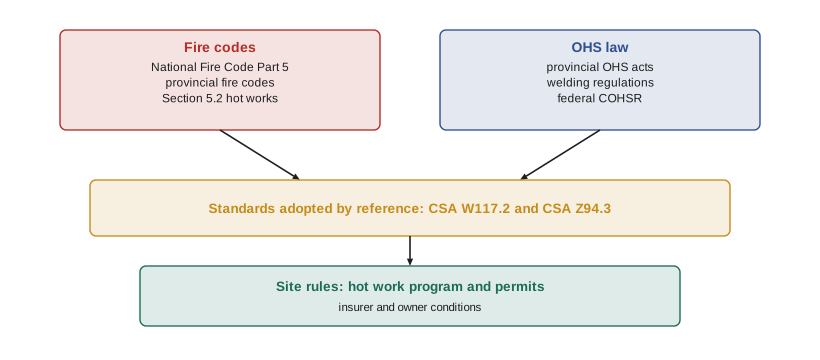
Fire codes: the National Fire Code and provincial codes
The National Fire Code of Canada (NFC) is a model code published by the National Research Council. Provinces and territories adopt it, sometimes with changes, or publish their own code based on it. Section 5.2 of Division B, Hot Works, applies to cutting, welding, soldering, brazing, grinding, adhesive bonding, thermal spraying, thawing pipes, torch-applied roofing and similar work. It requires hot work to be done by trained people, requires equipment to be examined for leaks and defects before each use, and requires hot work to conform to CSA W117.2 except where the code says otherwise.
Where hot work cannot be done in an area free of combustibles, the code requires precautions: combustible and flammable materials within 15 m of the work must be protected, a continuous fire watch must be maintained during the work and for at least 60 minutes after it ends, and the area must be inspected again later, typically 4 hours after the work is finished, unless a more thorough inspection is done when the fire watch ends. At least one portable extinguisher must be available. Hot work on containers or piping that hold or held flammable or combustible substances is restricted until they have been made safe. Where a building needs a fire safety plan, the plan must include the hot work precautions.
Each province enforces its own version. The Ontario Fire Code (O. Reg. 213/07) contains its own Section 5.2 based on the NFC. British Columbia, Alberta, Quebec and the other provinces and territories adopt the NFC with amendments; a few large cities have their own bylaws. The 2025 edition of the National Fire Code was published in late 2025, and provinces adopt new editions on their own schedules, so always check which edition applies where you work.
Occupational health and safety law
Every province and territory, and the federal government for federally regulated workplaces, has OHS regulations covering welding and hot work. The details vary, but common themes appear across the country: testing for flammable atmospheres before hot work, purging and cleaning containers, protecting nearby workers from arc flash, ventilation and local exhaust, respiratory protection, flashback arrestors on oxy-fuel equipment, fire extinguishers near the work and fire watches when combustibles are at risk.
- Ontario: the Industrial Establishments regulation (Reg. 851) requires hot processes in areas where explosive mixtures could form to be controlled, and the Construction Projects regulation (O. Reg. 213/91) has sections on cylinders, fire precautions during welding and cutting, and fire extinguishers.
- British Columbia: Part 12 of the OHS Regulation includes a division on welding, cutting and allied processes, covering local exhaust, removing hazardous coatings, testing vessels that may contain flammable substances, flame-resistant clothing, flashback arrestors, fire extinguishers and marking recently welded hot work.
- Alberta: the OHS Code requires a hot work permit or equivalent controls, removal or isolation of combustibles, and atmospheric testing showing flammable substances at or below a set fraction of the lower explosive limit, repeated at intervals.
- Federally regulated workplaces: the Canada Occupational Health and Safety Regulations prohibit hot work in a hazardous confined space where flammable substances exceed 10 % of the lower explosive limit or oxygen exceeds 23 %, unless a qualified person determines it is safe, and require a fire watch and emergency equipment.
- Manitoba, Saskatchewan, Quebec, the Atlantic provinces and the territories have similar sections, many referring to CSA W117.2, sometimes to an older edition.
OHS law also includes general duties. Employers must take every precaution reasonable in the circumstances to protect workers, supervisors must ensure workers follow safe procedures, and workers must use the protective equipment and follow the procedures. These general duties mean that following only the specific welding sections is not enough if a hazard remains.
CSA W117.2 and other standards
CSA W117.2, Safety in welding, cutting, and allied processes, is the main Canadian standard. The eighth edition, CSA W117.2:25, was published in 2025 and replaces the 2019 edition, which had been reaffirmed in 2023. Many regulations still refer to older editions such as W117.2-94, W117.2-06 or W117.2-12, so the edition that is legally binding can differ from the latest one. The standard covers fire prevention, protection of people, ventilation and fume control, gas cylinders and equipment, arc welding equipment and specific processes. Other standards that matter include CSA Z94.3 for eye and face protectors, including welding filter shades, CSA Z94.4 for respirators and the fire code's references to NFPA standards for some gases.
Insurers also publish hot work guidance. Many Canadian property insurers require a written permit system, a fire watch of 60 minutes or more, and final checks several hours after the work, and their conditions can be stricter than the code.
Welder qualification and other requirements
Welders in Canada are certified in the Red Seal and provincial trade systems, and companies that weld structural steel and other critical work must be certified by the Canadian Welding Bureau (CWB) to CSA W47.1 or related standards. These qualifications are about weld quality, not fire prevention, but CSA W117.2 and the fire code both require hot work operators to be trained in the hazards and precautions. WHMIS applies to welding gases and consumables: labels, safety data sheets and worker training. Transportation of Dangerous Goods rules apply when cylinders are moved on public roads.
| Source | Who enforces it | Typical hot work content |
|---|---|---|
| National Fire Code / provincial fire code, Section 5.2 | Fire marshal, local fire department | 15 m protection zone, 60-minute fire watch, later inspection, extinguisher, containers |
| Provincial and federal OHS regulations | OHS inspectors | Atmospheric testing, ventilation, PPE, flashback arrestors, fire watch, permits |
| CSA W117.2:25 (earlier editions in some regulations) | Adopted by reference; used by employers and insurers | Detailed fire prevention, fume control, gas equipment and process rules |
| CSA Z94.3, Z94.4 | Adopted by reference | Welding filters and face protection; respirators |
| Insurer and owner conditions | Contracts and policies | Permits, longer fire watches, final checks, impairment rules |
Worked problem
Which rule is stricter?
A contractor in Ontario is welding brackets in a warehouse that stores cardboard. The site's insurer requires a 90-minute fire watch and a final check 4 hours after the work. The Ontario Fire Code requires a 60-minute fire watch. How long must the fire watch last?
Show solution
- Legal minimum from the fire code: 60 minutes after the hot work ends.
- Contractual minimum from the insurer: 90 minutes.
- When several rules apply, the most protective one sets the practical requirement, because complying with it satisfies all of them.
Answer: The fire watch should last at least 90 minutes after the hot work ends, followed by the insurer's final check at 4 hours. Meeting only the code minimum would breach the insurance conditions.
Due diligence
When a hot work fire or injury leads to charges, employers and supervisors can defend themselves by showing due diligence: that they took every reasonable precaution. In practice that means a written hot work program, trained people, permits that were actually completed with a real inspection of the area, fire watches that were posted and documented, equipment that was inspected, and supervisors who checked that the rules were followed. Paperwork alone is not due diligence; a permit signed without anyone looking at the area is evidence of the opposite.
Who enforces what, in practice
On a typical day, the people most likely to look at hot work are not fire marshals or OHS inspectors but supervisors, joint health and safety committee members, insurance inspectors and the owner's own maintenance or facilities staff. Fire inspectors usually become involved after a complaint, during routine inspections of buildings that need fire safety plans, or after a fire. OHS inspectors visit after injuries, complaints and during targeted campaigns, and they can issue orders to stop work, require precautions or produce documents such as permits and training records. Both kinds of inspector can lay charges, and courts have imposed large fines on employers and supervisors after hot work fires and explosions.
Joint health and safety committees and health and safety representatives have a useful role. They can inspect hot work areas, review permits and training records, and make written recommendations to the employer, who must respond. Workers also have the right to refuse unsafe work, which includes refusing to do hot work in an area that has not been prepared, or to act as a fire watch without training or an extinguisher.
Reading a requirement correctly
Hot work rules are short, and small words matter. A requirement that a fire watch be maintained for at least a set time means that time is a minimum, not a target. A requirement that combustibles be protected within a distance means everything inside that distance, in every direction, including above and below. Where a rule says an extinguisher must be available, it means within immediate reach of the work, charged and of the right type, not somewhere in the building. When in doubt, read the rule with its purpose in mind: to stop a spark from becoming a fire, and a fire from becoming a disaster.
Many organizations summarize the legal requirements in a one-page table inside their hot work program, listing each rule, its source and how the site meets it. That table is useful for training, audits and showing inspectors how the program meets the law, and it should be updated whenever codes, standards or regulations change.
Common mistakes
MistakeAssuming only the fire code or only OHS law applies.
InsteadBoth apply to most hot work, along with adopted standards and insurer conditions; follow the most protective requirement.
MistakeQuoting the latest CSA W117.2 edition as the legal requirement everywhere.
InsteadRegulations may adopt older editions; check which edition your regulation references.
MistakeThinking a welder certification covers fire prevention.
InsteadWeld quality certification does not replace hot work hazard training and permits.
MistakeTreating the permit as paperwork.
InsteadA permit is only valid if someone actually inspected the area and confirmed the precautions.
MistakeIgnoring insurer conditions.
InsteadBreaching hot work conditions in an insurance policy can leave the owner without coverage after a fire.
Summary and key terms
- Hot work in Canada is governed by fire codes and by OHS law, with CSA W117.2 adopted by reference.
- NFC Section 5.2 sets a 15 m protection zone, a 60-minute fire watch and a later inspection.
- Provinces adopt the NFC, often with changes; the 2025 NFC is being adopted on different schedules.
- Provincial and federal OHS regulations require testing, ventilation, PPE and fire precautions.
- CSA W117.2:25 is the current edition, but regulations may reference older ones.
- Insurers often add stricter conditions, and the most protective rule sets the practical requirement.
- Due diligence requires a working program, trained people and real inspections, not just paperwork.
- National Fire Code of Canada
- The model fire code published by the National Research Council and adopted by provinces and territories.
- Section 5.2
- The part of Division B of the NFC and provincial fire codes that covers hot works.
- CSA W117.2
- The Canadian standard Safety in welding, cutting, and allied processes; current edition 2025.
- CSA Z94.3
- The Canadian standard for eye and face protectors, including welding filters.
- Adoption by reference
- When a regulation makes a standard, or part of one, legally binding by naming it.
- Fire marshal
- The provincial official responsible for fire code enforcement and fire investigation.
- Due diligence
- Taking every precaution reasonable in the circumstances to prevent harm.
- General duty
- The broad legal duty of employers to protect workers, beyond specific rules.
- Canadian Welding Bureau
- The organization that certifies companies and welders to CSA welding standards.
- WHMIS
- The Workplace Hazardous Materials Information System for labels, safety data sheets and training.
Practice problems
Work each problem on paper first, then reveal the answer to check.
Which part of the National Fire Code covers hot works?
Show answer
Section 5.2 of Division B.
How far from hot work must combustibles be protected under NFC Section 5.2?
Show answer
Within 15 m.
How long must the fire watch last after hot work under NFC Section 5.2?
Show answer
At least 60 minutes.
What is the current edition of CSA W117.2?
Show answer
The eighth edition, CSA W117.2:25.
Why might a regulation require an older CSA W117.2 edition?
Show answer
Because the regulation adopted a specific edition by reference and has not been updated.
Who enforces fire codes?
Show answer
Fire marshals and local fire departments.
What does the federal regulation say about flammable substances in a hazardous confined space?
Show answer
Hot work is prohibited above 10 % of the LEL unless a qualified person determines it is safe.
When several rules apply, which one sets the practical requirement?
Show answer
The most protective one, because meeting it satisfies all the others.
Does welder certification cover fire prevention?
Show answer
No. It covers weld quality; hot work hazard training is separate.
What makes a permit system evidence of due diligence?
Show answer
Real inspections of the area, trained people, documented fire watches and supervisors who enforce the rules.
Lesson quiz · 5 questions
Score 60% or more to complete this lesson.
Create a free account to save your progress, take quizzes and earn a certificate.