
HSE-216 · Lesson 4 of 12 · 25 min
Avoiding hot work and planning the job
The safest hot work is the hot work that never happens. That sounds obvious, yet many sites reach for a torch or grinder out of habit when a cold method would do the job almost as well. The CSB's first lesson from its hot work investigations was simple: avoid hot work when possible and consider alternatives. When hot work is necessary, the next best step is to move it to a place built for it, such as a welding shop or designated area, rather than bringing it to a place full of fuel. Only when neither is possible do permits, fire watches and covers carry the whole load. This lesson applies the hierarchy of controls to hot work and walks through planning a job before anyone lights a torch.
The hierarchy of controls for hot work
The hierarchy of controls ranks ways of managing a hazard from most to least effective. Applied to hot work, it looks like this.
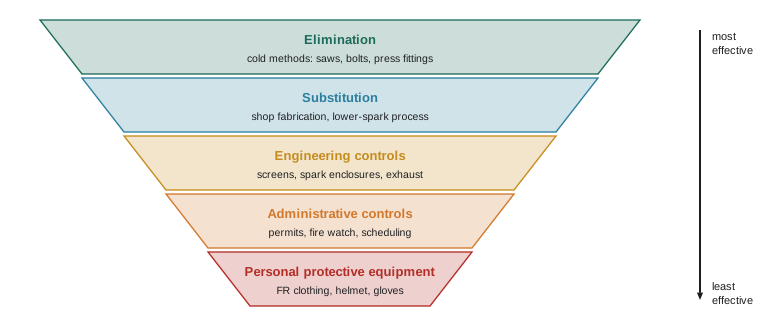
- Elimination: do the job without heat. Bolt instead of weld, cut with a saw instead of a torch, use press-fit or crimped fittings instead of soldering or brazing, use mechanical pipe cutters, nibblers, shears or hydraulic splitters.
- Substitution: if heat is needed, use a process or location that produces fewer sparks or keeps them away from fuel. Fabricate parts in the shop and bring them to site for bolting. Choose a lower-spark process. Use electric induction heating or hot water instead of an open flame to thaw pipes.
- Engineering controls: physical measures that contain heat and sparks: welding curtains and screens, spark containment habitats, fire-resistive blankets and pads, local exhaust ventilation, and pressurized enclosures in process plants.
- Administrative controls: the permit system, fire watch, scheduling hot work when the area is least occupied but still staffed, training and supervision.
- Personal protective equipment: flame-resistant clothing, helmets, gloves, boots and respirators. PPE protects the worker but does nothing to stop a fire spreading to the building.
Most real jobs use several layers together. The point of the hierarchy is to push the solution as high up the list as practical before relying on permits and fire watches alone.
Cold work alternatives
Cold work methods have improved enormously. Many tasks that once needed a torch can now be done without one.
| Task | Hot method | Cold alternatives |
|---|---|---|
| Cutting steel sections | Oxy-fuel or plasma cutting, abrasive cut-off saw | Band saw, cold saw with carbide blade, hydraulic shears, nibblers, reciprocating saw |
| Removing bolts and fasteners | Torch cutting, grinding | Nut splitters, impact tools, hydraulic bolt cutters, penetrating oil and patience |
| Joining copper pipe | Soldering or brazing with a torch | Press-fit fittings, push-fit fittings, compression fittings, grooved couplings |
| Joining steel pipe | Welding | Grooved mechanical couplings, flanged or threaded joints |
| Cutting pipe on process lines | Torch or abrasive wheel | Clamshell cold cutters, wheel cutters, abrasive water jet |
| Thawing frozen pipes | Propane torch | Electric pipe thawing machines, heat tape, warm air at a safe distance, hot water |
| Attaching brackets to steel | Welding | Beam clamps, bolting through drilled holes, structural adhesives where approved |
| Roofing membranes | Torch-applied modified bitumen | Self-adhered, cold-applied or mechanically fastened membranes, hot-air welded single-ply |
Cold methods are not free of hazards. Saws and shears have cutting and crushing hazards, abrasive water jets inject water at extreme pressure, and impact tools are noisy. But none of them will ignite a building. When a cold method meets the engineering requirements and its own hazards are controlled, it is almost always the better choice in an area with fuel.
Designated hot work areas
A designated area is a permanent location built for hot work: a welding shop or bay with noncombustible floors, walls and benches, no stored combustibles, screens to protect passers-by, local exhaust ventilation, extinguishers and a clear layout. Because the area is designed to be safe, routine hot work there usually does not need a separate permit for each job, although the area itself should be inspected regularly and its conditions maintained.
- Floors are concrete or another noncombustible surface, kept clear of oily rags, sawdust and debris.
- Walls and ceilings are noncombustible, with no openings to combustible areas.
- Cylinders are secured and stored as the rules require, away from exits and heat.
- Welding screens or curtains protect others from arc flash and spatter.
- Ventilation removes fumes at the source.
- Extinguishers suitable for the hazards are mounted and inspected.
When a job can be moved to the designated area, it should be. Cutting a part in the shop and carrying it to the job takes a few more minutes; a fire takes months to recover from.
Planning the job
Good hot work planning happens before the permit is requested, ideally when the maintenance or construction work is first scheduled. A planner, supervisor or contractor works through a set of questions.
- What exactly is the task, and is hot work really needed? Could a cold method or shop fabrication do it?
- Where is the work, and what is around it, above it, below it and on the other side of walls, floors and roofs?
- What fuels are present: stored goods, building materials, dust, insulation, flammable liquids, gases, process materials?
- Are there tanks, pipes, drums or vessels that hold or once held flammable or combustible material?
- Are fire protection systems working? Will any be impaired during the work?
- Which process will be used, how many sparks will it throw and how far?
- Who will be the operator, who will authorize the permit and who will be the fire watch? Are they trained?
- What equipment is needed: extinguishers, blankets, screens, gas detectors, ventilation?
- When should the work be scheduled so the area is quiet but staffed and the fire watch can stay long enough afterward?
- What could go wrong, and what is the emergency plan?
Planning early also lets the site arrange housekeeping, move stored goods, isolate and clean equipment and book the fire watch before the job, so nobody feels pressured to skip steps on the day.
Worked problem
Choosing a method for a pipe repair
A food plant needs to replace a 50 mm copper water line that runs through a ceiling space above a packaging room stocked with cardboard. The maintenance crew normally solders copper joints with a propane torch. There are six joints. What should the planner consider?
Show solution
- Elimination first: press-fit copper fittings are made in this size and need no flame. If they are approved for the system pressure and fluid, all six joints can be made cold.
- If press fittings are not suitable, substitution: solder as many joints as possible on the bench in the shop and carry pre-made sections up to the ceiling, reducing the joints made in place from six to perhaps two.
- For the joints that must be soldered in place, engineering and administrative controls: open the ceiling to see what is in the space, protect combustibles with fire-resistant blankets, use a heat-shield pad behind the joint, issue a permit and post a fire watch with access to the ceiling space and the room below.
- Schedule the work early in a shift so the fire watch and post-work checks can be completed while staff are present.
Answer: Press-fit fittings remove the fire hazard entirely and are usually the best choice. If they cannot be used, shop prefabrication cuts the in-place hot work to a minimum, and the remaining joints need a permit, protection of the ceiling space and a fire watch who can see both the ceiling and the room below.
Scheduling and timing
Timing matters more than many planners realize. Hot work late in the day or at the end of a shift is risky, because people want to go home and the fire watch is the first thing to be cut short. Work that ends just before a building is locked up leaves no one to notice a smouldering fire. Many insurers and owners therefore prohibit hot work within a set time, often one to several hours, before the end of the working day, or require the post-work monitoring to be done by someone who will still be on site.
Hot work should also be coordinated with other activities. Painting, coating, adhesive application, cleaning with solvents, deliveries of flammable materials and work that impairs fire protection should not happen nearby at the same time. Large sites use permit coordination meetings so that two crews do not create a hazard for each other without knowing it.
Communicating the plan
Everyone affected by the work should know about it: the operator, fire watch, area supervisor, other workers nearby, security and, where alarms are temporarily affected, the alarm monitoring company. If detection devices are temporarily covered to prevent false alarms from smoke or heat, that is an impairment of fire protection and must be managed as one, with extra precautions and a plan to restore the devices as soon as the work stops.
Spark containment and temporary enclosures
When hot work must be done in place, engineering controls can contain the sparks rather than relying only on covering everything around them. Modular spark containment enclosures, sometimes called habitats or welding tents, are made of fire-resistant fabric panels on a frame and can be set up around a joint, a pump or a section of pipe. They keep sparks and slag inside a small footprint, make protecting the surroundings much easier and give the fire watch a clear boundary to monitor. In process plants, pressurized habitats add positive pressure and gas detection, as Lesson 11 explains.
Smaller devices help too. Spark catcher pans and fire-resistant pads placed under the work catch falling slag. Grinding guards and spark deflectors direct sparks downward or into a container. Welding screens around a work area protect both people and materials. Low-spark grinding discs and cutting wheels reduce, but do not eliminate, the spark stream. None of these replaces the permit and fire watch, but each makes them more effective.
Asking the right question early
The most useful moment to avoid hot work is at the design or purchasing stage, long before the maintenance crew arrives. Engineers who specify grooved couplings instead of welded joints, bolted supports instead of welded brackets, or self-adhered roofing instead of torch-on membranes remove hot work from the life of a building or plant. Maintenance planners who keep stocks of press fittings and mechanical connectors make cold methods the easy choice.
Common mistakes
MistakeReaching for a torch out of habit.
InsteadAsk first whether a cold method or shop fabrication can do the job.
MistakeBringing hot work to the fuel instead of the fuel to the shop.
InsteadMove portable work to a designated hot work area whenever possible.
MistakePlanning hot work on the day it happens.
InsteadPlan when the job is scheduled so housekeeping, isolation and the fire watch are arranged in advance.
MistakeScheduling hot work at the end of the day.
InsteadSchedule it early enough that the fire watch and later checks happen while people are on site.
MistakeCovering smoke detectors without telling anyone.
InsteadTreat covered detectors as an impairment, notify the right people and restore them promptly.
Summary and key terms
- The safest hot work is the hot work that is avoided altogether.
- Apply the hierarchy of controls: elimination, substitution, engineering, administrative, then PPE.
- Cold alternatives such as press-fit fittings, saws, shears and grooved couplings remove the ignition source.
- Designated hot work areas are built to be safe for routine work and reduce the need for site permits.
- Planning should start when the job is scheduled, not when the torch is lit.
- Schedule hot work early enough for a full fire watch and later checks while people are present.
- Communicate the plan and manage any impairment of fire protection.
- Hierarchy of controls
- A ranking of control measures from elimination, the most effective, to PPE, the least.
- Cold work
- Work that does not produce flames, sparks or ignition-level heat.
- Elimination
- Removing the hazard entirely, such as by using a cold method.
- Substitution
- Replacing a hazardous method or location with a less hazardous one.
- Designated hot work area
- A permanent location built and maintained for safe hot work, such as a welding shop.
- Press-fit fitting
- A pipe fitting joined by crimping with a tool rather than by soldering or brazing.
- Grooved coupling
- A mechanical pipe joint using grooved pipe ends, a gasket and a bolted housing.
- Spark containment habitat
- A temporary enclosure built around hot work to contain sparks and slag.
- Impairment
- Any condition in which a fire protection system is shut off or not fully working.
- Permit coordination
- Reviewing all work permits in an area so jobs do not create hazards for each other.
Practice problems
Work each problem on paper first, then reveal the answer to check.
What was the first of the CSB's seven key lessons on hot work?
Show answer
Avoid hot work when possible and consider alternative methods.
Give two cold alternatives to soldering copper pipe.
Show answer
Press-fit fittings, push-fit fittings or compression fittings.
Name a cold alternative to torch-cutting steel sections.
Show answer
A band saw, cold saw, hydraulic shears or nibbler.
What is a designated hot work area?
Show answer
A permanent location built for safe hot work, with noncombustible surfaces, screens, ventilation and extinguishers.
Where does PPE sit in the hierarchy of controls, and why?
Show answer
At the bottom, because it protects the worker but does not prevent a fire from spreading.
Name four questions to ask when planning hot work.
Show answer
Is hot work needed? What fuels are nearby? Is fire protection working? Who are the operator and fire watch? When should it be scheduled?
Why is hot work at the end of the day risky?
Show answer
The fire watch is often cut short and no one may be present to notice a smouldering fire.
What is a safer way to thaw a frozen pipe than a torch?
Show answer
An electric pipe thawing machine, heat tape or hot water.
How does shop prefabrication reduce risk?
Show answer
It moves most of the hot work to a designated area and reduces the work done in place.
Why should covered smoke detectors be treated as an impairment?
Show answer
They reduce fire protection, so extra precautions and prompt restoration are needed.
Lesson quiz · 5 questions
Score 60% or more to complete this lesson.
Create a free account to save your progress, take quizzes and earn a certificate.