
HSE-216 · Lesson 6 of 12 · 25 min
Protecting combustibles and the hot work zone
Once the decision is made to do hot work in place, the main job is to make sure there is nothing for the sparks, slag and heat to ignite. That means defining a protective zone around the work, removing everything that can burn from it, protecting what cannot be moved, closing off the paths that sparks use to escape, and having fire extinguishing equipment ready. This lesson explains how to prepare the area so that the fire watch has nothing to do but watch.
The protective zone
Codes and standards set a radius around the hot work within which combustibles must be removed or protected. The National Fire Code of Canada uses 15 m. CSA W117.2, like NFPA 51B, uses 11 m (35 ft), and many Canadian employers and insurers use the larger of the two. These distances are minimums for typical work. Cutting, work at height, windy conditions and very fine fuels such as dust or lint can throw ignition farther, and the authorizing individual should extend the zone when the job calls for it.
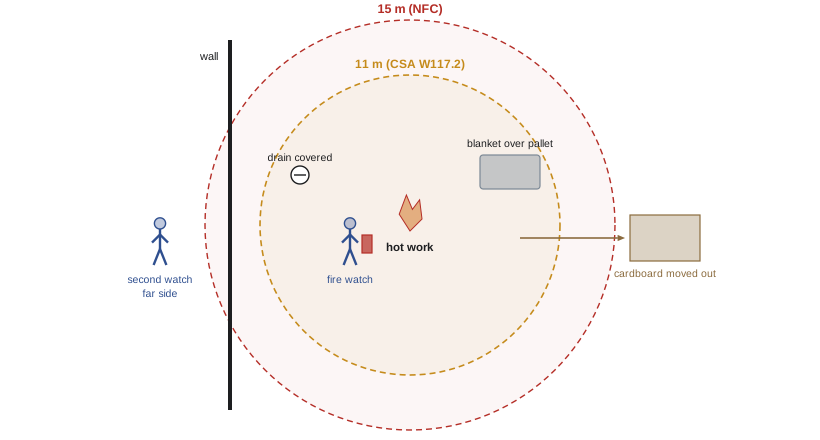
The zone is three-dimensional. It extends above the work, where sparks can land on beams, ledges, cable trays and roof structures, and below it, where slag falls through gratings, openings and gaps to lower floors. It also extends through walls, floors and roofs wherever heat can conduct or sparks can pass.
Remove, then protect
The first choice is always to remove combustibles from the zone. Moving pallets, packaging, stored goods, waste bins, flammable liquids, gas cylinders and debris out of the zone is cheap and completely effective. Removal also includes housekeeping: sweeping floors clean of dust, sawdust, paper and oily residue, and cleaning dust from overhead beams, ledges and equipment.
What cannot be removed must be protected. The usual methods are:
- Welding blankets and curtains listed or tested for the purpose, made of materials such as fibreglass, silica or treated fabrics. They come in light, medium and heavy grades, and the grade must suit the process; light blankets are for spatter from welding, heavier ones for slag from cutting. Ordinary tarpaulins are not fire-resistant and can make things worse.
- Noncombustible barriers such as sheet metal or cement board, sealed at the edges so sparks cannot get behind them.
- Wetting down combustible floors or materials that cannot be moved or covered, where water will not create an electrical or chemical hazard. Wet materials can dry during long jobs and need rewetting.
- Covering wooden floors with damp sand, metal or noncombustible sheets.
Blankets must cover completely and overlap, be weighted or secured so they do not lift or slide, and be inspected for holes, burns and oil contamination. A blanket with a hole or a gap at the floor gives little protection.
| Item in the zone | Preferred action | If it cannot be done |
|---|---|---|
| Cardboard, paper, packaging, wood pallets | Remove beyond the zone | Cover completely with a suitable welding blanket; consider wetting |
| Flammable liquids, aerosols, gas cylinders | Remove beyond the zone | Hot work should not proceed until they are removed |
| Dust on floors, beams and ledges | Clean thoroughly, including overhead | Wet down; postpone if dust cannot be controlled |
| Combustible walls, partitions or floors | Do the work elsewhere or use a cold method | Shield with noncombustible barriers; wet down; fire watch on both sides |
| Floor openings, drains, cable and pipe penetrations | Cover tightly with noncombustible material | Post a fire watch below or on the far side |
| Machinery with oil, belts or plastic parts | Clean oil and debris; move portable equipment | Shield with blankets; protect hoses and cables |
Openings, penetrations and adjacent areas
Every opening in floors, walls and ceilings within the zone is a path for sparks to reach places the fire watch cannot see. Cable trays and pipes that pass through walls often have gaps around them. Doors may not seal at the bottom. Drains and trench covers lead to spaces that can hold vapour or debris. Ductwork openings lead into ceiling spaces. Each opening should be covered tightly with noncombustible material, or a fire watch posted where the sparks would land.
Adjacent areas need checking too. If combustibles lie against the far side of a metal wall, floor, ceiling or roof being heated, they must be moved or protected, and a second fire watch posted on that side if the first cannot see it. The same applies to the floor below when working on an upper floor or roof.
Combustible construction and building elements
Some buildings are themselves combustible: wood-frame construction, heavy timber, combustible roof assemblies, foam-insulated panels and older buildings with hidden wood or paper linings. In these buildings, the structure cannot be removed from the zone, so hot work needs extra care: cold methods wherever possible, noncombustible shields, wetting, a fire watch with access to concealed spaces, and longer post-work monitoring. Heritage and religious buildings are particularly vulnerable because of large concealed roof spaces, old dry timber and the irreplaceable value of what may be lost.
Insulated metal panels deserve a special mention. Panels with expanded polystyrene or polyurethane foam cores look like metal from the outside, but the core can melt, ignite and burn inside the panel, spreading fire quickly and out of sight. Hot work on or near such panels should be avoided wherever possible, and done only with careful protection when unavoidable.
Fire protection equipment at the work
At least one portable fire extinguisher suited to the hazard must be available at the hot work location, and the fire watch must be trained to use it. Many sites require two, or a charged hose line where one is available. Extinguishers should be at least a 2-A:10-B:C or larger multipurpose dry chemical unit for general hot work, or a water-based unit for Class A fires in areas where dry chemical would damage equipment, as the site's fire safety plan specifies. The fire safety course, HSE-105, explains extinguisher ratings in more detail.
Sprinklers must be in service. Hot work in a sprinklered area with impaired sprinklers is generally prohibited unless the impairment procedure allows it with additional precautions, such as continuous fire watches and charged hose lines. Fire alarm systems should remain active; if detectors near the work must be temporarily protected to prevent false alarms, the impairment should be documented and the devices restored as soon as the work stops.
Worked problem
Sizing the zone and counting the blankets
A welder will weld a steel bracket to a column at floor level in a warehouse. The site uses a 15 m zone. Inside it are: 12 pallets of boxed goods that can be moved, a wooden workbench fixed to the floor (2 m by 1 m), a stack of plastic crates (1.5 m by 1.5 m) that cannot be moved because a forklift is out of service, and a floor drain. Light welding blankets measure 1.8 m by 1.8 m. How should the area be prepared, and how many blankets are needed?
Show solution
- Move the 12 pallets beyond the zone. Removal beats protection.
- Cover the workbench top and sides. Its top is 2 m by 1 m and its sides add height; one 1.8 m by 1.8 m blanket will not cover the top with overlap, so use two, overlapping by at least 0.3 m and tucked to the floor.
- Cover the crate stack: its top is 1.5 m by 1.5 m, but the sides must also be covered to floor level. Use at least three blankets, one over the top and two draped around the sides, overlapping and weighted.
- Cover the floor drain with a sheet of steel or a noncombustible pad.
- Sweep the floor, check overhead for dust and confirm an extinguisher and fire watch are in place.
Answer: At least five blankets, plus a cover for the drain. Better still, get the crates moved before the work starts, because plastic crates give off dense smoke and are hard to protect fully. If they cannot be moved, consider a heavier blanket grade or a noncombustible screen between the work and the crates.
Housekeeping during and after the work
Protection is not set-and-forget. During the work, spatter and slag accumulate; hot slag can burn through a blanket or roll off it. The operator and fire watch should check blankets and covers regularly, brush off slag into a metal container, and keep the floor clear. Electrode stubs, which stay hot, should go into a metal container rather than onto the floor. When the work ends, hot pieces should be cooled or marked, and debris removed before the area returns to normal use.
Choosing and caring for welding blankets
Not all fire-resistant fabrics are alike. Welding blankets and curtains are tested for how well they resist burn-through from spatter, slag and heat, and manufacturers classify them for light, medium or heavy duty. Light-duty blankets suit spatter from arc welding and light grinding sparks. Medium and heavy-duty blankets, often thicker silica or coated fibreglass, are needed under oxy-fuel and plasma cutting, where large globules of molten slag fall on them. Using a light blanket under heavy cutting can let slag burn straight through to whatever is underneath.
Blankets need care. Oil, grease and solvents soaked into a blanket can burn. Holes, frayed edges and burned patches let sparks through. Blankets stored wet or crumpled can degrade. Inspect blankets before each use, keep them clean and dry, and replace damaged ones rather than patching them. Mark blankets by grade so workers do not grab the wrong type.
The walk-around before lighting up
A short structured walk-around just before work starts catches what the morning inspection missed. The operator and fire watch walk the zone together: look up for dust and combustibles on beams and cable trays, look down for gaps, drains and debris, check behind and under blankets, look through doors and into adjacent rooms, confirm the extinguisher gauge is in the green and the pin and seal are intact, and agree where the fire watch will stand. It takes five minutes and often finds something that changed since the permit was signed, such as a delivery of packaging or a door propped open.
Common mistakes
MistakeCovering combustibles that could easily have been moved.
InsteadRemove combustibles from the zone first; protect only what truly cannot be moved.
MistakeUsing ordinary plastic or canvas tarpaulins.
InsteadUse welding blankets or curtains listed or tested for the process, or noncombustible barriers.
MistakeLeaving gaps at the bottom of blankets or between them.
InsteadOverlap blankets, tuck them to the floor and weight them so sparks cannot get underneath.
MistakeForgetting the zone extends up, down and through walls.
InsteadCheck beams, ceiling spaces, floors below and the far side of walls, and cover openings.
MistakeThrowing electrode stubs on the floor.
InsteadPut stubs and slag in a metal container; they stay hot enough to ignite debris.
Summary and key terms
- The NFC requires protection within 15 m; CSA W117.2 and NFPA 51B use 11 m (35 ft).
- Extend the zone for cutting, work at height, wind and fine fuels; it is three-dimensional.
- Remove combustibles first; protect what cannot be moved with suitable blankets, barriers or wetting.
- Cover every opening, drain and penetration in the zone, and check adjacent areas.
- Combustible buildings, foam-core panels and heritage structures need extra caution.
- Have suitable extinguishers at the work and keep sprinklers and alarms in service.
- Keep up housekeeping during the work and dispose of slag and stubs safely.
- Protective zone
- The area around hot work, 11 to 15 m in Canada, in which combustibles must be removed or protected.
- Welding blanket
- A fire-resistant fabric cover, tested or listed for hot work, used to protect materials that cannot be moved.
- Welding curtain
- A fire-resistant screen that contains spatter and protects people from arc radiation.
- Noncombustible barrier
- A shield of material that does not burn, such as sheet metal or cement board.
- Penetration
- An opening through a wall or floor for pipes, cables or ducts.
- Housekeeping
- Keeping the work area clean and free of combustible debris and dust.
- Electrode stub
- The short unused end of a welding electrode, which remains hot after use.
- Insulated metal panel
- A wall or roof panel with metal skins and an insulating core that may be combustible.
- Impairment procedure
- The site procedure for managing fire protection systems that are out of service.
- 2-A:10-B:C
- An extinguisher rating indicating capability on ordinary combustibles, flammable liquids and energized electrical equipment.
Practice problems
Work each problem on paper first, then reveal the answer to check.
What protective zone does the National Fire Code use?
Show answer
15 m.
Name three conditions that justify extending the protective zone.
Show answer
Cutting, work at height, wind or drafts, and fine fuels such as dust or lint.
What is the first choice for combustibles in the zone?
Show answer
Remove them from the zone.
Why are ordinary tarpaulins unsuitable?
Show answer
They are not fire-resistant and can ignite or melt.
How should welding blankets be installed?
Show answer
Overlapping, tucked to the floor, weighted or secured, and inspected for holes.
What should be done with floor drains and penetrations in the zone?
Show answer
Cover them tightly with noncombustible material or post a watch where sparks would land.
Why are foam-core insulated panels a hot work hazard?
Show answer
The core can ignite and burn inside the panel, spreading fire out of sight.
What fire protection equipment should be at the work?
Show answer
At least one suitable portable extinguisher, often two or a charged hose line, with a trained fire watch.
Can hot work be done while sprinklers are impaired?
Show answer
Generally not, unless the impairment procedure allows it with extra precautions.
Where should electrode stubs go?
Show answer
Into a metal container, not onto the floor.
Lesson quiz · 5 questions
Score 60% or more to complete this lesson.
Create a free account to save your progress, take quizzes and earn a certificate.