
HSE-216 · Lesson 2 of 12 · 24 min
OSHA hot work standards, NFPA 51B and the law in the US
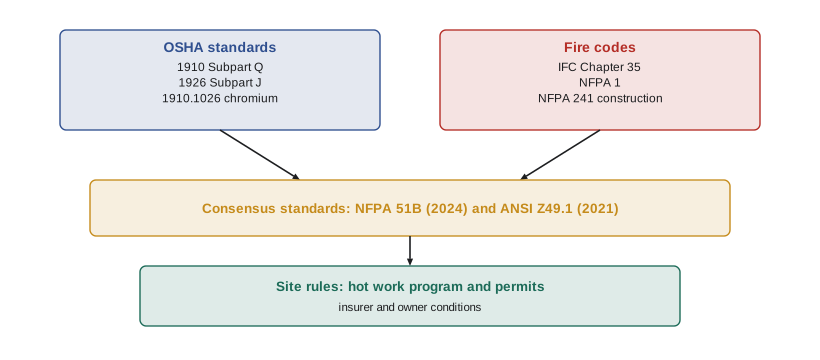
Hot work in the United States is governed by two overlapping sets of rules. OSHA standards protect workers. State and local fire codes, usually based on the International Fire Code or NFPA 1, protect buildings and occupants and are enforced by fire marshals and local fire departments. Consensus standards, especially NFPA 51B and ANSI Z49.1, fill in the detail and are often adopted by reference. Insurers and owners add their own conditions. This lesson maps the framework so you know where each requirement comes from.
OSHA general industry: 29 CFR 1910 Subpart Q
OSHA's general industry rules for welding, cutting and brazing are in 29 CFR 1910 Subpart Q. Section 1910.252 sets general requirements, including fire prevention and protection, protection of personnel and health protection and ventilation. Section 1910.253 covers oxygen-fuel gas welding and cutting, including cylinder storage. Section 1910.254 covers arc welding and cutting equipment, and 1910.255 resistance welding. OSHA's fire prevention rules in 1910.252(a) are short but clear: if the object to be welded or cut cannot readily be moved, all movable fire hazards in the vicinity must be taken to a safe place; if fire hazards cannot be removed, guards must confine the heat, sparks and slag.
The rules require fire watchers whenever welding or cutting is done where other than a minor fire might develop, or where appreciable combustible material is closer than 35 ft (10.7 m) to the point of operation, or more than 35 ft away but easily ignited by sparks, or where wall or floor openings within 35 ft expose combustibles in adjacent areas, including concealed spaces, or where combustibles are adjacent to the opposite side of metal walls, partitions, ceilings or roofs. Fire watchers must have extinguishing equipment readily available, be trained in its use, know how to sound an alarm, and watch for at least a half hour after the work is completed to detect and extinguish smoldering fires.
Before hot work begins, the area must be inspected by the individual responsible for authorizing cutting and welding, who designates precautions to be followed in granting authorization to proceed, preferably in the form of a written permit. Hot work is not permitted in areas not authorized by management, in sprinklered buildings while the sprinklers are impaired, in explosive atmospheres or where they could develop, or near large quantities of exposed, readily ignitable materials such as bulk sulfur, baled paper or cotton. Management must designate an individual responsible for authorizing hot work, and supervisors have specific duties to determine combustible hazards, protect them and ensure fire watches are posted.
Construction, shipyards and other OSHA rules
Construction work is covered by 29 CFR 1926 Subpart J, Welding and Cutting, with sections on gas welding and cutting (1926.350), arc welding (1926.351), fire prevention (1926.352), ventilation and protection (1926.353) and preservative coatings (1926.354). Section 1926.352 requires fire extinguishing equipment to be immediately available, a fire watch when the normal fire prevention precautions are not sufficient, and no welding in the presence of explosive atmospheres. Shipyards have their own rules in 29 CFR 1915, including detailed requirements for hot work in confined and enclosed spaces and for marine chemist certificates.
- Hexavalent chromium, 29 CFR 1910.1026 (general industry) and 1926.1126 (construction), sets a permissible exposure limit of 5 µg/m³ as an 8-hour time-weighted average and an action level of 2.5 µg/m³, relevant to welding on stainless steel and chromium-coated metals.
- The Hazard Communication Standard, 29 CFR 1910.1200, requires labels, safety data sheets and training for welding consumables and gases.
- Respiratory protection, 29 CFR 1910.134, applies whenever respirators are used to control welding fume exposure.
- Confined spaces, 29 CFR 1910.146 and 1926 Subpart AA, apply when hot work is done inside a permit-required confined space. Lesson 11 and the confined space course cover this.
- State plans: about half the states run their own OSHA-approved plans. California's Title 8, for example, includes its own welding and hot work orders, and some state rules are stricter than federal OSHA.
OSHA's General Duty Clause, section 5(a)(1) of the OSH Act, also applies. Where a recognized hazard is not covered by a specific standard, an employer can be cited for failing to protect workers from it. OSHA has used the General Duty Clause and the fire prevention rules together in hot work cases, especially explosions involving tanks.
NFPA 51B, NFPA 241 and the fire codes
NFPA 51B, Standard for Fire Prevention During Welding, Cutting, and Other Hot Work, is the most widely used hot work standard in the US. OSHA's 1910.252 refers to an old edition, but current editions go further. Since the 2019 edition, NFPA 51B has required the fire watch to continue for at least one hour after hot work ends, with fire monitoring for up to three more hours as the permit authorizing individual decides. The 2024 edition changed written permits to documented permits so electronic permit systems are recognized, and allows the permit authorizing individual to reduce the fire watch to no less than 30 minutes in defined, lower-risk circumstances; check the edition your jurisdiction has adopted for the exact conditions.
NFPA 241, Standard for Safeguarding Construction, Alteration, and Demolition Operations, applies on construction sites and requires a two-hour fire watch after torch-applied roofing and in some large wood and mass timber construction. The International Fire Code, Chapter 35 (Welding and Other Hot Work), and NFPA 1 set similar requirements and are enforced by local fire officials. ANSI Z49.1, Safety in Welding, Cutting, and Allied Processes (2021 edition), published by the American Welding Society, covers protection of personnel, ventilation, fire prevention and equipment.
Welder qualification and other requirements
Welders in the US are certified to codes such as AWS D1.1 for structural steel, ASME Section IX for pressure work and API 1104 for pipelines. These qualifications are about weld quality, not fire prevention, but NFPA 51B, ANSI Z49.1 and OSHA all require operators to be trained in hot work hazards and precautions. Cylinders moved on public roads are regulated by the Department of Transportation under the Hazardous Materials Regulations, 49 CFR.
| Source | Who enforces it | Typical hot work content |
|---|---|---|
| 29 CFR 1910 Subpart Q | OSHA | 35 ft rule, fire watch for at least 30 minutes, permit authorization, ventilation, cylinders |
| 29 CFR 1926 Subpart J | OSHA | Construction welding, fire prevention, ventilation, coatings |
| NFPA 51B (2024) | Adopted by fire codes; used by employers and insurers | Roles, documented permits, 35 ft zone, 1-hour fire watch plus monitoring |
| International Fire Code Ch. 35, NFPA 1, NFPA 241 | Fire officials | Hot work programs, construction sites, roofing fire watch |
| ANSI Z49.1:2021 | Referenced by OSHA and contracts | Personnel protection, ventilation, fire prevention, equipment |
Worked problem
Which rule is stricter?
A contractor is welding brackets in a warehouse that stores cardboard. OSHA 1910.252 requires a fire watch for at least 30 minutes after the work. The city has adopted a fire code that references NFPA 51B (2019), and the owner's insurer requires a 90-minute fire watch. How long must the fire watch last?
Show solution
- Legal minimum from OSHA: 30 minutes.
- Legal minimum from the local fire code via NFPA 51B (2019): 1 hour, plus possible additional monitoring decided by the permit authorizing individual.
- Contractual minimum from the insurer: 90 minutes. When several rules apply, the most protective one sets the practical requirement.
Answer: The fire watch should last at least 90 minutes. Meeting only OSHA's 30 minutes would breach both the local fire code and the insurance conditions.
Due diligence
When a hot work fire or injury leads to citations or lawsuits, employers defend themselves by showing they recognized the hazard and took reasonable steps: a written hot work program, trained people, permits completed after a real inspection of the area, fire watches posted and documented, equipment inspected and supervisors who enforced the rules. OSHA can cite willful violations with much higher penalties when employers knowingly ignore hot work requirements, and fatalities can lead to criminal referrals. Paperwork alone is not enough; a permit signed without anyone looking at the area is evidence of the opposite.
Who enforces what, in practice
On a typical day, the people most likely to look at hot work are not OSHA compliance officers or fire marshals but supervisors, safety committee members, insurance loss-control inspectors and the owner's own maintenance or facilities staff. Fire officials usually become involved during routine inspections of buildings with hot work programs, when permits are required under the local fire code, or after a fire. OSHA inspects after serious injuries and fatalities, after complaints and during emphasis programs, and can issue citations and penalties, which are adjusted for inflation each year. Both fire officials and OSHA can require work to stop until hazards are corrected.
Safety committees, where they exist, can review permits and inspect hot work areas, and workers have the right to raise safety concerns and to file complaints with OSHA without retaliation under section 11(c) of the OSH Act. Workers may refuse work that poses an imminent danger of death or serious injury in limited circumstances, such as being told to weld on an untested tank, when there is no time to get the hazard corrected through normal channels.
Reading a requirement correctly
Hot work rules are short, and small words matter. A requirement that a fire watch be maintained for at least a set time means that time is a minimum, not a target. A requirement that combustibles be protected within a distance means everything inside that distance, in every direction, including above and below. Where a rule says an extinguisher must be available, it means within immediate reach of the work, charged and of the right type, not somewhere in the building. When in doubt, read the rule with its purpose in mind: to stop a spark from becoming a fire, and a fire from becoming a disaster.
Many organizations summarize the legal requirements in a one-page table inside their hot work program, listing each rule, its source and how the site meets it. That table is useful for training, audits and showing inspectors how the program meets the law, and it should be updated whenever codes, standards or regulations change.
Common mistakes
MistakeAssuming only OSHA or only the fire code applies.
InsteadBoth apply to most hot work, along with adopted standards and insurer conditions; follow the most protective requirement.
MistakeTreating OSHA's 30-minute fire watch as the full requirement everywhere.
InsteadLocal fire codes adopting NFPA 51B often require 1 hour or more, and insurers may require longer.
MistakeThinking a welder certification covers fire prevention.
InsteadWeld quality certification does not replace hot work hazard training and permits.
MistakeTreating the permit as paperwork.
InsteadA permit is only valid if someone actually inspected the area and confirmed the precautions.
MistakeIgnoring insurer conditions.
InsteadBreaching hot work conditions in an insurance policy can leave the owner without coverage after a fire.
Summary and key terms
- Hot work in the US is governed by OSHA standards and by state and local fire codes, with NFPA 51B and ANSI Z49.1 adopted by reference.
- OSHA 1910.252 sets a 35 ft (10.7 m) zone and a fire watch of at least 30 minutes after the work.
- NFPA 51B requires at least 1 hour of fire watch plus up to 3 hours of monitoring; the 2024 edition allows reductions in defined cases.
- OSHA 1926 Subpart J covers construction, and 1915 covers shipyards.
- NFPA 241 requires a 2-hour fire watch after torch-applied roofing.
- Insurers often add stricter conditions, and the most protective rule sets the practical requirement.
- Due diligence requires a working program, trained people and real inspections, not just paperwork.
- Subpart Q
- OSHA's general industry standards for welding, cutting and brazing, 29 CFR 1910.251 to 1910.255.
- Subpart J
- OSHA's construction standards for welding and cutting, 29 CFR 1926.350 to 1926.354.
- NFPA 51B
- The NFPA standard for fire prevention during welding, cutting and other hot work; current edition 2024.
- NFPA 241
- The NFPA standard for safeguarding construction, alteration and demolition operations.
- ANSI Z49.1
- The AWS standard Safety in Welding, Cutting, and Allied Processes; current edition 2021.
- Adoption by reference
- When a regulation or code makes a standard legally binding by naming it.
- General Duty Clause
- Section 5(a)(1) of the OSH Act, requiring employers to protect workers from recognized hazards.
- State plan
- An OSHA-approved state occupational safety and health program that may be stricter than federal OSHA.
- Fire official
- The local authority responsible for enforcing the fire code.
- Willful violation
- An OSHA violation committed with intentional disregard of, or plain indifference to, the law.
Practice problems
Work each problem on paper first, then reveal the answer to check.
Which OSHA section covers fire prevention during welding in general industry?
Show answer
29 CFR 1910.252(a).
Within what distance of hot work do combustibles trigger a fire watch under OSHA?
Show answer
35 ft (10.7 m).
How long must an OSHA fire watch last after the work?
Show answer
At least a half hour.
How long is the fire watch under NFPA 51B since the 2019 edition?
Show answer
At least 1 hour, plus up to 3 hours of monitoring as the permit authorizing individual decides.
What did the 2024 edition of NFPA 51B change about permits?
Show answer
It changed written permits to documented permits, recognizing electronic systems.
Who enforces fire codes?
Show answer
State and local fire officials.
What is the OSHA PEL for hexavalent chromium?
Show answer
5 µg/m³ as an 8-hour time-weighted average.
When several rules apply, which one sets the practical requirement?
Show answer
The most protective one, because meeting it satisfies all the others.
Does welder certification cover fire prevention?
Show answer
No. It covers weld quality; hot work hazard training is separate.
What makes a permit system evidence of due diligence?
Show answer
Real inspections of the area, trained people, documented fire watches and supervisors who enforce the rules.
Lesson quiz · 5 questions
Score 60% or more to complete this lesson.
Create a free account to save your progress, take quizzes and earn a certificate.