
HSE-216 · Lesson 12 of 12 · 27 min
Contractors, audits, incident lessons and capstone: a hot work program
Individual precautions only work when an organization makes them routine. A hot work program ties everything in this course together: a written policy, defined roles, permits, training, equipment, contractor management, audits and learning from incidents. This final lesson covers how to manage contractors, how to audit and improve a permit system, what major incidents teach, and then walks through building a hot work program for a manufacturing plant.
The elements of a hot work program
A complete program usually includes the following elements, written down and owned by a named manager.
- Policy and scope: what counts as hot work, where it is allowed, where it is banned, and the commitment to avoid hot work where possible.
- Roles and authority: who may authorize permits, who may act as fire watch, and what training each needs.
- Designated areas: where routine hot work can be done without individual permits, and how those areas are inspected.
- Permit procedure: the form, inspection steps, gas testing rules, fire watch duration, close-out and record keeping.
- Equipment: extinguishers, blankets, screens, gas detectors, cylinder storage and inspection schedules.
- Contractor management: prequalification, orientation, permit rules and supervision.
- Training and competence: initial and refresher training for operators, authorizing individuals and fire watches.
- Audits and review: regular checks of permits and field conditions, and annual review of the program.
- Incident reporting and investigation, including near misses such as small fires put out by a fire watch.
Managing contractors
Many serious hot work incidents involve contractors. They may not know the site, its hidden spaces, its processes or what a tank once held. They may be under pressure to finish quickly. The seventh of the CSB's key lessons is to supervise contractors and make sure they understand the site's hot work requirements and hazards. Good contractor management includes:
- Prequalification: checking the contractor's safety record, hot work procedures and training before awarding work.
- Orientation: telling contractors about the site's hazards, emergency procedures and hot work program before they start.
- Clear rules: contractors work under the site's permit system, not their own, unless the owner has reviewed and accepted the contractor's system.
- Information: the owner tells the contractor what equipment held and what is nearby; the contractor tells the owner what processes and gases they will bring.
- Supervision and audit: someone from the owner checks that permits, fire watches and precautions are actually in place.
Under provincial OHS law, owners, constructors and employers have overlapping duties. On construction projects, the constructor or prime contractor coordinates safety for all employers. In industrial settings, the owner must share hazard information and ensure contractors can work safely. Insurers often require owners to keep control of hot work permits even when contractors do the work.
Learning from incidents
Investigations of major hot work incidents show the same failures again and again. Three cases investigated by the US Chemical Safety Board illustrate them; similar incidents have occurred in Canada and elsewhere.
| Incident | What happened | Key lessons |
|---|---|---|
| Packaging Corporation of America, Tomahawk, Wisconsin, July 2008 | Welding on a catwalk above a storage tank of water and pulp fibre ignited hydrogen gas produced by bacterial decomposition inside it. Three maintenance workers were killed and one injured. | Flammable gas can form in unexpected places; test inside tanks and connected equipment even when flammables are not expected. |
| DuPont Yerkes plant, Buffalo, New York, November 2010 | Contractors welding on top of a slurry tank ignited flammable vapour inside it. One contractor was killed and another seriously injured. | Monitor tank interiors for flammable vapour before and during hot work, and isolate connected equipment. |
| Packaging Corporation of America, DeRidder, Louisiana, February 2017 | Welding on piping above a foul condensate tank ignited turpentine vapour inside the tank. Three contract workers were killed and seven injured; the tank was thrown about 115 m (375 ft). | Test inside the tank, not just outside; analyze hazards and assign clear responsibility for equipment. |
The CSB's seven key lessons, from its 2010 safety bulletin on hot work, summarize what these cases teach: avoid hot work where possible; analyze the hazards first; monitor the atmosphere with a calibrated detector; test the area, including inside equipment and connected spaces, and drain or purge; use written permits; train thoroughly; and supervise contractors.
Building fires from hot work teach complementary lessons: protect combustibles in the full zone, check concealed spaces and the far side of walls, keep the fire watch for the full time, and do not schedule hot work at the end of the day.
Auditing the permit system
Audits check whether the program works in reality. Two kinds are useful. Document audits review a sample of closed permits for completeness and consistency: were gas tests recorded, was the fire watch named and long enough, was the final check signed? Field audits visit active hot work jobs and compare conditions to the permit: are combustibles actually removed, are openings covered, is the fire watch present and watching, is the extinguisher charged?
Worked problem
Scoring a permit audit
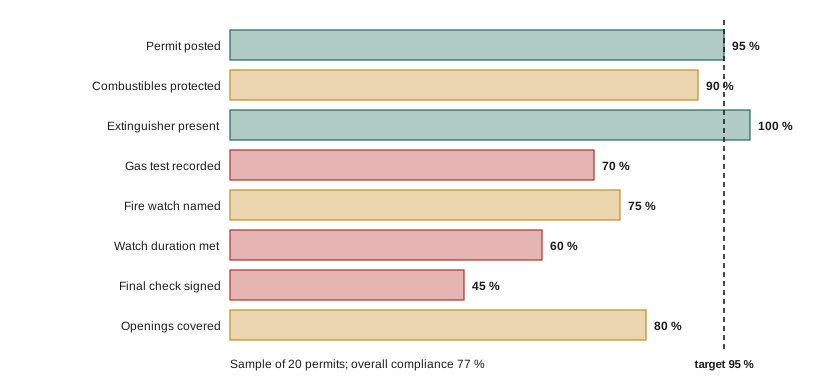
An auditor reviews 20 closed permits and checks eight items on each, scoring 1 for each item met. The totals are: permit posted 19, combustibles moved or covered 18, extinguisher present 20, gas test recorded where required 14, fire watch named 15, fire watch duration met 12, final check signed 9, openings covered 16. The site's target is 95 % compliance for every item. What is the overall score, and where should improvement focus?
Show solution
- Total possible points: 20 permits × 8 items = 160.
- Points scored: 19 + 18 + 20 + 14 + 15 + 12 + 9 + 16 = 123.
- Overall compliance: 123 ÷ 160 = 0.769, or about 77 %.
- Item scores: final check 9 ÷ 20 = 45 %, fire watch duration 12 ÷ 20 = 60 %, gas test 70 %, fire watch named 75 %, openings 80 %, combustibles 90 %, posted 95 %, extinguisher 100 %.
Answer: Overall compliance is about 77 %, well below the 95 % target. The weakest items, final checks, fire watch duration and gas testing, are exactly the controls that prevent delayed fires and explosions. Improvement should focus there: scheduling hot work earlier, making fire watch a dedicated role, adding a final check step that cannot be skipped, and training authorizing individuals on gas testing.
Audit results should go back to the people who issue and use permits, with clear actions and follow-up. A high score on paper with poor field conditions is a warning sign that permits are being filled in without real inspection.
The cost case
Programs need resources, and managers often ask what hot work controls cost compared with the risk. A simple comparison helps.
Worked problem
Comparing program cost with expected loss
A plant does about 300 hot work permits a year. Running the program costs about $60,000 a year: fire watch time, blankets and extinguishers, gas detectors, training and audits. The plant's insurer estimates that without effective controls there would be about a 1-in-20 chance each year of a major hot work fire costing about $8 million in damage and lost production, plus a 1-in-5 chance of a smaller fire costing about $150,000. With an effective program, both probabilities fall by about 90 %. Is the program worth it?
Show solution
- Expected annual loss without the program: 0.05 × 8,000,000 + 0.2 × 150,000 = 400,000 + 30,000 = $430,000.
- Expected annual loss with the program: 10 % of that, about $43,000.
- Reduction in expected loss: 430,000 − 43,000 = $387,000 a year.
- Program cost: $60,000 a year, or about $200 per permit.
Answer: The program reduces expected losses by about $387,000 a year for $60,000, a return of more than six to one, before counting injuries, deaths, prosecution and reputational harm, which cannot be measured in money. These are illustrative figures, but real cases usually show the same pattern.
Capstone: building a hot work program for a manufacturing plant
Imagine you have been asked to set up a hot work program for a 200-worker metal fabrication and assembly plant in Ontario. The plant has a welding shop, a paint line using solvent-based coatings, a warehouse of packaged finished goods, a roof with torch-applied membrane due for repair, and maintenance contractors who weld on conveyors and racking several times a week. Work through the steps below.
- Legal requirements: list the Ontario Fire Code Section 5.2 requirements, the Occupational Health and Safety Act and Regulation 851 duties, CSA W117.2 as the technical standard, and the insurer's conditions. Set the fire watch at the longest required time, for example 60 minutes by code or longer if the insurer requires, plus a final check.
- Designated area: confirm the welding shop meets designated-area criteria, with noncombustible construction, screens, local exhaust and extinguishers, so routine shop work runs under an area authorization reviewed monthly.
- Bans and restricted areas: ban hot work in the paint line and solvent storage area unless the line is shut down, cleaned, tested and ventilated under a special permit; ban torch-applied roofing and specify a self-adhered or mechanically fastened membrane for the roof repair.
- Permits: introduce a one-page permit with the job, time, people, a precautions checklist, gas test section, fire watch and close-out signatures. Train five maintenance and production supervisors as permit authorizing individuals.
- Fire watches: designate and train a pool of fire watches, make the role dedicated, and set a rule that hot work outside the shop must finish early enough for the fire watch and final check to be completed during staffed hours.
- Equipment: provide hot work carts with two extinguishers, welding blankets of suitable grades, drain covers and a bump-tested combustible gas detector.
- Contractors: prequalify welding contractors, require orientation, require them to work under the plant's permits, and assign an internal contact to audit their jobs.
- Training: initial and refresher training for operators, authorizing individuals and fire watches, including hands-on extinguisher practice.
- Audits: monthly review of a sample of permits and field audits of active jobs, with results reported to the joint committee or safety committee and the plant manager.
- Review: an annual review of the program, incidents, near misses and audit trends.
When you have worked through the capstone, you should be able to explain each choice in terms of the hierarchy of controls, the legal requirements and the incident lessons in this course. That is the test of a good hot work program: every rule has a reason, and every person knows it.
Common mistakes
MistakeLetting contractors use their own permits without review.
InsteadContractors work under the site program, or one the owner has reviewed and accepted, with site supervision.
MistakeAuditing only paperwork.
InsteadCombine document audits with field audits of active jobs.
MistakeTreating small fires put out by the fire watch as unimportant.
InsteadReport and investigate them as near misses.
MistakeAssuming the program is complete once written.
InsteadTrain people, provide equipment, audit, review annually and act on findings.
MistakeArguing that hot work controls are too expensive.
InsteadCompare program cost with the expected loss; effective programs usually pay for themselves many times over.
Summary and key terms
- A hot work program combines policy, roles, designated areas, permits, equipment, contractors, training, audits and review.
- Contractors must be prequalified, oriented, informed of hazards and supervised under the site's program.
- CSB investigations show repeated failures: untested tanks, unmonitored atmospheres and poor contractor oversight.
- The CSB's seven key lessons summarize how to prevent hot work incidents.
- Audits should combine permit reviews with field checks and focus on fire watch duration and final checks.
- Effective programs cost far less than the expected losses they prevent.
- The capstone applies every element to a real plant.
- Hot work program
- The written system of policy, roles, permits, training, equipment and audits that controls hot work.
- Prequalification
- Checking a contractor's safety record and procedures before awarding work.
- Orientation
- Briefing a contractor on site hazards, rules and emergency procedures before work begins.
- Document audit
- A review of completed permits for completeness and consistency.
- Field audit
- An inspection of active hot work comparing conditions with the permit.
- Near miss
- An event that could have caused harm but did not.
- Expected loss
- The probability of an event multiplied by its cost, summed over events.
- Area authorization
- A standing approval for routine hot work in a designated area.
- Chemical Safety Board
- The US agency that investigates major chemical incidents, including many hot work explosions.
- Program review
- A periodic evaluation of the hot work program, incidents and audit results.
Practice problems
Work each problem on paper first, then reveal the answer to check.
List six elements of a hot work program.
Show answer
Policy, roles, designated areas, permits, equipment, contractor management, training, audits and incident investigation.
What is the seventh of the CSB's key lessons?
Show answer
Supervise contractors and make sure they understand the site's hot work hazards and requirements.
What should the owner tell a contractor before hot work on equipment?
Show answer
What the equipment held, what is nearby and the site's hazards and emergency procedures.
What failure was common to the Tomahawk, Buffalo and DeRidder incidents?
Show answer
Flammable gas or vapour inside a tank was not detected because the interior was not tested.
What is the difference between a document audit and a field audit?
Show answer
A document audit reviews closed permits; a field audit checks active jobs against the permit.
In the audit example, what was the overall compliance?
Show answer
About 77 % (123 of 160 points).
Which audit items are most important for catching smouldering fires?
Show answer
Fire watch duration and the final check.
How is expected annual loss calculated?
Show answer
Probability of each event times its cost, added together.
Why ban torch roofing in the capstone plant?
Show answer
Cold-applied or self-adhered alternatives remove the high fire risk of open flame on the roof.
How should the capstone plant handle hot work in the paint line?
Show answer
Ban it unless the line is shut down, cleaned, tested and ventilated under a special permit.
Lesson quiz · 5 questions
Score 60% or more to complete this lesson.
Create a free account to save your progress, take quizzes and earn a certificate.