
HSE-216 · Lesson 1 of 12 · 25 min
Hot work: what it is and why it matters
Hot work is any work that produces flames, sparks or enough heat to ignite something nearby. Welding, flame cutting and grinding are the familiar examples, but the definition is much wider: brazing, soldering, torch-applied roofing, thawing frozen pipes with a torch, heat-shrinking, hot riveting, using a hot-air gun near combustibles, and even drilling or cutting metal with abrasive tools can all count. Hot work is essential. Buildings, pipelines, ships, plants and machinery could not be built or repaired without it. It is also one of the most reliable ways to start a fire or explosion at work, because it deliberately brings an ignition source to places that were never designed to have one.
This is an awareness course for welders' helpers, maintenance workers, contractors, fire watchers, supervisors, joint health and safety committee members, health and safety representatives, facility managers and anyone who issues or works under hot work permits. It explains how hot work starts fires and explosions, what the National Fire Code of Canada, provincial fire codes, provincial and federal occupational health and safety law and CSA W117.2 expect, and how permits, fire watches, gas testing and good planning prevent losses. It does not qualify anyone as a welder, does not replace Canadian Welding Bureau certification or site-specific permit training, and does not make anyone a certified fire watch where a jurisdiction or employer requires one.
Why hot work deserves its own course
Most fire prevention depends on keeping ignition sources away from fuel. Hot work turns that idea upside down: the worker creates an ignition source on purpose and carries it to the job, which may be next to stored materials, inside an occupied building, on a roof made of combustible layers, or on equipment that once held flammable liquid. The heat is not an accident or a defect. It is the whole point of the task. That means the controls must be deliberate too. Fires from hot work rarely come from bad luck. They come from a missing step: combustibles that were not moved, a hidden space that was not checked, a gas test that was not done, a fire watch who left early, or a permit signed without anyone looking at the area.
Fire statistics show the scale. In the United States, the National Fire Protection Association estimated that fire departments responded to an average of about 4,440 structure fires a year involving hot work, causing about 12 civilian deaths, about 208 injuries and about US$287 million in direct property damage each year. Canada does not publish a single national figure on the same basis, but provincial fire marshals and insurers report the same pattern: torches, welding and grinding are a leading cause of fires in buildings under construction or renovation, and roofing torches start some of the largest losses. Workers' compensation boards also record burns, eye injuries and fume-related illness among welders every year.
The numbers understate the real cost. A hot work fire can destroy an irreplaceable building, shut down a plant for months, put neighbours out of work and kill firefighters who respond. Insurers treat hot work as one of the main causes of large industrial losses, and many insurance policies now include specific hot work conditions. Breaking them can leave the owner without coverage after a fire.
What counts as hot work
Standards and codes define hot work broadly so that no one can argue a particular task falls outside the rules. The table below lists common hot work activities and the reason each can start a fire.
| Activity | Typical ignition mechanism | Notes |
|---|---|---|
| Arc welding (SMAW, GMAW, FCAW, GTAW) | Spatter, molten metal, slag, hot workpiece, arc | Spatter can travel several metres and smoulder in dust |
| Oxy-fuel cutting and welding | Large showers of sparks and molten slag, open flame | Cutting throws far more sparks than welding |
| Plasma and air carbon arc cutting | Molten metal blown out at high speed | Air carbon arc gouging is one of the most spark-intensive processes |
| Grinding and abrasive cutting | Streams of hot metal particles | Often treated casually, yet sparks can ignite dust and vapours |
| Brazing and soldering | Torch flame, hot joint, conduction | Common in plumbing and HVAC inside finished buildings |
| Torch-applied roofing | Open flame on combustible roof layers | Fire can spread unseen inside the roof assembly |
| Pipe thawing with torches | Open flame near hidden combustibles | Electrical thawing or hot water is usually safer |
| Hot riveting, heat-shrinking, hot-air tools | Hot surfaces and heated air | Included in most permit definitions |
Some organizations add work that does not involve heat at all but can create an ignition source in a flammable atmosphere, such as using non-intrinsically-safe electrical equipment, cameras or internal combustion engines in a classified area. These are often managed under the same permit system because the hazard, an ignition source meeting fuel, is the same.
The fire triangle and hot work
A fire needs three things: fuel, oxygen and heat. Hot work always supplies the heat, often far more than is needed. A welding arc reaches several thousand degrees Celsius. Molten spatter leaves the arc at well over 1,000 °C. Grinding sparks are small, but they are particles of metal hot enough to glow. An oxy-fuel flame burns at about 3,000 °C for acetylene. Any of these can ignite paper, wood, cardboard, plastics, insulation, dust, flammable vapours and gases.
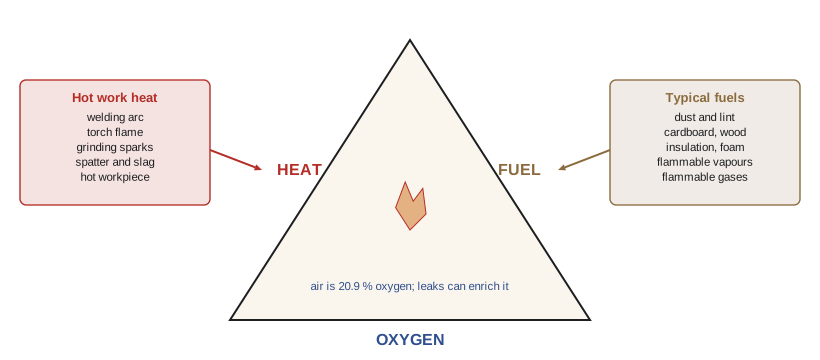
Hot work can also add oxygen. A leaking oxygen hose or regulator, or oxygen used wrongly to blow dust off clothing or to ventilate a space, can create an oxygen-enriched atmosphere in which clothing and hair ignite easily and burn fiercely. Normal air is about 20.9 % oxygen. Above about 23 %, materials that would only smoulder can burst into flame. This is why codes forbid using oxygen for ventilation or to dust off work.
Why hot work fires are often discovered late
One of the defining features of hot work fires is delay. A spark that lands in sawdust, in a gap between floorboards, inside a wall cavity or under roofing felt may smoulder for an hour or more before it bursts into flame. By then the welder may have packed up and left. A smouldering fire inside a roof or wall can grow out of sight until it breaks through and spreads rapidly. Many large hot work losses began after the workers had gone home. This is the reason for fire watches that continue after the work stops, for post-work monitoring and for final inspections hours later. Lesson 8 covers fire watch in detail.
Explosions are the other side of the problem. When hot work meets a flammable gas or vapour in the right concentration, ignition is instant. Tanks, drums, sewers, process vessels and pipes that look empty may contain vapour from residue, sludge, scale or liquid trapped in pockets. CSB investigations have repeatedly found workers welding on or near tanks that were believed to be empty or harmless, without testing inside the tank or in nearby connected equipment. Lesson 7 covers gas testing and work near flammables.
Who is involved
Hot work safety is shared. Several roles appear in most permit systems, and later lessons describe each in detail.
- The hot work operator does the welding, cutting, grinding or other hot work and must follow the permit conditions.
- The permit authorizing individual, sometimes called the permit issuer or area authority, inspects the area, decides whether hot work can be done safely, sets the precautions and signs the permit.
- The fire watch observes the area during and after the work, ready to put out small fires and to raise the alarm.
- The supervisor or site management makes sure the system works: people are trained, permits are used, combustibles are controlled and contractors are briefed.
- The owner or facility manager knows the building's fire protection systems, hidden spaces and special hazards, and remains responsible for the property even when contractors do the work.
In small jobs, one person may hold more than one role, but the operator should not be their own fire watch while working, because their attention and their view are both taken up by the work. Masks and helmets also restrict peripheral vision.
Worked problem
Is this hot work?
A maintenance worker plans three tasks in a food warehouse: cutting a seized bolt with an angle grinder, soldering a copper water line behind a drywall partition, and drilling holes in a steel beam with a cordless drill. Which tasks should be managed as hot work under the site's permit system, which follows the National Fire Code and CSA W117.2?
Show solution
- Angle grinding throws streams of hot metal particles. It is spark-producing work and is hot work in every common definition.
- Soldering uses a torch flame and heats the joint and pipe. The drywall partition may hide combustible paper facing, insulation, dust and wiring. This is hot work, and the hidden space makes it higher risk.
- Drilling with a cordless drill and a sharp bit at normal speed produces chips, not sparks, and does not create an open flame. Most systems do not treat it as hot work, unless it is done in a flammable atmosphere where any ignition source is controlled.
Answer: The grinding and the soldering are hot work and need permits and the precautions in later lessons. The drilling usually does not, but if the warehouse stored flammable aerosols or dusts that could form an explosive atmosphere, even the drill might need to be controlled as an ignition source.
The cost of getting it wrong
A hot work fire affects far more than the worker holding the torch. People who were never near the work can be killed by smoke. Businesses lose stock, equipment and customers. Workers lose jobs if a plant does not rebuild. Communities lose heritage buildings and churches; many famous building fires during restoration work began with hot work or other work involving heat. Contractors can face prosecution, lawsuits and insurance claims for decades.
Against that, the controls are simple and inexpensive: plan the job, avoid hot work where another method works, move or protect combustibles, test the atmosphere, keep extinguishers ready, use a permit, post a fire watch and check the area again later. The rest of this course explains each control and why it works.
Common mistakes
MistakeThinking only welding and torch cutting count as hot work.
InsteadGrinding, brazing, soldering, torch roofing, pipe thawing and other spark- or flame-producing work are hot work too.
MistakeAssuming a fire will be noticed right away.
InsteadSparks can smoulder for an hour or more in dust, insulation or hidden spaces before flames appear.
MistakeBelieving an empty tank or drum is safe to weld on.
InsteadResidue and trapped vapour can explode; containers must be cleaned, purged and tested first.
MistakeLetting the welder act as their own fire watch.
InsteadThe operator is focused on the work and has limited vision; a separate fire watch is needed where required.
MistakeUsing oxygen to blow dust off clothing or to ventilate a space.
InsteadOxygen enrichment makes clothing and hair ignite easily; use only air for these purposes, or better, vacuum the dust.
Summary and key terms
- Hot work is any work that produces flames, sparks or enough heat to ignite materials, not just welding.
- Hot work deliberately brings an ignition source to the fuel, so controls must be deliberate too.
- Hot work causes thousands of structure fires each year, with deaths, injuries and large property losses.
- Smouldering fires from sparks can stay hidden for an hour or more before flaming up.
- Hot work near flammable gases or vapours can cause instant explosions, often in containers believed empty.
- Operators, permit issuers, fire watches, supervisors and owners all have roles.
- This awareness course does not qualify anyone as a welder or certified fire watch.
- Hot work
- Work that produces flames, sparks or heat able to ignite materials, such as welding, cutting, grinding, brazing and torch roofing.
- Spatter
- Droplets of molten metal thrown from a welding arc.
- Slag
- Molten or solidified waste material produced in welding and cutting, often thrown or dropped from the work.
- Fire triangle
- The three elements a fire needs: fuel, oxygen and heat.
- Oxygen-enriched atmosphere
- Air with more than about 23 % oxygen, in which materials ignite more easily and burn faster.
- Smouldering fire
- A slow, flameless combustion that can later burst into open flame.
- Hot work operator
- The person doing the welding, cutting, grinding or other hot work.
- Permit authorizing individual
- The person who inspects the area, sets precautions and authorizes hot work.
- Fire watch
- A trained person who watches the hot work area for fires during and after the work.
- Hot work permit
- A documented authorization listing the hazards, precautions and people responsible for a hot work job.
Practice problems
Work each problem on paper first, then reveal the answer to check.
Name five activities that count as hot work.
Show answer
Arc welding, oxy-fuel cutting, grinding, brazing, soldering, torch-applied roofing, pipe thawing with torches or hot riveting.
Which side of the fire triangle does hot work supply?
Show answer
Heat, in the form of flames, arcs, sparks, slag and hot metal.
How can hot work also add oxygen?
Show answer
Through leaking oxygen hoses or regulators, or by misusing oxygen for ventilation or dusting.
Why are fire watches continued after hot work stops?
Show answer
Sparks can smoulder for an hour or more before flames appear.
Why are containers that look empty dangerous to weld on?
Show answer
Residue, sludge or trapped liquid can produce flammable vapour that explodes when heated.
About how many US structure fires a year involve hot work, according to NFPA estimates?
Show answer
About 4,440 a year on average.
Who signs a hot work permit?
Show answer
The permit authorizing individual, after inspecting the area and setting precautions.
Why should the operator not be their own fire watch?
Show answer
Their attention and vision are taken up by the work, and helmets restrict peripheral vision.
Is drilling metal with a cordless drill usually hot work?
Show answer
Usually not, unless done in a flammable atmosphere where any ignition source must be controlled.
Name three costs of a hot work fire beyond the property damage.
Show answer
Deaths and injuries, business interruption, lost jobs, prosecution, lawsuits and loss of heritage buildings.
Lesson quiz · 5 questions
Score 60% or more to complete this lesson.
Create a free account to save your progress, take quizzes and earn a certificate.