
HSE-216 · Lesson 5 of 12 · 25 min
Hot work permits, roles and responsibilities
A hot work permit is a documented authorization to do a specific hot work job, at a specific place, for a specific time, under specific precautions. It is the backbone of most hot work programs. Done well, a permit forces a qualified person to look at the area before work starts, confirms that each precaution is in place, tells everyone who is responsible for what, and leaves a record. Done badly, it is a form signed at a desk that gives a false sense of security. This lesson covers what a permit system should include, who does what and how to make the permit a real control rather than paperwork.
When is a permit needed?
The National Fire Code and CSA W117.2 require precautions whenever hot work is done outside an area that is free of combustibles. Most employers and insurers implement this with a written permit system: any hot work outside a designated hot work area needs a permit. Some provincial OHS rules, such as Alberta's, require a hot work permit or equivalent controls directly. Federal and provincial confined space rules require entry permits that address hot work inside a confined space.
Even where the law does not use the word permit, a permit system is the clearest way to show that the area was inspected and precautions were taken. Sites usually define exceptions carefully: routine work in a designated welding shop, for example, may run under a standing area authorization reviewed regularly rather than a permit for each job.
What a permit should contain
Permit forms vary, but good ones share the same core content.
- The job: location, equipment, description of the hot work and the process to be used.
- The time: date, start time and expiry. Permits are usually valid for one shift or less and must be renewed if the work continues.
- The people: operator, fire watch, permit authorizing individual and any contractor supervisor, with signatures.
- A precautions checklist confirming, for example, that sprinklers and alarms are working, extinguishers are on hand, combustibles within the protective zone are removed or covered, floors are swept and wetted where needed, openings are covered, the far side of walls has been checked, and the atmosphere has been tested where needed.
- Gas test results, with time, readings, instrument and tester, where required.
- Fire watch requirements, including duration and any post-work monitoring.
- Close-out: the time the work ended, the time the fire watch ended, the final inspection and the signature confirming the area was left safe.
The roles
Hot work standards define a small number of roles. Each needs training and authority appropriate to the job.
- The permit authorizing individual (sometimes called the permit issuer or area authority) is designated by management, knows the area and its hazards, inspects the work site, decides whether hot work can proceed, sets the precautions and signs the permit. CSA W117.2 and many employer programs require this person to be trained and competent in fire hazards and the site's systems.
- The hot work operator does the work, makes sure the permit is in place and its conditions are met before starting, uses equipment correctly and stops if conditions change.
- The fire watch is trained in fire extinguisher use and the alarm procedure, watches the area during the work and for the required time afterward, and has authority to stop the work if conditions become unsafe.
- Management designates the people above, provides training, equipment and time, and makes sure contractors follow the site's program.
- Contractors must follow the owner's hot work program, and the owner must inform contractors of the site's hazards. Under provincial OHS law, owners and constructors also have duties to coordinate safety on multi-employer sites.
On small jobs one person may combine roles, but the authorizing individual should not normally be the operator, because the purpose is an independent check. The operator should never be their own fire watch while working.
Inspecting the area before signing
The heart of the permit is the inspection. The authorizing individual should walk the area, not sign from memory or from a description. A practical inspection works outward from the work.
- At the work: what will be heated, what is it attached to, what is on the other side, has the equipment been isolated, cleaned and tested if it held flammables?
- In the protective zone: what combustibles are present, can they be moved, can the rest be covered, are floors clean, where are the openings, drains and penetrations?
- Above and below: what is on the floor below, in the ceiling space, on the roof, on beams and ledges?
- Adjacent areas: what is on the other side of walls, partitions and doors, and does it need a second watch?
- Fire protection: are sprinklers in service, are alarms working, is there an extinguisher and, where required, a charged hose line?
- The atmosphere: is a gas test needed, by whom, and how often?
The authorizing individual then decides: approve with conditions, require changes before approval, or refuse. Refusing a permit is a legitimate outcome, and a good program supports the person who refuses.
Posting and using the permit
Once signed, the permit should be posted at the work location where the operator and fire watch can see it. Some sites use a two-part permit, with one copy at the job and one at a control point so that operations know where hot work is under way. Electronic permits are increasingly common and are recognized by NFPA 51B since the 2024 edition as documented permits, but they still need a physical inspection of the area and a visible indication at the job.
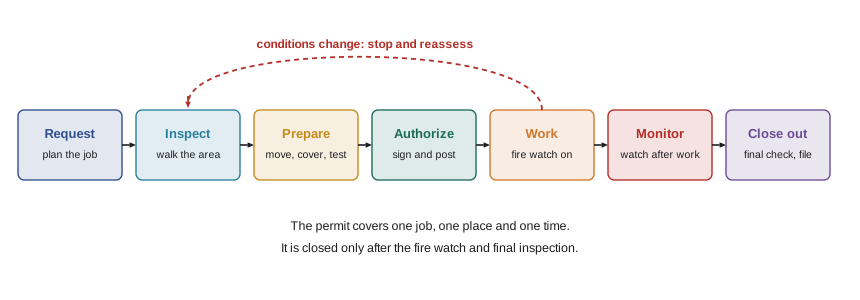
The permit applies only to the work, place and time it names. If the job changes, the work moves to a new location, the process changes, a fire protection system is impaired, a flammable release occurs nearby, or the shift ends, the work stops and the permit must be reassessed or reissued.
| Change during the job | What to do |
|---|---|
| Work moves to a different location | Stop; inspect the new location and issue a new permit |
| Process changes, for example from welding to cutting | Stop; reassess the spark zone and precautions |
| Sprinkler or alarm impairment begins | Stop unless the impairment plan allows work with extra precautions |
| Gas detector alarms or odour of vapour | Stop immediately, shut off equipment, leave and reassess |
| Fire watch has to leave | Stop until a trained replacement takes over |
| Permit expires or shift ends | Stop; complete the fire watch and close out, or renew the permit |
Closing out the permit
A permit is not finished when the welding stops. The fire watch continues for the required time; then the area is inspected, often by the authorizing individual, and the permit is signed off. Many programs also require a final check some hours later. Only then is the permit closed and filed. Closed permits are valuable records for audits, incident investigations and showing due diligence.
Worked problem
Reviewing a completed permit
An auditor reviews a permit for welding in a warehouse. It shows: work started 13:10, work ended 15:40, fire watch ended 16:00, final check blank, gas test not required, combustibles moved: yes, sprinklers in service: yes, signatures: operator and authorizing individual, fire watch name blank. The site follows the National Fire Code. What problems can the auditor identify?
Show solution
- The fire watch lasted only 20 minutes after the work ended (15:40 to 16:00). The code requires at least 60 minutes.
- The final check is blank, so there is no evidence anyone inspected the area later.
- No fire watch is named, so there is no evidence a trained person was assigned.
- The work ran for two and a half hours, which may have spanned a break or shift change; the permit does not show whether conditions were rechecked.
Answer: The permit shows a fire watch that was too short, no named fire watch and no final check. These are the controls that catch smouldering fires. The auditor should treat this as a serious finding, follow up with the people involved and check other permits for the same pattern.
Making permits work in practice
Permit systems fail in predictable ways: forms signed in advance, inspections skipped, permits reused, fire watches combined with other duties, contractors unaware of the system, and permits that are so long that people stop reading them. The fixes are equally predictable: keep the form short and specific, train authorizing individuals, require signatures at the work location, audit permits regularly, and support people who stop work. Lesson 12 covers auditing and improving a permit program.
Training the people who sign permits
The permit authorizing individual carries real responsibility, and the role needs more than a signature. Training typically covers how hot work starts fires and explosions, the site's fire protection systems and how impairments are managed, the hazards of particular areas and equipment, how and when to require gas testing, how to read detector results, the precautions on the permit and why each matters, how long fire watches must last, and the authority to refuse or stop work. Many organizations require authorizing individuals to be supervisors or senior technicians with good knowledge of the area, and they keep a list of who is authorized for which areas.
Operators need training too: the permit system and their duties under it, safe use of their equipment, the hazards of the materials they work on, and when to stop. Fire watches need hands-on extinguisher practice, knowledge of the alarm and evacuation procedures, and a clear understanding that watching is their only job.
Electronic permit systems
Many large sites now use electronic permit-to-work software. Electronic permits make it easier to see all active hot work on a site, to prevent conflicting permits, to record gas test readings and times automatically, and to audit closed permits. They also carry risks: approvals given from a desk without visiting the area, checklists ticked by habit, and permits that are hard to see at the work location. A good electronic system still requires the authorizing individual to inspect the area in person, displays the permit at the job on a printed copy, tablet or tag, and records who did what and when.
Common mistakes
MistakeSigning the permit without visiting the area.
InsteadThe authorizing individual must inspect the work site, including above, below and adjacent areas.
MistakeUsing one permit for several locations or days.
InsteadA permit covers one job, place and time; changes require reassessment or a new permit.
MistakeLeaving the fire watch box blank or assigning someone with other duties.
InsteadName a trained fire watch whose only job is watching for fire.
MistakeClosing the permit when the welding stops.
InsteadClose it only after the fire watch period and final inspection are complete.
MistakeTreating a refused permit as a failure.
InsteadRefusing an unsafe permit is the system working; support the person who refuses.
Summary and key terms
- A hot work permit authorizes a specific job, place and time under specific precautions.
- Hot work outside a designated area normally needs a permit under employer, insurer and code requirements.
- A good permit lists the job, time, people, precautions, gas tests, fire watch and close-out.
- The authorizing individual must inspect the area in person before signing.
- Operators, fire watches, management and contractors each have defined duties.
- If conditions change, the work stops and the permit is reassessed.
- The permit is closed only after the fire watch and final inspection are complete.
- Hot work permit
- A documented authorization for a specific hot work job, location and time under listed precautions.
- Permit authorizing individual
- The designated person who inspects the area, sets precautions and signs the permit.
- Hot work operator
- The person performing the hot work.
- Fire watch
- A trained person assigned to watch for fires during and after hot work.
- Documented permit
- A permit recorded on paper or electronically, as recognized by NFPA 51B since 2024.
- Close-out
- The final steps that end a permit: fire watch completed, final inspection and signatures.
- Expiry
- The time after which a permit is no longer valid and work must stop or the permit be renewed.
- Designated area
- A location built for routine hot work where individual permits may not be needed.
- Multi-employer site
- A workplace where more than one employer's workers are present, such as a construction project.
- Area authorization
- A standing approval for routine hot work in a designated area, reviewed regularly.
Practice problems
Work each problem on paper first, then reveal the answer to check.
What four things does a permit tie together?
Show answer
A specific job, location, time and set of precautions.
Who should inspect the area before the permit is signed?
Show answer
The permit authorizing individual, in person.
Name five items on a typical permit precautions checklist.
Show answer
Sprinklers working, extinguisher present, combustibles moved or covered, floors swept, openings covered, far side checked, gas test done.
Why should the authorizing individual not usually be the operator?
Show answer
The permit is meant to provide an independent check.
Where should the signed permit be posted?
Show answer
At the work location, visible to the operator and fire watch.
What should happen if the work moves to a new location?
Show answer
Stop, inspect the new location and issue a new permit.
What should happen if a gas detector alarms during the work?
Show answer
Stop immediately, shut off the equipment, leave and reassess.
When can a permit be closed?
Show answer
After the fire watch period and the final inspection are completed and signed.
What did the 2024 edition of NFPA 51B recognize about permits?
Show answer
That documented permits, including electronic ones, can be used.
Name three common ways permit systems fail.
Show answer
Signing without inspection, reusing permits, short fire watches, untrained contractors or overly long forms.
Lesson quiz · 5 questions
Score 60% or more to complete this lesson.
Create a free account to save your progress, take quizzes and earn a certificate.