
HSE-216 · Lesson 7 of 12 · 25 min
Gas testing and hot work near flammables, tanks and containers
The deadliest hot work incidents are explosions. They happen in an instant, often kill several workers at once, and almost always involve flammable gas or vapour that nobody measured. Tanks, drums, pipes, sewers, vessels and process equipment that seem empty can hold enough vapour to explode when a spark or hot surface reaches it. The CSB's investigations from the 2000s and 2010s read like a list of repeated mistakes: welding on top of a tank believed empty, testing outside the tank but not inside, testing the tank being worked on but not the connected one next to it, or not testing at all. This lesson explains how to measure flammable atmospheres, what the readings mean and how to make containers safe before hot work.
Why gas testing matters
You cannot smell or see a flammable atmosphere reliably. Some vapours have strong odours at harmless levels; others are almost odourless at dangerous ones. Odour fatigue means people stop noticing a smell after a few minutes. Hydrogen generated by bacteria or corrosion is odourless and invisible. The only reliable way to know is to measure with a calibrated instrument, before the work starts and, where conditions can change, continuously or at frequent intervals during the work.
The second of the CSB's seven key lessons is to assess the hazards before starting; the third is to use a calibrated combustible gas detector before and during the work, even in areas where flammables are not expected. The fourth is to drain or purge equipment and test not only the equipment being worked on but also surrounding tanks and adjacent spaces.
How combustible gas detectors read
Most portable detectors used for hot work measure combustible gas as a percentage of the lower explosive limit (% LEL). A reading of 0 % LEL means no combustible gas detected; 100 % LEL means the mixture has reached its lower explosive limit and can ignite. A reading of 10 % LEL means the atmosphere holds one-tenth of the amount of gas needed to burn.
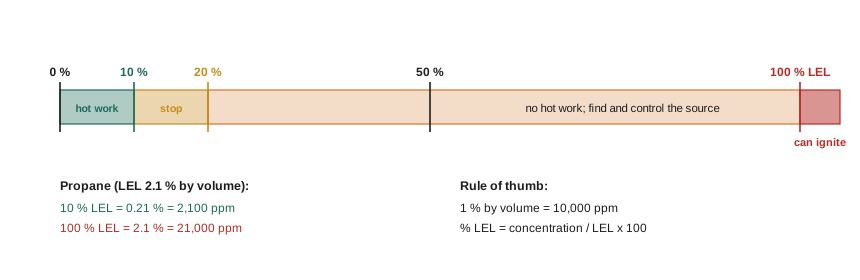
Hot work standards set limits well below the LEL to leave a safety margin for measurement error, uneven mixing and changing conditions. CSA W117.2, the federal regulations for hazardous confined spaces and most employer programs prohibit hot work when combustible gas exceeds 10 % of the LEL. Some provincial rules use 20 % LEL as the legal maximum for some situations, and many detectors are set to alarm at 10 % and 20 %. Where requirements differ, the stricter limit applies, and many sites require a reading of 0 % LEL for hot work on or in equipment that held flammables.
Converting between units
Safety data sheets and process data often give concentrations in percent by volume or parts per million (ppm). Converting to % LEL helps you understand what a reading means.
- 1 % by volume equals 10,000 ppm.
- % LEL equals the concentration in percent by volume divided by the gas's LEL in percent, multiplied by 100.
For propane, with an LEL of 2.1 %, a concentration of 0.21 % by volume (2,100 ppm) is 10 % LEL. For acetylene, with an LEL of 2.5 %, 10 % LEL is 0.25 % by volume or 2,500 ppm. For methane, with an LEL of 5.0 %, 10 % LEL is 0.5 % or 5,000 ppm.
Worked problem
What does the reading mean?
A worker uses a detector calibrated to pentane to test a tank that held propane. The display reads 6 % LEL. The site rule is that hot work may not start above 10 % LEL. The detector's correction factor sheet says that, for propane, actual % LEL equals the pentane-calibrated reading multiplied by 0.8 (an illustrative value; always use the manufacturer's own factors). A process engineer also reports a propane level of 1,500 ppm from a separate measurement. Can hot work start?
Show solution
- Correct the detector reading: 6 × 0.8 = 4.8 % LEL of propane.
- Convert the engineer's figure: 1,500 ppm = 0.15 % by volume. Divide by the LEL: 0.15 / 2.1 = 0.071, or about 7.1 % LEL.
- The two measurements disagree but both are below 10 % LEL, which suggests a real but low concentration, possibly varying with location in the tank.
- Any measurable flammable vapour in a tank about to be heated is a warning sign: the tank still contains propane or residue that can release more when heated.
Answer: Both readings are below the 10 % limit, but hot work on the tank should not start yet. The tank is not clean or inert. It should be purged and ventilated until readings at the top, middle and bottom are at or close to 0 % LEL, then retested immediately before work and monitored continuously, because heating can release more vapour from residue.
Using a detector properly
A detector is only as good as the person using it and the care it receives. Key practices include:
- Bump test the detector before each day's use by exposing it to a known gas and confirming it alarms, and calibrate it at the intervals the manufacturer specifies.
- Know what the instrument is calibrated to and use correction factors for other gases. Catalytic bead sensors need oxygen to work and can give low readings in oxygen-deficient atmospheres; some gases and vapours poison them.
- Test oxygen first, then combustible gas, then toxic gases, because oxygen level affects the combustible reading.
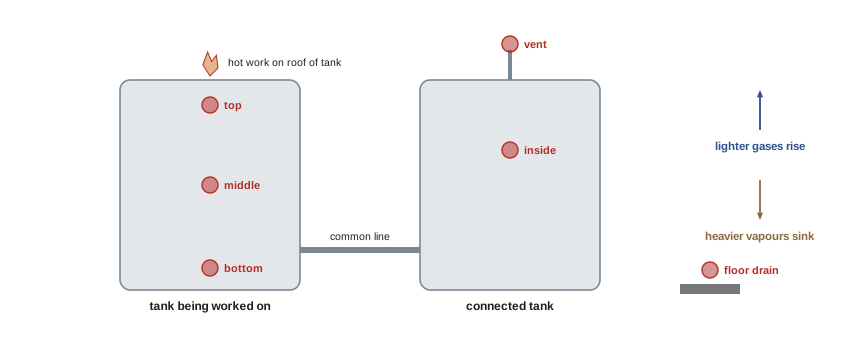
- Sample at several heights and places, because gases stratify: lighter-than-air gases such as methane and hydrogen collect at the top, heavier vapours such as propane and gasoline at the bottom, and others in pockets.
- Allow time for the sample to travel through long sampling tubes before reading.
- Test inside the equipment, not just around it, and test connected and nearby equipment, drains, sewers and low spots.
- Record readings, times, locations and instrument details on the permit.
- Monitor continuously during the work when conditions can change, for example near process equipment, sewers or tanks, or when heating may release vapour from residue.
Hot work on tanks, drums and containers
Welding, cutting or grinding on a container that holds or has held flammable or combustible material is one of the most dangerous jobs in industry. Even a few drops of liquid, a coating of residue on the walls or sludge in the bottom can release enough vapour when heated to form an explosive mixture. Drums are particularly notorious: cutting the top off an empty drum with a torch or abrasive wheel has killed many workers. The rule taught to every welder is simple: never weld, cut or grind on a drum or container until it has been properly cleaned and tested or made inert.
The National Fire Code and CSA W117.2 prohibit hot work on containers or piping that contain, or have contained, flammable or combustible substances until they have been made safe by cleaning, purging, ventilating or inerting and testing. Provincial OHS rules set out similar steps, and some require written procedures for containers that held hazardous substances.
Making a container safe typically follows these steps.
- Identify what the container held, using labels, records and safety data sheets. If the contents are unknown, treat them as flammable.
- Isolate the container from all connected piping by blanking, blinding or disconnecting lines, not just closing valves, and lock out pumps and agitators.
- Drain and remove liquids and sludge.
- Clean the inside by steaming, washing with hot water and detergent or other approved methods, and ventilate to remove vapours.
- Either make the container free of flammable vapour and confirm by testing, or make it inert by filling it with water to near the work point or purging it with an inert gas such as nitrogen and confirming low oxygen.
- Retest immediately before the work and during it, because heat can release vapour from residue in seams and corrosion.
- Provide a vent so heat cannot pressurize the container.
Inerting with nitrogen creates an asphyxiation hazard, because the container and the area around openings will be oxygen-deficient. Nobody should enter or put their head into an inerted container, and the area around vents should be monitored for oxygen.
Work near process equipment, sewers and storage
Hot work near operating process equipment brings its own hazards. Leaks from flanges, seals, sample points and relief valves can release flammable gas without warning. Sewers and drains can carry vapours from far away. Storage tank vents can release vapour when tanks are filled or when the sun warms them. In refineries, chemical plants and terminals, hot work in operating areas is usually controlled by stricter rules: continuous gas monitoring with alarms, coverings for drains and sewers, wind direction checks, spark containment habitats with positive pressure, and the authority to stop work instantly if a release occurs.
The DeRidder, Louisiana paper mill explosion in February 2017 shows how these factors combine. Contract workers were welding on piping above and disconnected from a 100,000-gallon foul condensate tank. Turpentine had accumulated in the tank because no one clearly owned its operation, and shutdown conditions let air in, forming an explosive mixture. The workers had tested for flammable gas outside the tank but not inside it. The explosion killed three contract workers, injured seven, and threw the tank about 375 ft (115 m) over a six-storey structure. The CSB found the explosion likely could have been prevented by a hazard analysis, effective safeguards and clear responsibility for the tank.
Who should do gas testing?
Gas testing is only as reliable as the person doing it. Testers need training on the specific instrument: how to bump test it, how to read and interpret the display, what its sensors can and cannot detect, how to sample through tubes and at different heights, and what to do when readings are unexpected. Many sites designate qualified gas testers and record their training. A tester who sees an unexpected reading, even a low one, should treat it as information about the equipment, find its source and involve the authorizing individual before any hot work begins.
Common mistakes
MistakeRelying on smell to detect flammable vapour.
InsteadUse a calibrated, bump-tested combustible gas detector; many dangerous gases are odourless or cause odour fatigue.
MistakeTesting outside a tank but not inside it, or not testing connected equipment.
InsteadTest inside at several levels, in connected and nearby equipment, at vents, drains and low spots.
MistakeStarting hot work at any reading below 100 % LEL.
InsteadHot work normally stops at 10 % LEL, and equipment that held flammables should read at or near 0 %.
MistakeCutting the top off an empty drum with a torch or grinder.
InsteadNever do hot work on a drum or container until it has been cleaned and tested or made inert.
MistakeTesting once and assuming conditions stay the same.
InsteadMonitor continuously or retest at intervals, especially when heat can release vapour from residue.
Summary and key terms
- Explosions from hot work almost always involve flammable gas or vapour that nobody measured.
- Combustible gas detectors read in % LEL; 100 % LEL means the mixture can ignite.
- Hot work is normally prohibited above 10 % LEL, and equipment that held flammables should read at or near 0 %.
- 1 % by volume equals 10,000 ppm; % LEL equals concentration divided by the LEL, times 100.
- Bump test and calibrate detectors, test oxygen first and sample at several levels.
- Containers that held flammables must be isolated, emptied, cleaned and tested or inerted before hot work.
- Hot work near process equipment needs continuous monitoring and the authority to stop instantly.
- % LEL
- A gas concentration expressed as a percentage of its lower explosive limit.
- Combustible gas detector
- An instrument that measures flammable gas, usually in % LEL.
- Bump test
- A brief exposure to a known gas to confirm that a detector responds and alarms.
- Calibration
- Adjusting a detector against a known gas concentration so its readings are accurate.
- Correction factor
- A multiplier used to convert a detector reading for one gas into a reading for another.
- Stratification
- Layering of gases by density, so concentrations differ at the top and bottom of a space.
- Inerting
- Replacing the atmosphere in a container with an inert gas such as nitrogen so combustion cannot occur.
- Purging
- Displacing gas or vapour from equipment with air, steam, water or inert gas.
- Blanking
- Isolating a line by inserting a solid plate between flanges.
- Odour fatigue
- Loss of the ability to notice a smell after continued exposure.
Practice problems
Work each problem on paper first, then reveal the answer to check.
What does a reading of 100 % LEL mean?
Show answer
The mixture has reached its lower explosive limit and can ignite.
What is the usual maximum combustible gas reading for hot work?
Show answer
10 % of the LEL, with many sites requiring at or near 0 % for equipment that held flammables.
How many ppm is 1 % by volume?
Show answer
10,000 ppm.
What is 10 % LEL of methane in ppm?
Show answer
Methane LEL is 5.0 %, so 10 % LEL is 0.5 % or 5,000 ppm.
Why test oxygen before combustible gas?
Show answer
Oxygen level affects how many combustible sensors respond, and low oxygen is itself a hazard.
Why sample at several heights?
Show answer
Gases stratify: light gases rise and heavy vapours sink.
What is a bump test?
Show answer
A brief exposure to a known gas to confirm the detector responds and alarms.
Name the main steps to make a used drum safe for hot work.
Show answer
Identify contents, isolate, drain, clean and ventilate, test or inert, retest, and vent.
What hazard does inerting with nitrogen create?
Show answer
Oxygen deficiency and asphyxiation inside and around the container.
What mistake did the DeRidder investigation highlight?
Show answer
Workers tested for flammable gas outside the tank but not inside it.
Lesson quiz · 5 questions
Score 60% or more to complete this lesson.
Create a free account to save your progress, take quizzes and earn a certificate.