
HSE-216 · Lesson 11 of 12 · 25 min
Hot work in special locations
The basic precautions of hot work, avoiding it where possible, removing or protecting combustibles, testing the atmosphere and keeping a fire watch, apply everywhere. Some locations add hazards that need extra controls or different thinking. Roofs hide fire inside their layers. Occupied buildings, hospitals and data centres cannot simply be cleared of people or equipment. Process plants and fuel terminals can release flammable gas at any moment. Confined spaces concentrate fumes and change oxygen levels. Construction sites have little fire protection and lots of fuel. This lesson looks at hot work in each of these settings.
Torch-applied roofing
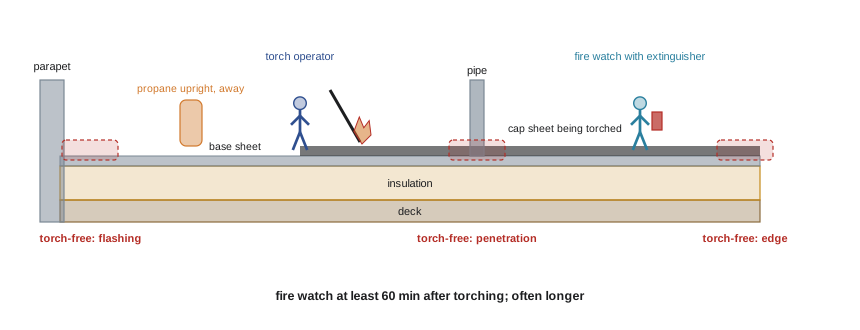
Torch-applied roofing uses a propane torch to melt the bitumen on the underside of modified bitumen membranes so they bond to the layer below. It is fast and produces durable roofs, but it brings an open flame of over 1,000 °C onto a roof assembly that may include wood decking, cant strips, insulation, old felts and hidden cavities. Fire can start inside the assembly, at flashings, around penetrations and at the edges, and smoulder out of sight for hours before breaking through. Roofing torches have caused some of the largest hot work losses, including fires that destroyed schools, churches and apartment buildings.
Roofing contractor associations have developed specific training for torch-applied roofing. The Canadian Roofing Contractors Association and provincial associations promote torch safety training and practices, and many insurers and owners require certified torch applicators. Key practices include:
- Never torch directly onto a combustible deck, wood blocking, cant strips or exposed insulation; install a noncombustible or mechanically fastened base sheet first.
- Do not torch in torch-free zones: at flashings, around penetrations, at edges and anywhere the flame could enter a gap or cavity. Use self-adhered membranes, cold-applied adhesives or hand-sealed details there.
- Keep the propane cylinder upright, away from the torching area and hatches, and shut it off at the cylinder when work stops.
- Have at least two suitable extinguishers on the roof within reach of the torch operator.
- Keep a fire watch for the required time after torching stops: at least 60 minutes under the National Fire Code, and longer where the insurer or owner requires, often with a final check using a thermal imaging camera.
- Stop torching well before the end of the day so the fire watch and final check happen in daylight with people present.
Many owners now ban torch-applied roofing on occupied, heritage or wood-frame buildings, and specify alternatives such as self-adhered, cold-applied or mechanically fastened membranes, or single-ply membranes welded with hot air, which carry far less fire risk.
Occupied buildings, hospitals and heritage sites
In offices, schools, hospitals, care homes, hotels and apartments, hot work must protect people who may not be able to evacuate quickly and who are not part of the work. Smoke from a small fire can spread through ducts and corridors and harm people far away. Hot work in these buildings is best done when the area is unoccupied, with smoke compartments closed, and with fire alarms in service. Health care facilities often require interim life safety measures when work affects fire protection, and infection control rules may limit dust and smoke.
Heritage buildings, churches and museums need special care. Large concealed roof spaces, old dry timber, decorative linings and irreplaceable contents mean a fire can be catastrophic. Many owners of heritage buildings ban open-flame work entirely, require cold methods, or allow hot work only in temporary noncombustible enclosures with extended fire watches and thermal imaging checks.
Data centres, telecommunications and clean environments
Data centres and telecommunications facilities are designed to keep fire out: very early smoke detection, pre-action or gaseous fire suppression, and strict control of combustibles. Hot work threatens all of these. Smoke and fume can trigger aspirating smoke detectors and release clean agent suppression systems, which are expensive to refill and can disrupt operations. Dust and metal particles can damage servers. The usual approach is to avoid hot work in white space altogether, fabricate off site, and use cold methods such as grooved couplings and mechanical fasteners for pipework and supports.
When hot work cannot be avoided, it is planned with the facility's operations team: detection and suppression zones may be placed in a controlled bypass with a documented impairment, a fire watch with suitable extinguishers stands by, the area is screened and ventilated to keep fume away from equipment, and systems are restored and tested immediately afterward. Similar principles apply in clean rooms, laboratories and control rooms. The data centre safety courses in this stream cover these facilities in more depth.
Process plants, refineries and fuel terminals
In refineries, chemical plants, gas plants, terminals and fuel storage sites, flammable gas can be released at any time from leaks, relief valves, sampling, maintenance on other equipment or upsets elsewhere in the plant. Hot work in operating areas is therefore controlled very tightly, usually under a site-wide permit-to-work system that coordinates hot work with other permits and with operations.
Industry practice in Canada follows the same guidance used internationally, including API Recommended Practice 2009, Safe Welding, Cutting, and Hot Work Practices in the Petroleum and Petrochemical Industries, and API RP 2201 for hot tapping, alongside provincial OHS rules and CSA Z767 for process safety management. Typical controls include continuous gas monitoring with alarms at the work and at nearby drains, covering sewers and drains, checking wind direction, and stopping work instantly when gas is detected or an alarm sounds.
Pressurized welding habitats are temporary enclosures built around the hot work and supplied with clean air from a safe location, keeping the inside at a slightly higher pressure than outside so flammable gas cannot enter. They include gas detectors at the air intake and inside, and they shut off the welding power automatically if gas is detected or the pressure is lost. Habitats allow hot work to continue in operating plants with much less risk, but they must be designed, installed and monitored by trained people.
Hot tapping, welding a fitting onto a pipe or vessel that is in service and then drilling through it, is a specialized form of hot work used to avoid shutting down a process. It requires engineering review of the pipe wall, the contents, flow and pressure, and should be done only by qualified specialists following a written procedure.
Confined spaces
Hot work in a confined space combines two of the most dangerous activities in industry. Fumes and gases concentrate quickly. Oxygen can be depleted by combustion or displaced by shielding gases such as argon and carbon dioxide, or increased by leaking oxygen hoses, making clothing extremely flammable. Flammable gas can enter from connected lines or be released from residue when it is heated. Escape is difficult, and rescue is slow.
Hot work in a confined space needs the full confined space program covered in HSE-211 in addition to the hot work permit: isolation of all lines, cleaning, continuous atmospheric monitoring for oxygen, flammables and toxic gases, forced ventilation with clean air, never using oxygen for ventilation, gas cylinders kept outside the space, torches and hoses removed during breaks, an attendant outside, a fire watch, and a rescue plan. Many sites require continuous monitoring inside the space during hot work and a fire watch both inside and outside where sparks could reach.
Construction and demolition sites
Buildings under construction or demolition are at their most vulnerable to fire. Sprinklers and fire separations may not yet be installed or may be removed, and combustible packaging, formwork, scaffold boards and debris are everywhere. Wood-frame and mass timber buildings under construction have burned down in large fires, some started by hot work. The National Building Code (Part 8) and the National Fire Code (Section 5.6) require fire safety planning at construction and demolition sites, including control of hot work, and many municipalities and insurers require a fire safety plan and a designated fire safety manager for large wood buildings during construction.
Good practice on construction sites includes daily removal of combustible waste, designated hot work and storage areas, charged standpipes and temporary fire protection as the building rises, hot work permits issued by a single site authority, and security patrols after hours.
Worked problem
Planning hot work in a data hall
A data centre needs to install a new steel support for a cable tray in a live data hall. The original design calls for welding a bracket to an existing steel column. The hall has aspirating smoke detection and a clean agent suppression system. What options should the planner consider, in order?
Show solution
- Elimination: use a bolted beam clamp or drill and bolt the bracket instead of welding. Drilling creates chips, so use a drill with a dust shroud and vacuum, and coordinate with operations because dust can still affect detection.
- Substitution: fabricate the bracket in a workshop and bring it in for bolted assembly.
- If welding is truly unavoidable: schedule it during a maintenance window, put the detection and suppression zone into a controlled, documented impairment with the operations team, screen and ventilate the work to keep fume away from equipment, post a trained fire watch with suitable extinguishers, and restore and test the systems immediately afterward.
Answer: A bolted clamp or drilled connection is almost always the right answer in a live data hall. Welding should be a last resort, planned with operations, because accidental release of a clean agent system or smoke damage to equipment can cost far more than the bracket.
Ships, vehicles and other unusual places
Hot work on ships, barges, rail tank cars and road tankers combines confined spaces, residues of flammable cargo and limited escape. Marine work in Canada falls under the Canada Labour Code and the Maritime Occupational Health and Safety Regulations, and tanks and holds that carried flammable cargo usually need certification by a competent person that they are safe for hot work. Vehicles bring their own hazards: fuel tanks and lines, upholstery, batteries that release hydrogen, and, for electric vehicles, high-voltage batteries that must never be heated. In every case, the same rule applies: find out what the space or object contains, make it safe and test it before any hot work.
Common mistakes
MistakeTorching roofing membranes directly at flashings, penetrations and edges.
InsteadUse torch-free details there and keep the flame off combustible layers and out of gaps.
MistakeDoing hot work in occupied areas without protecting the occupants.
InsteadSchedule when unoccupied, keep alarms in service and close smoke compartments.
MistakeWelding in a data hall without coordinating with operations.
InsteadUse cold methods, or plan the work, impairments and restoration with the operations team.
MistakeStarting hot work in a process unit without continuous gas monitoring.
InsteadMonitor continuously, cover drains and stop instantly when gas is detected.
MistakeUsing oxygen to sweeten the air in a confined space.
InsteadNever use oxygen for ventilation; use clean air and continuous monitoring.
Summary and key terms
- Some locations add hazards that need controls beyond the basic hot work precautions.
- Torch-applied roofing needs trained applicators, torch-free details and at least a 60-minute fire watch, often longer.
- Occupied buildings and heritage sites need protection for occupants and irreplaceable structures.
- Data centres and clean environments should avoid hot work; if unavoidable, plan impairments with operations.
- Process plants use permit-to-work systems, continuous gas monitoring and pressurized habitats.
- Hot work in confined spaces needs the full confined space program plus the hot work permit.
- Construction sites need fire safety plans, waste control and strict hot work authorization.
- Torch-applied roofing
- Roofing in which a torch melts bitumen on a membrane to bond it to the layer below.
- Torch-free zone
- An area of a roof, such as flashings and penetrations, where torching is not allowed.
- Pressurized welding habitat
- A temporary enclosure kept at positive pressure with clean air so flammable gas cannot enter.
- Hot tapping
- Welding a fitting onto in-service equipment and drilling through it without shutting down.
- Permit-to-work system
- A site-wide system coordinating hot work and other high-risk permits.
- Clean agent suppression
- A gaseous fire suppression system used to protect electronics.
- Aspirating smoke detection
- A very sensitive detection system that samples air through a pipe network.
- Interim life safety measures
- Temporary precautions used in health care facilities when fire protection is affected by work.
- Fire safety plan
- A written plan for fire prevention and emergency response at a building or site.
- Mass timber
- Large engineered wood structural elements such as cross-laminated timber.
Practice problems
Work each problem on paper first, then reveal the answer to check.
Why is torch-applied roofing a high fire risk?
Show answer
An open flame meets combustible roof layers and gaps where fire can smoulder unseen for hours.
Where are torch-free zones on a roof?
Show answer
At flashings, around penetrations, at edges and anywhere the flame could enter a gap or cavity.
How long should the fire watch last after torch roofing under the NFC?
Show answer
At least 60 minutes, often longer as the insurer or owner requires.
Name two alternatives to torch-applied membranes.
Show answer
Self-adhered, cold-applied or mechanically fastened membranes, or hot-air welded single-ply membranes.
Why is hot work in a data hall particularly disruptive?
Show answer
Smoke and fume can trigger detection and release clean agent suppression and damage equipment.
What is a pressurized welding habitat?
Show answer
An enclosure kept at positive pressure with clean air, with gas detection that shuts off welding power.
What is hot tapping?
Show answer
Welding a fitting onto in-service equipment and drilling through it without shutting down.
Why must oxygen never be used to ventilate a confined space?
Show answer
It creates an oxygen-enriched atmosphere in which clothing and materials ignite easily.
Why are buildings under construction vulnerable to hot work fires?
Show answer
Fire protection is incomplete and combustible materials and debris are everywhere.
What should be done with gas cylinders during hot work in a confined space?
Show answer
Keep them outside the space, and remove or disconnect torches and hoses during breaks.
Lesson quiz · 5 questions
Score 60% or more to complete this lesson.
Create a free account to save your progress, take quizzes and earn a certificate.