
HSE-211 · Lesson 2 of 12 · 24 min
Confined space law and standards in Canada
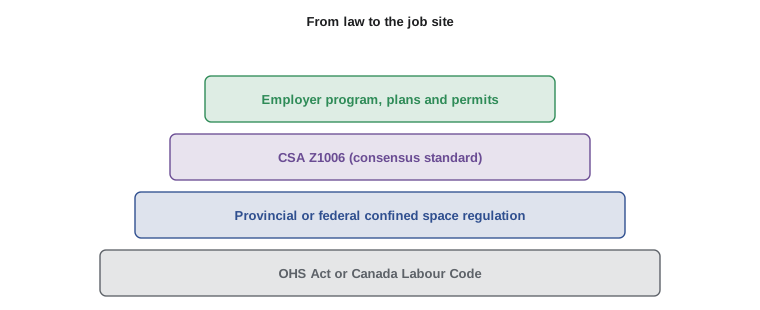
In Canada, occupational health and safety is mainly a provincial and territorial responsibility. Each province and territory has its own act and regulations, and federally regulated workplaces such as banks, interprovincial transport, telecommunications, ports and federal government operations follow the Canada Labour Code and the Canada Occupational Health and Safety Regulations. Every jurisdiction has confined space rules, and while they share the same basic structure, the details differ: the definition of a confined space, the atmospheric limits, the permit requirements and the rules for attendants and rescue. This lesson explains the common structure, summarizes the main jurisdictions and introduces CSA Z1006, the national consensus standard.
As always in this course, the law described here is a summary for awareness. Regulations change, and the exact wording of the regulation that applies to your workplace is what counts. Your employer's program, written by people who know the applicable rules, is your practical guide.
The common structure of Canadian confined space rules
Although the wording varies, Canadian confined space regulations generally require the employer to:
- identify confined spaces at the workplace and have a qualified or competent person assess the hazards of each one;
- prepare a written program or code of practice covering how entries are managed;
- prepare a written entry plan or procedure for each space or group of similar spaces;
- issue an entry permit before each entry, recording hazards, controls, tests and the people involved;
- isolate the space from hazardous energy and materials, using lockout, blanking or other methods;
- test the atmosphere before entry and as often as necessary during it, using calibrated instruments;
- ventilate or purge the space, or provide respiratory protection where acceptable levels cannot be maintained;
- station an attendant or tending worker outside the space, with a means of communication;
- have rescue procedures, equipment and trained rescuers ready before entry;
- train workers and keep records.
The table below compares several jurisdictions. Section numbers and limits are given for awareness; check the current regulation for your workplace.
| Jurisdiction | Main rule | Notable features |
|---|---|---|
| Ontario | O. Reg. 632/05 Confined Spaces | Assessment, plan, entry permit, attendant (s. 15), on-site rescue (s. 11); acceptable atmospheric levels of 19.5 to 23 per cent oxygen and flammables below 25, 10 or 5 per cent of the LEL depending on the work |
| British Columbia | OHS Regulation Part 9 | Classifies atmospheres as low, moderate or high hazard; flammables kept below 20 per cent of the LEL; standby person rules vary with the hazard level; annual rescue drill |
| Alberta | OHS Code Part 5 | Code of practice; oxygen 19.5 to 23.0 per cent; tending worker for every entry; entry permit signed by a competent person; restricted spaces also covered |
| Quebec | Regulation respecting occupational health and safety, ss. 297 to 312 | Revised in 2023: broader definition, written risk information before work, surveillant with two-way contact, rescue plan, age 18 minimum |
| Saskatchewan and Manitoba | Saskatchewan OHS Regulations, 2020; Manitoba Workplace Safety and Health Regulation Part 15 | Similar structure: hazard assessment, entry permits, testing, attendants and rescue |
| Federal | Canada Occupational Health and Safety Regulations, Part XI | Hazard assessment by a qualified person, entry permit, testing, attendant and emergency procedures for federally regulated workplaces |
Ontario's regulation in a little more detail
Ontario's regulation, O. Reg. 632/05, applies to most workplaces in the province, including construction projects. It requires a written program for confined spaces (s. 5), a written assessment of the hazards of each space by a competent person (s. 6), a written plan for controlling those hazards (s. 7), general and plan-specific training (ss. 8 and 9), and an entry permit for each entry (s. 10). Where workers from more than one employer are involved, a written co-ordination document sets out who does what (s. 4). On-site rescue procedures and equipment must be ready before anyone enters (ss. 11 and 12). An attendant must be assigned and stationed outside the space, in constant communication with the workers inside (s. 15). The atmosphere must be tested as often as necessary before and while a worker is inside (s. 18), and the regulation sets out what 'acceptable atmospheric levels' means.
Under Ontario's definition, acceptable atmospheric levels mean an oxygen content of at least 19.5 per cent but not more than 23 per cent by volume; exposure to atmospheric contaminants that does not exceed the applicable occupational exposure limits; and a flammable gas or vapour concentration below 25 per cent of its lower explosive limit (LEL), 10 per cent of the LEL, or 5 per cent of the LEL, depending on which situation in section 19 applies. The lowest limit applies to hot work and other situations with a source of ignition, and the middle limit applies where workers enter with special precautions. Lesson 5 explains the LEL.
British Columbia's hazard classification
British Columbia's Part 9 classifies the atmosphere in a confined space as low, moderate or high hazard. A low hazard atmosphere is shown by pre-entry testing, or otherwise known, to contain clean respirable air immediately before entry and is not likely to change. A moderate hazard atmosphere is not clean respirable air but is not likely to impair the worker's ability to escape unaided. A high hazard atmosphere may expose the worker to risk of death, incapacitation, injury or acute illness, or impair their ability to escape. The requirements for ventilation, monitoring and standby persons step up with the hazard level. For example, a standby person for a low or moderate hazard entry must check on the workers at least every 20 minutes, while a high hazard entry needs a standby person continuously attending at the entrance. Flammable gas and vapour must be kept below 20 per cent of the LEL.
Alberta, Quebec and the federal rules
Alberta's OHS Code Part 5 requires a written code of practice for confined space entry, a hazard assessment by a competent person, an entry permit for each entry, and atmospheric testing confirming oxygen between 19.5 and 23.0 per cent by volume and identifying any toxic, flammable or explosive substances. A competent worker must be designated as the tending worker for every entry, and must be present outside the space when oxygen is out of range, when listed toxic substances exceed half their exposure limit, or when other hazards have not been eliminated. Alberta also regulates restricted spaces, which have limited access but no atmospheric hazard. Records must be kept for at least one year, or two if there was an incident.
Quebec's rules, in sections 297 to 312 of the Regulation respecting occupational health and safety, were substantially revised by a regulation published in January 2023 that came into force in July 2023. The revised rules broaden the definition of a confined space, require information on the risks and the prevention measures to be written and available on site before work starts, require a surveillant stationed outside near the entrance with two-way communication and the authority to order evacuation, require work to stop if an unplanned hazard appears, and require a rescue plan with checked equipment, a call protocol, a designated person to lead the rescue, trained rescuers and periodic exercises. Workers in confined spaces must be at least 18 years old. Federally regulated workplaces follow Part XI of the Canada Occupational Health and Safety Regulations, which requires a hazard assessment by a qualified person, an entry permit system, atmospheric testing, an attendant and written emergency procedures.
CSA Z1006: Management of work in confined spaces
CSA Z1006 is the Canadian consensus standard for managing work in confined spaces. The current edition is CSA Z1006:23. It sets out a management system approach: roles and responsibilities, identification and assessment of confined spaces, hazard control, entry permits, atmospheric testing, ventilation, attendants, rescue, training and program evaluation. Like other CSA standards, it is voluntary unless a regulation refers to it, but regulators, courts and auditors often use it as a benchmark of good practice, and Quebec's revised rules draw on it. Employers often build their program around Z1006 and then check it against their provincial regulation.
Duties of employers, supervisors and workers
Every Canadian jurisdiction places the main duty on the employer, but supervisors and workers have duties too. Supervisors must make sure workers follow the plan and permit and must not authorize entry until the controls are in place. Workers must follow the procedures, use the equipment provided, report hazards and refuse unsafe work. All jurisdictions give workers the right to refuse work they believe is dangerous, and entering a confined space without proper controls is a classic example. Workers are also protected from reprisal for raising safety concerns. Joint health and safety committees or representatives are usually involved in reviewing the confined space program.
Enforcement and penalties
Provincial inspectors can issue orders to stop work, require compliance and, in serious cases, recommend prosecution. Penalties vary by province. In Ontario, the maximum fine for a corporation convicted under the Occupational Health and Safety Act is $2,000,000 per count, and individuals, including directors and officers, face fines and possible imprisonment. Courts add victim surcharges. Where a worker dies or is seriously injured through criminal negligence, section 217.1 of the Criminal Code makes anyone who directs work responsible for taking reasonable steps to prevent bodily harm, and corporations and individuals have been prosecuted under it. Check current penalty amounts in your jurisdiction, because they are revised from time to time.
Comparing atmospheric limits
Different rules use slightly different numbers for the same hazards. The table below compares commonly used values. Your employer's program will specify the limits that apply at your site, and they may be stricter.
| Parameter | Common Canadian values | OSHA 1910.146 |
|---|---|---|
| Minimum oxygen | 19.5 per cent (Ontario, Alberta); Quebec revised its threshold in 2023 | Below 19.5 per cent is a hazardous atmosphere |
| Maximum oxygen | 23 per cent (Ontario, Alberta) | Above 23.5 per cent is a hazardous atmosphere |
| Flammable gas or vapour | Below 20 per cent (BC) or 25, 10 or 5 per cent (Ontario) of the LEL | Above 10 per cent of the lower flammable limit is a hazardous atmosphere |
| Toxic contaminants | Provincial occupational exposure limits | Above the OSHA permissible exposure limit |
Two points stand out. First, oxygen enrichment is a hazard, not just deficiency, because extra oxygen makes materials burn far more readily. Second, the flammable limits are set well below the level at which a fire or explosion could actually happen, to leave a margin for error, for gas pockets and for instrument limitations. Lessons 4 and 5 explain why.
What the rules mean for you on the job
For a worker, the practical meaning of these rules is consistent across Canada. Before you enter, there must be a written assessment and plan for the space, an entry permit completed at the space, atmospheric tests within the acceptable limits, isolation and ventilation in place, an attendant outside, and rescue arrangements ready. You must have been trained for your role. If any of these is missing, you can and should stop and ask, and you may refuse the work. Your joint health and safety committee or representative can help resolve concerns, and an inspector can be called if they are not resolved.
Where a provincial regulation and CSA Z1006 differ, the regulation is the legal minimum, and a program that also meets the standard will usually go further.
Municipalities, utilities and large project owners often add their own requirements for sewer, vault and tank work through permits and contracts, for example requiring specific gas detector alarm settings, a minimum number of attendants or a designated rescue provider. Contractors should ask for these requirements before bidding on or starting the work.
Common mistakes
MistakeAssuming every province uses the same confined space rules.
InsteadThe structure is similar, but definitions, limits and attendant rules differ. Follow the regulation for your jurisdiction.
MistakeTreating CSA Z1006 as optional advice with no weight.
InsteadConsensus standards are widely used as benchmarks of good practice by regulators, courts and auditors.
MistakeThinking only the employer has duties.
InsteadSupervisors and workers have duties too, and workers can refuse unsafe entries.
MistakeUsing one set of atmospheric limits everywhere.
InsteadLimits differ between rules and sites. Use the values in your program and on the permit.
MistakeIgnoring oxygen enrichment because extra oxygen seems harmless.
InsteadEnriched air greatly increases fire risk and is treated as a hazardous atmosphere.
Summary and key terms
- Each Canadian province and territory has confined space regulations, and federal workplaces follow COHSR Part XI.
- The common structure is assessment, program, plan, permit, isolation, testing, ventilation, attendant, rescue and training.
- Ontario's O. Reg. 632/05 sets acceptable levels of 19.5 to 23 per cent oxygen and flammables below 25, 10 or 5 per cent of the LEL.
- British Columbia classifies atmospheres as low, moderate or high hazard and keeps flammables below 20 per cent of the LEL.
- Alberta requires a tending worker for every entry; Quebec revised its rules in 2023.
- CSA Z1006:23 is the national consensus standard for managing work in confined spaces.
- Workers can refuse unsafe work, and serious failures can lead to large fines or Criminal Code charges.
- Occupational exposure limit
- The maximum airborne concentration of a substance a worker may be exposed to, set by regulation.
- Lower explosive limit (LEL)
- The lowest concentration of a gas or vapour in air that can ignite; also called the lower flammable limit.
- Competent person
- A person with the knowledge, training and experience to perform a task and identify its hazards, as defined in the applicable rules.
- Entry permit
- A written authorization for a specific entry that records hazards, controls, tests and people.
- Code of practice
- A written set of procedures required by some regulations, such as Alberta, for a hazardous activity.
- Consensus standard
- A standard developed by a standards body through a consensus process, such as CSA Z1006 or ANSI/ASSP Z117.1.
- State plan
- An OSHA-approved state occupational safety and health program.
- Alternate procedures
- In 1910.146(c)(5), simplified entry procedures for spaces whose only hazard is an atmosphere controlled by ventilation.
- Reclassification
- In 1910.146(c)(7), treating a permit space as a non-permit space once all hazards are eliminated.
- Right to refuse
- A worker's legal right to refuse work they believe is dangerous.
Practice problems
Work each problem on paper first, then reveal the answer to check.
Which part of the federal regulations covers confined spaces in federally regulated workplaces?
Show answer
Part XI of the Canada Occupational Health and Safety Regulations.
What oxygen range is acceptable under Ontario's regulation?
Show answer
At least 19.5 per cent and not more than 23 per cent by volume.
Which section of O. Reg. 632/05 requires an attendant?
Show answer
Section 15.
What are the three British Columbia atmosphere hazard levels?
Show answer
Low, moderate and high hazard.
What flammable limit does British Columbia use?
Show answer
Below 20 per cent of the LEL.
When did Quebec's revised confined space rules come into force?
Show answer
In July 2023.
Why is oxygen enrichment treated as a hazard?
Show answer
It makes materials ignite and burn much more readily.
What is CSA Z1006?
Show answer
The Canadian consensus standard on management of work in confined spaces; current edition 2023.
Why are flammable limits set far below the LEL?
Show answer
To leave a margin for gas pockets, instrument error and changing conditions.
What right lets a worker decline an entry without proper controls?
Show answer
The right to refuse dangerous work, with protection from reprisal.
Lesson quiz · 5 questions
Score 60% or more to complete this lesson.
Create a free account to save your progress, take quizzes and earn a certificate.