
HSE-211 · Lesson 5 of 12 · 29 min
Flammable and toxic atmospheres
After oxygen, the two other great atmospheric hazards in confined spaces are flammable atmospheres, which can burn or explode, and toxic atmospheres, which poison. Both are common, both can be invisible, and both can develop during the entry as well as before it. This lesson explains flammable limits and how they are measured, the toxic gases most often found in confined spaces, how gas concentrations are expressed and converted, and how exposure limits compare between Canada and the United States.
How a flammable atmosphere forms
A fire or explosion needs three things: fuel, oxygen and a source of ignition. In a confined space, fuel can come from gases such as methane, propane and hydrogen; vapours from solvents, fuels, coatings and cleaning chemicals; and fine combustible dusts such as grain, flour, sugar, wood, coal and some metal powders. Because the space traps whatever is released, fuel concentrations can build up quickly, and because the space is enclosed, the pressure from ignition has nowhere to go. A flash fire or explosion in a tank can kill everyone inside and people near the opening.
Every flammable gas or vapour burns only within a range of concentrations in air. Below the lower explosive limit (LEL), also called the lower flammable limit (LFL), the mixture is too lean to burn. Above the upper explosive limit (UEL), it is too rich. Between the two, any ignition source can set it off.
| Gas or vapour | LEL (per cent by volume) | UEL (per cent by volume) | Density relative to air |
|---|---|---|---|
| Methane (natural gas, sewer gas) | 5.0 | 15 | About 0.55: lighter, rises |
| Propane | 2.1 | 9.5 | About 1.5: heavier, sinks |
| Hydrogen | 4.0 | 75 | About 0.07: much lighter, rises |
| Hydrogen sulfide | 4.0 | 44 | About 1.2: heavier, sinks |
| Carbon monoxide | 12.5 | 74 | About 0.97: mixes with air |
| Gasoline vapour (typical) | 1.4 | 7.6 | About 3 to 4: heavier, sinks |
A space that is above the UEL is not safe. As it is ventilated, the concentration falls through the flammable range on its way to safety, and any air leaking in can bring it into the range.
Percent of LEL
Gas detectors used for confined space entry measure flammable gases as a percentage of the LEL, not as a percentage of the air. A reading of 100 per cent LEL means the concentration has reached the lower explosive limit and the mixture can burn. A reading of 10 per cent LEL means the concentration is one tenth of the LEL.
Worked problem
Converting percent LEL to concentration
A detector calibrated for methane reads 10 per cent LEL in a manhole. What is the methane concentration by volume and in ppm?
Show solution
- Methane's LEL is 5.0 per cent by volume.
- Concentration = 10 per cent of 5.0 per cent = 0.10 × 5.0 = 0.5 per cent by volume.
- In ppm: 0.5 per cent × 10,000 = 5,000 ppm.
Answer: 0.5 per cent methane, or 5,000 ppm. The atmosphere is still far below the LEL, but the reading shows that gas is entering the space and conditions must be watched closely.
Regulations set entry limits far below 100 per cent LEL. Ontario's regulation uses less than 25, 10 or 5 per cent of the LEL depending on the situation, with the lowest limit for hot work. British Columbia requires flammable gas and vapour to be kept below 20 per cent of the LEL, and Alberta does not allow monitoring equipment to be energized in the space if flammables exceed 10 per cent of the LEL unless it cannot ignite them. Many employers set a single company-wide alarm at 10 per cent LEL and require everyone to leave if it sounds.
Why set limits so low? Because a reading at one point is not the whole space. Gas pockets, stratification, a slug of vapour from disturbed sludge, a change in wind or process, or instrument error can all produce dangerous concentrations a short distance from where the reading was taken. The low limits leave room for those uncertainties.
Combustible dust
Combustible dusts can form explosive clouds in silos, bins, hoppers, dust collectors, ducts and mills. Gas detectors do not measure dust. Dust hazards are controlled by cleaning, by keeping dust settled or wet, by preventing ignition, and by using equipment rated for the hazard. A common rule of thumb is that a dust cloud dense enough to obscure vision at about 1.5 m (5 ft) may be at or near its explosive concentration. Dust explosions are covered further in fire safety courses; for confined space entry, the key point is that a clean gas reading does not mean there is no explosion risk.
Toxic gases and vapours
Many substances found in confined spaces are poisonous. Some, such as hydrogen sulfide and carbon monoxide, can kill quickly at high concentrations. Others, such as solvent vapours, cause dizziness, unconsciousness or long-term damage. The most important ones for confined space work are summarized below.
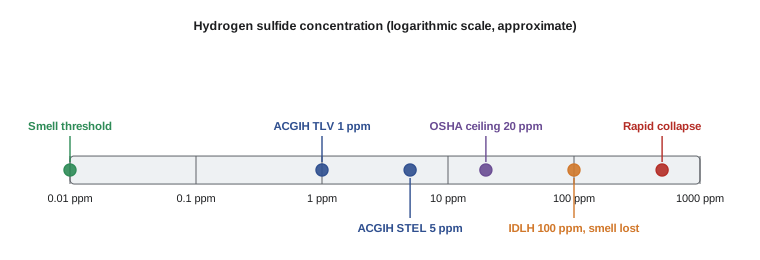
Hydrogen sulfide (H₂S) is produced when organic matter decays without oxygen, so it is common in sewers, manure pits, wastewater plants, pulp and paper mills, tanneries and oil and gas operations. It is heavier than air, colourless and smells of rotten eggs at low concentrations. At higher concentrations it quickly knocks out the sense of smell, so a worker may think the gas has gone when it is actually rising. It irritates the eyes and lungs, and at several hundred ppm it can cause sudden collapse and death after a few breaths. Disturbing sludge can release a burst of hydrogen sulfide even when the initial test was clear.
Carbon monoxide (CO) is produced by incomplete combustion in engines, generators, heaters, welding and fires, and can migrate into spaces from nearby traffic or equipment. It is colourless, odourless and about the same density as air. It binds to haemoglobin in the blood far more strongly than oxygen, so even modest concentrations reduce the blood's ability to carry oxygen. Symptoms include headache, dizziness, nausea and confusion; high concentrations cause collapse and death. Gasoline-powered pumps, generators and compressors must never be run inside or near the opening of a confined space.
Other common toxic hazards include ammonia from refrigeration and fertilizer; chlorine and other disinfectants in water treatment; sulfur dioxide; nitrogen dioxide from welding and engines; solvent vapours from coatings, adhesives and degreasers; welding fume containing metals; and residues of whatever the space last contained. The safety data sheets for the materials involved, and the process history of the space, guide which toxic gases must be tested for.
Expressing concentrations: ppm and mg/m³
Gases and vapours are usually measured in parts per million by volume (ppm), while exposure limits for some substances, especially dusts and fumes, are given in milligrams per cubic metre (mg/m³). For gases and vapours, you can convert between the two at normal room conditions (25 °C and 101.3 kPa) using the molar volume of 24.45 litres:
Here M is the molar mass of the substance in grams per mole.
Worked problem
Converting hydrogen sulfide and carbon monoxide
Convert 10 ppm of hydrogen sulfide (molar mass 34.08 g/mol) and 25 ppm of carbon monoxide (molar mass 28.01 g/mol) to mg/m³.
Show solution
- Hydrogen sulfide: 10 × 34.08 / 24.45 = 340.8 / 24.45 ≈ 13.9 mg/m³.
- Carbon monoxide: 25 × 28.01 / 24.45 = 700.25 / 24.45 ≈ 28.6 mg/m³.
Answer: About 13.9 mg/m³ of hydrogen sulfide and 28.6 mg/m³ of carbon monoxide. Detectors usually show ppm directly, but the conversion matters when comparing to limits expressed in mg/m³.
Exposure limits
Exposure limits set the maximum airborne concentration a worker may be exposed to. Three kinds are common: an eight-hour time-weighted average (TWA), a short-term exposure limit (STEL) averaged over 15 minutes, and a ceiling that must never be exceeded. The American Conference of Governmental Industrial Hygienists (ACGIH) publishes threshold limit values (TLVs) that are widely used as a scientific benchmark. Many Canadian jurisdictions adopt the ACGIH values, sometimes with a delay or with changes. In the United States, OSHA's legally enforceable permissible exposure limits (PELs) are mostly from 1971 and are often much higher than current ACGIH values, while NIOSH publishes recommended exposure limits (RELs).
| Substance | ACGIH TLV | OSHA PEL (general industry) | NIOSH IDLH |
|---|---|---|---|
| Hydrogen sulfide | 1 ppm TWA; 5 ppm STEL | 20 ppm ceiling; 50 ppm peak for up to 10 minutes | 100 ppm |
| Carbon monoxide | 25 ppm TWA | 50 ppm TWA | 1,200 ppm |
| Carbon dioxide | 5,000 ppm TWA; 30,000 ppm STEL | 5,000 ppm TWA | 40,000 ppm |
| Ammonia | 25 ppm TWA; 35 ppm STEL | 50 ppm TWA | 300 ppm |
| Sulfur dioxide | 0.25 ppm STEL | 5 ppm TWA | 100 ppm |
Provincial limits are set in each jurisdiction's regulations, and they are not all the same. Some provinces adopt the current ACGIH TLVs automatically or regularly; others keep older values for some substances. For hydrogen sulfide, for example, limits in different provinces range from the current ACGIH value of 1 ppm as an eight-hour average to older values such as 10 ppm. Your employer's program and the entry permit will state the limits used at your site. For confined space entry, many programs set gas detector alarms at or below the applicable short-term or ceiling limit and require workers to leave when an alarm sounds.
Worked problem
Checking a time-weighted average
A worker spends 2 hours in a space at 3 ppm of hydrogen sulfide and the remaining 6 hours of the shift in clean air. What is the eight-hour TWA, and how does it compare with an ACGIH TLV of 1 ppm and a 5 ppm STEL?
Show solution
- TWA = (3 ppm × 2 h + 0 ppm × 6 h) / 8 h = 6 / 8 = 0.75 ppm.
- The TWA of 0.75 ppm is below the 1 ppm TLV.
- The short-term concentration of 3 ppm is below the 5 ppm STEL.
- However, the reading inside the space shows hydrogen sulfide is present and could rise, especially if sludge is disturbed, so continuous monitoring is essential.
Answer: A TWA of 0.75 ppm, below the 1 ppm TLV. Meeting a TWA does not make a space safe if concentrations can spike; confined space alarms are set to catch spikes.
Toxic atmospheres created by the work
Many toxic atmospheres in confined spaces are created by the work itself. Welding and cutting produce metal fume, ozone, nitrogen oxides and carbon monoxide, and consume oxygen. Painting and coating release solvent vapours, often heavier than air. Cleaning with chemicals can release chlorine or other gases, especially if incompatible chemicals mix. Abrasive blasting produces dust. Scraping out sludge can release hydrogen sulfide, methane and carbon dioxide trapped in it. Each of these must be anticipated in the hazard assessment and controlled with ventilation, monitoring and, where necessary, respiratory protection. Hot work in confined spaces is covered further in HSE-216.
Common mistakes
MistakeThinking a space above the UEL is safe because it is too rich to burn.
InsteadAs air enters or ventilation starts, the mixture passes through the flammable range.
MistakeReading 10 per cent LEL as 10 per cent gas in the air.
InsteadIt means one tenth of the LEL; for methane that is 0.5 per cent by volume.
MistakeTrusting the rotten-egg smell to warn of hydrogen sulfide.
InsteadHydrogen sulfide knocks out the sense of smell at higher concentrations. Use a detector.
MistakeRunning a gasoline pump or generator near the opening.
InsteadExhaust carbon monoxide can be drawn into the space. Keep engines away and downwind, or use electric equipment.
MistakeAssuming a clean gas reading rules out explosion risk in a dusty silo.
InsteadGas detectors do not measure dust. Control combustible dust separately.
Summary and key terms
- Flammable gases and vapours burn only between their LEL and UEL; above the UEL is still dangerous.
- Detectors read flammables as a percentage of the LEL; 10 per cent LEL of methane is 0.5 per cent by volume.
- Canadian limits range from 25 to 5 per cent of the LEL depending on the rule and the work.
- Combustible dust can explode but is not measured by gas detectors.
- Hydrogen sulfide and carbon monoxide are the most common deadly toxic gases in confined spaces.
- mg/m³ = ppm × molar mass ÷ 24.45 at normal room conditions.
- ACGIH TLVs, provincial or OSHA limits and IDLH values differ; follow the limits on your permit.
- Lower explosive limit
- The lowest concentration of a gas or vapour in air that can ignite; also called the LFL.
- Upper explosive limit
- The highest concentration of a gas or vapour in air that can ignite; also called the UFL.
- Percent LEL
- A flammable gas reading expressed as a percentage of the lower explosive limit.
- Time-weighted average
- The average exposure over a work shift, usually eight hours.
- Short-term exposure limit
- A limit averaged over 15 minutes.
- Ceiling limit
- A concentration that must not be exceeded at any time.
- Threshold limit value
- An exposure guideline published by the ACGIH.
- Permissible exposure limit
- A legally enforceable OSHA exposure limit.
- Molar mass
- The mass of one mole of a substance, used to convert ppm to mg/m³.
- Olfactory fatigue
- Loss of the ability to smell a gas after exposure, as happens with hydrogen sulfide.
Practice problems
Work each problem on paper first, then reveal the answer to check.
What is 20 per cent LEL of methane in per cent by volume?
Show answer
0.20 × 5.0 = 1.0 per cent by volume (10,000 ppm).
Propane has an LEL of 2.1 per cent. What is 10 per cent LEL in ppm?
Show answer
0.10 × 2.1 = 0.21 per cent = 2,100 ppm.
Why can a space above the UEL become explosive?
Show answer
Ventilation or leaks dilute it into the flammable range.
Where does hydrogen sulfide tend to collect, and why?
Show answer
Low areas, because it is about 1.2 times as dense as air.
Convert 50 ppm of carbon monoxide to mg/m³.
Show answer
50 × 28.01 / 24.45 ≈ 57.3 mg/m³.
Convert 7 mg/m³ of hydrogen sulfide to ppm.
Show answer
7 × 24.45 / 34.08 ≈ 5.0 ppm.
What is the NIOSH IDLH for hydrogen sulfide?
Show answer
100 ppm.
Give two ways work in a space can create a toxic atmosphere.
Show answer
Welding fume and CO, solvent vapours from coating, chemical cleaning gases, gas released from disturbed sludge.
A worker is exposed to 4 ppm for 1 hour and 0 for 7 hours. What is the 8-hour TWA?
Show answer
4 × 1 / 8 = 0.5 ppm.
Why are gasoline engines kept away from confined space openings?
Show answer
Their exhaust carbon monoxide can be drawn into the space.
Lesson quiz · 5 questions
Score 60% or more to complete this lesson.
Create a free account to save your progress, take quizzes and earn a certificate.