
HSE-211 · Lesson 10 of 12 · 27 min
Rescue planning and emergency response
Every confined space entry must begin with a simple question: if something goes wrong, how will we get this person out, alive, quickly? If there is no good answer, the entry does not go ahead. Rescue planning is not an afterthought; it is a condition of entry in every Canadian jurisdiction and under OSHA. This lesson explains the types of rescue, retrieval systems, how to judge whether a rescue service is fast enough, what a rescue plan contains and why drills matter.
Why rescue must be planned in advance
Confined space emergencies move fast. A worker overcome by low oxygen, hydrogen sulfide or carbon monoxide may suffer brain damage within about four to six minutes without breathable air, and an engulfed worker may suffocate even faster. A rescue service that takes 20 or 30 minutes to arrive, find the space, assess it and set up equipment will often be too late. At the same time, untrained people who rush in without breathing apparatus are often killed, as lesson 1 described. The only answer is to plan the rescue before the entry, have the right equipment set up at the space and have trained rescuers available within a time that matches the hazards.
The rescue hierarchy
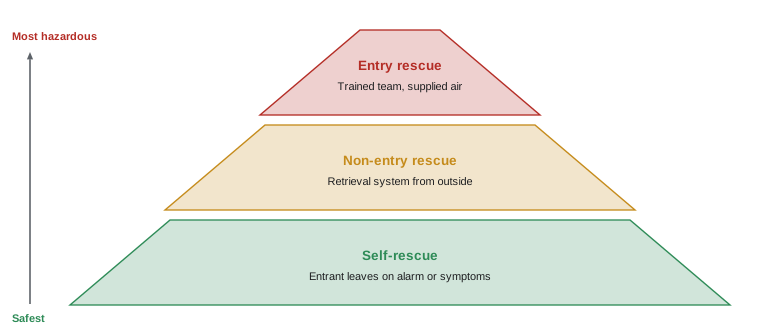
Rescue methods are usually ranked from safest to most dangerous:
- self-rescue: the entrant recognizes a problem, such as an alarm or symptoms, and leaves on their own before they are incapacitated. Training, continuous monitoring and clear evacuation rules make self-rescue the most common and most successful kind;
- non-entry rescue: the attendant or rescuers retrieve the entrant from outside, without entering, usually using a retrieval system attached to the entrant's full-body harness. It is fast and does not expose anyone else, but it only works when the line runs straight and unobstructed;
- entry rescue: trained and equipped rescuers enter the space to reach and remove the entrant. It is the most complex and hazardous form of rescue, and requires supplied-air respiratory protection where the atmosphere is or may be hazardous, a backup team and specialized training.
A good plan provides for all three, with non-entry rescue set up wherever it is feasible and entry rescue available as backup.
Retrieval systems
A retrieval system usually consists of a full-body harness worn by the entrant, a retrieval line attached to the harness at the back or shoulders, and a mechanical device, such as a winch on a tripod or davit arm, that lets the attendant lift the entrant out. For vertical entries, the retrieval line also acts as fall protection. Some systems combine a self-retracting lifeline with a retrieval winch.
Canadian rules require rescue equipment suitable for the space to be readily available, and many require harnesses and lifelines where they would assist rescue. British Columbia, for example, sets out requirements for lifelines, harnesses and lifting equipment (sections 9.42 to 9.44), including their use where a worker could not otherwise be rescued.
Retrieval lines can become a hazard in some spaces. In a horizontal space with turns, baffles or obstructions, the line can snag and prevent retrieval or injure the entrant. Near agitators or moving parts, the line can become entangled. The assessment decides where retrieval systems help and where other rescue methods are needed.
Mechanical advantage
A rescuer cannot lift a person straight up a manhole by hand for long. Winches and rope systems use mechanical advantage (MA) so a small force lifts a large load. With an ideal MA, the force needed is the load divided by the MA. Friction in pulleys and winches reduces the real advantage, so practical calculations include an efficiency factor.
Worked problem
How hard does the attendant have to pull?
An entrant and their equipment have a mass of 100 kg. The rope system on the tripod gives a mechanical advantage of 4:1 with an overall efficiency of 0.8. What force must the attendant apply?
Show solution
- Weight W = m × g = 100 kg × 9.81 m/s² ≈ 981 N.
- Effective advantage = 4 × 0.8 = 3.2.
- F = 981 / 3.2 ≈ 307 N.
- 307 N is roughly the force needed to lift a 31 kg load: hard but manageable for a short lift, and easier with a geared winch.
Answer: About 307 N. Without mechanical advantage the attendant would need almost 1,000 N, more than most people can lift steadily while guiding a person through a manhole.
Retrieval equipment must be rated for the load, inspected before each use, set up and anchored before entry, and operated by people trained to use it. The tripod or davit must be stable and positioned so the line runs straight down to the entrant.
Is the rescue service fast enough?
Many employers rely on an outside rescue service, often the local fire department or a specialized contractor, rather than training their own team. This can be acceptable, but only if the service is able and available to respond in time with the right skills and equipment. Asking these questions before entry is part of the plan:
- Has the service agreed to provide confined space rescue for this site, and do they know the spaces and their hazards?
- Do they have the training and equipment for this type of space, including supplied-air respirators and rope rescue?
- How long will it take them to be notified, travel to the site, find the space, set up and reach the entrant?
- Will they be available during the planned entry, or could they be committed to another call?
- How will they be summoned, and has the method been tested?
Canadian rules require the employer to ensure that rescue can be carried out effectively. Ontario requires on-site rescue procedures to be ready for immediate implementation (s. 11). Alberta prohibits entry unless an effective rescue can be carried out. British Columbia requires the employer to provide rescue persons, equipped and trained, with practice drills at least annually.
Worked problem
Comparing response time with the hazard
A municipal fire department estimates 6 minutes to receive the call and dispatch, 9 minutes to drive to the site, 4 minutes to find the space and 8 minutes to set up rope and air systems. The space could develop an IDLH hydrogen sulfide atmosphere. Is relying on the fire department acceptable for this entry?
Show solution
- Total response time = 6 + 9 + 4 + 8 = 27 minutes.
- In an IDLH atmosphere, brain damage can begin within about four to six minutes without breathable air.
- 27 minutes is far longer than the time available.
- For this entry, a trained rescue team must be at the space, set up and ready, with non-entry retrieval in place.
Answer: No. A 27-minute response cannot protect an entrant in an IDLH atmosphere. A standby rescue team at the space is needed. An outside service might be acceptable for a lower-hazard space, as backup, or where the plan shows that its response time matches the hazard.
The rescue plan
A written rescue plan for each space or type of space typically covers:
- the rescue method or methods: self-rescue, non-entry retrieval and entry rescue;
- who will perform the rescue, their training and how they will be summoned;
- the equipment at the space: harnesses, retrieval systems, tripods, supplied-air respirators, gas detectors, stretchers or rescue litters, lighting and first aid equipment;
- how the rescuers will reach and remove a casualty, considering the size of the openings and the shape of the space;
- the call protocol, including who calls the rescue team, emergency services and the supervisor, and what information they give;
- first aid and medical care, including CPR, oxygen and safety data sheets for any chemical exposure to go with the casualty to hospital;
- how others will be kept away so they do not become victims.
| Element | Questions the plan answers |
|---|---|
| Method | Can the entrant be retrieved from outside? If not, how will rescuers enter? |
| People | Who rescues? Are they trained, equipped, available and close enough? |
| Equipment | What is set up at the space before entry? Is it inspected and rated? |
| Access | Will a person in a harness or on a stretcher fit through the openings? |
| Communication | How is rescue summoned? Has the method been tested from this location? |
| Medical | Who gives first aid and CPR? How is the casualty handed over to paramedics? |
| Control | How are untrained people kept from entering? |
Rescue team training and drills
Rescuers need training in the hazards of confined spaces, the use of supplied-air respirators, rope rescue and retrieval systems, patient packaging in tight spaces, first aid and CPR, and the specific spaces they may have to enter. Skills fade quickly without practice, so rescue teams must practise regularly on real or representative spaces.
British Columbia requires a practice drill at least annually, and Quebec's revised rules require periodic exercises. Many employers and CSA Z1006 recommend more frequent practice, especially for spaces with unusual access or high hazards.
Drills often reveal problems that look obvious afterwards: a tripod that will not fit over a manhole, a stretcher that will not fit through an opening, a radio that does not work at the bottom of a tank, or a rescue service that takes far longer to arrive than expected. Each problem found in a drill is one less problem in a real emergency.
What to do in an emergency
For people outside the space who are not trained rescuers, the actions are simple and should be practised until they are automatic:
- do not enter;
- raise the alarm and call the rescue team and emergency services using the agreed method;
- if you are the attendant and a retrieval system is attached, begin non-entry retrieval if it is safe to do so;
- keep the ventilation running if it is safe, unless the plan says otherwise;
- keep other people away from the opening;
- when rescuers arrive, tell them how many people are inside, where they are, what happened, the latest gas readings and the hazards of the space;
- once the casualty is out, give first aid and CPR if trained, and send the safety data sheets and permit information with the casualty to hospital.
Common mistakes
MistakeRelying on calling the fire department without checking their response time.
InsteadEvaluate the rescue service before entry and match its response time to the hazards.
MistakeSetting up the retrieval tripod only after someone collapses.
InsteadSet up and test retrieval equipment before the first person enters.
MistakeAttaching a retrieval line in a space with turns or agitators without checking.
InsteadAssess whether the line could snag or entangle and choose another method if it could.
MistakeNever practising rescues because the plan exists on paper.
InsteadDrill regularly on real or representative spaces; drills reveal problems.
MistakeBystanders rushing in to help.
InsteadStay out, raise the alarm and keep others away until trained rescuers arrive.
Summary and key terms
- No entry should start without a workable rescue plan for that space.
- Brain damage can begin within minutes without breathable air, so rescue must be fast and planned.
- Rescue hierarchy: self-rescue, non-entry retrieval, then entry rescue by trained, equipped teams.
- Retrieval systems and harnesses are required or expected where they help, and must not create new hazards.
- Mechanical advantage reduces the force needed: F = W ÷ (MA × efficiency).
- Outside rescue services must be evaluated for training, equipment, availability and response time; IDLH spaces need a standby team.
- Rescue teams must train and drill regularly, and bystanders must never enter.
- Self-rescue
- An entrant leaving the space on their own when they recognize a problem.
- Non-entry rescue
- Retrieving an entrant from outside the space, usually with a retrieval system.
- Entry rescue
- Rescue by trained, equipped rescuers who enter the space.
- Retrieval system
- A harness, retrieval line and mechanical device used to remove an entrant without entering.
- Tripod
- A three-legged frame placed over an opening to support a retrieval winch.
- Davit arm
- A mast and boom used to support a retrieval line over an opening.
- Mechanical advantage
- The ratio of load lifted to force applied in a rope or winch system.
- Standby rescue team
- A trained team positioned at the space and ready to act immediately.
- Patient packaging
- Securing a casualty in a harness or litter for removal from a tight space.
- Rescue drill
- A practice rescue using a manikin or person from a real or representative space.
Practice problems
Work each problem on paper first, then reveal the answer to check.
List the three levels of the rescue hierarchy.
Show answer
Self-rescue, non-entry rescue, entry rescue.
Why is self-rescue the most successful?
Show answer
The entrant leaves before being incapacitated, with no one else exposed.
When can a retrieval line be a hazard?
Show answer
In spaces with turns, baffles or obstructions where it can snag, or near moving parts where it can entangle.
With a 3:1 system at 0.85 efficiency, what force lifts 90 kg?
Show answer
W = 883 N; F = 883 / (3 × 0.85) ≈ 346 N.
A service needs 5 + 12 + 3 + 6 minutes to respond. Is that adequate for an IDLH space?
Show answer
No: 26 minutes is far too long; a standby team at the space is needed.
Name four items of rescue equipment set up before entry.
Show answer
Harness, retrieval line, tripod or davit with winch, supplied-air respirators, detector, stretcher, lighting, first aid kit.
What information should be given to arriving rescuers?
Show answer
Number and location of entrants, what happened, latest gas readings and the hazards.
Why send safety data sheets with a casualty?
Show answer
So medical staff know which chemicals were involved.
What problems do drills commonly reveal?
Show answer
Equipment that does not fit, radios that fail, stretchers too big for openings, slow response times.
What should a bystander do if someone collapses inside?
Show answer
Stay out, raise the alarm and keep others away.
Lesson quiz · 5 questions
Score 60% or more to complete this lesson.
Create a free account to save your progress, take quizzes and earn a certificate.