
HSE-211 · Lesson 6 of 12 · 27 min
Gas testing and atmospheric monitoring
Because confined space atmospheres can kill without warning, the only reliable way to know whether the air is safe is to measure it. Gas testing before entry, and monitoring during entry, are the core atmospheric controls in every confined space rule. This lesson explains how portable gas detectors work, the order in which gases are tested, how to test a space from outside and at different levels, how bump testing and calibration keep detectors trustworthy, and how to respond when an alarm sounds. Operating a detector and interpreting the results is a skill that requires hands-on training on the instruments your employer uses; this lesson gives the awareness behind that training.
The portable gas detector
The most common instrument for confined space work is a multi-gas detector, often called a four-gas meter because it usually measures oxygen, flammable gases (as percent LEL), carbon monoxide and hydrogen sulfide. Many models can take additional sensors for gases such as carbon dioxide, ammonia, chlorine, sulfur dioxide, nitrogen dioxide or volatile organic compounds. The choice of sensors must match the hazards identified in the assessment. A four-gas meter will not detect a solvent vapour, ammonia or carbon dioxide unless it has a sensor for it.
The sensors work in different ways:
- oxygen and many toxic gas sensors are electrochemical cells, in which the gas reacts at an electrode and produces a current proportional to its concentration;
- flammable gas sensors are usually catalytic bead (pellistor) sensors, which measure the heat produced when gas burns on a heated bead, or infrared sensors, which measure how much infrared light the gas absorbs;
- photoionization detectors (PIDs) measure many organic vapours at low ppm levels;
- infrared sensors are also used for carbon dioxide.
Each type has limitations. Catalytic bead sensors need oxygen to work and can read falsely low in oxygen-deficient air; they can be poisoned by silicones, lead compounds and some other chemicals, and damaged by very high gas concentrations. Infrared flammable sensors do not respond to hydrogen. Electrochemical sensors can be affected by other gases (cross-sensitivity), by extreme temperatures and by age. Detectors also have a warm-up period and a response time. Knowing these limits is part of being trained to test.
The testing sequence
Before entry, the atmosphere is tested in a fixed order: oxygen first, then flammable gases, then toxic gases.
- Oxygen first, because many combustible gas sensors need adequate oxygen to give a correct reading, and because an oxygen reading below normal shows that something has displaced or consumed the air.
- Flammable gases second, because the threat of fire or explosion is more immediately life-threatening, and affects more people, than most toxic exposures.
- Toxic gases third, because they are measured against exposure limits that assume oxygen and flammables are already controlled.
Modern multi-gas detectors measure all their gases at the same time, so in practice the sequence means reading and interpreting the results in this order, and stopping if oxygen or flammables are out of range.
Testing from outside, and at every level
The first test is always made from outside the space, without breaking the plane of the opening. A detector with a pump and a length of sample tubing, or a probe on a pole, draws air from inside the space to the instrument. Lowering a diffusion detector (one without a pump) on a string is a poor substitute: it gives readings only near where it hangs, and it may take a long time to respond.
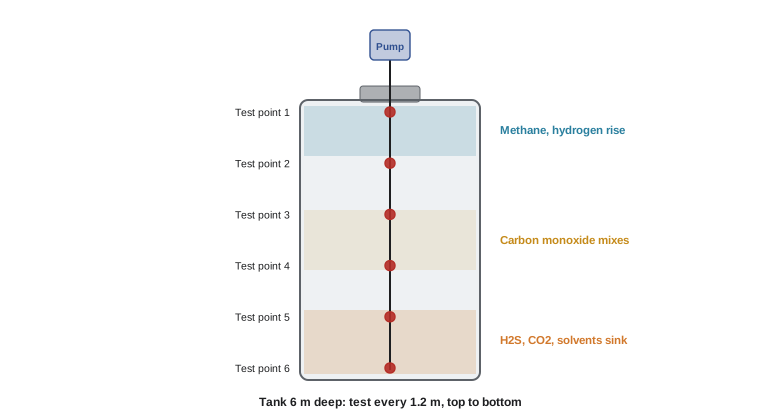
Gases stratify according to their density. Methane and hydrogen rise to the top; hydrogen sulfide, carbon dioxide, propane and solvent vapours sink to the bottom; carbon monoxide and nitrogen mix fairly evenly. A space must therefore be tested at several levels, typically every 1.2 m (4 ft) or so in a vertical space, and at the top, middle and bottom at minimum, as well as in corners, sumps, side passages and anywhere gases could collect. In a long horizontal space such as a sewer or a tunnel, it is tested ahead of the entrants as they advance.
Worked problem
How long to wait at each test point
A detector manufacturer specifies a sample transport time of about 3 seconds per metre of tubing, plus the sensor's own response time of about 30 seconds. A technician is testing the bottom of a tank 6 m deep through 8 m of tubing. How long should they wait for a stable reading at the bottom?
Show solution
- Transport time = 8 m × 3 s/m = 24 s.
- Add the sensor response time: 24 + 30 = 54 s.
- Round up and allow the reading to stabilize: about 1 minute or a little more at that level.
- Repeat at each level on the way down, waiting the appropriate time at each point.
Answer: About one minute per test point at the bottom. Rushing a test with long tubing gives readings from air that has not yet reached the sensors. Always follow the times given by your detector's manufacturer.
Bump tests and calibration
A gas detector is only useful if it responds correctly. Two checks keep detectors reliable:
- A bump test (or functional test) briefly exposes the detector to a known concentration of test gas to confirm that the sensors respond and the alarms work. It does not adjust the readings. Industry guidance, including the widely used position of the International Safety Equipment Association, and most manufacturers recommend a bump test before each day's use, and many confined space programs require one before every entry.
- A full calibration adjusts the detector so its readings match known gas concentrations. It is done at the interval the manufacturer specifies, after a failed bump test, after exposure to high concentrations or sensor poisons, and after sensor replacement.
Detectors also need a fresh-air zero in clean air, charged batteries, clean filters and intact tubing. Records of bump tests and calibrations should be kept, and many detectors store them automatically for download to a docking station.
Worked problem
Planning bump tests and calibration
A crew has six detectors used Monday to Friday. The program requires a bump test before each day's use and calibration every 30 days or after any failed bump test. In one month (21 working days), two detectors fail a bump test once each. How many bump tests and calibrations are needed that month?
Show solution
- Bump tests: 6 detectors × 21 days = 126 tests.
- Each failed detector is recalibrated and must pass a new bump test before use: 2 extra bump tests, so 128 in total.
- Routine calibrations: each detector once in the 30-day period = 6.
- Extra calibrations after failures: 2. Total calibrations: 8.
Answer: About 128 bump tests and 8 calibrations. A docking station that bumps and calibrates automatically, and keeps records, makes this practical.
Correction factors for flammable gases
A catalytic bead flammable sensor is calibrated on one gas, usually methane or pentane, but it responds differently to other gases. If the gas in the space is not the calibration gas, the reading must be corrected using a factor supplied by the manufacturer. For example, if a sensor calibrated on methane responds only half as strongly to a particular solvent vapour, a reading of 8 per cent LEL might mean the true concentration is about 16 per cent LEL. Correction factors vary by instrument and gas, so they must come from the manufacturer's data for the specific detector. Programs that work with many different vapours often calibrate on pentane or use a PID to get a more appropriate response.
Continuous monitoring during entry
An atmosphere that was safe at the start can change. Gas can be released by sludge disturbed by a shovel, by a leaking valve, by heat, by coatings and cleaning chemicals, by welding, by a change in weather pushing sewer gas along a line, or by a process upset elsewhere. For this reason, the atmosphere must be tested as often as necessary during the entry, and continuous monitoring is required or strongly recommended wherever conditions could change.
Canadian rules require testing as often as necessary before and during the entry. Alberta requires continuous monitoring where the atmosphere could change unpredictably, and British Columbia requires continuous monitoring where a flammable atmosphere above 20 per cent of the LEL could develop and in other higher-hazard situations.
In practice, continuous monitoring means each entrant, or the work area, has a detector running and alarming throughout the entry, and the attendant may also have a detector sampling the space or a remote readout of the entrants' detectors. The detector must be positioned near the breathing zone and where gases are expected, not left in a toolbox or on the surface.
Responding to alarms
Gas detectors have alarm set points, typically a low alarm and a high alarm for each gas, plus alarms for over-range readings, low battery and sensor faults. Typical set points are around 19.5 per cent for low oxygen and 23 or 23.5 per cent for high oxygen, 10 per cent LEL for flammables, and toxic alarms at or below the applicable exposure or ceiling limits. The program and the permit state the set points used.
The rule for entrants is simple: when an alarm sounds, leave the space immediately, without stopping to finish the job or to check the reading. The attendant orders evacuation and does not allow re-entry until the cause is found, the space is re-evaluated and the atmosphere is acceptable again. A detector that alarms for an unknown reason, or shows a fault, is treated as a real alarm until proven otherwise.
| Gas | Typical low alarm | Typical high alarm |
|---|---|---|
| Oxygen | 19.5 per cent (deficiency) | 23 per cent (enrichment) |
| Flammables | 10 per cent LEL | 20 per cent LEL |
| Carbon monoxide | 25 ppm | 100 to 200 ppm |
| Hydrogen sulfide | 1 to 10 ppm | 10 to 15 ppm |
Recording test results
Test results are recorded on the entry permit or an attached log: the time, the location in the space, each gas reading, the instrument used and its last bump test or calibration, and the name of the tester. During long entries, readings are recorded at the intervals the permit specifies. Records show that the atmosphere was acceptable, help investigators if something goes wrong, and reveal trends, such as hydrogen sulfide creeping up through the morning, that should prompt action before an alarm.
Who may test
Canadian rules require testing by a competent, qualified or adequately trained person, depending on the jurisdiction. Ontario requires the person performing the tests to have adequate knowledge, training and experience; Alberta requires a competent worker.
Whoever tests must know how the instrument works, its limitations, the sequence, the sampling technique, the acceptable values and what to do when readings are out of range.
Common mistakes
MistakeTesting only at the opening or at one level.
InsteadTest from outside at several levels and in corners and sumps, because gases stratify.
MistakeUsing a detector without a bump test.
InsteadBump test before use as required, and calibrate on schedule and after failures.
MistakeReading an oxygen-deficient space with a catalytic bead sensor and trusting a low LEL reading.
InsteadCatalytic sensors need oxygen; read oxygen first and treat low-oxygen LEL readings with caution.
MistakeTesting once before entry and putting the detector away.
InsteadConditions change; monitor continuously in the breathing zone throughout the entry.
MistakeFinishing the task when the alarm sounds.
InsteadLeave immediately; re-enter only after the cause is found and the atmosphere is acceptable.
Summary and key terms
- Multi-gas detectors usually measure oxygen, percent LEL, carbon monoxide and hydrogen sulfide; other gases need extra sensors.
- Each sensor type has limits, such as catalytic sensors needing oxygen and being poisoned by silicones.
- Test oxygen first, then flammables, then toxics.
- Test from outside with a pump and tubing, at several levels, allowing transport and response time.
- Bump test before use; calibrate at the specified interval and after failures; keep records.
- Monitor continuously during entry, because conditions change.
- When an alarm sounds, leave immediately and do not re-enter until the space is re-evaluated.
- Multi-gas detector
- A portable instrument that measures several gases at once, commonly oxygen, LEL, CO and H₂S.
- Electrochemical sensor
- A sensor in which the target gas reacts at an electrode to produce a current.
- Catalytic bead sensor
- A flammable gas sensor that measures heat from gas burning on a heated bead.
- Photoionization detector
- An instrument that measures organic vapours at low concentrations using ultraviolet light.
- Bump test
- A brief exposure to test gas to confirm sensors respond and alarms work.
- Calibration
- Adjusting a detector so its readings match known gas concentrations.
- Cross-sensitivity
- A sensor responding to gases other than the one it is designed for.
- Sensor poisoning
- Permanent loss of sensitivity caused by chemicals such as silicones.
- Correction factor
- A multiplier to correct a flammable reading for a gas other than the calibration gas.
- Continuous monitoring
- Measuring the atmosphere throughout the entry with an alarming detector.
Practice problems
Work each problem on paper first, then reveal the answer to check.
In what order are gases tested, and why is oxygen first?
Show answer
Oxygen, flammables, toxics; catalytic sensors need oxygen and low oxygen shows displacement.
Why test at several levels?
Show answer
Gases stratify: light gases rise and heavy gases sink.
Name two gases that collect at the top of a space.
Show answer
Methane and hydrogen.
What is the difference between a bump test and a calibration?
Show answer
A bump test checks response and alarms; calibration adjusts the readings to match known concentrations.
With 3 s/m transport time and 30 s response, how long for 12 m of tubing?
Show answer
36 + 30 = 66 seconds, so a little over a minute.
A methane-calibrated sensor reads 6 per cent LEL; the correction factor for the vapour is 1.8. What is the corrected reading?
Show answer
6 × 1.8 ≈ 10.8 per cent LEL.
Name a chemical that can poison catalytic bead sensors.
Show answer
Silicones (also lead compounds and some sulfur compounds).
What should entrants do when a detector alarms?
Show answer
Leave the space immediately.
Why is a diffusion detector on a string a poor way to test before entry?
Show answer
It samples only where it hangs and responds slowly; a pump and tubing sample each level properly.
What information is recorded for each test?
Show answer
Time, location, readings, instrument and its bump or calibration status, and the tester.
Lesson quiz · 5 questions
Score 60% or more to complete this lesson.
Create a free account to save your progress, take quizzes and earn a certificate.