
HSE-211 · Lesson 11 of 12 · 26 min
Learning from confined space incidents
Confined space incidents tend to repeat themselves. The same hazards, the same assumptions and the same fatal rescue attempts appear in investigation reports decade after decade, in every country and industry. Studying them is one of the best ways to understand why the controls in this course matter. This lesson looks at three well-documented public incidents, one in Canada and two in the United States, and two composite cases built from common patterns, then draws out the lessons they share and shows a simple way to analyse an incident.
The public cases below are summarized from investigation reports and news coverage for awareness, without assigning blame beyond what the investigators found. The composite cases are clearly labelled: they are not descriptions of real events but are typical of many real reports.
Case 1: a mushroom farm pump shed, British Columbia, 2008
On September 5, 2008, at a mushroom composting facility in Langley, British Columbia, two workers and a supervisor were trying to clear a blocked pipe inside a small pump shed connected to the farm's wastewater system. When they separated the pipe, it released toxic gas, most likely hydrogen sulfide and carbon dioxide produced by decomposing organic material. The worker closest to the pipe collapsed. Two coworkers who heard the commotion ran into the shed to help, and they too were overcome. Three workers died, and two others suffered severe, permanent brain damage.
WorkSafeBC's investigation found that the deaths and injuries were preventable. The facility's design, construction and operation allowed gases to build up and pipes to block. The employer had no program for managing the hazards of enclosed spaces and no meaningful safety procedures; the only precaution was an informal reminder to be careful. Workers had no gas detection, ventilation, isolation, attendant or rescue plan. The regulator had also received earlier complaints about air quality at the farm. The company and its owners were later fined under workplace safety law, and a coroner's inquest made recommendations about training, inspections and the protection of farm workers.
Key lessons: a small shed or pump house can be a confined space; disturbing pipes or sludge can release a sudden burst of gas; and untrained coworkers who rush in become victims.
Case 2: nitrogen at a refinery reactor, Delaware, 2005
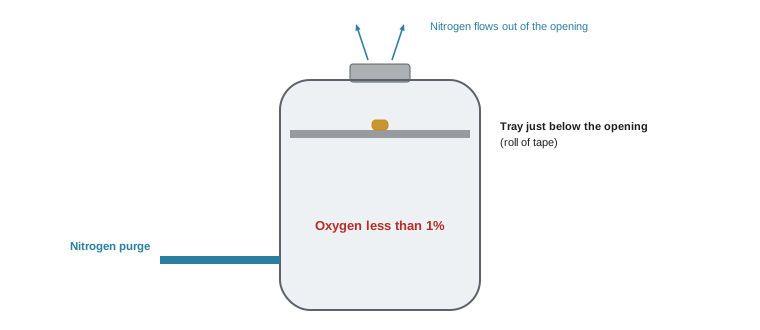
On the night of November 5, 2005, contract workers at a refinery in Delaware City, Delaware, were reinstalling a large pipe elbow on top of a hydrocracker reactor during a maintenance shutdown. The reactor was being purged with nitrogen, so its atmosphere contained almost no oxygen. A roll of duct tape fell through the 24-inch (61 cm) opening onto a tray about five feet (1.5 m) inside the reactor. Entering to retrieve it would have required a specially equipped crew under the site's permit rules, which would have delayed the job. According to the U.S. Chemical Safety Board (CSB), one worker tried to hook the tape from the opening, most likely sitting on the ledge; the CSB could not determine whether he entered deliberately or slipped in, but he ended up on the tray. A second worker climbed in with a ladder to help him. Both were asphyxiated. An oxygen measurement in the reactor afterwards showed less than 1 per cent oxygen.
The CSB found that workers were not adequately warned that oxygen-deficient atmospheres could exist at and around the openings of purged equipment, that the opening was marked with a sign and tape but not barricaded, and that training on nitrogen hazards and on not attempting emotional rescues was inadequate. It recommended better training on inert gas purging and on the hazards around openings.
Key lessons: inert gases give no warning; the area at and just inside an opening can be deadly; a dropped tool or object is never a reason to break the plane of an opening without a permit; and the instinct to rescue kills.
Case 3: fire in a hydroelectric penstock, Colorado, 2007
On October 2, 2007, workers were recoating the inside of a long, steel-lined tunnel called a penstock at a hydroelectric plant near Georgetown, Colorado. The penstock runs thousands of feet, deep underground, and the workers were using epoxy coatings and highly flammable solvents inside it. A fire started inside the tunnel. Five workers who were farther up the sloping tunnel, beyond the fire, could not escape: the CSB described how the only way out was past the fire, and they died. Three others were injured.
The CSB found that the utility and its contractor had not adequately prepared for the hazardous work in the confined space. Flammable vapours were not adequately controlled or monitored, and there were no technically qualified rescuers on standby. The CSB issued 20 recommendations, including continuous monitoring of flammable atmospheres, treating large spaces such as penstocks as permit spaces, planning alternative escape routes or refuge chambers where there is only one exit, providing standby rescue teams where hazards threaten life, and improving contractor oversight.
Key lessons: a confined space can be very large; the work can create the hazard; a single exit means a fire, flood or collapse can trap everyone beyond it; and rescue teams must be at the space when the hazards are life-threatening.
Composite case A: a grain bin
This composite case is typical of many agricultural reports. A farm worker notices that grain has stopped flowing from a bin. Thinking it has bridged, he climbs in through the roof hatch with a shovel while the unloading auger is still running, intending to break up the crust. The crust gives way and he is pulled into the flowing grain. Within seconds he is buried to his chest and cannot move. A family member hears him shout and climbs in to help, but she sinks too. The auger is eventually shut off from outside, and fire and rescue services use a rescue tube to free the second person, but the first worker has suffocated.
What would have prevented it: locking out the unloading equipment before entry; breaking the bridge from outside; a harness and lifeline tied off and tended by an attendant; a rescue plan; and, above all, not entering.
Composite case B: a sewer connection
This composite case is typical of municipal reports. A contractor crew is connecting a new line to an existing sewer manhole. The manhole is deeper than a person is tall. A worker climbs down to check the connection without testing the air, because the job will only take a few minutes and the crew has done many similar connections. At the bottom, disturbed sediment releases hydrogen sulfide and the worker collapses. A second worker goes down the ladder and also collapses. A third worker, remembering his training, stays at the top, calls emergency services and keeps others away. Firefighters with breathing apparatus recover both men; one survives with injuries.
What would have prevented it: testing from outside at all levels, ventilation, continuous monitoring, a harness and retrieval system on a tripod, an attendant, and a rescue plan.
| Case | Hazard | Missing controls | Rescuers harmed? |
|---|---|---|---|
| Pump shed, BC 2008 | Hydrogen sulfide and carbon dioxide released from a pipe | Program, gas detection, ventilation, isolation, rescue plan | Yes |
| Reactor, Delaware 2005 | Nitrogen (oxygen below 1 per cent) | Barricade, awareness of opening hazards, no entry without permit | Yes |
| Penstock, Colorado 2007 | Fire from flammable solvent vapour | Vapour control and monitoring, escape route, standby rescue | No rescue possible |
| Grain bin (composite) | Engulfment in flowing grain | Lockout, work from outside, harness and lifeline | Yes |
| Sewer (composite) | Hydrogen sulfide from sediment | Testing, ventilation, monitoring, retrieval, attendant | Yes |
The common threads
Across these cases and many others, investigators keep finding the same contributing factors:
- the space was not recognized as a confined space, or its hazards were underestimated, especially small sheds, pits and the areas at openings;
- the atmosphere was not tested, or was tested only once, or not at the right level;
- the work, such as disturbing sludge, separating a pipe, coating or using solvents, created or released the hazard;
- energy and material inflows were not isolated;
- there was no attendant, or the attendant had other duties or went in;
- there was no rescue plan, no retrieval equipment set up and no rescuers available in time;
- untrained coworkers entered to help and became victims;
- production pressure, a quick job or a familiar task led people to skip steps;
- contractors and host employers did not share information about the hazards.
These threads map directly onto the controls in lessons 3 to 10. No incident in this lesson required an unknown hazard or bad luck. Each happened when known controls were missing.
Analysing an incident: barrier analysis
A simple way to learn from an incident, or to review a planned entry, is barrier analysis. List the barriers that should stand between the hazard and the worker, then ask, for each one, whether it was present, whether it worked and why not. In confined space work the main barriers are: recognizing the space; avoiding entry; isolation; cleaning and ventilation; testing and monitoring; the permit; the attendant and communication; retrieval equipment; and planned rescue.
Worked problem
Barrier analysis of composite case B
For the sewer composite case, score each of nine barriers as present and working (2), present but failed (1) or absent (0). What does the total show?
Show solution
- Recognizing the space: the crew knew it was a manhole but treated it as routine. Present but failed: 1.
- Avoiding entry: a camera could have checked the connection. Absent: 0.
- Isolation: no upstream flow control. Absent: 0.
- Ventilation: none. Absent: 0.
- Testing and monitoring: none. Absent: 0.
- Permit: none. Absent: 0.
- Attendant and communication: the third worker acted as an attendant only after the collapse. Present but late: 1.
- Retrieval equipment: none set up. Absent: 0.
- Planned rescue: emergency services called, but no plan or standby. Present but failed: 1.
- Total = 3 out of a possible 18.
Answer: A score of 3 out of 18. Most barriers were absent, and the few that existed came too late. A planned entry should score close to 18, with every barrier present and checked on the permit.
Barrier analysis is useful not only after incidents but before entries. Teams can use it to check a draft permit: if any barrier is missing, the entry is not ready.
Near misses and reporting
For every confined space fatality there are many near misses: a detector alarm that sent workers out in time, a missed valve discovered during verification, a rescue drill that showed the tripod would not fit. Reporting and investigating these events, without blame, lets the program improve before someone is hurt. A culture in which people report problems with permits, equipment and procedures, and in which those reports lead to visible changes, is one of the strongest protections a workplace can have.
Common mistakes
MistakeThinking past incidents were caused by unusual hazards or bad luck.
InsteadMost were caused by known hazards and missing, well-understood controls.
MistakeTreating a small shed or pump house as a normal room.
InsteadAssess any enclosed space where gases can build up, whatever its size.
MistakeReaching into an opening to retrieve a dropped item.
InsteadThe atmosphere at an opening can be deadly; follow the permit process or use a tool from a safe position.
MistakePlanning work in a long space with only one exit without considering escape.
InsteadPlan alternative escape routes or refuge, control ignition, and have rescue on standby.
MistakeIgnoring near misses because no one was hurt.
InsteadReport and investigate near misses so the program improves.
Summary and key terms
- Confined space incidents repeat the same patterns across industries and decades.
- In Langley in 2008, gas released from a pipe in a small shed killed three workers, including two rescuers.
- In Delaware in 2005, nitrogen inside a purged reactor killed a worker and the coworker who went in to help.
- In Colorado in 2007, a solvent fire in a long penstock with one exit killed five workers.
- Grain bins and sewers show the same missing controls: lockout, testing, ventilation, retrieval and rescue planning.
- Barrier analysis checks whether each control was present and working, before or after an entry.
- Near-miss reporting and a strong safety culture help prevent the next incident.
- Investigation report
- A document from a regulator or investigator explaining how an incident happened and how to prevent it.
- Contributing factor
- A condition or action that helped an incident happen.
- Barrier analysis
- A method of checking whether each control between a hazard and a person was present and effective.
- Penstock
- A large pipe or tunnel that carries water to the turbines of a hydroelectric plant.
- Inert gas purge
- Filling equipment with nitrogen or another inert gas, leaving little or no oxygen.
- Composite case
- A fictional case built from common patterns in many real incidents.
- Near miss
- An event that could have caused harm but did not.
- Production pressure
- Pressure to finish work quickly that can lead to skipped steps.
- Rescue tube
- A barrier placed around a person trapped in grain to relieve pressure before extraction.
- Coroner's inquest
- A public hearing that examines a death and can make recommendations to prevent others.
Practice problems
Work each problem on paper first, then reveal the answer to check.
What released the gas in the 2008 Langley incident?
Show answer
Separating a blocked pipe connected to the wastewater system in a pump shed.
How many people died in that incident, and how many were rescuers?
Show answer
Three died, two of them coworkers who ran in to help; two others suffered brain damage.
What did the CSB find about warnings at the Delaware reactor?
Show answer
Workers were not adequately warned that low-oxygen atmospheres exist at and around openings of purged equipment.
Why could the Colorado penstock workers not escape?
Show answer
They were beyond the fire in a long tunnel whose only way out was past the fire.
Name three CSB recommendations from the penstock fire.
Show answer
Continuous flammable monitoring, permit-space management of large spaces, alternative escape or refuge, standby rescue, contractor oversight.
What should the grain bin worker have done before entering?
Show answer
Locked out the unloading equipment, tried to break the bridge from outside, and used a harness, lifeline and attendant.
What did the third worker in the sewer case do right?
Show answer
Stayed out, called emergency services and kept others away.
List four common threads across confined space incidents.
Show answer
Unrecognized space, no testing, work released hazard, no isolation, no attendant, no rescue plan, untrained rescuers, production pressure, poor contractor communication.
In barrier analysis, what score does a barrier that was present but failed receive in the example?
Show answer
1 out of 2.
Why investigate near misses?
Show answer
They reveal weaknesses before anyone is hurt.
Lesson quiz · 5 questions
Score 60% or more to complete this lesson.
Create a free account to save your progress, take quizzes and earn a certificate.