
HSE-211 · Lesson 1 of 12 · 24 min
What makes a confined space and why confined spaces kill
Every year workers die in tanks, silos, sewers, manholes, pits, vaults, vessels and bins. Many of them were doing ordinary jobs: cleaning out a tank, checking a valve in a vault, freeing grain that had bridged in a bin, repairing a pump at the bottom of a wet well. Many of the others were coworkers who saw someone collapse and went in to help. Confined space incidents are notorious for killing more than one person at a time, and for killing people who had no intention of entering a hazardous place at all.
This course is about recognizing confined spaces and understanding how their hazards are controlled. It explains what makes a space confined, why the air inside can kill without warning, how gas testing, ventilation, isolation and permits work, who does what during an entry, and why rescue must be planned before anyone goes in. It covers the general principles and how the law and standards apply them in your country.
It is an awareness course. It will help you recognize confined spaces, understand the signs and labels you see at work and take part in your employer's program. It does not qualify you to enter a confined space, to act as an attendant or entry supervisor, to test the atmosphere or to perform a rescue. Each of those roles requires training by your employer on the specific spaces, equipment and procedures at your site, and some require hands-on certification.
What is a confined space?
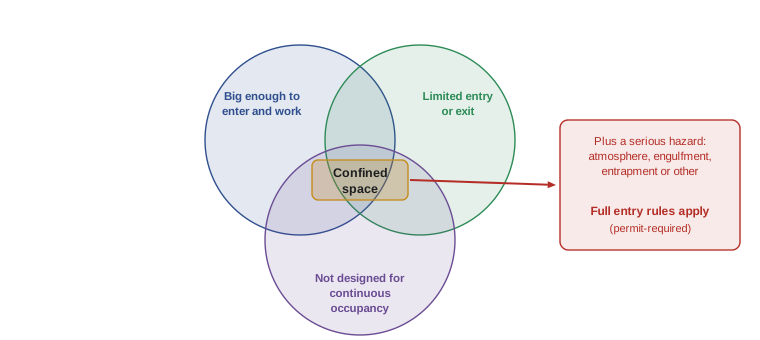
The details vary between jurisdictions, but almost every definition of a confined space combines three ideas:
- the space is large enough and configured so that a person can bodily enter it and do work;
- it has limited or restricted means of entry or exit, such as a manhole, a hatch, a ladder, a narrow passage or a long crawl;
- it is not designed for continuous human occupancy. People go in to inspect, clean, repair or maintain it, not to work there all day.
Canadian definitions add a fourth idea: the space may contain hazards because of its construction, location, contents or the work done in it. Ontario's regulation, for example, defines a confined space as a fully or partially enclosed space that is not designed and constructed for continuous human occupancy and in which atmospheric hazards may occur because of its construction, location or contents, or because of work done in it. British Columbia's regulation focuses on a space that is enclosed or partly enclosed, is not designed or intended for continuous human occupancy, has limited or restricted means of entry or exit, and is large enough and configured for a worker to enter and work. Quebec's definition, revised in 2023, names three kinds of risk: atmospheric or thermal hazards, engulfment, and drowning or entrainment. Lesson 2 compares the main provincial and federal rules.
Look at what the definitions do not say. A confined space does not have to be small, dark, deep or underground. A large storage tank, a ship's hold, a boiler, a railcar, an attic crawlspace or a long duct can all be confined spaces. Nor does a space have to be completely enclosed. An open-topped pit, a trench-like vault or a degreasing tank can trap heavy gases and meet the definition. The test is about access, design and hazards, not size.
Examples by industry
Confined spaces appear in almost every sector. Some common examples:
| Sector | Typical confined spaces |
|---|---|
| Municipal and utilities | Sewers, manholes, wet wells, lift stations, valve chambers, utility vaults, water tanks and reservoirs |
| Agriculture and food | Grain bins and silos, manure pits and tanks, fermentation vessels, hoppers, rendering tanks |
| Manufacturing and chemicals | Reactors, process vessels, storage tanks, mixers, kilns, dust collectors, degreasers, pits under presses |
| Oil, gas and energy | Tanks, separators, boilers, fireboxes, pipelines, turbine housings, transformer vaults, wind turbine blades and hubs |
| Construction | Crawlspaces, attics, utility vaults, pipe chambers, tanks under construction, sewer connections, deep footings |
| Transportation | Rail tank cars, tanker trailers, ship holds and ballast tanks, aircraft fuel tanks, tunnels and culverts |
| Buildings and data centres | Mechanical penthouses with limited access, pipe chases, elevator pits, cooling tower basins, cable vaults and some deep underfloor plenums |
Some places are obvious. Others are easy to overlook: the pit under a vehicle hoist, the inside of a large duct, a sump at the bottom of a building, a vault where electrical cables enter a data centre, or a room that is normally ventilated but becomes a confined space when its fans are shut down for maintenance. Lesson 3 explains how workplaces identify and inventory their confined spaces so that none are missed.
Why confined spaces are so dangerous
Confined spaces combine several features that make ordinary hazards deadly:
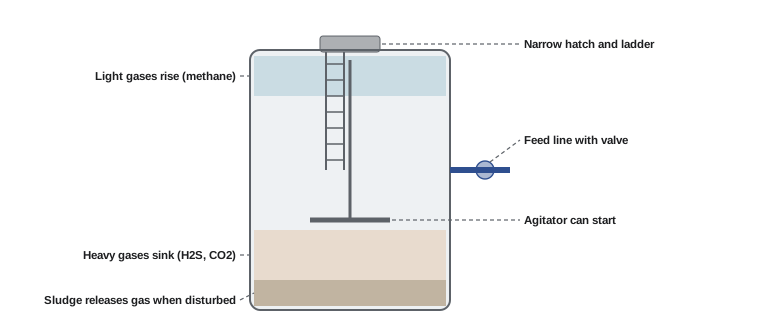
- the air can be wrong, and you cannot tell by looking or smelling. Oxygen can be displaced or consumed; toxic gases can build up; flammable vapours can collect. Some of the most dangerous gases, such as nitrogen and methane, have no smell at all, and hydrogen sulfide deadens the sense of smell at high concentrations;
- the shape of the space limits ventilation, so contaminants do not disperse and fresh air does not come in on its own;
- the limited entry and exit make escape slow and rescue difficult. A worker who is dizzy or unconscious cannot climb a ladder or squeeze through a manhole;
- materials stored in the space, such as grain, sand, sludge or liquids, can flow, collapse and bury a worker in seconds;
- equipment inside the space, such as agitators, augers, conveyors and mixers, can start unexpectedly, and lines feeding the space can release steam, chemicals or water;
- the work itself can create the hazard: welding uses up oxygen and produces fumes, solvents release vapours, and cleaning sludge can release hydrogen sulfide trapped in it.
The common thread is that the hazard may not be present when the worker enters, may not be detectable without instruments, and may disable the worker before they can get out. That is why confined space entry relies on testing, ventilation, isolation, continuous monitoring, an attendant outside the space and a rescue plan, rather than on the worker's own judgment once inside.
The scale of the problem
Canadian jurisdictions do not publish a single national count of confined space deaths, but provincial investigations and coroner's inquests describe the same patterns year after year: workers overcome in sewers, tanks, manure pits and vaults, and coworkers who die trying to help. Agricultural confined spaces, especially manure storage and grain bins, are a recurring source of fatalities. Federal research cited by the Canadian Centre for Occupational Health and Safety and by provincial regulators echoes the long-standing United States finding that a large share of confined space deaths are would-be rescuers. Lesson 11 describes several public cases.
A frequently cited finding comes from investigations by the National Institute for Occupational Safety and Health (NIOSH) in the United States in the 1980s: about 60 per cent of the people who died in confined space incidents it studied were would-be rescuers. The exact share varies between studies and periods, and the figure is decades old, but the lesson has not changed. When someone collapses in a confined space, the instinct to go in after them kills people. Most rescuers who enter without breathing apparatus are overcome by the same atmosphere that disabled the first worker.
The same NIOSH investigations found other telling patterns. In most incidents a supervisor was present or had authorized the entry. Few of the spaces had been tested before entry, few had been ventilated, and very few of the employers had a rescue plan. Written procedures sometimes existed but were not used. In other words, many of the deaths happened at workplaces that knew the space was a concern but did not follow the controls.
Why people go in
Confined space deaths rarely involve reckless behaviour. More often they involve ordinary assumptions:
- the space was entered many times before without a problem;
- the job was expected to take only a few minutes;
- the worker could see the bottom and it looked clean and dry;
- there was no smell, or the smell was familiar;
- the space had been tested earlier in the day, before conditions changed;
- the gas detector was in the truck, or its battery was dead;
- a coworker collapsed and someone had to do something.
Each of these feels reasonable at the moment. The controls in this course exist to make safety independent of those moments, so that no one has to rely on a hunch about whether the air is safe.
The basic approach
Confined space programs in both Canada and the United States follow the same basic logic:
- identify every confined space at the workplace and warn people about it;
- avoid entry where possible, by doing the work from outside or by redesigning the space;
- where entry is necessary, have a competent person assess the hazards and write a plan or procedure;
- isolate the space from energy and materials, clean and ventilate it, and test the atmosphere;
- issue an entry permit that records the hazards, controls, tests and people involved;
- keep an attendant outside the space for the whole entry, with continuous communication;
- have a rescue plan, equipment and trained rescuers ready before anyone enters;
- train everyone involved, and review the program regularly.
The rest of the course follows this sequence. Lesson 3 covers identifying and classifying spaces, lessons 4 to 6 cover the atmosphere and gas testing, lesson 7 covers physical hazards and isolation, lesson 8 covers ventilation, lesson 9 covers permits and roles, lesson 10 covers rescue, lesson 11 looks at real incidents and lesson 12 brings it together in an entry plan.
Related courses
Several topics connect closely to confined space work. Isolating machinery and energy sources before entry is covered in detail in HSE-210 Lockout and Hazardous Energy Control. Respiratory protection and other personal protective equipment are introduced in HSE-104. Fire hazards and hot work are covered in HSE-105 and HSE-216. Fall protection for vertical entries is covered in HSE-212. This course points to those courses rather than repeating them.
Common mistakes
MistakeThinking a confined space must be small, dark or underground.
InsteadA space is confined because of its access, design and hazards. Large tanks, ship holds and open pits can qualify.
MistakeJudging the air by smell or appearance.
InsteadMany deadly gases are odourless or deaden the sense of smell. Only a properly used gas detector can tell you.
MistakeGoing in to help a coworker who has collapsed inside.
InsteadRaise the alarm and follow the rescue plan. Untrained rescuers without breathing apparatus are often the next victims.
MistakeAssuming a space is safe because it was safe last time.
InsteadConditions change with weather, process upsets, sludge and the work itself. Test every time and monitor continuously.
MistakeTreating this awareness course as permission to enter or attend.
InsteadEntrants, attendants, supervisors, testers and rescuers need site-specific training for their roles.
Summary and key terms
- A confined space is big enough to enter and work in, has limited entry or exit, and is not designed for continuous occupancy.
- Serious hazards, especially atmospheric hazards, are what make a confined space deadly and trigger the full entry rules.
- Confined spaces exist in almost every sector, including utilities, agriculture, manufacturing, energy, construction and buildings.
- Air hazards are often invisible and odourless, the shape of the space traps them, and the limited exit slows escape and rescue.
- A large share of confined space deaths are would-be rescuers who enter without breathing apparatus.
- Most incidents involve ordinary assumptions: a quick job, a familiar space, no smell or an earlier test.
- Programs identify spaces, avoid entry, assess, isolate, ventilate, test, permit, attend and plan rescue.
- Confined space
- A space big enough to enter and work in, with limited entry or exit, not designed for continuous occupancy.
- Permit-required confined space
- In US rules, a confined space with a serious hazard such as a hazardous atmosphere, engulfment or entrapment.
- Entrant
- A person who enters a confined space.
- Attendant
- A person stationed outside a confined space who monitors the entrants and summons rescue.
- Engulfment
- Being surrounded and captured by a liquid or a flowable solid such as grain or sand.
- Hazardous atmosphere
- Air that could cause death, incapacitation, injury or illness, for example from too little oxygen or toxic gas.
- Would-be rescuer
- A person who enters a confined space to help a collapsed worker without proper protection.
- Stratification
- The layering of gases in a space according to their density.
- Entry
- Passing through an opening into a confined space, usually defined as when any part of the body breaks the plane of the opening.
- Rescue plan
- A written plan for getting a worker out of a confined space quickly and safely if something goes wrong.
Practice problems
Work each problem on paper first, then reveal the answer to check.
List the three common elements of a confined space definition.
Show answer
Big enough to enter and work in; limited or restricted entry or exit; not designed for continuous occupancy.
Give two examples of confined spaces in agriculture.
Show answer
Grain bins or silos and manure pits or tanks; also hoppers and fermentation vessels.
Why can an open-topped pit be a confined space?
Show answer
Heavy gases can collect in it, it may be hard to climb out of, and it is not designed for occupancy.
Name two gases that have no smell.
Show answer
Nitrogen and methane; carbon monoxide is also odourless.
Why is relying on smell dangerous with hydrogen sulfide?
Show answer
At high concentrations it deadens the sense of smell, so the odour seems to disappear.
What share of confined space deaths did NIOSH investigations find were would-be rescuers?
Show answer
About 60 per cent, a long-standing and widely cited figure.
How can the work itself create an atmospheric hazard?
Show answer
Welding consumes oxygen and makes fumes, solvents give off vapours and disturbing sludge releases gases.
What should you do if a coworker collapses inside a confined space?
Show answer
Stay out, raise the alarm and start the rescue plan, including non-entry retrieval if available.
Why is a test done in the morning not enough for an afternoon entry?
Show answer
Conditions can change; test before entry and monitor continuously during it.
Which course covers isolating energy sources before entry?
Show answer
HSE-210 Lockout and Hazardous Energy Control.
Lesson quiz · 5 questions
Score 60% or more to complete this lesson.
Create a free account to save your progress, take quizzes and earn a certificate.