
HSE-211 · Lesson 12 of 12 · 28 min
Managing the program and capstone: writing an entry plan
The earlier lessons covered each part of confined space safety separately. In practice they must work together as a program: a set of written procedures, trained people, equipment and checks that make every entry safe, every time, whoever is doing it. This final lesson explains how a confined space program is managed, how contractors are coordinated, what training each role needs and how the program is reviewed. It finishes with a capstone in which you put everything together to draft an entry plan for a real-world type of space.
The written program
Canadian regulations require a written program or code of practice. Ontario requires a written program for confined spaces (s. 5), developed and maintained in consultation with the joint health and safety committee or representative, and reviewed as often as necessary. Alberta requires a written code of practice that is maintained and periodically reviewed. CSA Z1006 describes a management system approach with defined responsibilities, documented procedures and periodic evaluation.
A typical program document covers:
- scope and responsibilities, from senior management to entrants;
- how confined spaces are identified, inventoried, signed and secured;
- how hazards are assessed and entry plans written;
- isolation, cleaning, ventilation and atmospheric testing requirements, including acceptable values and instrument care;
- the permit system, including who may issue permits and for how long they are valid;
- duties of entrants, attendants, entry supervisors, testers and rescuers;
- rescue arrangements and drills;
- contractor coordination;
- training and competency requirements;
- records, audits and program review.
Training and competency
Every role in confined space work needs training matched to its duties, and that training must be refreshed and updated when the spaces, hazards, equipment or procedures change.
| Role | Training should cover |
|---|---|
| Everyone at the site | Recognizing confined spaces and signs; never entering without authorization; never attempting an untrained rescue |
| Entrants | Hazards and symptoms; the entry plan and permit; equipment use; communication; evacuation |
| Attendants | All entrant topics plus counting entrants, communication, recognizing exposure symptoms, ordering evacuation, summoning rescue, non-entry retrieval |
| Entry supervisors and permit issuers | Hazard assessment, permits, verifying controls, rescue availability, terminating entries |
| Atmospheric testers | Instrument operation, limitations, bump tests and calibration, sampling technique, acceptable values |
| Rescuers | Supplied-air respirators, rope and retrieval systems, patient packaging, first aid and CPR, regular drills |
Ontario requires general training in recognizing confined space hazards (s. 8) and plan-specific training for workers involved in an entry (s. 9), with training records kept. Alberta requires a competent person to train workers assigned to entry duties and keeps records of that training. Quebec requires workers to be at least 18 years old and to be informed of the risks and prevention measures before work begins.
This awareness course is only the first step. Before taking any of the roles above, you need training from your employer on the actual spaces, procedures and equipment, and practical skills such as using a detector, a retrieval system or breathing apparatus must be demonstrated, not just studied.
Contractors and multi-employer work
Much confined space work is done by contractors: tank cleaners, coating crews, inspectors, welders, sewer specialists. Incidents often happen when the host employer and the contractor each assume the other is handling a hazard. Coordination should cover:
- the host telling the contractor about the space, its hazards and any known precautions, and about its own confined space program;
- the contractor telling the host about the hazards its work will create, such as solvents or welding;
- agreeing who isolates the space, who tests, who issues the permit, who attends and who provides rescue;
- coordinating when more than one employer's workers are in or near the same space;
- debriefing at the end to share any hazards found or problems encountered.
Ontario requires a written co-ordination document when workers of more than one employer perform work in the same confined space (s. 4), so that the duties of each employer are carried out without endangering anyone. Other jurisdictions place similar duties on owners, prime contractors and employers to share information and coordinate.
Auditing and reviewing the program
A program on paper is only as good as its use in the field. Regular checks help keep it alive:
- field audits of entries in progress, checking that the permit matches what is actually happening at the space;
- review of completed permits for missing tests, signatures or information, and for trends such as rising gas readings;
- review of detector bump test and calibration records;
- rescue drill results and the lessons learned from them;
- investigation of incidents, near misses and alarms;
- updates to the inventory and entry plans when spaces or processes change;
- feedback from entrants, attendants and the health and safety committee.
Worked problem
Reviewing a year of permits
A program review examines 150 cancelled permits from the past year. It finds 12 with missing periodic gas readings, 6 where the rescue contact field was blank, and 3 where an alarm occurred but no follow-up was recorded. What percentage of permits had at least one of these problems, assuming no permit had more than one, and what should the review recommend?
Show solution
- Total permits with a problem = 12 + 6 + 3 = 21.
- Percentage = 21 ÷ 150 × 100 = 14 per cent.
- Missing periodic readings (8 per cent of permits) suggest monitoring is not being recorded or not being done; check whether detectors with data logging should be used and whether attendants have time to record readings.
- Blank rescue fields (4 per cent) mean entries may have started without confirmed rescue; make the field mandatory before authorization.
- Alarms without follow-up (2 per cent) mean possible hazards were not investigated; require an alarm report.
Answer: 14 per cent of permits had a significant gap. The review should lead to specific changes, such as data-logging detectors, a mandatory rescue confirmation step and an alarm follow-up form, then check the results the following year.
Capstone: writing an entry plan
In this capstone you draft an entry plan for a common type of space, using everything in the course. Read the scenario, then compare your plan with the model answer that follows.
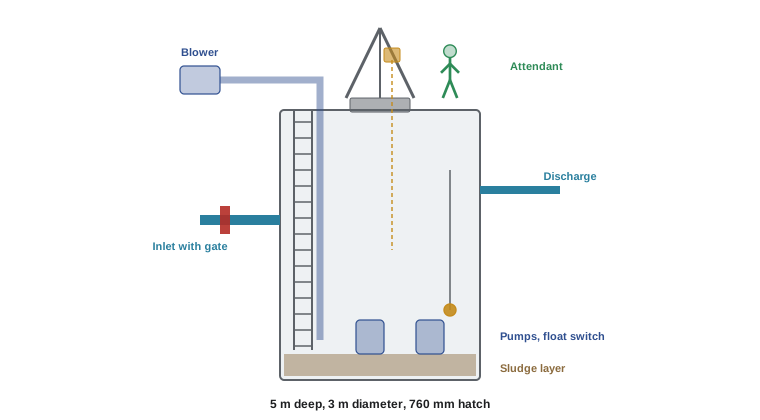
The scenario. A municipal lift station has a wet well 5 m deep and 3 m in diameter, entered through a 760 mm square hatch with a fixed ladder. Two submersible pumps at the bottom need their float switch replaced. Sewage enters through an inlet pipe that can be closed with an upstream gate; the pumps discharge through a separate line. The well contains a layer of sludge. Previous tests in similar wells have found hydrogen sulfide up to 50 ppm when sludge was disturbed, and occasional low oxygen. The nearest fire department with confined space rescue capability is about 20 minutes away. Two maintenance workers and a supervisor are available, and another crew can be called in.
Before reading on, write down: the classification of the space; the hazards; how you would avoid or reduce entry; isolation; cleaning and ventilation; testing; the permit and roles; equipment; communication; and rescue.
Model answer
Classification. The wet well is a confined space with serious hazards: a hazardous atmosphere (hydrogen sulfide, low oxygen, possibly methane), drowning or engulfment from incoming sewage, moving parts in the pumps, electrical hazards and a fall risk on the ladder. It requires a written assessment, an entry plan and an entry permit under the provincial regulation.
Avoiding or reducing entry. Can the float switch be replaced from the surface? Many lift stations have guide rails that let pumps and switches be raised without entry. If so, no entry is needed. If entry is unavoidable, pump the well down as far as possible first and plan the work to minimize time inside.
Isolation. Close and lock the upstream inlet gate and, where possible, divert or store incoming flow; lock out both pumps and the control panel at their disconnects and verify zero energy (HSE-210); isolate the discharge line with its check and isolation valves, locked; and confirm that no other lines can introduce sewage or gas.
Cleaning and ventilation. Pump down and, if practical, vacuum out sludge from the surface. Set up a supply blower with a clean intake upwind and away from vehicles, and run the duct to the bottom of the well. Estimate purge time and keep the blower running throughout the entry.
Worked problem
Capstone calculations
The wet well holds about 35 m³ of air when pumped down (π × 1.5² × 5 ≈ 35 m³). The blower delivers 15 m³/min after duct losses. Using a mixing factor of 3, how long should ventilation run before testing to reduce an initial 50 ppm of hydrogen sulfide to 1 ppm? And if the rescue team needs 2 minutes to reach an entrant once at the space, is a standby team needed?
Show solution
- V/Q = 35 / 15 ≈ 2.3 minutes per air change.
- ln(50 / 1) = ln(50) ≈ 3.9.
- Time = 3 × 2.3 × 3.9 ≈ 27 minutes.
- Hydrogen sulfide could rise to IDLH levels if sludge is disturbed, so rescue must be immediate. The 20-minute fire department response is too slow on its own.
- A standby rescue team at the space, with non-entry retrieval set up, can reach an entrant in about 2 minutes, within the critical window.
Answer: Ventilate for about 30 minutes, then test at all levels. Provide non-entry retrieval plus a standby rescue capability at the space; the fire department is backup, not the primary rescue.
Testing. After ventilation, test from the surface with a pumped multi-gas detector (oxygen, percent LEL, hydrogen sulfide and carbon monoxide), at the top, middle and bottom and near the sludge, allowing transport time for the tubing. Record the results. Entry may start only if all readings are within the acceptable values on the permit. The entrant wears a personal detector, and continuous monitoring continues throughout.
Permit and roles. The supervisor acts as entry supervisor, completes the permit at the space and verifies each control before signing. One worker is the entrant. The second is the attendant, who stays at the hatch for the whole entry with no other duties. Because standby rescue is needed and the attendant must not enter, a second crew trained and equipped for entry rescue is called in to stand by at the station.
Equipment. Multi-gas detectors (bump tested), the blower and ducting, a tripod and winch over the hatch with the entrant in a full-body harness attached to the retrieval line, which also provides fall protection on the ladder; supplied-air respirators for the rescue team; low-voltage or battery lighting rated for possible flammable gas; radios checked for coverage at the bottom; gloves, boots, protective clothing and washing facilities for biological hazards; barriers around the hatch.
Communication. Radio contact with check-ins at least every few minutes plus visual contact down the hatch; rope signals as backup; the attendant's radio or phone tested for calling the rescue team and emergency services.
Rescue. Self-rescue on alarm or symptoms; non-entry retrieval by the attendant using the winch; entry rescue by the standby team with supplied air if retrieval fails; the fire department notified before the entry and called immediately in an emergency; first aid and CPR available; safety data sheets and permit information ready to send with a casualty.
Closing. When the work is done, confirm the entrant is out and counted, tools are removed, the hatch is closed, isolation is removed in the right order, the pumps are tested from the panel, and the permit is signed off with any issues noted.
Common mistakes
MistakeWriting a program and never checking how it works in the field.
InsteadAudit entries, review permits and drills, and update the program.
MistakeAssuming the contractor will handle all hazards.
InsteadHost and contractor share information, agree responsibilities and debrief.
MistakeTraining once and never again.
InsteadRetrain when duties, spaces, hazards or procedures change, or when gaps appear.
MistakeUsing the fire department as the only rescue for an IDLH-capable space.
InsteadProvide non-entry retrieval and a standby rescue team at the space; use the fire department as backup.
MistakeStarting the capstone with entry instead of asking whether entry is needed.
InsteadAlways ask first whether the work can be done from outside.
Summary and key terms
- A written program ties together inventory, assessment, plans, permits, testing, ventilation, roles, rescue, training and review.
- Every role needs training matched to its duties, refreshed when anything changes; this course is only awareness.
- Hosts and contractors must share hazard information, agree who does what and debrief after the work.
- Field audits, permit reviews, drill results and near misses keep the program effective.
- An entry plan starts by asking whether entry can be avoided.
- The wet well capstone needs isolation, ventilation, testing, a permit, an attendant, retrieval and standby rescue.
- Rescue capability must match the hazard: for IDLH-capable spaces, rescuers must be at the space.
- Confined space program
- The written system of procedures, roles, equipment and checks for confined space work.
- Program review
- A periodic evaluation of the program using permits, audits, drills and incidents.
- Co-ordination document
- In Ontario, a written document setting out duties when several employers work in one space.
- Host employer
- The employer that owns or controls the workplace where a contractor works.
- Controlling contractor
- In US construction rules, the employer with overall responsibility for the site.
- Training certification
- A record confirming that training was completed, with names and dates.
- Field audit
- A check at the space comparing actual practice with the permit and plan.
- Wet well
- A chamber at a pumping station where sewage collects before being pumped.
- Lift station
- A facility that pumps wastewater from a lower to a higher elevation.
- Debrief
- A discussion after the work to share hazards found and lessons learned.
Practice problems
Work each problem on paper first, then reveal the answer to check.
List five topics a confined space program should cover.
Show answer
Responsibilities, inventory, assessment and plans, isolation, testing, ventilation, permits, roles, rescue, contractors, training, review.
When must training be repeated or updated?
Show answer
When duties, spaces, hazards, equipment or procedures change, or when gaps or deviations appear.
What should a host tell a contractor?
Show answer
The spaces, their hazards, precautions taken and the host's program.
Why review cancelled permits?
Show answer
To find missing information, trends and weaknesses in how entries are done.
In the review example, what percentage of permits had a gap?
Show answer
21 of 150, or 14 per cent.
What is the first question in any entry plan?
Show answer
Can the work be done without entering?
Name three isolation steps for the wet well.
Show answer
Lock the upstream gate, lock out both pumps and the panel, isolate the discharge line, verify.
Purge time for 35 m³ at 15 m³/min, K = 3, from 50 to 1 ppm?
Show answer
About 3 × 2.3 × 3.9 ≈ 27 minutes.
Why is a standby rescue team needed for the wet well?
Show answer
Hydrogen sulfide could reach IDLH levels and the fire department is 20 minutes away.
Who must not enter to rescue in the capstone, and why?
Show answer
The attendant, because they are the link to rescue and must stay outside.
Lesson quiz · 5 questions
Score 60% or more to complete this lesson.
Create a free account to save your progress, take quizzes and earn a certificate.