
HSE-211 · Lesson 2 of 12 · 23 min
OSHA confined space standards and the law in the US
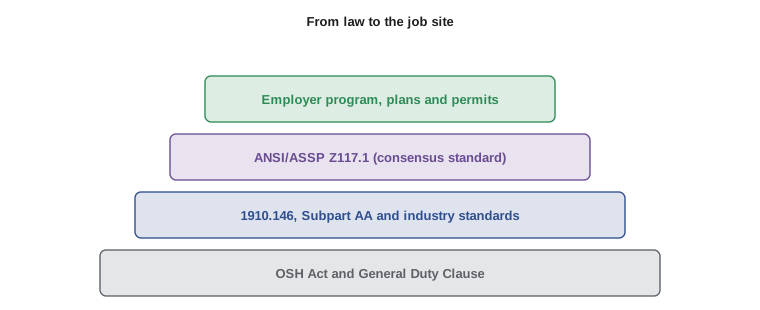
In the United States, the Occupational Safety and Health Administration (OSHA) sets federal standards that apply to most private employers. About half the states run their own OSHA-approved state plans, which must be at least as effective as the federal rules and sometimes go further. For confined spaces, the key federal rules are the general industry standard for permit-required confined spaces, 29 CFR 1910.146, and the construction standard, 29 CFR 1926 Subpart AA. Other standards cover particular industries such as grain handling, shipyards and telecommunications. This lesson explains how these rules fit together, introduces the voluntary consensus standard ANSI/ASSP Z117.1 and describes how OSHA enforces them.
As always in this course, the law described here is a summary for awareness. Regulations change, and the exact wording of the regulation that applies to your workplace is what counts. Your employer's program, written by people who know the applicable rules, is your practical guide.
Who must follow the rules
Federal OSHA standards apply to private-sector employers in most states and to federal agencies. State plans cover private employers in their states and also state and local government workers, who are not covered by federal OSHA. State plan states such as California, Washington, Oregon, Michigan and others adopt their own confined space rules, which are usually based on the federal standards and are sometimes stricter. California, for example, has its own detailed confined space orders. If you work in a state plan state, your employer's program follows the state rule.
1910.146: permit-required confined spaces in general industry
The general industry standard was published in 1993 and is the foundation of US confined space practice. Its key ideas are:
- definitions of a confined space and a permit-required confined space (permit space), as described in lesson 1;
- an evaluation of the workplace to find permit spaces, with danger signs or other effective means to inform employees of their existence and hazards (paragraph (c));
- if employees will not enter permit spaces, measures to prevent entry; if they will, a written permit space program (paragraph (d));
- a permit system that requires an entry permit, signed by the entry supervisor, before entry (paragraphs (e) and (f));
- training for authorized entrants, attendants and entry supervisors, with certification of training (paragraph (g));
- duties for entrants, attendants and entry supervisors (paragraphs (h), (i) and (j));
- rescue and emergency services, including evaluating rescue services, providing retrieval systems and practicing rescues at least once every 12 months (paragraph (k));
- consultation with employees and their representatives, and access to the program and permits (paragraph (l)).
The standard also has two important alternatives for spaces whose hazards can be controlled. Paragraph (c)(5) allows alternate procedures for spaces where the only hazard is an actual or potential hazardous atmosphere that can be controlled by continuous forced-air ventilation alone, with monitoring data to support it. Paragraph (c)(7) allows a permit space to be reclassified as a non-permit confined space when all hazards are eliminated, not just controlled, without entering, or when testing and inspection during entry show they have been eliminated. Lesson 3 explains both in more detail.
| Paragraph | Topic | Key point |
|---|---|---|
| (b) | Definitions | Confined space, permit space, hazardous atmosphere, engulfment, entry, IDLH and more |
| (c) | General requirements | Evaluate the workplace, post signs, alternate procedures (c)(5), reclassification (c)(7), contractor coordination (c)(8) |
| (d) | Permit space program | Written program with testing, ventilation, equipment, attendants, rescue and annual review |
| (e), (f) | Permit system and permit | Entry supervisor signs; permit lists hazards, controls, tests, people, rescue and communication |
| (g) | Training | Before first assignment and when duties, hazards or procedures change; certified |
| (h), (i), (j) | Duties | Authorized entrants, attendants and entry supervisors |
| (k) | Rescue | Evaluate rescue service; trained in-house teams practice at least every 12 months; retrieval systems |
Subpart AA: confined spaces in construction
Construction work in confined spaces was covered for many years by a few general provisions. In 2015 OSHA published 29 CFR 1926 Subpart AA (sections 1926.1200 to 1926.1213), which became effective on August 3, 2015. Subpart AA follows the structure of 1910.146 but adds requirements suited to construction sites, where many employers work together and conditions change quickly:
- a competent person must evaluate the worksite to identify confined spaces and permit spaces before work begins;
- the controlling contractor, host employer and entry employers must share information about permit spaces and coordinate entries, so that one employer's work does not create a hazard in another's space;
- continuous atmospheric monitoring is required where possible, and continuous monitoring for engulfment hazards with an early-warning system, for example for an upstream storm that could flood a sewer;
- permits can be suspended rather than canceled when conditions change temporarily, and the space must be re-evaluated before entry resumes;
- the standard includes a table of terms that differs slightly from 1910.146 and gives more detailed rules for rescue planning, including arranging for rescue services in advance and confirming their availability.
Subpart AA does not apply to some construction activities that have their own rules, such as excavations covered by Subpart P and underground construction covered by Subpart S. A trench is generally handled under the excavation rules rather than as a confined space, although some trench hazards overlap.
Other OSHA standards and the General Duty Clause
Several industry-specific standards contain their own confined space rules. The grain handling standard, 29 CFR 1910.272, covers entry into grain bins, silos and tanks, including rules on lockout of augers, lifelines and the prohibition on walking down grain to make it flow. Shipyard employment has its own confined and enclosed space rules in 29 CFR 1915 Subpart B. Telecommunications work in manholes and vaults is covered by 1910.268, and electric utility work in enclosed spaces by 1910.269. Where no specific standard applies, OSHA can use the General Duty Clause, section 5(a)(1) of the Occupational Safety and Health Act, which requires employers to keep their workplaces free from recognized hazards likely to cause death or serious harm.
ANSI/ASSP Z117.1
ANSI/ASSP Z117.1, Safety Requirements for Entering Confined Spaces, is the American national consensus standard. The current edition was published in 2022. It is broader than the OSHA standards in some respects, covering all confined spaces, emphasizing hazard assessment and the hierarchy of controls, and giving detailed guidance on atmospheric testing, ventilation, attendants and rescue. It is voluntary unless adopted by a regulation or contract, but many employers use it to build programs that go beyond the minimum, and OSHA may refer to it as evidence of recognized good practice.
Enforcement and penalties
OSHA inspectors can cite employers for violations, with penalties that are adjusted for inflation each January. As of January 2025, the maximum penalty was $16,550 for a serious or other-than-serious violation and $165,514 for a willful or repeated violation; check the current amounts. State plans set their own penalties within federal limits. A willful violation that causes a worker's death can also be prosecuted as a criminal offense under the OSH Act. Employers must report a work-related fatality to OSHA within 8 hours and an in-patient hospitalization, amputation or loss of an eye within 24 hours (29 CFR 1904.39). Workers have the right to report hazards and are protected from retaliation under section 11(c) of the Act, and OSHA regulations recognize a limited right to refuse work that poses an imminent danger.
Comparing atmospheric limits
Different rules use slightly different numbers for the same hazards. The table below compares commonly used values. Your employer's program will specify the limits that apply at your site, and they may be stricter.
| Parameter | Common Canadian values | OSHA 1910.146 |
|---|---|---|
| Minimum oxygen | 19.5 percent (Ontario, Alberta); Quebec revised its threshold in 2023 | Below 19.5 percent is a hazardous atmosphere |
| Maximum oxygen | 23 percent (Ontario, Alberta) | Above 23.5 percent is a hazardous atmosphere |
| Flammable gas or vapor | Below 20 percent (BC) or 25, 10 or 5 percent (Ontario) of the LEL | Above 10 percent of the lower flammable limit is a hazardous atmosphere |
| Toxic contaminants | Provincial occupational exposure limits | Above the OSHA permissible exposure limit |
Two points stand out. First, oxygen enrichment is a hazard, not just deficiency, because extra oxygen makes materials burn far more readily. Second, the flammable limits are set well below the level at which a fire or explosion could actually happen, to leave a margin for error, for gas pockets and for instrument limitations. Lessons 4 and 5 explain why.
What the rules mean for you on the job
For a worker, the practical meaning of these rules is the same in every state. Before you enter a permit space, there must be a written permit space program, a permit signed by the entry supervisor, atmospheric tests within the acceptable limits, isolation and ventilation in place, an attendant outside and rescue arrangements ready. You must have been trained and certified for your role, and you have the right to observe the atmospheric testing and to ask for a retest if you think the results are not accurate. Entrants and their authorized representatives also have the right to see the program and the permits. If any of these is missing, stop and ask. You can raise concerns with your supervisor, your safety committee or union, or file a complaint with OSHA or your state plan, and you are protected from retaliation for doing so.
Where federal rules, state plan rules and ANSI/ASSP Z117.1 differ, the applicable OSHA or state rule is the legal minimum. Many employers, insurers and project owners require compliance with the consensus standard as well, through contracts and corporate policies, so a program built to Z117.1 will usually go further than the minimum. Contractors working at several sites should check which rules each host employer follows, because one site's program may be stricter than another's.
Municipalities, utilities and large project owners often add their own requirements for sewer, vault and tank work through permits and contracts, for example requiring specific gas detector alarm settings, a minimum number of attendants or a designated rescue provider. Some state plans also publish detailed confined space orders for particular industries. Contractors should ask for these requirements before bidding on or starting the work, and should keep copies of the host employer's confined space information with their own permits.
Common mistakes
MistakeAssuming federal OSHA rules apply in every state without change.
InsteadState plan states adopt their own rules, which can be stricter. Follow the rule that applies where you work.
MistakeTreating ANSI/ASSP Z117.1 as irrelevant because it is voluntary.
InsteadConsensus standards are widely used as benchmarks of good practice by regulators, courts and auditors.
MistakeThinking construction sites can ignore confined space rules.
InsteadSubpart AA has applied to construction confined spaces since August 2015.
MistakeUsing one set of atmospheric limits everywhere.
InsteadLimits differ between rules and sites. Use the values in your program and on the permit.
MistakeIgnoring oxygen enrichment because extra oxygen seems harmless.
InsteadEnriched air greatly increases fire risk and is treated as a hazardous atmosphere.
Summary and key terms
- Federal OSHA standards cover most private employers; state plans cover their states and public workers.
- 29 CFR 1910.146 sets out permit spaces, programs, permits, training, duties and rescue for general industry.
- Paragraphs (c)(5) and (c)(7) allow alternate procedures and reclassification in limited cases.
- Subpart AA, effective August 3, 2015, covers construction and stresses coordination and continuous monitoring.
- Grain handling, shipyards, telecommunications and utilities have their own rules; the General Duty Clause fills gaps.
- ANSI/ASSP Z117.1-2022 is the voluntary national consensus standard.
- Penalties are inflation-adjusted, deaths must be reported within 8 hours, and workers are protected from retaliation.
- Occupational exposure limit
- The maximum airborne concentration of a substance a worker may be exposed to, set by regulation.
- Lower explosive limit (LEL)
- The lowest concentration of a gas or vapor in air that can ignite; also called the lower flammable limit.
- Competent person
- A person with the knowledge, training and experience to perform a task and identify its hazards, as defined in the applicable rules.
- Entry permit
- A written authorization for a specific entry that records hazards, controls, tests and people.
- Code of practice
- A written set of procedures required by some regulations, such as Alberta, for a hazardous activity.
- Consensus standard
- A standard developed by a standards body through a consensus process, such as CSA Z1006 or ANSI/ASSP Z117.1.
- State plan
- An OSHA-approved state occupational safety and health program.
- Alternate procedures
- In 1910.146(c)(5), simplified entry procedures for spaces whose only hazard is an atmosphere controlled by ventilation.
- Reclassification
- In 1910.146(c)(7), treating a permit space as a non-permit space once all hazards are eliminated.
- Right to refuse
- A worker's legal right to refuse work they believe is dangerous.
Practice problems
Work each problem on paper first, then reveal the answer to check.
Which OSHA standard covers permit-required confined spaces in general industry?
Show answer
29 CFR 1910.146.
When did Subpart AA become effective?
Show answer
August 3, 2015.
Which paragraph of 1910.146 covers rescue and emergency services?
Show answer
Paragraph (k).
What is required by paragraph (c)(5)?
Show answer
Alternate procedures where the only hazard is an atmosphere controlled by continuous forced-air ventilation.
What does 1910.146 treat as a hazardous level of flammable gas?
Show answer
Above 10 percent of the lower flammable limit.
Which standard covers grain bin entry?
Show answer
29 CFR 1910.272.
Why is oxygen enrichment treated as a hazard?
Show answer
It makes materials ignite and burn much more readily.
What is ANSI/ASSP Z117.1?
Show answer
The American consensus standard on entering confined spaces; current edition 2022.
Why are flammable limits set far below the LEL?
Show answer
To leave a margin for gas pockets, instrument error and changing conditions.
What right lets a worker decline an entry without proper controls?
Show answer
The right to refuse dangerous work, with protection from reprisal.
Lesson quiz · 5 questions
Score 60% or more to complete this lesson.
Create a free account to save your progress, take quizzes and earn a certificate.