
HSE-211 · Lesson 9 of 12 · 25 min
Entry permits, roles and communication
Testing, isolation and ventilation only protect people if they are actually done, checked and kept in place for the whole entry. The entry permit is the tool that makes sure of this. It turns the hazard assessment and entry plan into a checklist for one specific entry, records who is involved and what was tested, and must be in place before anyone enters. This lesson explains what goes on a permit, the roles of the people involved, how entrants and attendants communicate, and how permits are closed or cancelled.
Plans and permits
Most programs use two documents. The entry plan or procedure is written in advance for a space or a group of similar spaces. It describes the hazards, the isolation points, the tests and acceptable values, the ventilation method, the equipment, the communication method and the rescue arrangements. The entry permit is completed for each entry, using the plan as its basis. It confirms that the plan's controls are in place on the day, records the actual test results and lists the people involved.
Ontario's regulation requires a written plan for each confined space or group of similar spaces (s. 7) and an entry permit for each entry (s. 10), issued by a competent person. Alberta requires a permit for every entry, signed by a competent person, with a copy readily available. British Columbia requires entry permits that set out the hazards, controls and people, and must be updated when conditions change. Quebec requires the information on the risks and prevention measures to be written and available on site before the work starts.
What goes on an entry permit
Permit forms differ between employers, but they generally include:
| Section | Typical contents |
|---|---|
| Space and purpose | Space identification and location; the work to be done; date and authorized duration |
| People | Names of entrants, attendants and the entry supervisor or issuer; rescue contacts |
| Hazards | The hazards identified in the assessment for this space and this job |
| Isolation | Lockout points, blanks, disconnections and double block and bleed, with lock numbers |
| Atmosphere | Acceptable values; initial and periodic test results with times, locations, instrument and tester |
| Ventilation | Method, equipment and duct placement |
| Equipment | Gas detectors, respirators, harnesses, retrieval system, lighting, communication equipment, PPE |
| Communication | How entrants and attendants stay in contact and how rescue is summoned |
| Rescue | The rescue method, team or service, contact details and equipment at the space |
| Other permits | Hot work permits, lockout records, excavation or work-at-heights permits as needed |
| Authorization and closure | Signature of the person authorizing entry; signature and time of closure or cancellation |
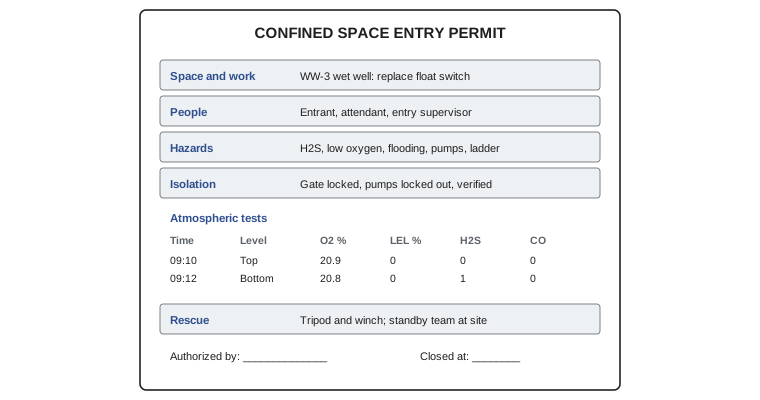
A permit is not a formality to be filled in after the fact. It is completed at the space, by people who check each item, and nobody enters until it is authorized. If a condition on the permit cannot be met, for example the gas readings are out of range or the rescue team is not available, entry does not go ahead.
The roles
Canadian regulations name the roles differently, but the jobs are the same. Ontario calls the person outside the space an attendant (s. 15); British Columbia uses standby person; Alberta uses tending worker; Quebec uses surveillant. The person who authorizes entry is often called the entry supervisor, issuer or competent person. The descriptions below use common terms.
Entrants must:
- know the hazards they may face, including the signs, symptoms and consequences of exposure;
- use the equipment provided correctly, including detectors, ventilation, respirators and harnesses;
- stay in communication with the attendant;
- alert the attendant to any warning sign, symptom or dangerous condition, or if a detector alarms;
- leave the space as quickly as possible when ordered to by the attendant, when an alarm sounds, when they notice a warning sign or symptom, or when they detect a dangerous condition.
Attendants must:
- stay outside the space, at or near the entrance, for the whole entry, until relieved by another trained attendant;
- know the hazards, the signs and symptoms of exposure and the possible behavioural effects, such as confusion or euphoria;
- keep an accurate count of who is inside, and know who they are;
- stay in continuous communication with the entrants and monitor conditions inside and outside the space;
- order the entrants out if a prohibited condition develops, if an entrant shows signs of exposure, if a situation outside the space could endanger them, or if the attendant cannot perform their duties;
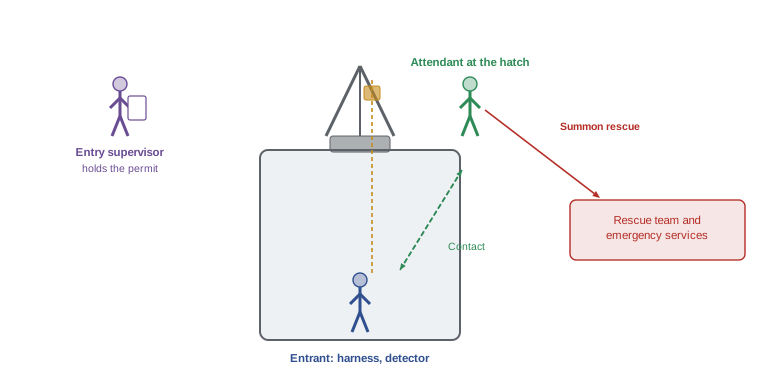
- summon rescue and emergency services as soon as entrants may need help;
- keep unauthorized people away from the space;
- perform non-entry rescue if the plan provides for it, for example by operating a retrieval winch;
- never enter the space to attempt a rescue unless they are trained and equipped as a rescuer and have been relieved by another attendant;
- perform no other duties that could interfere with monitoring and protecting the entrants.
The entry supervisor or permit issuer must:
- know the hazards of the space and the work;
- check that the permit is complete, that all tests have been done and all procedures and equipment are in place before signing it and allowing entry;
- confirm that rescue services are available and that the means of summoning them work;
- remove unauthorized people who enter or try to enter;
- make sure entry operations remain consistent with the permit, especially when responsibility changes, for example at a shift change;
- terminate the entry and cancel the permit when the work is done or a condition not allowed by the permit arises.
Why the attendant must not go in
The rule that the attendant stays out is one of the most important in confined space work, and one of the hardest to follow when a colleague collapses. The attendant is the entrant's link to rescue. If the attendant goes in and is overcome, there is no one left to raise the alarm, operate the retrieval system or direct rescuers. Many multiple-fatality incidents began with an attendant or a coworker going in to help. The attendant's job in an emergency is to call for rescue immediately, attempt non-entry retrieval if it is provided, and keep others out until trained rescuers arrive.
Communication
Entrants and attendants must be able to communicate at all times. The method depends on the space:
- voice, when the entrant is close to the opening and the space is quiet;
- visual contact and hand signals, when the attendant can see the entrant clearly;
- rope signals on a lifeline, using an agreed code, for example one pull for 'OK', two for 'more line', three for 'take up slack' and four for 'help, pull me out';
- two-way radios, which must be checked for coverage inside the space, because steel and concrete block signals, and must be rated for any flammable atmosphere;
- hard-wired intercoms or communication systems built into breathing apparatus;
- remote monitoring systems that relay entrants' gas readings, motion or man-down alarms and video to the attendant.
Whatever the method, it must be agreed and tested before entry, it must work with the PPE being worn, such as hearing protection and full-face respirators, and there must be a backup if the primary method fails. A loss of communication is treated as an emergency until contact is restored.
British Columbia requires the standby person for low and moderate hazard entries to check the well-being of workers inside at least every 20 minutes, and for high hazard entries to be stationed at the entrance and continuously attending. Ontario requires the attendant to be in constant communication with all workers in the space, and Quebec requires two-way communication.
Worked problem
Planning communication checks
An entry plan requires the attendant to check in with each entrant at least every 10 minutes by radio, and to start the rescue plan if an entrant does not answer two calls 30 seconds apart. An entry with two entrants is planned to last 2 hours. How many routine check-ins will the attendant make, and what is the longest time an entrant could be in trouble before rescue is called?
Show solution
- Check-ins per entrant: 120 minutes ÷ 10 minutes = 12.
- For two entrants: 2 × 12 = 24 routine check-ins.
- Worst case: an entrant collapses just after a check-in. The next check-in is 10 minutes later.
- The attendant calls twice, 30 seconds apart, then starts the rescue plan: about 10.5 minutes after collapse.
Answer: 24 check-ins. In the worst case, rescue is called about 10.5 minutes after a problem begins. That is why continuous monitoring, man-down alarms or continuous visual contact are preferred in higher-hazard spaces, where minutes matter.
Entry and exit
The means of entry and exit must be safe for entrants and usable by rescuers. Openings should be large enough for a person in a harness, and if possible for a person on a stretcher. Ladders must be secure and suitable. In vertical entries, a full-body harness connected to a retrieval system allows the attendant to lift an entrant out without entering. In horizontal entries, such as long ducts or sewers, lifelines can snag around corners, so other rescue methods are needed. Clear access around the opening, barriers to keep others away and good lighting at the entrance all help.
Changes during the entry
Conditions on a permit apply to that entry only. The permit must be reviewed and, if necessary, the entry stopped when:
- the work changes, for example from inspection to welding;
- new hazards appear, such as a leak, an alarm or a change in weather;
- the people change, for example at a shift change or when a new trade joins;
- the permit time expires;
- the attendant, the communication method or the rescue arrangements become unavailable.
Quebec's revised rules require work to stop and entry to be prohibited if an unplanned hazard appears, and work to resume only after a qualified person has reviewed the information. British Columbia requires the permit to be updated when conditions change.
Closing the permit
When the work is done, the entry supervisor or issuer confirms that all entrants have left, the attendant's count agrees, tools and equipment have been removed, the space is closed or guarded, and isolation can be removed in the correct sequence. The permit is signed off and kept as a record. Any problems, such as alarms, near misses or difficulties with equipment, are noted so the plan and program can be improved.
Permits work best when everyone involved can see them. Posting the permit at the entrance, reviewing it together at a short pre-entry meeting, and having each entrant confirm that they understand the hazards and the evacuation signal all help make sure the permit is a shared plan, not a form signed by one person. At the end, the same people can review what went well and what should change next time.
Common mistakes
MistakeCompleting the permit in the office after the entry starts.
InsteadComplete and authorize the permit at the space before anyone enters.
MistakeGiving the attendant other jobs to do while watching the space.
InsteadThe attendant performs no duties that could interfere with monitoring the entrants.
MistakeThe attendant going in to help a collapsed entrant.
InsteadThe attendant calls rescue, attempts non-entry retrieval and keeps others out.
MistakeRelying on a radio without checking it works inside the space.
InsteadTest communication before entry and have a backup.
MistakeKeeping the same permit after the work changes to hot work.
InsteadReview the permit and stop the entry when work, hazards or people change.
Summary and key terms
- An entry plan is written for a space; an entry permit is completed for each entry.
- The permit records the space, work, people, hazards, isolation, tests, ventilation, equipment, communication and rescue.
- Nobody enters until the permit is complete and authorized at the space.
- Entrants follow the plan, stay in contact and leave immediately when warned or alarmed.
- Attendants stay outside, count entrants, communicate continuously, order evacuation and summon rescue.
- Entry supervisors verify the permit, confirm rescue availability and terminate entries when conditions change.
- Communication must be tested before entry, work with PPE and have a backup; loss of contact is an emergency.
- Entry plan
- A written procedure for a confined space or group of similar spaces.
- Entry permit
- A written authorization for one entry that records hazards, controls, tests and people.
- Entrant
- A person authorized to enter a confined space.
- Attendant
- A person stationed outside a confined space who monitors entrants and summons rescue.
- Entry supervisor
- The person who verifies the permit, authorizes entry and terminates it when needed.
- Standby person
- British Columbia's term for the person outside a confined space.
- Tending worker
- Alberta's term for the person outside a confined space.
- Rope signals
- An agreed code of pulls on a lifeline used to communicate.
- Man-down alarm
- A detector or device that alarms if the wearer stops moving.
- Permit cancellation
- Ending a permit when work is complete or conditions change.
Practice problems
Work each problem on paper first, then reveal the answer to check.
What is the difference between an entry plan and an entry permit?
Show answer
A plan is written in advance for a space; a permit is completed for each specific entry.
List four things recorded on a permit.
Show answer
Space and work, people, hazards, isolation, tests, ventilation, equipment, communication, rescue, signatures.
Name three duties of an attendant.
Show answer
Stay outside, count entrants, communicate, order evacuation, summon rescue, keep others away.
Why must the attendant not enter to rescue?
Show answer
They may be overcome, leaving no one to call rescue or operate retrieval.
When must entrants leave the space?
Show answer
When ordered, when an alarm sounds, or when they notice warning signs, symptoms or dangerous conditions.
Give three communication methods.
Show answer
Voice, visual signals, rope signals, radios, intercoms, remote monitoring.
What should happen if communication is lost?
Show answer
Treat it as an emergency until contact is restored.
With checks every 15 minutes for 3 hours and three entrants, how many check-ins?
Show answer
12 per entrant × 3 = 36.
Name three changes that require the permit to be reviewed.
Show answer
Change of work, new hazards, change of people, expired time, loss of attendant, communication or rescue.
What is checked when closing a permit?
Show answer
All entrants out and counted, tools removed, space closed or guarded, isolation removed in sequence, sign-off.
Lesson quiz · 5 questions
Score 60% or more to complete this lesson.
Create a free account to save your progress, take quizzes and earn a certificate.