
GAS-350 · Lesson 4 of 12 · 23 min
Review: the gas code
▶ Video coming soon A video version of this lesson is on the way.
Rosa kept the second half of the October 27 evening for the code. She brought her own B149.1, twenty years of editions on a shelf at home reduced to the current one, tabbed in four colours. "On the exam," she said, "the code questions split two ways. Half of them you should know cold, because you use them every week: test pressures, clearances to a garage floor, what a sediment trap is for. The other half you're not meant to remember. You're meant to know where to look and what the words mean when you get there. So tonight is partly facts and partly how to read."
This lesson reviews GAS-120, with the codes and regulations that the later courses added. It covers who writes and adopts the codes, how a code is organized, how to read its language, the general requirements that apply to every installation, the rules on unsafe conditions, and a method for finding an answer in the book quickly. It does not reproduce the code: every rule here is described in the program's own words, and on the exam the book itself is the authority.
Who writes the codes and who adopts them
The installation code is CSA B149.1, Natural Gas and Propane Installation Code, written by a CSA Group technical committee and revised on a regular cycle. It has legal force in Ontario because the Technical Standards and Safety Act and O. Reg. 212/01, Gaseous Fuels, adopt it, with any Ontario changes set out in TSSA's code adoption document. The current edition is B149.1-25, adopted with Ontario amendments by the code adoption document effective June 1, 2026. B149.2:25, the Propane Storage and Handling Code, came into force in Ontario with the propane code adoption document on June 8, 2026, under O. Reg. 211/01, Propane Storage and Handling. B149.3, the code for the field approval of fuel-related components on appliances and equipment, governs approval of equipment that is not certified, and the 2025 edition is now adopted too. Certificates are issued under O. Reg. 215/01.
Two ideas from GAS-120 matter most for the exam. First, a code has force only where a law adopts it, and the law may change it: an exam question about what "the code" requires means the edition and amendments in force where you are licensed. Second, the code sets a minimum. An appliance maker's installation instructions often ask for more, and where they do, the instructions must be followed too; the code itself requires installation according to the certified or listed instructions.
How a code is organized
B149.1 opens with its scope, the reference publications it calls up and the definitions. Then come the general requirements, the requirements for piping and tubing, pressure regulators and controls, the installation of specific kinds of appliance, venting systems and air supply, and then the annexes. Some annexes are mandatory, because the code calls them up; others are informative only. The pipe sizing tables are in an annex. Knowing that structure is the fastest way to find anything.
Reading the language
Code language is precise, and exam questions test the precision:
- Shall is mandatory. Should is advice, usually found in notes or informative annexes. May gives permission. A question that asks what the code requires is asking about the shall statements.
- Defined words mean what the definition says, not what they mean in conversation. Appliance, accessible, readily accessible, concealed, vent connector, chimney, approved, certified or listed: each has a definition, and many exam questions turn on one.
- Exceptions follow the rule they change. A clearance rule followed by "except where the appliance is certified for..." means the general rule is not the final answer.
- Units and limits. "Not less than" is a minimum, "not more than" a maximum, and "within" a distance or time inside which something must happen.
General requirements every installation meets
Most of the general requirements reviewed in GAS-120 apply to every job, which is why they are favourite exam topics. In summary:
- Certified or listed appliances, installed according to the maker's instructions, with the rating plate visible. An appliance that is not certified needs a field approval under B149.3 before it may be used, as Luis found when the Marigold Kitchen's owner bought an imported wok range.
- Location. Appliances are kept out of places the code prohibits for them, such as sleeping rooms and bathrooms for many types, and appliances in garages have their ignition sources raised at least 450 mm above the floor unless they are certified as resistant to flammable vapour ignition.
- Access and clearance. Appliances and their controls must be accessible for service, with clearances to combustibles as the certification and the code set out; reduced clearances need the shields or methods the code allows.
- Piping materials and joints: only approved materials, with joints of the kinds allowed; no concealed unions or other fittings the code prohibits in concealed spaces; supports at the spacing the code requires; a shut-off valve and a sediment trap, called a drip in some books, ahead of each appliance where required.
- Corrugated stainless steel tubing installed by trained installers to the maker's instructions, with the bonding the code and the maker require.
- Testing and purging. New and altered piping is pressure tested before use, then purged safely, to outdoors where the code requires, as GAS-120 and GAS-330 taught. The test pressure and duration depend on the piping's size, length and pressure; the code's tables and clauses set them.
- Putting into service. Gas is turned on only after the test, the purge and the leak check at each appliance, and each appliance is started and checked to the maker's instructions, including combustion and venting checks.
Worked problem
Garage appliance check
A furnace is to be installed in an attached garage. It is not certified as resistant to flammable vapour ignition. Its burner is 300 mm above the floor. Does this meet the general requirement, and if not, what must change?
Show solution
- Required height of the ignition source above the garage floor: at least 450 mm.
- Actual height: 300 mm.
- \[450 - 300 = 150 \text{ mm short}\]
Answer: It does not meet the requirement. The furnace must be raised, usually on a stand, so that its burner and other ignition sources are at least 450 mm above the floor, or a furnace certified as resistant to flammable vapour ignition must be used. Vehicle protection is a separate requirement.
Unsafe conditions and the duties they bring
O. Reg. 212/01 makes the person who finds an unsafe condition responsible for acting on it, and GAS-340 set out the duties in detail. An immediate hazard is a condition that presents an immediate danger to people or property. The certificate holder shuts off the gas to the appliance, or to the building if that is needed, notifies the distributor orally and the user in writing promptly, attaches a tag, and notifies the distributor in writing within 14 days. For an unacceptable condition that is not an immediate hazard, the gas stays on, the same notices are given and the tag attached, and the distributor sets a deadline for correction that the regulation caps at 90 days, after which it must shut off the gas if the condition has not been reported corrected.
On every unsafe condition, the record matters as much as the shut-off: what was found, the readings, what was done, what the customer was told and when, and who was notified. An exam question that asks what a technician must do about a hazard has an answer built from the duties above, and the distractors usually leave one step out.
Code questions that catch people
Rosa's list of the code questions her apprentices get wrong most often:
- The test pressure question that offers one and a half times a low working pressure and forgets the minimum.
- The clearance question that asks about a certified appliance with a reduced clearance on its label: the label governs, within the code's rules.
- The concealed-fitting question: unions, bushings and running threads are not allowed where they will be concealed.
- The definition question: accessible is not the same as readily accessible.
- The authority question: who approves an uncertified appliance, who issues a certificate, who turns on the meter.
- The two-answer question: both the code and the maker's instructions apply, and the stricter of the two is the answer.
Words the exam turns on
Some definitions come up so often that they are worth learning by heart. The wording here is the program's paraphrase; on the exam, check the definition in the book you are allowed.
| Term | What it means in the code | Why it matters |
|---|---|---|
| Accessible | Can be reached for service, though panels or doors may have to be removed | Most appliances and valves must be at least accessible |
| Readily accessible | Can be reached quickly without removing panels, climbing over obstacles or using portable ladders | Some shut-off valves must be readily accessible, which is stricter |
| Appliance | A device that uses gas as a fuel or raw material | The word decides which rules apply to a piece of equipment |
| Vent connector | The pipe joining an appliance to a vent or chimney | Connectors have their own rules for slope, length and material |
| Concealed | Hidden by the building, not reachable without damaging it | Many fittings are prohibited where concealed |
| Certified | Tested and marked by an accredited certification organization as meeting its standard | Only certified or listed appliances may be installed without a field approval or evaluation |
| Authority having jurisdiction | The body that enforces the code: TSSA and its inspectors in Ontario | Approvals, inspections and orders come from it |
The difference between accessible and readily accessible catches more candidates than any other pair. A valve behind a removable access panel is accessible. A valve that needs a stepladder, or is behind a stack of stored boxes, is not readily accessible. Where the code asks for readily accessible, only the stricter meaning satisfies it.
A lookup, step by step
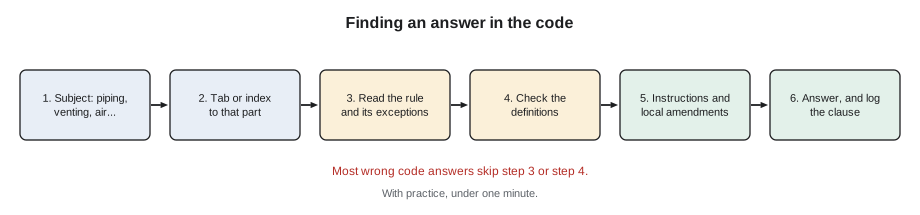
Worked problem
Finding an answer you do not remember
A practice question asks for the B149.1 requirement on the location of a gas meter's relation to building openings. Luis does not remember it. Show the lookup routine he used.
Show solution
- Subject: meters and their location, which is about piping and the utility's equipment.
- Go to the tab for the general requirements and piping, or look up 'meter' in the index.
- Read the requirement, then read on for any exception.
- Check the definitions of any word that decides the answer, such as building opening.
- Check whether TSSA's code adoption document or the utility's rules add to it.
- Answer, and note the clause number in his error log for next time.
Answer: The routine took Luis about 45 seconds by the end of his drills. The note in the error log meant that the second time a similar question came up, he went straight to the page.
Who does what
Many code questions are really questions about authority: who may do a thing, approve it or turn it on. A simple map helps:
- TSSA certifies gas technicians, registers contractors, adopts and amends the codes through code adoption documents, inspects, approves field-built equipment through B149.3 and investigates incidents.
- Enbridge Gas, the distributor, owns the meter and service regulator, sets the service pressure, turns on gas to new services and receives the notices of unsafe conditions.
- The certificate or license holder installs, tests and puts into service, within scope, and is responsible for what they sign.
- The appliance maker writes the installation instructions, which the code makes part of the requirement.
Common mistakes
MistakeAnswering from an old edition or another jurisdiction's rules.
InsteadAnswer from the edition and amendments in force where you are licensed.
MistakeReading a should as a shall.
InsteadOnly shall statements are requirements.
MistakeMissing the exception after a rule.
InsteadRead on past every rule to see whether an exception follows.
MistakeUsing the everyday meaning of a defined word.
InsteadCheck the definition: words like accessible and appliance have code meanings.
MistakeForgetting the minimum test pressure.
InsteadCheck both the multiple of working pressure and the minimum.
MistakeLeaving a step out of the unsafe-condition duties.
InsteadShut off where required, notify, tag, record, and follow up as the rules set out.
Summary and key terms
- B149.1-25 is in force in Ontario with the TSSA code adoption document effective June 1, 2026; B149.2:25 followed on June 8, 2026.
- O.
- Reg. 212/01 adopts the codes and sets the unsafe-condition duties; O.
- Reg. 211/01 covers propane; O.
- Reg. 215/01 covers certificates; B149.3 governs field approval of uncertified equipment.
- The code sets a minimum, and the certified instructions must also be followed.
- Shall is mandatory, should is advice, may is permission; defined words have code meanings; exceptions follow rules.
- General requirements cover certification, location (garage ignition sources at least 450 mm up), access and clearances, materials and joints, CSST bonding, testing, purging and putting into service.
- An immediate hazard means shut-off, prompt oral and written notices, a tag and written notice to the distributor within 14 days; a non-immediate condition leaves gas on, with a correction deadline of no more than 90 days.
- Find answers by subject, tab, requirement, exceptions, definitions and amendments.
- Code adoption
- The legal act by which a government makes a code edition enforceable, often with local amendments.
- Shall
- The code word for a mandatory requirement.
- Exception
- A statement following a rule that changes how the rule applies in stated cases.
- Field approval
- Approval of an uncertified appliance or equipment at its site by the authority or its delegate, after inspection against a standard.
- Immediate hazard
- An unsafe condition that presents an immediate danger to people or property and requires the gas to be shut off.
- Sediment trap
- A capped tee and nipple ahead of an appliance that collects debris before it reaches the controls; also called a drip.
Practice problems
Work each problem on paper first, then reveal the answer to check.
What does the word should mean in a code?
Show answer
It is advice, not a requirement.
Why must you read past a rule before answering?
Show answer
An exception may follow that changes the rule.
Within how many days must the distributor be notified in writing of an immediate hazard?
Show answer
Within 14 days.
Which applies when the code and the maker's instructions differ?
Show answer
Both apply, so the stricter requirement is followed.
How high must ignition sources be above a garage floor for an ordinary appliance?
Show answer
At least 450 mm.
Lesson quiz · 5 questions
Score 60% or more to complete this lesson.
Create a free account to save your progress, take quizzes and earn a certificate.