
GAS-350 · Lesson 11 of 12 · 19 min
Practice exam and review
▶ Video coming soon A video version of this lesson is on the way.
Maureen's practice exam was on Saturday morning, November 14, in the Bayline office with the blinds down and the phones in a box on the reception desk. Luis and Grant each had a pencil, the calculator the exam allows, scrap paper, their B149.1 and B149.3 code books and a paper of 100 questions that Maureen had written over two years of running certification nights. She used the timing of the real exam, three hours, and gave them no breaks except the one they could take by leaving the room. Rosa, Jonah and Ayesha were not there: they and Grant had the on-call rotation the next day, Sunday.
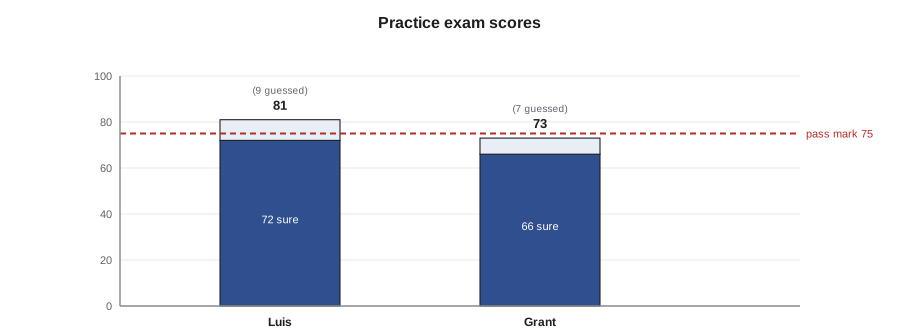
The scores were Luis 81 and Grant 73, against a pass mark of 75. Grant's face fell. Maureen handed both papers back with a sheet of paper stapled to the front, headed "Error log", and said: "The score is the least useful number on that page. What you do with the mistakes in the next two months decides the real exam." This lesson shows how to use a practice exam: marking it, keeping an error log, sorting mistakes by kind, deciding what to change in the plan, and what to do if the real exam goes badly.
Marking a practice exam
Mark the whole paper the same day, while you still remember why you chose each answer. For each question, record one of four results:
- Right and sure: you knew it. Leave it.
- Right but guessed: you were lucky. Treat it as wrong for study purposes.
- Wrong, and you can see why as soon as you read the answer: a slip, a misread qualifier, a unit error.
- Wrong, and you still do not understand after reading the answer: a gap in knowledge.
Then count each kind by topic. The totals tell you more than the score. Luis's paper had 81 right, but 9 of them were guesses, so his solid score was 72; the slips and the gaps showed him where those points were hiding.
The error log
An error log is a list of every question you got wrong or guessed, with four columns: the topic, what you answered, the right answer, and the kind of mistake. Over two or three practice tests it becomes the most valuable study document you have, because it shows patterns that one test cannot. Maureen's group used five kinds of mistake:
| Kind of mistake | What it looks like | What fixes it |
|---|---|---|
| Knowledge gap | You did not know the fact or the rule | Study the topic; make flash cards; write questions on it |
| Misread question | You missed NOT, EXCEPT, FIRST or MINIMUM, or answered a different question | Read the last sentence first; underline qualifiers |
| Calculation slip | Right method, wrong arithmetic or units | Write units; estimate first; recheck |
| Lookup failure | You knew where to look but ran out of time, or read the wrong clause or table | Lookup drills; better tabs; read the exceptions |
| Second-guessing | You had it right and changed it | Change an answer only for a definite reason |
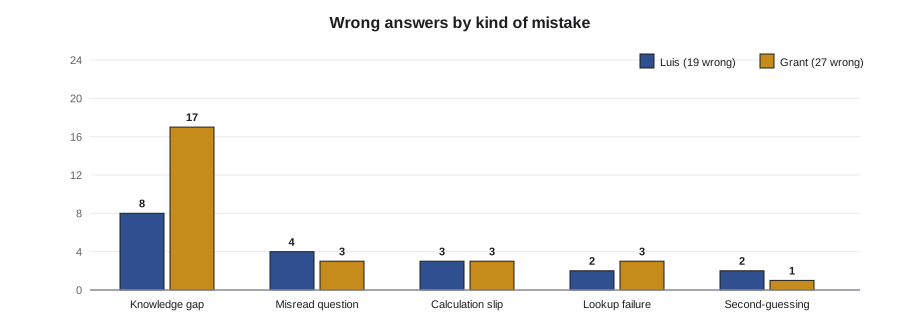
The patterns were different for the two candidates. Most of Grant's mistakes were knowledge gaps, nearly all in residential appliances, venting and propane, the parts of the trade he had met least in eleven years on rooftop units. His plan for the last weeks became a block of study on exactly those topics, with Rosa's help. More than half of Luis's mistakes were not about knowledge at all: four misread questions, three calculation slips and two answers he had changed from right to wrong. His fix was a routine, not more study: read the last sentence first, underline the qualifiers, write the units, and change an answer only for a definite reason.
Changing answers
Candidates often believe their first answer is usually right and that changing it is a mistake. Studies of multiple-choice exams have generally found the opposite: when people change an answer for a reason, such as noticing a qualifier or redoing a calculation, the change more often goes from wrong to right than the other way. What does go wrong is changing an answer out of nerves, with no new reason. The rule Maureen gave was simple: change an answer only if you can say in one sentence why the new one is right.
Turning results into the last weeks of the plan
A practice exam six to eight weeks before the real one leaves time to act on it. The plan changes in three ways:
- Topics with knowledge gaps move to the front of the remaining weeks, with the active methods of lesson 2: questions, explaining aloud, drawing from memory.
- Mistakes of method, misreading, slips, lookups, second-guessing, are fixed by practice under time, with the routine written on a card and used every time.
- A second practice exam goes in two or three weeks before the real one, under the same conditions, to check that the changes worked.
Luis's exam is booked for late January 2027, inside his April 2027 deadline, so his plan now runs to then: six weeks of mixed question sets with his routine, a second practice exam in early January, and the two weeks before the exam off the on-call rotation. Grant's score below 75 was a useful warning rather than a failure: he has not booked an exam yet, and he now plans to take the G.1 course from January before he books.
A practice set from the whole program
These twenty short questions come from every part of the program. They are original practice questions, not questions from any real exam. Answer them without notes, then check against the answers that follow.
| # | Question | Answer |
|---|---|---|
| 1 | Which gas pools in low places if it leaks? | Propane, with a specific gravity of about 1.52 |
| 2 | How many volumes of air does one volume of propane need to burn completely? | About 23.9 |
| 3 | An analyzer reads 10.0 in 100 O₂ and 50 ppm CO. What is the air-free CO? | 50 × 20.9 ÷ 10.9 ≈ 96 ppm |
| 4 | Which code word is mandatory? | Shall |
| 5 | Within how many days must the distributor be told in writing of an immediate hazard? | 14 days |
| 6 | Where must ignition sources on an ordinary garage appliance be? | At least 450 mm above the floor |
| 7 | A section carries the whole load. Which column of a sizing table is used in the longest-length method? | The one for the length to the most remote outlet, or the next longer |
| 8 | What does a regulator whose outlet creeps up with no flow need? | Repair or replacement; it does not lock up |
| 9 | Why do the codes restrict purging indoors? | Purged gas can form a flammable mixture inside the building |
| 10 | What category is a condensing appliance with a positive-pressure vent? | Category IV |
| 11 | What happens to an appliance left alone in an oversized cold chimney? | Its flue gas cools and condenses, draft is lost and it may spill |
| 12 | What does a closed switch read across it in a live circuit? | Close to 0 V |
| 13 | A flame lights and goes out at the end of the trial for ignition. What is not happening? | The flame is not being proven |
| 14 | What kind of reset does a rollout switch have? | Manual reset |
| 15 | What sets the pressure in a propane cylinder with liquid in it? | The temperature of the liquid |
| 16 | Why are there two stages of regulation on a propane system? | To hold appliance pressure steady as tank pressure varies, and to protect the piping if one fails |
| 17 | What does a proof-of-closure switch prove? | That a safety valve is fully closed before the next start |
| 18 | A purge must give four volume changes and the chamber is changed every 30 s. What is the shortest purge? | 120 s |
| 19 | What must a boiler's relief valve capacity be at least? | The boiler's output |
| 20 | A candidate's calculated answer is not among the options. What should they do? | Find the skipped step and recalculate |
Notes on the practice set
If you missed questions 3, 18 or 20, go back to lesson 10 and work its problems again. If you missed 5, 6 or 4, the code lesson and a lookup drill will help. Questions 12 to 14 are the sequence-of-operation and safety-switch material of lesson 7, and the commonest gap among residential technicians writing a commercial exam is 17 to 19, the burner and boiler material of lesson 9. A score of 16 or more out of 20 on a set like this, without notes, suggests the material is solid; a score below 12 suggests going back to the review lessons before writing a full practice exam.
If you do not pass
A failed exam is not the end of anything, but it does need a plan. TSSA sends a breakdown of results by topic to a candidate who fails, and that breakdown is the start of the new error log. A candidate may book the exam again after the waiting period TSSA sets; check the current preparation guide. Remember the rule from lesson 1: after three failed attempts at the same exam, the training program must be completed again, so the second attempt should come only after the study the breakdown shows is needed. Remember the time limit too: the exam must be passed within a year of completing the training.
In both cases the advice is the same: rest for a few days, then read the breakdown honestly, sort the weak areas into the kinds of mistake above, and build a short plan before booking again. Maureen has seen more people pass on a second attempt with a plan than on a first attempt without one.
An exam-day checklist
| Before the day | On the day | In the room |
|---|---|---|
| Booking confirmed; route planned | Up at the usual time; breakfast | Read the instructions; note the time |
| Code books checked against the guide: dividers and highlighting only | Photo identification | First pass: answer everything you can; mark the rest |
| Light review of the error log only | Arrive about 30 minutes early | Second pass: the marked questions |
| A normal night's sleep | Water and a snack if allowed | No blanks; change answers only for a reason |
The last two weeks
The final fortnight before an exam is for consolidation, not new learning. Maureen's advice for it, which Luis wrote on the inside cover of his binder:
- Work through the error log, every entry, and make sure each one is now a question you could answer.
- Do short mixed sets of 20 to 30 questions under time every other day, to keep the reading routine automatic.
- Run the lookup drill twice a week, so the book stays familiar.
- Stop new topics about a week before. If something important is still a gap, learn the one or two facts most likely to be asked and let the rest go.
- Sleep, eat and exercise normally. The day before, do a light review in the morning and nothing in the evening.
Writing your own questions
The last exercise of the certification nights was for each person to write five questions of their own, with four options each, in which every wrong option was the answer a particular mistake would give. Grant found it harder than answering questions, and said it was the most useful hour of the four weeks: to write a good distractor for an air-free CO question he had to think through every way the calculation goes wrong. Jonah wrote one about where a propane detector goes, with options for the ceiling, the middle of the wall, near the floor and beside the furnace, and Rosa put it in her own question bank.
Common mistakes
MistakeLooking only at the score.
InsteadMark every question, count guesses as wrong, and sort mistakes by kind.
MistakeTreating every mistake as a knowledge gap.
InsteadMisreading, slips, lookups and second-guessing need different fixes.
MistakeChanging answers out of nerves.
InsteadChange an answer only if you can say why the new one is right.
MistakeWriting the practice exam too close to the real one to act on it.
InsteadWrite it six to eight weeks ahead, and a second one two or three weeks ahead.
MistakeRebooking straight after a failure.
InsteadRead the breakdown, plan, then book.
MistakeCramming new material the night before.
InsteadLight review of the error log and a normal night's sleep.
Summary and key terms
- Mark a practice exam the same day, recording each answer as right and sure, right but guessed, wrong with a clear reason, or wrong without understanding; count guesses as wrong.
- Keep an error log with topic, your answer, the right answer and the kind of mistake: knowledge gap, misread question, calculation slip, lookup failure or second-guessing.
- Gaps need study; mistakes of method need a routine practised under time.
- Change answers only for a definite reason.
- Write the practice exam six to eight weeks before the real one and a second one two or three weeks before.
- If you fail, rest, read the result breakdown, plan and then rebook, keeping TSSA's three-attempt rule and the one-year limit after training in mind.
- On the day: identification, the allowed books, arrive early, answer everything and leave no blanks.
- Error log
- A record of every question answered wrongly or by guessing, with its topic and the kind of mistake.
- Knowledge gap
- A mistake caused by not knowing the fact or rule the question tests.
- Mistake of method
- A mistake caused by how the question was read, calculated or looked up rather than by lack of knowledge.
- Solid score
- A practice score counting only the answers the candidate was sure of.
- Result breakdown
- The report an exam body gives a failed candidate showing performance by topic.
Practice problems
Work each problem on paper first, then reveal the answer to check.
Why should a guessed right answer be treated as wrong when studying?
Show answer
It shows a gap that luck covered; the real exam may not be so lucky.
Name the five kinds of mistake in the error log.
Show answer
Knowledge gap, misread question, calculation slip, lookup failure and second-guessing.
When is changing an answer a good idea?
Show answer
When you can say in one sentence why the new answer is right.
How long before the real exam should the first practice exam be?
Show answer
About six to eight weeks, so there is time to act on it.
What should a candidate do first after failing an exam?
Show answer
Rest briefly, then read the result breakdown and build a plan before rebooking.
Lesson quiz · 5 questions
Score 60% or more to complete this lesson.
Create a free account to save your progress, take quizzes and earn a certificate.