
GAS-350 · Lesson 1 of 12 · 21 min
How the exam is built
▶ Video coming soon A video version of this lesson is on the way.
On Tuesday evening, October 20, Maureen Fitch pushed two benches together at the back of the Bayline shop, put a coffee urn on the parts counter and wrote one line on the whiteboard: "G.1: by April." Luis Ferreira sat in the front row with a new binder. Grant Whitlock sat beside him, and behind them, with permission to listen, were Jonah Clarke and Ayesha Rahman. "Four Tuesdays," Maureen said, "then a full practice exam on the Saturday after the last one. Rosa takes the residential nights, I take the commercial ones, and Hank comes in one night to talk about what happens after you pass. Tonight is about the exam itself, because you cannot plan for something you have never looked at properly."
This is the last course in the gasfitter program. It does not teach new trade content. It reviews the whole program, GAS-110 to GAS-340 and the piping course PLB-230, in the order a certification exam tests it, and it shows how to prepare for that exam and what comes after it. The review lessons repeat the facts, numbers and practice tables that the earlier courses used, so that what you study here matches what you were taught. Where a review lesson says "sample", the table or chart is the same invented one used in the earlier course: good for practice, never for real work. This first lesson describes the Ontario gas technician certificates and the exams that lead to them.
The gas technician certificates
Ontario certifies individual gas workers under the Technical Standards and Safety Act and O. Reg. 215/01, Fuel Industry Certificates, and the Technical Standards and Safety Authority (TSSA) runs the certification. Ontario's word for the trade is gas technician; most other provinces say gasfitter, and Alberta, for example, has Gasfitter (B) and Gasfitter (A) certificates. The three Ontario certificates were introduced in GAS-110 and build on each other:
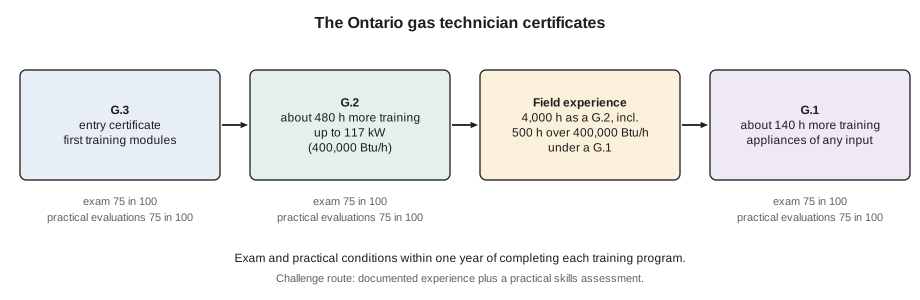
- G.3, the entry certificate, earned after the first modules of the gas technician training. A G.3 holder works within the limited scope that O. Reg. 215/01 sets out, and on most work under the supervision of a G.2 or G.1.
- G.2, which adds the later modules of the training, about 480 hours in the suggested program, and covers appliances up to 117 kW (400,000 Btu/h) of input, the range that includes most houses and light commercial buildings.
- G.1, the full certificate, which covers appliances of any input. A candidate needs a valid G.2 and at least 4,000 hours of field experience as a G.2, of which at least 500 hours must be on appliances over 400,000 Btu/h under the direct supervision of a G.1. The suggested G.1 training program adds about 140 hours.
There are two routes to each exam. Most candidates take the training route: an accredited training provider teaches the TSSA-approved curriculum, assesses the practical skills module by module, and then the candidate applies through TSSA's client portal to write the certification exam. The challenge route lets an experienced candidate write the exam without the training program, but they must document their experience and also pass a practical skills assessment. For a G.1 challenge, TSSA's own example asks for proof of 3,500 hours at the G.2 level and 500 supervised hours on equipment over 400,000 Btu/h.
Luis holds a G.2 and has done four years of service work with it. He finished the G.1 theory course at a college in the evenings between January and April 2026, and he has been logging commercial hours under Maureen since. TSSA's policy gives a candidate one year after completing a training program to meet the exam and practical conditions, so his deadline is April 2027. Grant, who came to Bayline from rooftop-unit service, holds a G.2 and is logging his hours toward the G.1; he will take the G.1 course next. Ayesha wrote her G.3 last spring, and Jonah will start his G.3 evening course in January.
What the exam looks like
TSSA's certification exams are multiple choice. Each question has a stem and several options, and only one option is correct. The length of the paper depends on the certificate: the guidance that training providers give their students describes papers of between 50 and 165 questions and up to about three and a half hours of writing time. The certificate exam you are writing will have its own number; check it when you book, in TSSA's Certification Examination Preparation Guide.
The pass mark is 75 in 100 on the exam, and a candidate on the training route must also have scored at least 75 in 100 on the practical evaluation for each module. A candidate who fails receives a breakdown by topic that shows where to study. After three failed attempts at the same exam, TSSA requires the candidate to complete an accredited training program again before writing it a fourth time, so each attempt matters.
For the G.3 and G.2 exams, candidates may bring the official codes: the Technical Standards and Safety Act and its regulations, the CSA B149.1 Natural Gas and Propane Installation Code and the B149.2 Propane Storage and Handling Code. The books may have page dividers and highlighting, but no handwritten notes, and a book that breaks the rule is taken away. Training providers usually require the hard-copy CSA code book, not a printout. For the G.1 exam, check the current preparation guide for which materials are allowed; do not assume. Pencils and a calculator are provided, and phones, watches and similar devices stay outside.
| Item | G.3 / G.2 / G.1 exams (Ontario) |
|---|---|
| Who runs it | TSSA |
| Format | Multiple choice |
| Length | Depends on the certificate; check the preparation guide |
| Pass mark | 75 in 100, plus 75 in 100 on each practical evaluation |
| Books | Official codes for G.3 and G.2; check the guide for G.1 |
| Rewrites | Retraining required after three failures |
| Time limit | Exam and practical conditions within one year of completing training |
Exam day
The exam is booked through TSSA's client portal, with the exam fee, after TSSA has confirmed that the candidate is eligible. Seats at each location fill on a first-come basis, so a candidate with a deadline books early. Cancelling less than about two weeks ahead normally loses the fee. On the day, candidates arrive about half an hour early with government-issued photo identification: a passport or a driver's licence, not a health card or a student card. Luis's training provider gave him the same list, and Maureen made him read it aloud.
Whatever the exam, the room has the same rules: no phones, smart watches or notes, the supervisor's instructions followed exactly, and nothing taken out of the room afterwards. Questions are not discussed with other candidates after the exam either. Exams are expensive to write and every question that leaks has to be thrown away, which is why certification bodies treat sharing their content seriously.
Where the questions come from
TSSA builds its exams from the same curriculum that the training providers teach, module by module, and from the codes and regulations the curriculum refers to. A G.1 exam therefore leans on the large-appliance content: commercial and industrial burners, gas trains and flame safeguards, elevated-pressure piping and regulators, large boilers, air handlers and process equipment, and the B149.3 approval of field-built equipment. It still includes the basics, because a G.1 is expected to know everything a G.2 knows. The review lessons in this course follow the same order.
Questions come in four kinds, and each kind needs a different kind of preparation:
- Recall questions ask for a fact: the specific gravity of propane, what a thermocouple produces, what a G.2 may work on. They are answered from memory, quickly.
- Understanding questions ask why: why a vent connector slopes up, why a mixture above the upper flammable limit is still dangerous. They need you to understand the principle, not just remember a sentence.
- Application questions describe a situation, usually a service call or an installation, and ask what to do or what the reading means. Most of a gas exam is this kind.
- Calculation and lookup questions ask for a number: an input from a clocked meter, a pipe size from a table, a combustion air opening, a clearance. Some need arithmetic, some need the code, many need both. Lesson 10 practises them.
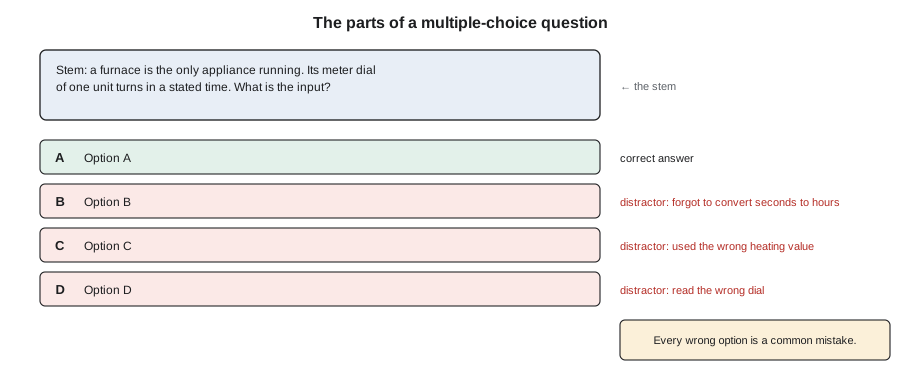
Every wrong option on a good exam is the answer that a particular mistake produces. An input calculation will offer the answer you get if you forget to multiply by 3,600, the answer for the wrong heating value and the answer for propane instead of natural gas. That is why you cannot check your answer by seeing whether it appears among the options: your mistake will be there too. You check by redoing the work, or by an estimate that tells you roughly what the answer should be.
Worked problem
How much time is there for each question?
Suppose the exam you are booked for has 100 questions and three hours of writing time. You want 20 minutes at the end to check the answers you marked. How long can you spend on each question on the first pass?
Show solution
- Time for the first pass:
- \[180 - 20 = 160 \text{ min}\]
- Time per question:
- \[\frac{160}{100} = 1.6 \text{ min} \approx 1 \text{ min } 36 \text{ s}\]
Answer: About a minute and a half each. Recall questions take seconds, which leaves time for the calculations. A candidate who spends five minutes on one question has taken the time of three others.
What the exam does not test
A written exam cannot test everything a gas technician does. It does not test whether your flare joints are good, whether you notice the smell of flue gas at the door, or whether you can calm a frightened customer. Those are tested by the practical evaluations, by supervisors' sign-offs and by years of work. A candidate who passes the written exam has shown that they know the codes and the theory; the people they work with decide whether they can be trusted alone on a job. Maureen made the point on the first night: "I've signed off people who scored in the sixties on practice tests, and I've refused to sign off people who scored in the nineties. The paper is necessary. It isn't enough."
The exam also does not test the company's rules. Bayline's CO monitor settings, its sign-off system and its red-tag paperwork are sound practice, and the earlier courses explained them, but an exam question about what the code requires must be answered from the code. When a review lesson in this course says "Bayline's rule", it means something you should know for work and leave out of an exam answer.
Keeping the certificate once you have it
A gas technician certificate is not issued for life. TSSA renews certificates every two years; a certificate expires on the second anniversary of the holder's birthday after it was issued, and TSSA sends a renewal invoice about 60 days ahead. A certificate that is not renewed by the date on the notice is suspended, and if it stays unrenewed it is eventually terminated and then cancelled, after which the holder may have to qualify again. TSSA can also suspend or revoke a certificate for unsafe work. A G.1 candidate studying for the exam should check that their G.2 is current, because an expired prerequisite certificate stops an application.
Whatever the jurisdiction, the habit that matters most is the same: keep your own records. Dates, employers, the kinds of equipment you worked on, the hours on large appliances, the names of the supervisors who signed for you. Luis kept a notebook of his commercial hours from his first week on Maureen's crew, with each job, its date, the appliance input and Maureen's initials, and it took him an evening, not a month, to fill in the experience form.
Common mistakes
MistakePlanning study around what was easy in the courses.
InsteadPlan around the exam's content and the topics you got wrong; lesson 2 shows how.
MistakeAssuming the rules are the same as last year, or the same as a friend's exam.
InsteadRead the current preparation guide or bulletin for your exam before you book.
MistakeBringing an annotated code book to the exam.
InsteadBring the clean official codes allowed for your exam, with dividers and highlighting only.
MistakeChecking an answer by seeing whether it is one of the options.
InsteadRedo the work or estimate; the wrong answers are built to match common mistakes.
MistakeLeaving questions blank.
InsteadAnswer every question; there is a chance on a guess and none on a blank.
MistakeTreating the company's rules as code requirements in exam answers.
InsteadAnswer code questions from the code; know the company rules for work.
Summary and key terms
- Ontario certifies gas technicians at three levels under O.
- Reg. 215/01: G.3, G.2 (appliances up to 117 kW, 400,000 Btu/h) and G.1 (any input).
- A G.1 candidate needs a G.2 and at least 4,000 hours of field experience as a G.2, including 500 hours on appliances over 400,000 Btu/h under a G.1.
- Candidates take the training route, with practical evaluations, or the challenge route, with a practical skills assessment.
- TSSA's exams are multiple choice; their length depends on the certificate.
- The pass mark is 75 in 100, and practical evaluations also need 75 in 100.
- After three failures, retraining is required.
- The exam and practical conditions must be met within a year of completing training.
- Official codes may be taken into the G.3 and G.2 exams with dividers and highlighting only.
- Questions test recall, understanding, application and calculation, and the wrong options match common mistakes.
- Certificate of qualification
- A document issued to an individual worker that allows them to do a regulated kind of work, such as gas work.
- Challenge exam
- An exam written on the strength of documented experience instead of completing the training program.
- Stem
- The part of a multiple-choice question that sets out the situation and asks the question.
- Distractor
- A wrong option on a multiple-choice question, usually the answer that a common mistake produces.
- Content outline
- A list of the topic areas an exam covers, often with the number of questions from each.
- Pass mark
- The score a candidate must reach to pass an exam.
Practice problems
Work each problem on paper first, then reveal the answer to check.
What experience does a G.1 candidate need?
Show answer
At least 4,000 hours as a G.2, including 500 hours on appliances over 400,000 Btu/h under a G.1.
What is the pass mark on a TSSA certification exam?
Show answer
75 in 100.
What happens after three failed attempts at the same exam?
Show answer
The candidate must complete an accredited training program again.
Why can an answer not be checked by finding it among the options?
Show answer
The wrong options are built from common mistakes, so a wrong answer is usually there too.
Name the four kinds of exam question.
Show answer
Recall, understanding, application, and calculation or lookup.
Lesson quiz · 5 questions
Score 60% or more to complete this lesson.
Create a free account to save your progress, take quizzes and earn a certificate.