
GAS-350 · Lesson 5 of 12 · 24 min
Review: piping and pipe sizing
▶ Video coming soon A video version of this lesson is on the way.
Maureen took the third Tuesday, November 3, and started with the table from GAS-120 projected on the shop wall: the invented practice table for Schedule 40 steel at low pressure that every apprentice at Bayline learned to size with. "Ten minutes," she said. "Garfield Avenue, longest-length method, every section. Then we'll do it again with the branch-length method, then we'll talk about everything that goes wrong with pipe once it's in." Grant finished in six. Luis finished in eight and found a mistake in Grant's.
This lesson reviews gas piping: materials and joints from GAS-120 and PLB-230, pipe sizing by table, pressure regulation, meters and elevated-pressure systems from GAS-330, testing and purging, and the faults GAS-340 traced to piping. The sizing table is the same invented practice table the program has used throughout; it is for learning only and is never to be used for real sizing.
Materials and joints
The codes allow a short list of piping materials for gas, each with rules for where it may go and how it is joined. Steel pipe, black or galvanized, is joined by threads or by welding; threaded joints use a compound or tape rated for gas on the male threads only. Copper tubing is allowed where the gas is not corrosive to it, with flared or brazed joints as the code permits; soft solder is not used for gas. Corrugated stainless steel tubing is installed by trained installers with the maker's fittings and bonded as the code and maker require. Polyethylene pipe is for outdoor underground service only, with a tracer wire and a transition riser where it comes above ground, as Grant found missing at the Greenway Garden Centre in GAS-330.
Fittings matter as much as pipe. Concealed unions, bushings and running threads are prohibited where they will be concealed. Pipe is supported at the spacing the code requires for its size, protected where it passes through walls and floors and where it could be struck, and kept out of places where it would be damaged, such as inside ducts or in contact with corrosive materials. A shut-off valve, accessible and near the appliance, and a sediment trap ahead of the appliance's controls are installed where the code requires them, which for most appliances is always.
The sizing method
Pipe is sized so that the pressure lost to friction between the meter and the farthest appliance, with every appliance running, is no more than the allowable drop. GAS-120 taught the steps:
- Find the load. Add the inputs of every appliance a section supplies, from the rating plates, and convert to the unit the table uses.
- Measure the lengths of each section along the actual route of the pipe.
- Choose the right table for the gas, the material, the inlet pressure and the allowable pressure drop.
- Read the table: go to the column for the length the method uses, the next longer length if the exact one is not listed, and down to the first size whose capacity equals or exceeds the load.
| Nominal size (in.) | 6 m | 12 m | 18 m | 24 m | 30 m |
|---|---|---|---|---|---|
| 1/2 | 32 | 22 | 18 | 15 | 13 |
| 3/4 | 67 | 47 | 38 | 32 | 29 |
| 1 | 129 | 88 | 70 | 60 | 53 |
| 1-1/4 | 264 | 182 | 147 | 125 | 111 |
In the longest-length method, every section is sized from the single column for the distance from the meter to the most remote outlet. In the branch-length method, each section is sized from the column for the distance from the meter to the most remote outlet that section supplies, which can give smaller pipe near the end of the system. Both methods appear on exams; the question says which to use, and if it does not, the longest-length method is the safe default.
Worked problem
Garfield Avenue by the longest-length method
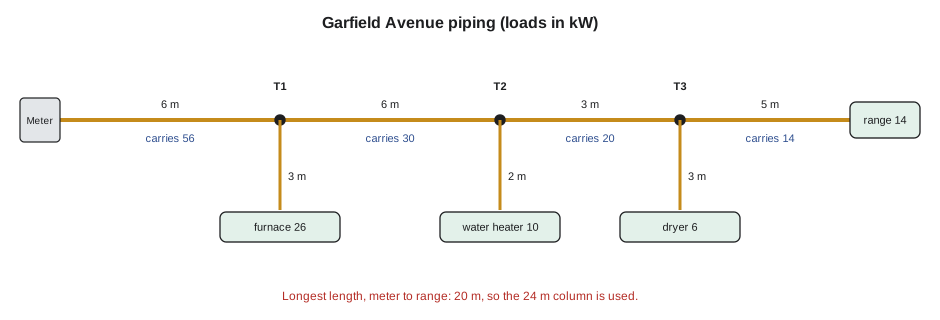
Size every section of the Garfield Avenue piping from the practice table by the longest-length method. Loads: furnace 26 kW, water heater 10 kW, dryer 6 kW, range 14 kW. The longest length, meter to range, is 20 m.
Show solution
- The table has no 20 m column, so use the next longer: 24 m.
- Meter to T1 carries everything: 26 + 10 + 6 + 14 = 56 kW. In the 24 m column, 3/4 in. carries 32 kW, too little; 1 in. carries 60 kW. Use 1 in.
- T1 to T2 carries 10 + 6 + 14 = 30 kW: 3/4 in. (32 kW).
- T2 to T3 carries 6 + 14 = 20 kW: 3/4 in. (1/2 in. carries only 15 kW).
- T3 to the range carries 14 kW: 1/2 in. (15 kW).
- Branches: furnace 26 kW, 3/4 in.; water heater 10 kW, 1/2 in.; dryer 6 kW, 1/2 in.
Answer: A 1 in. main to the first tee, as Rosa installed in GAS-120 when she replaced the 1950s 3/4 in. main. The two commonest exam errors are using the 18 m (60 ft) column because it is closer to the real length, and sizing the first section for the furnace alone instead of the whole load.
Pressure regulation
A regulator reduces a higher, varying inlet pressure to a lower, steady outlet pressure. GAS-330 described its parts: a spring pushing one way on a diaphragm, outlet pressure pushing the other, and a valve linked to the diaphragm. Three behaviours appear on exams and on service calls:
- Droop (offset): as the flow through a regulator rises, its outlet pressure falls below the set point. An undersized regulator droops badly at full load, as the Romano's Pizzeria line regulator did in GAS-330, falling from 1.74 to 1.20 kPa.
- Lock-up: when the flow stops, the outlet pressure rises slightly and the valve closes tight. A regulator whose outlet keeps creeping up at zero flow has a leaking seat and must be repaired or replaced.
- Venting: the space above the diaphragm breathes through a vent. A blocked vent, frozen, painted or plugged by insects like the Kingsview Manor mud dauber nest in GAS-310, makes the regulator respond slowly or hunt. Vents that could release gas indoors are piped outdoors or fitted with a vent limiter where the code and the regulator's certification allow it.
Where the service pressure is higher than the appliances can take, as on a 14 kPa system, a line regulator or an appliance regulator reduces it, and overpressure protection prevents the downstream piping and appliances from seeing the full inlet pressure if the regulator fails: a relief valve, a monitor regulator or a slam-shut device, as the code requires for the pressures involved.
Meters and clocking
A gas meter measures the volume of gas passing through it. To find an appliance's actual input, the technician turns off every other appliance on the meter and times one revolution of the test dial with the appliance at steady fire. The flow is the dial volume divided by the time, times 3,600 seconds per hour, and the input is the flow times the heating value. At elevated pressure the reading must be corrected, because gas at higher pressure is denser: the pressure factor is the absolute meter pressure over the base pressure, and the temperature factor is the base absolute temperature over the gas temperature. Lesson 10 practises both.
Worked problem
Clocking a furnace
A furnace is the only appliance running. The meter's 0.05 m³ test dial turns once in 72 s. The heating value is 37.5 MJ/m³. What is the input in kW?
Show solution
- Flow:
- \[\frac{0.05}{72} \times 3{,}600 = 2.5 \text{ m}^3/\text{h}\]
- Energy per hour:
- \[2.5 \times 37.5 = 93.75 \text{ MJ/h}\]
- Input:
- \[\frac{93.75}{3.6} \approx 26.0 \text{ kW}\]
Answer: About 26 kW, the program's standard example furnace from GAS-110. Divide MJ/h by 3.6 to get kW.
Testing and purging
New or altered piping is pressure tested before it is used: isolated from appliances that could be damaged by the test pressure, filled with air or inert gas at the test pressure, and held for the time the code sets, with no drop except what temperature change explains. GAS-330's Glenview test showed how sun and cloud can move a reading, which is why long tests are logged and temperatures recorded. After the test, the gas is admitted and the air is purged out. Large or long systems are purged to outdoors through a hose, with a combustible gas detector at the outlet, no ignition sources near, and the purge stopped as soon as the detector reads gas. The 2010 Kleen Energy explosion, discussed in GAS-120, is why the codes now restrict purging indoors. Finally, each appliance connection is leak checked with the gas on, and only then is each appliance started.
Piping faults on service calls
GAS-340 traced several service problems to the piping rather than the appliance, and exam questions often describe the readings:
- Good static pressure, low running pressure at the appliance: the piping or regulator cannot deliver the flow, such as an undersized line after a new appliance was added, or a droopy regulator.
- Running pressure good at the meter but low at the appliance: the loss is in the piping between them; check size, length and partly closed valves.
- Good inlet, low manifold: the fault is in the appliance's own regulator or combination valve, not the piping.
- Pressure that creeps up with no flow: a regulator that does not lock up.
- Pressure that falls on a cold day on propane: vaporization, not the piping; lesson 8 reviews it.
Two-pound systems and elevated pressure
Many newer houses and most commercial buildings are supplied at more than the usual 1.75 kPa. A two-pound system, about 14 kPa, carries the gas at higher pressure through smaller pipe or CSST to a line regulator near the appliances, which reduces it to appliance pressure. Larger commercial and industrial services run higher still: Keystone Coatings in GAS-330 had a 35 kPa service and a welded NPS 2 main. The rules that come with elevated pressure are the ones GAS-330 reviewed: a regulator for each pressure change, overpressure protection where the code requires it, regulator vents piped to outdoors or fitted with limiters as the code and the regulator allow, welding by qualified welders, testing at the higher pressures the code sets, and purging to outdoors.
Sizing an elevated-pressure system uses tables for the higher inlet pressure and a larger allowable drop, and sizes the part of the system ahead of the line regulator separately from the low-pressure part after it. An exam question that gives a two-pound system and a low-pressure table has given you the wrong table on purpose.
Worked problem
The branch-length method on one branch
At Garfield Avenue, the water heater branch leaves the main at T2, 12 m from the meter, and is 2 m long. By the branch-length method, which column sizes the water heater branch, and what size does it need for 10 kW?
Show solution
- Length from the meter to the water heater:
- \[6 + 6 + 2 = 14 \text{ m}\]
- Next longer column: 18 m.
- In the 18 m column, 1/2 in. carries 18 kW, which is more than 10 kW.
Answer: 1/2 in., the same size as the longest-length method gave. On the main, the branch-length method can save a size near the end of a long system, which is why exam questions sometimes ask which method gives the smaller pipe.
One more pattern from the sizing questions: a section's load is always the sum of everything downstream of it, never the largest single appliance, and a branch is sized only for the appliance or appliances it feeds. A quick check on any answer is that pipe sizes never get larger as you move away from the meter along one path.
Common mistakes
MistakeUsing the length column nearest the real length.
InsteadUse the exact or next longer length, never the shorter.
MistakeSizing the first section for one appliance.
InsteadEach section carries the total load of everything downstream.
MistakeTaking a code sizing answer from the practice table.
InsteadThe practice table is invented for learning; real sizing uses the code's tables.
MistakeClocking with other appliances running.
InsteadTurn off everything else on the meter, and correct for pressure and temperature at elevated pressure.
MistakePurging a large system into the building.
InsteadPurge to outdoors through a hose with a detector, as the code requires.
MistakeBlaming the appliance for low pressure without measuring at the meter.
InsteadMeasure static and running pressure at the meter and the appliance, then compare.
Summary and key terms
- Approved gas piping materials include steel, copper where allowed, CSST installed by trained installers and polyethylene outdoors underground only, with tracer wire.
- Concealed unions, bushings and running threads are prohibited.
- Size pipe by finding the load, measuring lengths, choosing the right table and reading the exact or next longer length; in the longest-length method every section uses the column for the most remote outlet.
- Garfield Avenue's 56 kW at the 24 m column needs a 1 in. main.
- Regulators droop with flow, lock up at no flow and need a clear vent; elevated-pressure systems need line or appliance regulators and overpressure protection.
- Clock an appliance alone: flow equals dial volume over time times 3,600, and kW equals MJ/h divided by 3.6; correct for pressure and temperature at elevated pressure.
- Test, purge to outdoors where required, leak check, then start.
- Longest-length method
- Sizing every section of a system from the table column for the length to the most remote outlet.
- Branch-length method
- Sizing each section from the column for the length to the most remote outlet that section supplies.
- Droop
- The fall in a regulator's outlet pressure below its set point as flow increases; also called offset.
- Lock-up
- The slightly higher outlet pressure at which a regulator closes tight when flow stops.
- Overpressure protection
- A device, such as a relief valve, monitor regulator or slam-shut, that keeps downstream pressure within safe limits if a regulator fails.
- Clocking
- Timing a gas meter's test dial to measure an appliance's actual input.
Practice problems
Work each problem on paper first, then reveal the answer to check.
Which column do you use if the longest length falls between two columns?
Show answer
The next longer one.
A section carries 30 kW at the 24 m column of the practice table. What size?
Show answer
3/4 in.
What does a regulator whose outlet creeps up with no flow need?
Show answer
Repair or replacement: its seat is not locking up.
A 0.05 m³ dial turns in 90 s. What is the flow?
Show answer
0.05 ÷ 90 × 3,600 = 2.0 m³/h.
Where is polyethylene gas pipe allowed?
Show answer
Outdoors, underground, with a tracer wire and a transition riser where it comes above ground.
Lesson quiz · 5 questions
Score 60% or more to complete this lesson.
Create a free account to save your progress, take quizzes and earn a certificate.