
GAS-350 · Lesson 6 of 12 · 25 min
Review: venting and air supply
▶ Video coming soon A video version of this lesson is on the way.
After the sizing problems on November 3, Maureen handed out a photograph from Rosa's files: the Haddad family's basement in Templemead from GAS-230, the water heater's draft hood blackened, the old tile-lined chimney behind it. "Tell me everything that's wrong in this picture," she said, "and which rule each thing breaks." Luis found the orphaned appliance, the exterior chimney and the missing cap. Grant found the dryer in the same room and asked about the room's pressure. Jonah, from the back, asked why nobody had relined the chimney when the furnace was replaced in 2024. "That," said Maureen, "is the right question, and it's an exam question too."
This lesson reviews venting and air supply: how draft works, the categories of appliance and the vent materials for each, connectors and chimneys, plastic venting for condensing appliances, combustion and ventilation air, and the spillage and depressurization problems that tie them together. It follows GAS-230, with the appliance material of GAS-210 and GAS-320. The sizing tables mentioned are the invented samples used in GAS-230; on the exam, use the code's tables.
How draft works
Hot flue gas is lighter than the cooler air around the building, so a column of it rises and pulls air in behind it. That pull is draft, and it grows with the height of the vent and the temperature difference between the flue gas and the outdoor air. Draft is lost to friction in the vent and its fittings, to cooling of the flue gas on its way up, and to anything that makes the building's pressure lower than outdoors, such as exhaust fans, clothes dryers and the stack effect of a tall, warm house in winter. A natural draft appliance depends entirely on that pull. A fan-assisted appliance uses an inducer to move the flue gas through the heat exchanger, but still relies on natural draft in the vent. A power-vented or direct-vent appliance pushes or pulls its flue gas with a fan through a sealed vent, and a direct-vent appliance also takes all its combustion air from outdoors.
A cold vent is the commonest cause of trouble. At start-up a cold chimney may push air down rather than pull it up, and the appliance spills flue gas from its draft hood until the vent warms. GAS-230's Strathcona/Harrison West water heater spilled for 70 seconds on a cold start in an exterior chimney, which is one reason the code is strict about exterior masonry chimneys.
Appliance categories and vent materials
Vented appliances are put into four categories by two questions: is the pressure in the vent positive or negative, and is the flue gas hot enough to stay above its dew point, or cool enough to condense?
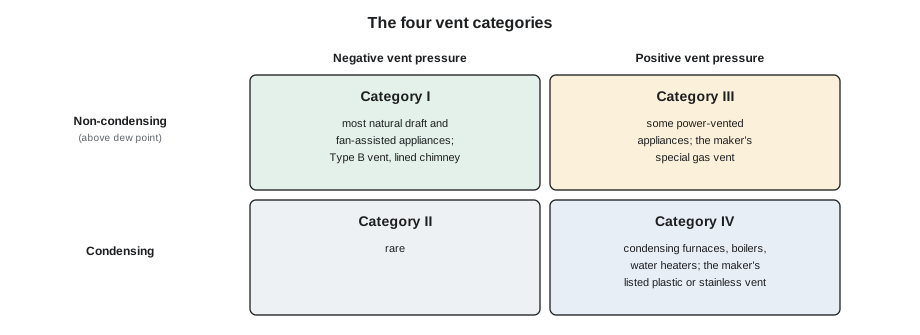
Category I appliances use Type B vent, a lined masonry chimney or a listed chimney, with single-wall or Type B connectors. Category IV appliances use the vent the maker specifies, which in Canada must be certified to ULC S636 for plastic venting: Class IIA for flue gas up to 65 °C, Class IIB up to 90 °C and Class IIC up to 110 °C, used only within the maker's temperature limits. Category III appliances use the maker's special gas vent. A vent material can never be chosen by appearance: ordinary plastic drain pipe looks like vent pipe and has killed people, as the Gibson Avenue power-vent water heater nearly showed in GAS-230.
Connectors, chimneys and liners
A vent connector joins a Category I appliance to its vent or chimney. It must rise toward the vent all the way, with a slope of at least 20 mm per metre, be supported so it cannot sag, and be as short and direct as the installation allows. GAS-220's Kowalczyk furnace locked out every cold morning because a 6 m (20 ft) exhaust pipe across an unheated garage had sagged and lost its slope; GAS-230 explained why a long, cold connector loses draft.
Worked problem
Connector slope
A vent connector runs 2.5 m horizontally from a water heater's draft hood to a chimney thimble. What is the minimum rise from one end to the other?
Show solution
- Minimum slope 20 mm per metre:
- \[2.5 \times 20 = 50 \text{ mm}\]
Answer: At least 50 mm higher at the thimble than at the draft hood, and more is better.
A masonry chimney used to vent gas appliances is examined before use and lined where the code requires. When an appliance is removed from a chimney it shared, the remaining appliance is often left orphaned: the chimney was sized for two, the remaining appliance's flue gas cools in it, condenses and may spill. Ontario's code adoption document is specific: the chimney must be examined, a liner of the right kind fitted when needed, within 5 days on residential work and 30 days on commercial work, and a clay tile liner is not acceptable for an exterior masonry chimney. That rule is exactly what the Haddad house broke: the furnace was replaced in 2024, the water heater was left alone in an exterior tile-lined chimney, and nobody came back.
Plastic venting for condensing appliances
A condensing appliance cools its flue gas below the dew point, about 55 °C for natural gas flue gas, and recovers the latent heat. The result is a cool, wet, slightly acidic flue gas under positive pressure, which needs a sealed vent that drains its condensate back to the appliance or a drain. The rules from GAS-210 and GAS-230: use only the vent materials, sizes and maximum equivalent lengths the maker lists; slope the vent back toward the appliance, usually at least 20 mm per metre; join it with the primer and cement the maker specifies; support it so it cannot sag or pull apart; allow for its expansion; and terminate it where the code and the instructions allow, which is the stricter of the two. Terminations must clear windows, doors, air intakes, soffits, the gas meter and service regulator vent, by at least 900 mm in Ontario, and the snow line.
An exam question about a condensing appliance's vent is usually about one of four things: material, length, slope or termination. The answer is almost always "what the maker's instructions say, within the code". Equivalent length counts each elbow as a length of straight pipe; GAS-230's sample counted 1.5 m for each 90° elbow, but the real figure comes from the instructions.
Combustion and ventilation air
Every appliance that takes its combustion air from the room needs enough air for combustion, for the draft hood's dilution and for ventilation of the room. B149.1 sets requirements for the air supply in terms of the appliance input and the kind of building, with openings to outdoors or to other spaces, sized from the code's clauses and tables. GAS-230 practised with an invented sample table; the code's own rules apply on the exam. Openings must stay open: louvres reduce their free area, screens must not be finer than the code allows, and manual dampers that could close the opening are not allowed.
Worked problem
Is the room big enough?
A finished basement utility room is 2.4 m by 1.8 m with a 2.3 m ceiling, as at the Stinson Street house in GAS-230. It holds a 23 kW furnace and an 11.7 kW water heater, both taking combustion air from the room. Why could this room not be treated as supplying its own air, and what did Bayline do?
Show solution
- Room volume:
- \[2.4 \times 1.8 \times 2.3 \approx 9.9 \text{ m}^3\]
- Total input:
- \[23 + 11.7 = 34.7 \text{ kW}\]
- A room of about 10 m³ holds very little air for nearly 35 kW of appliances, and it was closed off from the rest of the basement by the finished walls.
Answer: A small closed room cannot supply enough air for appliances of this size. Bayline sized the air supply from the code, added an insulated outdoor air duct of 150 mm and grilles in the door, and checked the spillage afterwards. On the exam, size openings from the code's own clauses.
Spillage, backdrafting and depressurization
A Category I appliance spills when flue gas comes out of its draft hood into the room instead of going up the vent, and it backdrafts when the vent flows the wrong way for long enough to fill the room. The causes are the ones in this lesson: a blocked or undersized vent, a cold or orphaned chimney, too little air, and a building pushed below outdoor pressure by exhaust fans, dryers, range hoods and fireplaces. A spillage test checks the draft hood with a mirror, a smoke pencil or a probe after the appliance has run for the time the procedure sets. A worst-case depressurization test closes the doors and windows, turns on every exhaust device, sets interior doors to the position that lowers the appliance room's pressure most, and then measures the pressure difference and tests for spillage. GAS-230 used the procedures and screening limits of CGSB 51.71 and the Ontario code adoption document, labelled as typical.
The fix for depressurization is usually not a bigger vent. It is a direct-vent or power-vented appliance, make-up air interlocked with the exhaust device that causes the problem, or both, as at the Bakshi house in GAS-230, where a new direct-vent water heater and an interlocked make-up air damper brought the worst case from −8.5 Pa to −3.1 Pa.
Air for commercial mechanical rooms
Commercial mechanical rooms often use a mechanical combustion air supply: a fan that brings outdoor air into the room, interlocked so that the appliances cannot fire unless it is running and its airflow is proven. GAS-320's Ferguson Place penthouse showed what happens when that interlock is defeated: the airflow switch had been jumpered, plywood covered the intake, the room fell to −12 Pa and a boiler's air-free CO rose from 22 to 96 ppm. GAS-320 sized the fan from an invented sample rate, 0.56 L/s per kW of input; the code's own requirement applies on the exam and on the job. Whatever the rate, the rule is the same: the fan is interlocked with the appliances, the airflow is proven, and the room is checked for negative pressure with everything running.
Worked problem
Combustion air fan for a boiler room
A boiler room holds two 440 kW boilers and a 58.6 kW water heater. Using GAS-320's sample rate of 0.56 L/s per kW, what airflow would the fan need? (The sample rate is for practice only.)
Show solution
- Total input:
- \[2 \times 440 + 58.6 = 938.6 \text{ kW}\]
- Airflow at the sample rate:
- \[938.6 \times 0.56 \approx 526 \text{ L/s}\]
Answer: About 526 L/s at the sample rate. The fan must be interlocked and its airflow proven; size it from the code for real work.
Termination clearances
Termination questions on the exam are lookup questions: a vent terminal a stated distance from a window, a door, an air intake, a corner, a soffit, a meter or the ground, and is it acceptable? The answer comes from the code's clearance requirements for that kind of terminal, direct-vent or not, and from the maker's instructions, whichever is stricter. Three points catch people. Clearances are measured to the nearest edge of the opening, not its centre. Snow lines and grade both count, and in Hamilton a terminal close to the ground in a snowy winter is a call waiting to happen, as GAS-340's snow-blocked terminations showed. And the intake and exhaust of a two-pipe system have their own separation rules, so that flue gas is not drawn back in.
A last point that links this lesson to the others. Venting problems are usually found by measuring, not by looking: draft with a manometer or draft gauge, spillage with a mirror or probe, combustion with an analyzer, and building pressure with a manometer across the appliance room's wall. An exam question that describes a reading is asking what it means; a question that describes a symptom, such as a sooted draft hood or condensation on a water heater's top, is asking which measurement would confirm the cause.
Common mistakes
MistakeChoosing vent pipe by what it looks like.
InsteadUse only the material, grade and standard the maker lists.
MistakeLeaving an appliance orphaned in a chimney after its partner is removed.
InsteadExamine the chimney and reline or resize it as the code requires, on that job.
MistakeLetting a vent connector run level or sag.
InsteadKeep a continuous rise toward the vent and support it.
MistakeTerminating a plastic vent where the instructions allow but the code does not.
InsteadMeet the stricter of the code and the instructions.
MistakeForgetting the free area lost to louvres and screens.
InsteadUse the louvre's rated free area, or the code's default if unknown.
MistakeFixing spillage from depressurization with a larger vent.
InsteadFind the exhaust that depressurizes the room; use make-up air or a sealed-combustion appliance.
Summary and key terms
- Draft is the pull of hot flue gas rising in a vent; it is lost to friction, cooling and building depressurization, and a cold vent can spill at start-up.
- Categories I to IV depend on vent pressure and condensing; Category I uses Type B vent or a lined chimney, Category IV the maker's vent, certified to ULC S636 for plastic (IIA 65 °C, IIB 90 °C, IIC 110 °C).
- Connectors rise at least 20 mm per metre and are supported.
- Orphaned appliances need the chimney examined and relined, within 5 days residential and 30 days commercial in Ontario, and tile liners are not acceptable in exterior chimneys.
- Condensing vents follow the maker's material, length, slope and termination rules within the code, including 900 mm from the meter and regulator vent.
- Air supply is sized from B149.1.
- Spillage and worst-case depressurization tests find the problems that make-up air and sealed-combustion appliances fix.
- Draft
- The pressure difference that moves flue gas up a vent, caused by the lower density of hot flue gas.
- Vent connector
- The pipe that joins a Category I appliance's flue outlet or draft hood to the vent or chimney.
- Orphaned appliance
- An appliance left venting alone into a chimney or vent that was sized for more than one appliance.
- Equivalent length
- The length of straight pipe that has the same resistance as a fitting, used to total a vent's resistance.
- Spillage
- Flue gas escaping from an appliance's draft hood into the room instead of rising up the vent.
- Worst-case depressurization
- The lowest pressure an appliance room can reach with exhaust devices running and doors set to the worst position.
Practice problems
Work each problem on paper first, then reveal the answer to check.
Which two questions decide an appliance's vent category?
Show answer
Whether the vent pressure is positive or negative, and whether the flue gas condenses.
What minimum rise does a 3 m vent connector need?
Show answer
3 × 20 = 60 mm.
Why is an exterior masonry chimney the worst case for an orphaned water heater?
Show answer
It is cold, so the flue gas cools, condenses and loses draft, and the appliance spills.
What usually fixes spillage caused by a powerful range hood?
Show answer
Interlocked make-up air, or a direct-vent or power-vented appliance.
Who decides the vent material for a Category IV appliance?
Show answer
The maker's instructions, within the code.
Lesson quiz · 5 questions
Score 60% or more to complete this lesson.
Create a free account to save your progress, take quizzes and earn a certificate.