
GAS-350 · Lesson 9 of 12 · 20 min
Review: commercial and industrial equipment
▶ Video coming soon A video version of this lesson is on the way.
Maureen kept the commercial review for herself and spread it over the second half of November 3 and an extra hour on November 10. She opened with a photograph of the Kingsview Manor boiler room from GAS-310: two boilers, a gas train along the wall, the flame safeguard's display reading a lockout. "This is where a G.1 exam separates people," she said. "Not because it's harder, but because most of you see it once a month and the residential stuff every day. Every part of this train has a job, and every one of them has failed on me at least once. Tell me what each one does, then tell me what it looks like when it fails."
This lesson reviews GAS-310, GAS-320 and the elevated-pressure and meter material of GAS-330 that applies to large equipment. It covers the scope of large-equipment work, burners and air-fuel ratios, gas trains, flame safeguards and burner management, firing rate control and tuning, large boilers, rooftop units and makeup air, commercial kitchens and water heaters, and the codes for large equipment.
The scope of large-equipment work
In Ontario the line between G.2 and G.1 work is 400,000 Btu/h, about 117 kW, of appliance input: a G.2 works on appliances up to that input, and above it the work belongs to a G.1, with G.2 holders and apprentices assisting under a G.1's direct supervision. That is why Luis's experience log counts his hours on appliances over 400,000 Btu/h separately, and why every one of them carries Maureen's initials. Appliances and equipment that are not certified, such as the imported spiral oven at Vitale Foods in GAS-310, need a field approval under CSA B149.3 before they may be used, and Ontario's code adoption documents now adopt the 2025 edition of B149.3.
Burners and air-fuel ratio
An atmospheric burner draws its primary air by the injection of the gas jet through a venturi, and its secondary air by draft; it is simple and quiet but cannot be controlled closely. A power burner uses a fan to supply all its combustion air, so it can run against the pressure of a boiler's combustion chamber and can be set to a much closer air-fuel ratio. That closeness is the point: a power burner typically runs at about 3 to 4.5 in 100 oxygen in the flue gas, about 15 to 25 in 100 excess air, against about 6 to 9 for an atmospheric burner, and every point of oxygen saved is heat that stays in the building. The maker's figures govern on any real burner.
The air a burner needs follows from the chemistry in lesson 3: about 9.57 volumes per volume of natural gas, plus the excess. A large burner therefore moves a great deal of air, and anything that changes the air supply changes the combustion: a dirty fan wheel, a slipping belt, a damper linkage that has worn, a boiler room that has gone negative because a makeup air unit's belt broke, as at Crown Linen in GAS-310, where the oxygen fell from 3.6 to 1.1 in 100 and the air-free CO rose to 410 ppm.
Gas trains
The gas train is the line of valves, regulators and switches between the building's gas supply and the burner. Its parts, in the order the gas meets them, are the ones Maureen made her group name from memory:
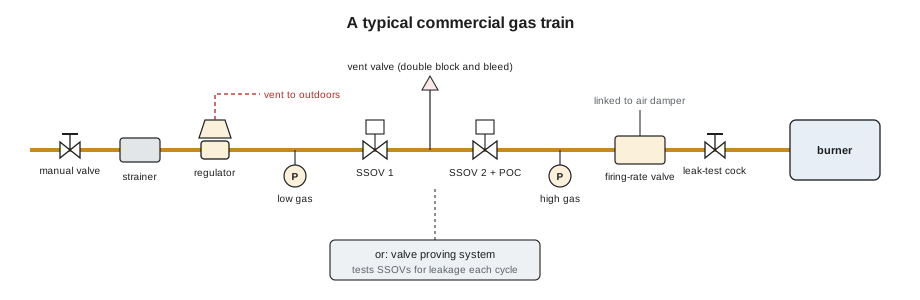
- Manual shut-off valve, to isolate the train for service.
- Strainer or filter, to catch scale and sealant before they reach the valves. Hearthstone Bakery's leaking safety valve in GAS-310 had scale and sealant on its seat from a nearby piping job.
- Pressure regulator, to deliver a steady pressure to the burner, with its vent piped to outdoors as the code requires.
- Low gas pressure switch, which stops the burner if the supply pressure falls too low for stable combustion, and high gas pressure switch, which stops it if the regulator fails and pressure rises.
- Two automatic safety shut-off valves in series, which close when the burner stops or a safety trips. Larger burners add a proof-of-closure switch on a valve, which proves it closed before the next start, and either a vent valve between the two safety valves, the double block and bleed arrangement, or a valve proving system that checks the valves for leakage automatically.
- Firing-rate valve, linked to the air damper mechanically or electronically, and the leak-test cock used to test the safety valves for leakage during service.
Flame safeguards and burner management
A flame safeguard or burner management system runs the burner's sequence and proves each step. The typical sequence: prove the air supply and that the safety valves are closed; pre-purge the combustion chamber with enough air to change its volume several times, typically at least four changes; light the pilot and prove it within the pilot trial for ignition, typically 10 seconds or less; open the main valves and prove the main flame within the main trial; then release the burner to modulate. When the burner stops, the valves close, typically within about a second, and the fan post-purges. If the flame is lost while running, the control must shut the gas within its flame failure response time, typically about 4 seconds or less on this kind of control. These are typical values; the burner's certification and the code set the real ones.
Flame is proven by a flame rod or, on most larger burners, an ultraviolet scanner. A scanner on a burner that runs continuously for long periods must be a self-checking type, which tests itself regularly by shuttering its own view, because a scanner that fails while seeing flame would otherwise keep the gas on. The flame signal is read on the safeguard's scale: at Kingsview Manor the control used a 0 to 5 V scale with a 1.25 V minimum, and a fouled lens from a cracked cooling-air hose had pulled the main flame signal down to 1.1 to 1.4 V.
Worked problem
A purge timer that was changed
At Lakeview Apartments in GAS-310, the boiler's purge card had been swapped for one giving 30 seconds, while the label called for 2 minutes. If the boiler's combustion chamber and passes hold a volume that the fan moves in 25 seconds, how many volume changes did each purge give before and after the swap?
Show solution
- Volume changes with the correct 2-minute purge:
- \[\frac{120}{25} = 4.8\]
- Volume changes with the 30-second card:
- \[\frac{30}{25} = 1.2\]
Answer: About 4.8 changes with the right card, above the typical minimum of four, and only 1.2 with the wrong one, enough to leave unburned gas in the chamber after a failed light-off. That is what caused the two small bangs the week before. Purge timing is never shortened, and the card is replaced only with the one the burner's label specifies.
Firing rate control and tuning
Large burners modulate or stage their firing rate to follow the load. The air and gas must change together so that the air-fuel ratio stays right at every rate: through a mechanical linkage, or in linkageless systems through separate servo motors on the gas valve and the air damper, set point by point along a curve. Turndown is the ratio of maximum to minimum firing rate; the Westmount library boilers in GAS-310 had been left at 5:1 when they could run at 10:1. Tuning sets the curve with an analyzer at each point, from low fire to high fire, aiming for the lowest oxygen that keeps CO low with a margin, and records the readings as left.
Large boilers, rooftop units and makeup air
GAS-320's equipment shows up on exams mostly through its safety devices and its limits. Low-pressure boilers are those up to 15 psi steam, or up to 160 psi and 250 °F water. Every boiler has a relief valve sized for at least its output, a fact the Riverdale Community Centre's undersized replacement valve in GAS-320 broke, and an operating control and a high limit that stop the burner. Steam boilers, and hot water boilers where the code requires, have a low-water cutoff that stops the burner if the water level falls. Outdoor reset changes the boiler water temperature with the outdoor temperature along a curve, which saves fuel and lets condensing boilers condense.
Rooftop units combine a gas heat section, a cooling section and a blower, and are serviced like furnaces with a roof's hazards added: fall protection, wind and weather. Makeup air units replace air exhausted from kitchens and buildings. A direct-fired unit burns gas in the air stream it delivers, so its burner must meet the added limits on carbon monoxide, carbon dioxide and nitrogen dioxide in the delivered air that its standard sets, and it must never recirculate room air unless certified for it. An indirect-fired unit heats the air through a heat exchanger. Kitchen hoods are interlocked with their makeup air, and the gas to cooking appliances under a hood is shut off when the hood's fire suppression system operates.
Kitchens and commercial water heating
Commercial cooking equipment is connected with connectors rated for it and restrained so that the appliance cannot be pulled far enough to strain the connector, a rule the Bella Notte charbroiler broke in GAS-320. Commercial water heaters supply hot water for sanitation, and dishwashers that sanitize with hot water need a final rinse of about 82 °C; a booster heater raises the water from the building's supply temperature to that level. Booster heaters must be fed with water hot enough for them to reach the rinse temperature, which is why the Lakeshore Inn's booster, fed from a mixed loop, could not keep up until the plumber repiped it.
Elevated pressure on large equipment
Large equipment usually sits at the end of an elevated-pressure service. The Keystone Coatings plant in GAS-330 had a 35 kPa service, a welded NPS 2 main, a rotary meter with a volume corrector, and appliance regulators at each machine reducing to the pressure its gas train needed. The things to know for the exam are the ones that link this lesson with lesson 5: the gas train's regulator and pressure switches are set for the pressure the train is designed for; the train's inlet pressure must be within its rating, so an elevated service needs an appliance or line regulator ahead of it; regulator vents go outdoors; and the input is confirmed by clocking with the pressure and temperature corrections, as at Iron Kettle Brewing.
What fails, and what it looks like
Maureen's second question on November 3 was what each part looks like when it fails. Her answers, from GAS-310 and GAS-340:
| Part | How it fails | What the technician sees |
|---|---|---|
| Strainer | Packs with scale or sealant | Low pressure at the train under load; low gas switch trips at high fire |
| Regulator | Blocked vent, worn diaphragm, failed seat | Hunting, slow response, creep at lock-up, low gas trips |
| Low gas pressure switch | Set too close to running pressure, or drifted | Nuisance trips when another load starts |
| Safety shut-off valve | Debris on the seat, worn seal | Valve proving faults; leakage at the leak-test cock |
| Scanner or flame rod | Fouled lens, failed cooling air, oxidized rod | Low or unstable flame signal; flame failure lockouts |
| Air damper linkage | Worn bushings, slipped set screw | Oxygen readings that drift from the as-left curve |
Common mistakes
MistakeShortening a purge to save time on start-up.
InsteadNever; the purge time is set by the burner's certification and the code.
MistakeTreating a lockout on a large burner as a nuisance to reset.
InsteadRead the safeguard's history, find the cause, then reset.
MistakeTuning by eye or by manifold pressure alone.
InsteadTune with an analyzer at each firing point and record as-left readings.
MistakeFitting a relief valve smaller than the boiler's output.
InsteadThe relief valve's capacity must be at least the boiler's output.
MistakeLetting a direct-fired makeup air unit recirculate room air.
InsteadOnly units certified for recirculation may do so.
MistakeDefeating a combustion-air or makeup-air interlock to keep equipment running.
InsteadInterlocks protect against depressurization and CO; repair, never bypass.
Summary and key terms
- Above 400,000 Btu/h (about 117 kW), work belongs to a G.1, with others assisting under direct supervision.
- Uncertified equipment needs a field approval under CSA B149.3.
- Power burners run at typically 3 to 4.5 in 100 O₂, atmospheric burners at 6 to 9.
- A gas train has a manual valve, strainer, regulator with vent, low and high gas pressure switches, two safety shut-off valves (with proof of closure and a vent valve or valve proving on larger burners), a firing-rate valve and a leak-test cock.
- A burner management system proves air and valve closure, pre-purges (typically four or more volume changes), proves pilot and main flame within their trials, and shuts the gas within its flame failure response time.
- Continuous burners use self-checking scanners.
- Linkageless controls set air and gas point by point.
- Low-pressure boilers are up to 15 psi steam or 160 psi water; relief valves must match output; low-water cutoffs protect boilers.
- Direct-fired makeup air must meet added limits on CO, CO₂ and NO₂ and not recirculate unless certified.
- Gas train
- The valves, regulators and switches between the gas supply and a burner.
- Proof of closure
- A switch on a safety shut-off valve that proves the valve is fully closed before the burner may start.
- Valve proving system
- A control that tests a burner's safety shut-off valves for leakage automatically.
- Pre-purge
- Running the combustion air fan before ignition to clear the combustion chamber of any gas.
- Flame failure response time
- The longest time a flame safeguard may take to shut off the gas after the flame is lost.
- Turndown
- The ratio of a burner's maximum firing rate to its minimum.
Practice problems
Work each problem on paper first, then reveal the answer to check.
Above what input does appliance work belong to a G.1?
Show answer
400,000 Btu/h, about 117 kW.
What does a proof-of-closure switch prove?
Show answer
That a safety shut-off valve is fully closed before the next start.
Why must a scanner on a continuously running burner be self-checking?
Show answer
A scanner that failed while seeing flame would otherwise keep the gas on.
What must a boiler's relief valve capacity be at least?
Show answer
The boiler's output.
What does a direct-fired makeup air unit do with its combustion products?
Show answer
Delivers them in the air stream, so it must meet added limits on CO, CO₂ and NO₂.
Lesson quiz · 5 questions
Score 60% or more to complete this lesson.
Create a free account to save your progress, take quizzes and earn a certificate.