
GAS-350 · Lesson 1 of 12 · 21 min
How the exam is built
▶ Video coming soon A video version of this lesson is on the way.
On Tuesday evening, October 20, Maureen Fitch pushed two benches together at the back of the Bayline shop, put a coffee urn on the parts counter and wrote one line on the whiteboard: "OCILB: by spring." Luis Ferreira sat in the front row with a new binder. Grant Whitlock sat beside him, and behind them, with permission to listen, were Jonah Clarke and Ayesha Rahman. "Four Tuesdays," Maureen said, "then a full practice exam on the Saturday after the last one. Rosa takes the residential nights, I take the commercial ones, and Hank comes in one night to talk about what happens after you pass. Tonight is about the exam itself, because you cannot plan for something you have never looked at properly."
This is the last course in the gasfitter program. It does not teach new trade content. It reviews the whole program, GAS-110 to GAS-340 and the piping course PLB-230, in the order a certification exam tests it, and it shows how to prepare for that exam and what comes after it. The review lessons repeat the facts, numbers and practice tables that the earlier courses used, so that what you study here matches what you were taught. Where a review lesson says "sample", the table or chart is the same invented one used in the earlier course: good for practice, never for real work. This first lesson describes how gas fitters are licensed in the United States, and in Ohio in particular, and what the exams look like.
Who licenses gas fitters
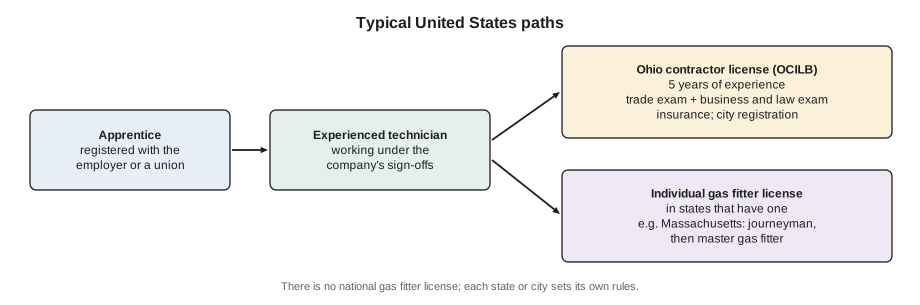
The United States has no national gas fitter license. Each state decides whether to license the people who install gas piping and appliances, and many states leave it to cities or counties, or license the contractor rather than the worker. GAS-110 described the Ohio arrangement, which is the one Bayline works under in Columbus:
- Ohio has no statewide gas fitter license for individuals. The Ohio Construction Industry Licensing Board (OCILB) licenses contractors: heating, ventilating and air conditioning (HVAC), plumbing, electrical, hydronics and refrigeration. The license holder, the qualifying person for the company, must show experience, pass exams and carry insurance.
- Cities add their own rules. Columbus requires every contractor who takes out permits to hold the right OCILB license, register with the city and post a 25,000-dollar bond. Some Ohio cities also license heating contractors or plumbers locally, and their codes say which license may run gas piping and set appliances.
- Individual technicians working for a licensed Ohio contractor do not need a state gas license. Bayline sets its own rules for who may work alone on what, and Maureen's sign-off is required before a technician works alone on appliances over 400,000 Btu/h.
Other states do things differently, and a gas fitter who moves must start by finding the licensing body in the new state. Massachusetts is a clear example of a state that licenses individual gas fitters: its Board of State Examiners of Plumbers and Gas Fitters registers apprentices, licenses a journeyman gas fitter after at least two years as an apprentice, 150 hours of gas fitting theory at an approved school and a written exam, and licenses a master gas fitter after a year as a journeyman and a further exam. Other states and many large cities have their own versions, often with exams written by national testing companies and based on the International Fuel Gas Code or NFPA 54.
Luis has worked in the trade for six years: two as a helper with an HVAC company and four as a service technician at Bayline. Hank holds Bayline's OCILB HVAC license, and he wants a second qualified person in the company who could hold a license if he retired or was ill. Luis now meets OCILB's experience requirement, so he is preparing for the HVAC contractor exam and the separate business and law exam. Grant has more than five years in the trade too and plans to follow him later in 2027. Jonah and Ayesha are registered apprentices working under Bayline's sign-off system.
What the exam looks like
The OCILB HVAC contractor exam is given by the testing company PSI at its test centers. Its candidate bulletin describes it as 100 scored multiple-choice questions plus 10 unscored trial questions, with four hours to answer them and a passing score of 70 in 100. It is open book: the candidate brings the 2021 International Fuel Gas Code, the 2024 Ohio Mechanical Code and the refrigeration and air conditioning textbook the bulletin names. Only permanent plastic or adhesive index tabs are allowed in the books; removable sticky flags are not. The business and law exam is separate: 50 scored questions plus 5 trial questions, two hours, passing score 70, open book with the Ohio edition of the contractor's business and law guide that the bulletin names.
A candidate who fails a section can retake it after a waiting period, which the current bulletin sets at 60 days, up to five times in a year. Trial questions are mixed in with the scored ones and look the same, so every question has to be answered as if it counted. The bulletin, not a training company's summary, is the authority: PSI and OCILB update the references and rules, and the book editions change when Ohio adopts new codes.
Open book does not mean easy. With 110 questions in 240 minutes, a candidate has a little over two minutes for each question. A candidate who has to search the whole book for each answer will run out of time. The people who pass know most of the material without the book and use the book to confirm a number or an exception, which is why the study plan in lesson 2 starts with knowing the codes' structure and tabbing them.
| Item | OCILB HVAC contractor exam (Ohio) |
|---|---|
| Who runs it | PSI, for OCILB |
| Format | 100 scored + 10 unscored multiple-choice questions |
| Length | Four hours |
| Pass mark | 70 in 100 |
| Books | 2021 IFGC, 2024 Ohio Mechanical Code, named textbook; permanent tabs only |
| Rewrites | After 60 days, up to five times a year |
| Also needed | Business and law exam (50 + 5 questions, two hours, 70 in 100), five years of experience, insurance |
Exam day
OCILB first approves the application, which includes the experience record, insurance information and a background check, and the approval is valid for one year. The candidate then books a seat with PSI, pays the exam fee for each exam, and arrives early with the identification the bulletin lists. The books are inspected at the door. Luis spent an evening putting permanent tabs in his code books and checking them against the bulletin's rules, because a book with the wrong tabs can be refused.
Whatever the exam, the room has the same rules: no phones, smart watches or notes, the supervisor's instructions followed exactly, and nothing taken out of the room afterwards. Questions are not discussed with other candidates after the exam either. Exams are expensive to write and every question that leaks has to be thrown away, which is why certification bodies treat sharing their content seriously.
Where the questions come from
The PSI bulletin includes a content outline: a list of topic areas with the number of questions from each. For the HVAC contractor exam, the outline covers the fuel gas code, the mechanical code and the refrigeration and air conditioning textbook, which means a gas fitter preparing for it must also review refrigeration, ductwork and air distribution, which this program does not teach. Luis's plan in lesson 2 starts from the outline. The gas content of the exam, piping, sizing, venting, combustion air, appliances and testing, is what this course reviews.
Questions come in four kinds, and each kind needs a different kind of preparation:
- Recall questions ask for a fact: the specific gravity of propane, what a thermocouple produces, what a G.2 may work on. They are answered from memory, quickly.
- Understanding questions ask why: why a vent connector slopes up, why a mixture above the upper flammable limit is still dangerous. They need you to understand the principle, not just remember a sentence.
- Application questions describe a situation, usually a service call or an installation, and ask what to do or what the reading means. Most of a gas exam is this kind.
- Calculation and lookup questions ask for a number: an input from a clocked meter, a pipe size from a table, a combustion air opening, a clearance. Some need arithmetic, some need the code, many need both. Lesson 10 practices them.
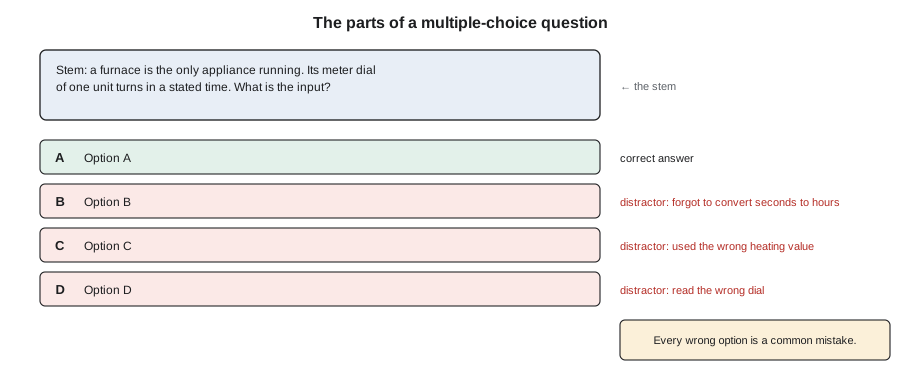
Every wrong option on a good exam is the answer that a particular mistake produces. An input calculation will offer the answer you get if you forget to multiply by 3,600, the answer for the wrong heating value and the answer for propane instead of natural gas. That is why you cannot check your answer by seeing whether it appears among the options: your mistake will be there too. You check by redoing the work, or by an estimate that tells you roughly what the answer should be.
Worked problem
How much time is there for each question?
The OCILB HVAC contractor exam has 110 questions, 10 of them unscored but indistinguishable, in four hours. You want 30 minutes at the end to return to the questions you marked. How long can you spend on each question on the first pass?
Show solution
- Time for the first pass:
- \[240 - 30 = 210 \text{ min}\]
- Every question must be answered, scored or not:
- \[\frac{210}{110} \approx 1.9 \text{ min} \approx 1 \text{ min } 55 \text{ s}\]
Answer: Just under two minutes each. A code lookup that takes five minutes uses the time of two and a half questions, which is why the tabs and the structure of the code book matter so much on an open-book exam.
What the exam does not test
A written exam cannot test everything a gas technician does. It does not test whether your flare joints are good, whether you notice the smell of flue gas at the door, or whether you can calm a frightened customer. Those are tested by the practical evaluations, by supervisors' sign-offs and by years of work. A candidate who passes the written exam has shown that they know the codes and the theory; the people they work with decide whether they can be trusted alone on a job. Maureen made the point on the first night: "I've signed off people who scored in the sixties on practice tests, and I've refused to sign off people who scored in the nineties. The paper is necessary. It isn't enough."
The exam also does not test the company's rules. Bayline's CO monitor settings, its sign-off system and its red-tag paperwork are sound practice, and the earlier courses explained them, but an exam question about what the code requires must be answered from the code. When a review lesson in this course says "Bayline's rule", it means something you should know for work and leave out of an exam answer.
Keeping a license once you have it
An OCILB contractor license is renewed every year. Renewal needs proof of the required liability insurance, at least 500,000 dollars of coverage including completed operations, the renewal fee, and the continuing education the board requires, up to 10 hours a year across all the licenses a person holds. A license that lapses cannot be used to take out permits, and Columbus checks the license and the city registration before it issues one. A candidate preparing for the exam should start collecting the experience records OCILB will ask for, because five years of work is easier to prove from records kept at the time than from memory.
Whatever the jurisdiction, the habit that matters most is the same: keep your own records. Dates, employers, the kinds of equipment you worked on, the hours on large appliances, the names of the supervisors who signed for you. Luis kept a notebook of his commercial hours from his first week on Maureen's crew, with each job, its date, the appliance input and Maureen's initials, and it took him an evening, not a month, to fill in the experience form.
Common mistakes
MistakePlanning study around what was easy in the courses.
InsteadPlan around the exam's content and the topics you got wrong; lesson 2 shows how.
MistakeAssuming the rules are the same as last year, or the same as a friend's exam.
InsteadRead the current preparation guide or bulletin for your exam before you book.
MistakeBringing books with sticky flags or the wrong editions.
InsteadUse the editions and permanent tabs the bulletin lists.
MistakeChecking an answer by seeing whether it is one of the options.
InsteadRedo the work or estimate; the wrong answers are built to match common mistakes.
MistakeLeaving questions blank.
InsteadAnswer every question; there is a chance on a guess and none on a blank.
MistakeTreating the company's rules as code requirements in exam answers.
InsteadAnswer code questions from the code; know the company rules for work.
Summary and key terms
- The United States has no national gas fitter license.
- Ohio licenses contractors through OCILB, which requires five years of experience, a trade exam, a business and law exam and insurance; Columbus also requires city registration and a bond.
- Some states, such as Massachusetts, license individual journeyman and master gas fitters.
- The OCILB HVAC contractor exam has 100 scored and 10 unscored questions in four hours, a passing score of 70, and is open book with the 2021 IFGC, the 2024 Ohio Mechanical Code and a named textbook, with permanent tabs only.
- The business and law exam is separate.
- A failed section can be retaken after 60 days.
- Questions test recall, understanding, application and calculation, and the wrong options match common mistakes.
- Certificate of qualification
- A document issued to an individual worker that allows them to do a regulated kind of work, such as gas work.
- Challenge exam
- An exam written on the strength of documented experience instead of completing the training program.
- Stem
- The part of a multiple-choice question that sets out the situation and asks the question.
- Distractor
- A wrong option on a multiple-choice question, usually the answer that a common mistake produces.
- Content outline
- A list of the topic areas an exam covers, often with the number of questions from each.
- Pass mark
- The score a candidate must reach to pass an exam.
Practice problems
Work each problem on paper first, then reveal the answer to check.
Who issues contractor licenses in Ohio?
Show answer
The Ohio Construction Industry Licensing Board (OCILB).
What is the passing score on the OCILB HVAC contractor exam?
Show answer
70 in 100.
What may be brought into the HVAC contractor exam?
Show answer
The 2021 IFGC, the 2024 Ohio Mechanical Code and the textbook named in the bulletin, with permanent tabs only.
Why can an answer not be checked by finding it among the options?
Show answer
The wrong options are built from common mistakes, so a wrong answer is usually there too.
Name the four kinds of exam question.
Show answer
Recall, understanding, application, and calculation or lookup.
Lesson quiz · 5 questions
Score 60% or more to complete this lesson.
Create a free account to save your progress, take quizzes and earn a certificate.