
GAS-240 · Lesson 2 of 12 · 23 min
Cylinders: types, markings and requalification
▶ Video coming soon A video version of this lesson is on the way.
On Friday afternoon, September 25, Priya Nair handed Luis a clipboard and a can of marking paint and sent him and Jonah to the cylinder cage behind Bayline's shop. Every fall, before the construction heating season, the propane crew checks every cylinder the company owns: the 9 kg cylinders for the torches and the barbecue demonstration, the 15 kg forklift cylinder for the shop's lift truck, and a row of 45 kg cylinders that supply the temporary heaters on new-house sites. Beside them stood four older 45 kg cylinders the farm customer outside Ancaster had retired when her new tank went in, which the supplier had asked Bayline to hold for pickup. "Every cylinder tells you its life story on its collar," Luis said, handing Jonah a wire brush. "Read it before you fill it, carry it or connect it. If you can't read it, it doesn't get used."
This lesson explains the kinds of propane cylinders, the markings stamped on them, the valves they carry, how long they may be used before they must be requalified, and how they are stored, carried and connected. Filling them is covered in lesson 7.
Cylinders and tanks: the difference
B149.2 and the federal rules divide propane containers into two families. A cylinder is a portable container built to a Transport Canada specification, sold by the mass of propane it holds and filled at a refill centre, by weight or by volume, or exchanged for a full one. A tank is a stationary container built to the ASME pressure vessel code, registered under the provincial pressure vessel rules and filled on site from a delivery truck. Cylinders are designed to be moved full; tanks are not. The distinction matters because the rules for building, marking, requalifying, filling, storing and locating the two are different.
The common cylinder types
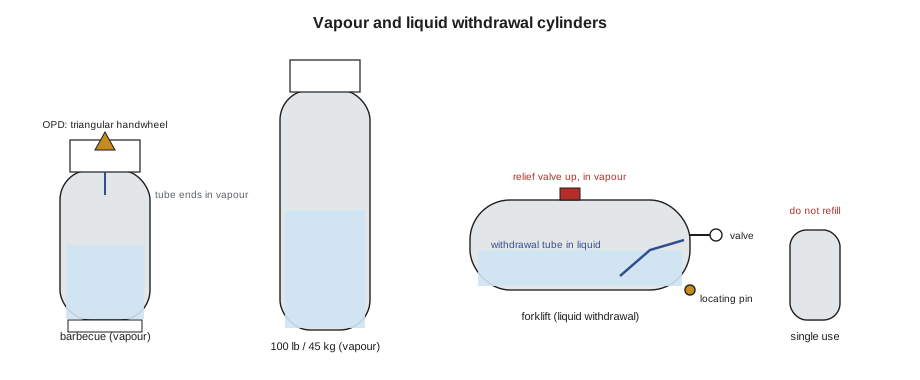
Cylinders come in a handful of standard sizes, each named by the propane it holds when properly filled. The 9 kg barbecue cylinder is a vertical vapour-withdrawal cylinder with a collar to protect the valve and a foot ring to stand on. Smaller sizes, from about 2 kg to 14 kg, serve camping stoves, patio heaters and torches. The 45 kg cylinder, about 1.2 m tall, is common on farms, at cottages and on construction sites, and two or more are often connected through a manifold with an automatic changeover regulator. Forklift cylinders, usually 15 kg, are horizontal and draw liquid from the bottom, because a forklift engine vaporizes the fuel itself, as lesson 10 explains. A locating pin or slot on the collar ensures the cylinder is mounted so that its withdrawal tube points down into the liquid and its relief valve discharges into the vapour space.
Most propane cylinders are steel, made in two pieces welded together or drawn from one piece. Aluminum cylinders are lighter and common for forklifts. Composite cylinders, made of a plastic liner wrapped in fibre, are translucent so the liquid level can be seen, and they have a shorter, fixed service life set by their specification. Single-use 0.45 kg cylinders for camping and plumbing torches are not refillable and must never be refilled.
| Cylinder | Typical use | Withdrawal | Notes |
|---|---|---|---|
| 2 to 14 kg | Camping, patio heaters, torches | Vapour | Must have an overfilling prevention device |
| 9 kg | Barbecues, torches, small heaters | Vapour | Most common exchange cylinder |
| 15 kg | Forklifts and floor machines | Liquid | Horizontal, with locating pin; mounted as marked |
| 45 kg | Farms, cottages, construction heat | Vapour | Often manifolded in pairs with a changeover regulator |
| 0.45 kg | Camping, hand torches | Vapour | Single use; never refilled |
Reading the collar
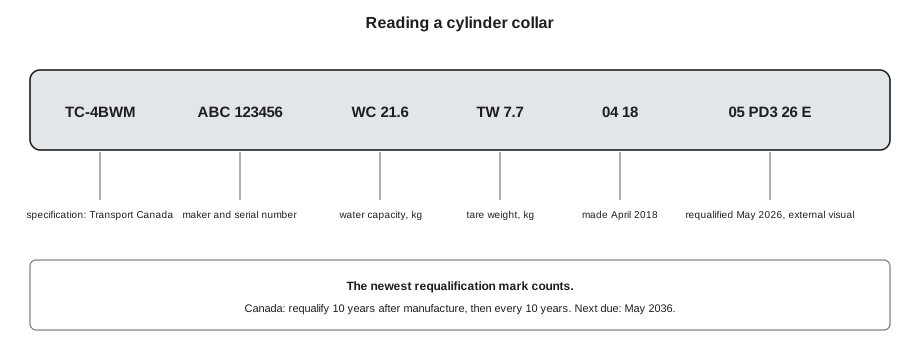
Every cylinder has permanent markings stamped into its collar or a plate, and they must stay legible. The specification shows the standard it was built to, such as TC-4BAM or TC-4BWM; the letters TC mean it was made to Transport Canada requirements and may be filled and used in Canada, and many cylinders are marked with both TC and DOT specifications. The service pressure follows the specification. The manufacturer's mark and serial number identify it. The water capacity (WC) is how much water it would hold, in litres or kilograms, and the tare weight (TW) is the mass of the empty cylinder with its valve, in kilograms. The date of manufacture, month and year, starts the clock for requalification. Each requalification adds a mark showing the month, the requalifier's registered mark issued by Transport Canada, the year and a letter for the method used, such as E for an external visual inspection. A cylinder that has been requalified several times carries several marks; the latest one counts.
How long a cylinder may be used
A cylinder must not be filled unless it is within its requalification period. In Canada a propane cylinder must be requalified 10 years after its date of manufacture, and again every 10 years after that, by a requalifier registered with Transport Canada under CSA B339. Requalification includes an inspection of the outside of the cylinder for dents, gouges, corrosion, fire damage, bulges and damage to the collar and foot ring, and the replacement of the relief valve or the whole valve, which also has a limited life. A cylinder that fails is condemned and must be made unusable and recycled; it is never patched or repainted to hide damage. A cylinder past its date may still be used to burn the propane already in it, but it may not be refilled or offered for transport full.
Worked problem
Is this cylinder in date?
A 45 kg cylinder from the farm is marked with a manufacture date of 08 13 and a requalification mark of 09 PD3 23 E. Another is marked 03 14 with no requalification mark. On Friday, September 25, 2026, which may be refilled?
Show solution
- First cylinder: last requalified September 2023; next due:
- \[2023 + 10 = 2033 \;\to\; \text{September 2033: in date}\]
- Second cylinder: made March 2014, never requalified; first requalification due:
- \[2014 + 10 = 2024 \;\to\; \text{March 2024: out of date}\]
Answer: The first cylinder may be refilled until September 2033. The second ran out of date in March 2024 and must be requalified or retired before it is filled again. Jonah tagged it with Bayline's yellow "out of date, do not fill" tag for the supplier.
Cylinder valves and the overfilling prevention device
The valve is the most important part of a cylinder after the steel itself. A vapour-service cylinder valve has a handwheel that opens and closes the main seat, an outlet for the regulator or hose, a pressure relief valve built into the valve body that discharges into the vapour space, and a short dip tube for the fixed liquid level gauge, a small bleeder valve whose tube ends at the level the cylinder should be filled to. Modern barbecue-size cylinders have a Type 1 outlet with a large external thread that accepts a hand-tightened connector with a built-in excess flow check and a thermal shutoff, and that will not let gas flow unless it is properly connected. Older cylinders used a POL connection, a left-hand thread tightened with a wrench.
Barbecue-size and similar small vapour cylinders must also have an overfilling prevention device (OPD): a float inside the cylinder that closes the filling path when the liquid reaches the safe level. OPD valves are identified by a triangular handwheel and the letters OPD on the valve. The OPD is a backup, not a filling method: TSSA has reminded refill attendants that B149.2 requires cylinders to be filled by weight or by volume, and that the OPD is not a gauge. A cylinder of that size without an OPD may not be refilled.
Storing cylinders
Cylinders are stored outdoors wherever possible, upright with the relief valve in the vapour space, valves closed and capped or plugged when not connected, away from building openings, air intakes, heat and ignition sources, and protected from vehicles and tampering. B149.2 limits the propane that may be stored inside a building to small quantities in specific circumstances, and generally prohibits storing cylinders in basements, under stairs or in places where escaping vapour could collect. Cylinder exchange cabinets at retail sites have their own rules: the Ontario amendments allow no more than four cabinets at a cylinder exchange, each holding no more than about 227 kg (500 lb) of propane. Bayline's cage is outdoors, fenced, locked, ventilated at the base, well away from the shop's doors and the neighbouring property, and signed with the propane and no smoking signs the code requires.
Worked problem
How much propane is in the cage?
The cage holds six 9 kg cylinders, one 15 kg forklift cylinder and five 45 kg cylinders, all full. The four retired farm cylinders are empty. What is the total mass of propane, and if propane releases about 46.4 MJ per kilogram, how much energy is stored?
Show solution
- Propane:
- \[6 \times 9 + 15 + 5 \times 45 = 54 + 15 + 225 = 294 \text{ kg}\]
- Energy:
- \[294 \times 46.4 = 13{,}642 \text{ MJ} \approx 13.6 \text{ GJ}\]
Answer: Almost 300 kg of propane, about the energy a house furnace uses in two weeks of cold weather, sits in a cage the size of a garden shed. That is why it is outdoors, locked, separated and signed.
Carrying cylinders
Cylinders travel in Bayline's vans and trucks under the federal Transportation of Dangerous Goods Regulations, which treat propane as a Class 2.1 flammable gas, UN1075. The regulations give an exemption for small quantities carried in a road vehicle, with conditions, which covers most of what a service van carries; larger loads need placards, documents and training. Whatever the quantity, Bayline's rules are the same: cylinders upright and secured so they cannot fall, roll or shift, valves closed and plugged or capped, never in the cab or a closed car trunk, the cargo area ventilated, and never left in a closed vehicle in the sun. A cylinder lying on its side can put its relief valve in the liquid, so a relief valve that opens on a hot day discharges liquid instead of vapour.
Connecting a cylinder
Before connecting any cylinder, Bayline technicians check the collar for the requalification date, look at the cylinder for damage and the valve for a damaged thread or seat, make sure the connector and its washer or O-ring are in good condition and fit the outlet, and confirm the regulator suits the appliance: a high-pressure torch or heater regulator is never put on an appliance meant for 2.75 kPa. They connect with the valve closed, open the valve slowly, and leak test every connection they made with leak detection solution or an electronic detector before lighting anything. Hoses must be certified for propane, of the right pressure rating, protected from damage and kept as short as practical; they are never run through doorways or windows where they can be pinched. When a cylinder is disconnected, its valve is closed first, the line is allowed to burn out or is bled safely outdoors, and the outlet is capped.
Manifolded cylinders and automatic changeover
Where a customer uses more propane than one cylinder can supply between deliveries, but a tank is not practical, two or more 45 kg cylinders are connected through a manifold to an automatic changeover regulator. The regulator draws from the cylinders on the service side until they run low, then switches by itself to the reserve side, and a small indicator on top turns from green to red to show that the service side is empty. The supplier, or the customer, then replaces or refills the empty cylinders and turns the lever to make the full ones the new reserve. A two-cylinder installation of this kind is what the farm outside Ancaster used before its tank was set, and it is common at cottages, small shops and construction sites. The cylinders stand on a firm, level, non-combustible base, are chained or strapped so they cannot be knocked over, and are connected with pigtails rated for full cylinder pressure. Because the changeover regulator is usually also the first stage of a two-stage system, a second-stage regulator is still needed at the building, as lesson 6 explains. Manifolding does not increase the vaporizing ability of a cylinder: a changeover set draws from one side at a time, so on a cold day a two-cylinder set supplies only what the cylinder in service can boil, which lesson 5 shows is often less than a furnace needs.
Common mistakes
MistakeFilling or using a cylinder without reading its collar.
InsteadCheck the manufacture and latest requalification marks first; out-of-date cylinders are not filled.
MistakeLaying a vapour-service cylinder on its side in a van.
InsteadCarry cylinders upright and secured so that the relief valve stays in the vapour space.
MistakeRelying on the OPD to stop the fill.
InsteadThe OPD is a backup; cylinders are filled by weight or by volume.
MistakeMounting a forklift cylinder any way it fits.
InsteadMount it as the locating pin and markings require so the relief valve is in the vapour space.
MistakeStoring a spare barbecue cylinder in a basement or attached garage.
InsteadCylinders are stored outdoors, away from openings and ignition sources, as the code limits indoor storage.
Summary and key terms
- Cylinders are portable containers built to Transport Canada specifications, sold by the propane they hold and filled at a refill station or exchanged; tanks are stationary ASME containers filled on site.
- Common sizes run from 2 kg camping cylinders to 45 kg farm and construction cylinders, with horizontal liquid-withdrawal cylinders for forklifts.
- The collar shows the specification, water capacity, tare weight, manufacture date and every requalification.
- Canadian cylinders are requalified 10 years after manufacture and every 10 years after that. Small vapour cylinders must have an OPD, recognized by its triangular handwheel, but are still filled by weight or volume.
- Cylinders are stored outdoors, carried upright and secured, and connected with the right regulator and a leak test.
- Cylinder
- A portable propane container built to a transport specification and filled at a refill station.
- Water capacity
- The amount of water a container would hold, the basis for its fill limit.
- Tare weight
- The weight of an empty cylinder with its valve.
- Requalification
- The periodic inspection or test that allows a cylinder to continue in service.
- Overfilling prevention device
- A float-operated device in a small cylinder valve that stops the fill at the safe level.
- Fixed liquid level gauge
- A small bleeder valve with a dip tube ending at the maximum fill level.
- Type 1 connection
- The hand-tightened barbecue cylinder connection that flows gas only when properly connected.
Practice problems
Work each problem on paper first, then reveal the answer to check.
What two collar markings decide whether a cylinder may be refilled?
Show answer
The date of manufacture and the latest requalification mark.
What does the letter E in a requalification mark mean?
Show answer
The cylinder was requalified by external visual inspection.
How do you recognize an OPD valve?
Show answer
By its triangular handwheel and the letters OPD on the valve.
Why must a forklift cylinder be mounted as its locating pin requires?
Show answer
So that the withdrawal tube is in the liquid and the relief valve is in the vapour space.
Why are cylinders carried upright?
Show answer
So the relief valve stays in the vapour space and would release vapour, not liquid.
Lesson quiz · 5 questions
Score 60% or more to complete this lesson.
Create a free account to save your progress, take quizzes and earn a certificate.