
GAS-240 · Lesson 9 of 12 · 23 min
Propane for construction heaters and temporary heat
▶ Video coming soon A video version of this lesson is on the way.
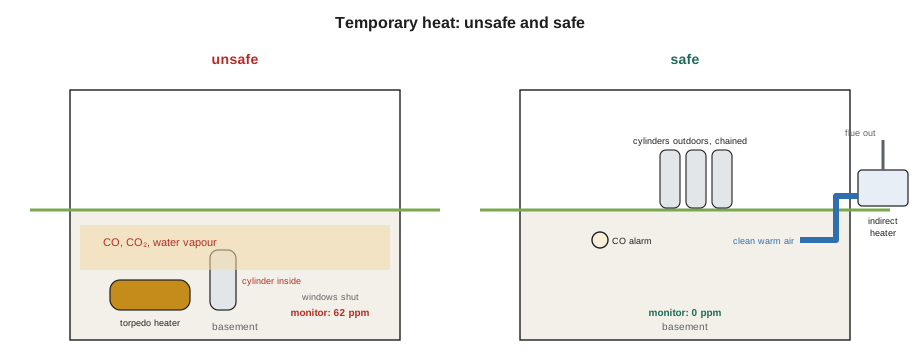
On Wednesday morning, November 4, Northvale Homes' site superintendent, Terry Vukovic, phoned Bayline from the subdivision in Binbrook where Bayline had roughed in the gas for the house on Fairhaven. The drywall crew in another house down the street had complained of headaches, and Terry wanted someone to look at the temporary heat before the cold weather really arrived. Luis and Jonah drove over. In the basement they found a 44 kW torpedo heater roaring at the bottom of the stairs, a 45 kg cylinder beside it, a hose running across the floor, and the basement windows and the door at the top of the stairs closed to keep the heat in. Jonah's personal CO monitor began to chirp halfway down the stairs and read 62 ppm by the heater. Luis turned the heater off, closed the cylinder valve, opened the windows and sent everyone up into the fresh air. "The heater is fine," he told Terry. "It's doing exactly what it was built to do. The problem is where somebody put it."
Propane is the most common fuel for heating buildings under construction, drying concrete and plaster, and keeping crews warm in winter, and construction sites are where many propane incidents happen. This lesson explains the kinds of construction heaters, what direct-fired heaters put into the air, the rules for using cylinders and heaters on construction sites, and how a safe temporary heat setup is planned.
Kinds of construction heaters
Construction heaters fall into two families. Direct-fired heaters burn propane in the air they heat and blow the combustion products straight into the space with it. They include the forced-air torpedo heater, the convection or salamander heater and the radiant heater, including small tank-top heaters that mount on a 9 kg cylinder. Direct-fired heaters are simple, cheap and nearly 100 parts in 100 efficient, because no heat leaves through a flue, but everything the flame produces stays in the room: carbon dioxide, water vapour, some carbon monoxide and some nitrogen oxides. Indirect-fired heaters burn propane in a sealed combustion chamber, vent the flue gas outdoors, and blow clean heated air into the building through a heat exchanger and a duct. They cost more and lose some heat up the flue, but they keep combustion products out of the workspace. Large indirect-fired units on trailers heat whole buildings on commercial sites; smaller ones heat houses.
| Heater | How it heats | Combustion products | Typical use |
|---|---|---|---|
| Forced-air torpedo (direct-fired) | Fan blows air past an open flame | Into the space | Open or well-ventilated areas; drying |
| Convection or salamander (direct-fired) | Flame heats a cylinder of air that rises | Into the space | Open structures, outdoor work areas |
| Radiant or tank-top (direct-fired) | Flame heats a radiant surface | Into the space | Spot heating outdoors or in open sheds; tank-top units outdoors only |
| Indirect-fired | Sealed burner and heat exchanger; clean air ducted in | Vented outdoors | Enclosed buildings, finished spaces, occupied work areas |
What a direct-fired heater puts into the air
Propane burns to carbon dioxide and water. Each molecule of propane, C₃H₈, combines with five of oxygen to make three of carbon dioxide and four of water. In practical terms, every kilogram of propane burned makes about 1.6 kg of water. A direct-fired heater therefore pours water into the building it heats, which is why freshly drywalled houses heated that way can drip with condensation and why plaster and paint take longer to dry. The flame also uses oxygen and produces carbon dioxide; in a closed space, oxygen falls and carbon dioxide rises. And no flame is perfect: a well-adjusted direct-fired heater makes a small amount of carbon monoxide, and a dirty, starved or damaged one can make a great deal. In an open, ventilated space those products are diluted to harmless levels. In a closed basement they build up, as Jonah's monitor showed.
Worked problem
How much water does the torpedo heater add?
The torpedo heater is rated 44 kW. Propane provides about 46.4 MJ/kg. How many kilograms of propane does it burn per hour at full input, and how much water does it add to the basement in an eight-hour shift, at 1.64 kg of water per kilogram of propane?
Show solution
- Energy per hour:
- \[44 \times 3.6 = 158.4 \text{ MJ/h}\]
- Propane per hour:
- \[\frac{158.4}{46.4} = 3.41 \text{ kg/h}\]
- Water per hour:
- \[3.41 \times 1.64 = 5.59 \text{ kg/h}\]
- Water per shift:
- \[5.59 \times 8 = 44.7 \text{ kg} \approx 45 \text{ L}\]
Answer: The heater adds about 45 L of water to the house in a shift, a large bucketful every hour, all of it ending up in the new drywall, the framing and the windows as condensation.
The rules on construction sites
B149.2 has a section on the use of propane on construction sites and for temporary heating, and the Ontario construction regulation, O. Reg. 213/91, adds general requirements for heating devices on construction projects. The main ideas are these. Cylinders for construction heaters are kept outdoors wherever possible; the code limits when a cylinder may be brought inside a building under construction, how large it may be and how many, and requires them to stand upright, be secured and be kept away from the heater and from exits. Heaters must be certified, used as their instructions require, kept the specified distances from combustible materials, tarpaulins and the cylinders, set on stable, level, non-combustible footing, and protected from damage. Hoses must be certified for propane at the pressure used, protected from traffic and sharp edges, as short as practical and never run through doors or windows that can close on them. And the space must be ventilated enough to keep carbon monoxide and carbon dioxide at safe levels, which in practice means that direct-fired heaters belong in open or well-ventilated spaces. In Ontario, the people who connect, light and look after propane construction heaters must hold the appropriate Record of Training under O. Reg. 211/01.
| Do | Do not |
|---|---|
| Keep cylinders outdoors, upright, secured, on a rack or firm base | Bring a spare cylinder into the building "to keep it warm" |
| Use indirect-fired heaters in enclosed or occupied spaces | Run a direct-fired heater in a closed basement or a sealed-up house |
| Keep heaters the listed distances from combustibles, tarps and cylinders | Point a torpedo heater at a stack of insulation or a cylinder |
| Run certified hoses along protected routes | Close a door or window on a hose |
| Provide fresh air and use CO alarms or monitors | Rely on smell or symptoms to detect CO |
| Shut off heaters and cylinders at the end of the day unless they are attended as required | Leave heaters running unattended against the instructions |
| Have trained people connect, light and maintain heaters | Let anyone on site hook up a cylinder |
Fuelling a large heater
Lesson 5's lesson applies with special force to construction heaters, which run at full input for hours on the coldest days. A single 45 kg cylinder cannot vaporize enough propane for a 44 kW heater in freezing weather, so the heater starves, its flame becomes unstable and it may produce more carbon monoxide or shut down. Large heaters are supplied from several cylinders connected through a manifold so that they draw together, not one at a time as with a changeover regulator, or from a temporary tank set by the supplier.
Worked problem
How many cylinders must draw together?
Using the SAMPLE chart in lesson 5, one 45 kg cylinder can supply about 18 kW at −7 °C and 10 kW at −18 °C. How many cylinders drawing together does the 44 kW heater need at each temperature?
Show solution
- At −7 °C:
- \[\frac{44}{18} = 2.44 \;\to\; 3 \text{ cylinders}\]
- At −18 °C:
- \[\frac{44}{10} = 4.4 \;\to\; 5 \text{ cylinders}\]
Answer: Three cylinders drawing together on a mild winter day, and five in deep cold. On a site with several houses heated for weeks, a temporary tank set by the supplier is simpler and safer than a crowd of cylinders, and it reduces the handling of full cylinders.
Carbon monoxide on construction sites
Carbon monoxide is the hazard construction heaters most often cause, and the people exposed are workers who may not know the symptoms or may put them down to a long day. Headache, dizziness, nausea, tiredness and confusion are early signs; at higher concentrations people collapse. Gasoline-powered saws, pumps, generators and concrete trowels running indoors add to the CO from heaters, and are often the larger source. Bayline's practice on any site where it supplies or services temporary heat is to recommend indirect-fired heat for enclosed spaces, to require CO alarms or monitors in the heated spaces, to check concentrations with a meter when it visits, and to stop work and ventilate when readings rise. Bayline uses the same ambient action levels as on service calls, from GAS-230: investigate any sustained reading above about 9 ppm, and treat readings above 35 ppm as a reason to stop, shut down the source and ventilate. Workplace exposure limits set by the occupational health and safety rules are averaged over a shift and are not a reason to keep working while a monitor alarms.
Torches, kettles and other site uses
Heaters are not the only propane equipment on a construction site. Roofers run torches for modified bitumen membranes and kettles for hot asphalt; plumbers and sheet metal workers use torches for soldering and brazing; concrete crews use blanket heaters and ground thawers; and road and landscape crews use weed burners and tar pots. Each brings the same hazards: cylinders that must be secured upright and kept away from the flame and the hot work, hoses that must be protected and checked, leaks that collect in low places, and combustion products in enclosed spaces. Torches add a hazard of their own, because they are used close to combustible building materials; that is why hot work is controlled by permits and fire watches, as GAS-110 described. On a site Bayline is working on, its technicians look at all of it, not only the heaters, and they speak to the site superintendent about any cylinder lying on its side, any hose run under a door, or any piece of propane equipment running inside an enclosed space without ventilation. On a construction project, every worker has the right and the duty to report a hazard, and propane hazards are among the easiest to see and the most serious to ignore.
Using the permanent furnace for construction heat
Builders sometimes ask to run a new house's permanent furnace during construction, once the gas is connected. Furnace makers' instructions usually allow it only under strict conditions or not at all: drywall dust and sanding grit are drawn through the furnace, clog filters and heat exchangers, and can damage the inducer and the burners; condensing furnaces can be harmed by construction chemicals, and a furnace run in a dusty house may void its warranty. Where the instructions allow it, the return air must be filtered and sealed against dust, the vent and combustion air must be complete and correct, and the furnace must be cleaned, inspected and given a new filter before the owner takes possession. Bayline's rule is that construction heat comes from the temporary heaters, and the furnace is started for the owner, clean.
Back at the subdivision
Before they left, Luis and Jonah set up the basement properly. The torpedo heater went outside, to be used only in the open garage with its door up. Northvale rented a 73 kW indirect-fired heater on a stand, which Luis placed outside on a level concrete paver base, with its flue clear of the house and its warm-air duct passing through a basement window opening sealed around the duct with plywood. Three 45 kg cylinders stood on a chained rack 3 m from the heater, manifolded to draw together, with a certified hose run along the foundation where no one would drive over it. Jonah mounted a battery CO alarm in the basement and another on the main floor. With everything running for half an hour and the windows closed, his monitor read zero in the basement. Terry had two of his crew booked for Record of Training courses in construction heater use the following week, and asked Bayline to come back in January to look at every house on the street.
Common mistakes
MistakeRunning a direct-fired heater in a closed basement.
InsteadUse indirect-fired heat in enclosed spaces, or provide the ventilation the heater needs.
MistakeBringing cylinders inside to keep them warm.
InsteadKeep cylinders outdoors, upright and secured, as the codes require.
MistakeSupplying a large heater from one cylinder in cold weather.
InsteadManifold enough cylinders to draw together, or use a temporary tank.
MistakeRunning a hose through a door or window that can close on it.
InsteadRoute hoses where they are protected from traffic, edges and pinching.
MistakeAssuming headaches on site are from the long day.
InsteadCheck for CO with a meter and stop work and ventilate if it is present.
Summary and key terms
- Direct-fired construction heaters put all their combustion products into the space: carbon dioxide, about 1.6 kg of water for every kilogram of propane, some carbon monoxide and less oxygen.
- Indirect-fired heaters vent flue gas outdoors and supply clean heated air, so they belong in enclosed and occupied spaces.
- B149.2, Ontario's construction regulation and the Record of Training rules under O. Reg. 211/01 require cylinders kept outdoors where possible, upright and secured; certified heaters used as instructed and kept clear of combustibles and cylinders; protected, certified hoses; and adequate ventilation.
- Large heaters need several cylinders drawing together or a temporary tank.
- CO alarms and meter checks are essential on heated sites.
- A new furnace should not be used for construction heat unless its instructions allow it, and then only with precautions and cleaning.
- Direct-fired heater
- A heater that releases its combustion products into the space it heats.
- Indirect-fired heater
- A heater that vents its combustion products outdoors and supplies clean heated air.
- Torpedo heater
- A forced-air direct-fired construction heater.
- Tank-top heater
- A small radiant heater that mounts on a cylinder, for outdoor use.
- Temporary heat
- Heating used during construction or repair before the permanent system is in service.
- Record of Training
- In Ontario, the TSSA document showing a person is trained for a specific propane task.
- Ambient CO
- Carbon monoxide in the air of a space, as opposed to in flue gas.
Practice problems
Work each problem on paper first, then reveal the answer to check.
What three things does a direct-fired heater put into the space besides heat?
Show answer
Carbon dioxide, water vapour and some carbon monoxide.
About how much water does burning one kilogram of propane make?
Show answer
About 1.6 kilograms.
When should an indirect-fired heater be used instead of a direct-fired one?
Show answer
In enclosed or occupied spaces where combustion products must be kept out.
Why does a large construction heater need several cylinders drawing together?
Show answer
One cylinder cannot vaporize enough propane in cold weather.
Why do furnace makers restrict using a new furnace for construction heat?
Show answer
Construction dust and chemicals can damage it and void the warranty.
Lesson quiz · 5 questions
Score 60% or more to complete this lesson.
Create a free account to save your progress, take quizzes and earn a certificate.