
GAS-240 · Lesson 11 of 12 · 26 min
Leak checks and emergency response
▶ Video coming soon A video version of this lesson is on the way.
On Sunday morning, October 25, Luis was on call, and Jonah rode along. The supplier's driver had been to a 1970s farmhouse near Rockton, in the rural northwest corner of Hamilton the evening before. The owners, Pat and Dennis Brennan, had been away for two weeks with the tank's float gauge already near the bottom; the furnace had run the tank dry, and the driver filled it but, following his company's rule, would not open the service valve until the system had been leak checked. "When a tank runs dry," Luis explained on the drive out, "every pilot goes out, and nobody knows what was left open. Maybe a range knob got bumped. Maybe the fireplace valve is still on. Maybe a fitting that never leaked at 2.75 kPa had a little air and moisture get into it. Before we put gas back in, we prove the system is tight."
This lesson explains how propane systems are checked for leaks, after a run-out, after any interruption of service and when an odour is reported, and what to do in an emergency: a leak indoors, a large release outdoors, or a fire involving a container. It builds on the leak-testing and pressure-testing methods of GAS-120.
When a leak check is required
A leak check proves that an existing system, with its appliances connected, holds gas without loss. It is different from the pressure test a new piping system receives before appliances are connected, at a higher pressure and for a longer time, as GAS-120 described. The codes and industry practice require a leak check whenever propane service is interrupted: when a container has run out of gas, when a supplier or technician has shut the system off at the container, when a container or a regulator is replaced, when a new supplier takes over a system, and before a new system is first put into service. A leak check is also the first step when a customer reports a propane odour. The person who opens the container's service valve after an interruption is responsible for making sure the check is done.
Methods of finding leaks
Three methods are used, and each has its place. Leak detection solution, a non-corrosive liquid made for the purpose, is brushed or sprayed on a joint; bubbles show a leak. It is the standard check for every joint a technician makes or disturbs, and for pinpointing a leak found another way. Dish soap is not used, because some brands corrode brass and copper over time. An electronic combustible gas detector sniffs the air near joints and in spaces; for propane it is held low and moved slowly, and it finds leaks in places a brush cannot reach. A pressure-drop test with a manometer or digital gauge checks the whole system at once: the system is pressurized, isolated from its supply and watched; if the pressure falls, there is a leak somewhere, and the other methods are used to find it. Matches and lighters are never used to look for leaks.
| Method | Finds | Limits |
|---|---|---|
| Leak detection solution | Leaks at a joint you can reach, and their exact location | Slow for a whole system; cannot reach hidden joints |
| Electronic combustible gas detector | Gas in the air near joints, in cabinets, low spaces and drains | Shows gas, not always the exact joint; needs a working, calibrated sensor |
| Pressure-drop test | Any leak anywhere in the isolated system | Does not show where; temperature changes can affect the reading |
The leak check after a run-out
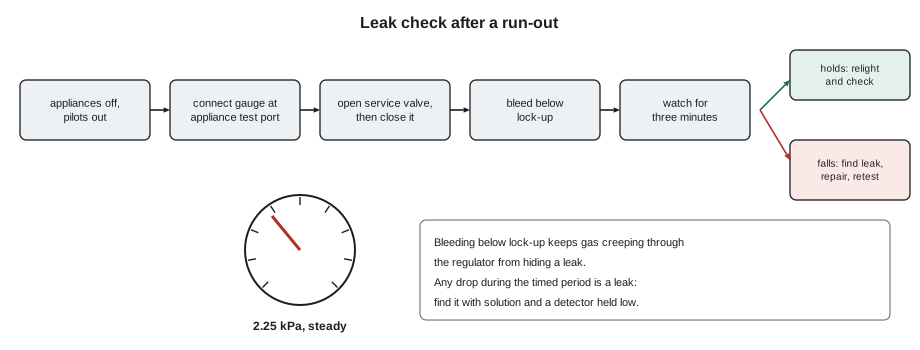
Suppliers and contractors follow a written procedure, based on industry practice and the appliance instructions, so that the check is done the same way every time. Bayline's procedure, which matches its suppliers', goes like this. First, with the container's service valve still closed, every appliance is checked: gas valves and range knobs off, pilots off, appliance shutoff valves open so that their connectors are included in the test, and any open line capped. Next, a gauge is connected at an appliance test port or at a test point downstream of the second-stage regulator. The service valve is opened to pressurize the system, then closed again. A small amount of gas is bled off at a burner or the test port until the gauge reads a little below the regulator's lock-up, so that the test is not affected by gas creeping through the regulator. The gauge is then watched for a set period, commonly three minutes for a residential low-pressure system. If it holds steady, the system is tight. If it falls, there is a leak, which must be found and repaired before the test is repeated.
Worked problem
Reading the Brennans' leak check
Luis pressurized the system to a lock-up of 2.90 kPa, closed the service valve and bled it down to 2.25 kPa. After three minutes the gauge read 2.10 kPa. After he found and fixed a leaking flare fitting at the fireplace valve, the repeat test went from 2.25 kPa to 2.25 kPa. Did each test pass?
Show solution
- First test, drop:
- \[2.25 - 2.10 = 0.15 \text{ kPa} > 0 \;\to\; \text{fails}\]
- Second test, drop:
- \[2.25 - 2.25 = 0 \;\to\; \text{passes}\]
Answer: The first test failed. Jonah went over the joints with the detector held low and found gas at the fireplace, where solution bubbled at a flare nut that someone had overtightened and cracked. With a new flare nut properly made up, the system held for the full three minutes.
Worked problem
How small a leak can the test find?
The Brennans' house piping and connectors hold about 25 L of gas. In the first test the pressure fell 0.15 kPa in three minutes. Atmospheric pressure is about 101.3 kPa, so the absolute pressure was about 103.6 kPa. Roughly how much gas leaked per hour?
Show solution
- Fraction of the gas lost:
- \[\frac{0.15}{103.6} = 0.00145\]
- Gas lost in 3 minutes:
- \[0.00145 \times 25 = 0.036 \text{ L}\]
- Per hour:
- \[0.036 \times 20 = 0.72 \text{ L/h}\]
Answer: Less than a litre an hour: too small to smell across a room, but over a weekend with the house shut up it would be enough to matter in a small closet, and a cracked fitting can open further. A pressure-drop test catches leaks far smaller than anyone would notice.
Relighting and checking the appliances
Only after the system has passed is the service valve opened fully and left open. Each appliance is then relit following its instructions, its operation checked, and its burner flames looked at. Air that entered the lines during the run-out is purged through the burners, outdoors or in a well-ventilated place, never into a room near an ignition source, which can take a few tries on a range or a fireplace with a long line. On the Brennans' furnace and water heater, Luis checked the inlet pressure with both running, and the combustion readings, as GAS-230 taught, because a run-out can leave rust and debris that affect a burner. He left a tag on the tank's dome recording the date, the test and the result, as his supplier requires, and explained to the Brennans how to read their float gauge and how to sign up for automatic delivery.
Every leak check is recorded: the date, the address, the reason for the check, the gauge readings at the start and end of the timed period, any leak found and how it was repaired, and the name of the person who did it. The record protects the customer, the supplier and the technician, and it tells the next person who opens the service valve what was found last time. A system that fails a leak check and cannot be repaired that day is left shut off at the container, with the service valve tagged or locked, the customer told in writing why, and the supplier informed, so that no driver opens it on the next delivery.
Responding to an odour call
A propane odour call is treated as a possible emergency until proven otherwise. When a customer phones, the dispatcher tells them what the supplier's safety information says: leave the building at once, without switching lights or appliances on or off and without using phones, lighters or anything that could make a spark inside; if it is safe to do so, close the service valve at the tank or cylinder, turning it clockwise; call the propane supplier and, if the smell is strong or anyone feels ill, the fire department, from a safe distance; and stay out until a qualified person says it is safe to return. On arrival, the technician tests the air before entering, starting at the door and working low, ventilates if gas is present, finds the source, and makes the system safe. A system shut off for a leak is not put back into service until it has been repaired and has passed a leak check.
Worked problem
What does the detector reading mean?
Jonah's combustible gas detector reads in parts of 100 of the lower flammable limit. Near the basement floor of a house with a reported odour it reads 20. Propane's lower flammable limit is about 2.1 parts in 100 by volume. What concentration of propane is in the air there, and how far below the lower limit is it?
Show solution
- Concentration:
- \[0.20 \times 2.1 = 0.42 \text{ parts in 100}\]
- Margin to the lower limit:
- \[2.1 - 0.42 = 1.68 \text{ parts in 100}\]
Answer: The air holds about 0.42 parts in 100 of propane, a fifth of the way to the lower flammable limit. That is far above zero and calls for ventilation, finding the source and keeping ignition sources off, even though the air will not yet burn. Many detectors alarm at 10 or 20 parts in 100 of the lower limit for exactly this reason.
Emergencies at the container
Most propane emergencies are leaks, and most leaks are small. A few are not, and a gas technician must know what not to do. A large release of liquid, from a broken line, a damaged valve or a vehicle that struck a tank, makes a heavy white cloud that flows downhill. People move upwind and uphill, well away; ignition sources are kept away if that can be done without entering the cloud; and the fire department is called. Firefighters may use water fog to disperse the vapour and to cool the container. Nobody walks into a vapour cloud to close a valve.
A fire involving a container is the most serious case. If a container is exposed to fire, its relief valve will open and may roar and flare; that is the valve doing its job. The danger is flame on the part of the shell above the liquid, where there is no liquid to carry the heat away. If that steel overheats while the relief valve is discharging, the shell can weaken and fail, releasing the whole contents at once in a fireball, an event called a boiling liquid expanding vapour explosion (BLEVE). Only firefighters, with large water supplies and from a safe distance, deal with an exposed container; everyone else evacuates a wide area and stays away. A burning leak at a valve or fitting is usually left burning until the fuel can be shut off, because putting the flame out without stopping the gas creates an unburned cloud that can reignite explosively.
| Situation | Do | Do not |
|---|---|---|
| Gas odour indoors | Leave; shut off at the container if safe; call from outside | Switch lights or appliances, use phones inside, or look for the leak with a flame |
| Leak at a cylinder outdoors | Close the valve if safe; move the cylinder to open air if safe and small; keep ignition away | Lay the cylinder on its side or move it toward a building |
| Large liquid release | Move upwind and uphill; evacuate; call the fire department | Enter the cloud to close a valve; start vehicles nearby |
| Container exposed to fire | Evacuate a wide area; call the fire department | Approach the container or try to fight the fire |
| Burning leak at a fitting | Keep people back; shut off the fuel upstream if safe | Extinguish the flame while gas is still flowing |
Detectors, alarms and the customer
The best emergency response is the one never needed. Bayline recommends that every home and business using propane has propane gas alarms, mounted low as their instructions direct, as well as the carbon monoxide alarms the codes require. Customers are shown how to find and close their service valve, how to recognize the smell, often with a scratch-and-sniff card from the supplier, and what to do if they smell gas or if their alarm sounds. Customers with a poor sense of smell, or who live alone, are encouraged to rely on alarms. And everyone is told the rule that lesson 1 explained: if the smell is weak or absent, that does not prove there is no leak, because odour can fade.
Common mistakes
MistakeOpening the service valve after a run-out fill without a leak check.
InsteadLeak check the system, then relight and check every appliance.
MistakeStarting the timed test without bleeding below lock-up.
InsteadBleed below lock-up so gas creeping through the regulator does not hide a leak.
MistakeUsing dish soap or a flame to find leaks.
InsteadUse certified leak detection solution and an electronic detector.
MistakeEntering a building with a strong odour to find the source.
InsteadTest from the door, work low, ventilate and control ignition sources first.
MistakePutting out a burning leak while gas is still flowing.
InsteadShut off the fuel first; an unburned cloud can reignite explosively.
Summary and key terms
- A leak check proves that an existing system with appliances connected is tight; it is required whenever service is interrupted, including after a run-out, a shutoff, a container or regulator change and before first service, and when an odour is reported.
- Leak detection solution pinpoints leaks at reachable joints, electronic detectors find gas in the air near the floor, and a pressure-drop test checks the whole isolated system.
- After a run-out, appliances are turned off, the system is pressurized and isolated, bled below lock-up and watched, commonly for three minutes; any drop means a leak to find and fix.
- Then appliances are purged, relit and checked.
- Odour callers leave, shut off at the container if safe and call from outside.
- Large releases call for moving upwind and uphill; containers exposed to fire are left to firefighters because of the BLEVE hazard; burning leaks are not extinguished until the fuel is shut off.
- Propane and CO alarms protect customers.
- Leak check
- A test proving that an existing system with appliances connected holds gas without loss.
- Interruption of service
- Any time the gas supply has been shut off or run out, after which a leak check is required.
- Pressure-drop test
- A test in which an isolated system is watched on a gauge for any fall in pressure.
- Leak detection solution
- A non-corrosive liquid that bubbles at a leaking joint.
- Combustible gas detector
- An instrument that measures flammable gas in air, often in parts of 100 of the lower flammable limit.
- BLEVE
- Boiling liquid expanding vapour explosion: the failure of a heated container releasing its contents at once.
- Propane gas alarm
- A detector mounted low that sounds when propane is present in the air.
Practice problems
Work each problem on paper first, then reveal the answer to check.
Name three situations that require a leak check before service resumes.
Show answer
A run-out, a shutoff at the container, and a container or regulator replacement, among others.
Why is the system bled below lock-up before the timed part of the test?
Show answer
So that gas creeping through the regulator does not raise the pressure and hide a leak.
What should a customer who smells propane indoors do first?
Show answer
Leave the building without operating switches or phones.
Why should nobody approach a propane container exposed to fire?
Show answer
The shell above the liquid can overheat and fail in a BLEVE.
Why is a burning leak not put out while gas is flowing?
Show answer
An unburned cloud would form and could reignite explosively.
Lesson quiz · 5 questions
Score 60% or more to complete this lesson.
Create a free account to save your progress, take quizzes and earn a certificate.